


NATA Accredited Scale Calibration Melbourne: The Definitive Guide to Compliance and Precision
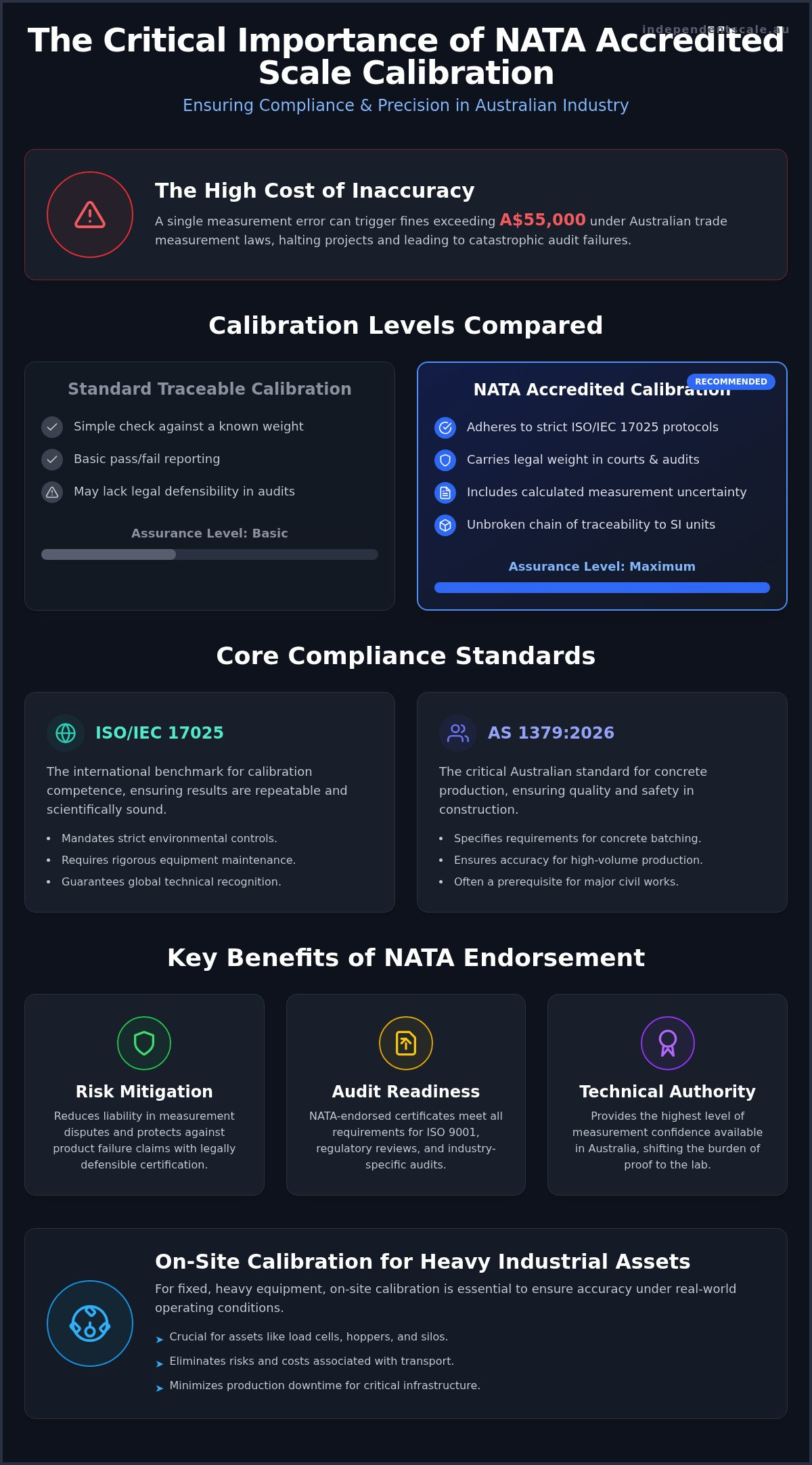
Did you know that a single measurement error in your industrial weighing system could trigger fines exceeding A$55,000 under current Australian trade measurement laws? In high-stakes environments like concrete production or heavy manufacturing, precision isn't just about quality; it's a critical risk-mitigation strategy. You're likely aware that even a minor deviation can halt multi-million dollar projects or lead to catastrophic audit failures during a regulatory review.
This comprehensive guide provides the technical roadmap you need to secure NATA accredited scale calibration Melbourne services that align with the rigorous AS 1379:2026 and ISO/IEC 17025:2017 standards. We'll ensure your equipment remains legally compliant while minimizing the operational downtime that often accompanies complex maintenance schedules. By understanding the distinction between simple traceable calibration and a NATA-endorsed certificate, you can protect your business from the financial and legal fallout of non-compliance. We'll examine the specific requirements for load cells, hoppers, and silos, while outlining how to maintain highly accurate and reliable equipment in demanding industrial settings. This approach ensures your facility meets every stringent Australian standard with methodical precision.
Key Takeaways
- Understand the critical legal and financial necessity of NATA accredited scale calibration Melbourne for maintaining compliance with Australian trade measurement laws.
- Learn the technical requirements of ISO/IEC 17025 and the specific impact of the AS 1379:2026 update on concrete batching plant operations.
- Identify when on-site calibration is required for heavy industrial assets like load cells and silos to eliminate transport risks and minimize production downtime.
- Discover how to categorize your weighing equipment to determine which assets require NATA-endorsed certification versus standard routine maintenance.
- Gain actionable insights into preparing your facility for a NATA audit to ensure seamless regulatory approval and long-term equipment reliability.
Understanding NATA Accredited Scale Calibration for Melbourne Industry
The National Association of Testing Authorities (NATA) serves as the peak authority for laboratory accreditation in Australia. For Melbourne's industrial sector, NATA isn't just a membership; it's a formal recognition of technical competence and reliability. Standard calibration often involves a simple check against a known weight, but NATA accredited scale calibration Melbourne requires adherence to strict ISO/IEC 17025 protocols. This process includes calculated measurement uncertainty and a documented chain of traceability to national primary standards.
Technical distinctions between standard and NATA-endorsed services are significant for risk management. A NATA-endorsed certificate carries legal weight in Australian courts and regulatory audits, providing a defensible evidence trail that standard reports can't match. This level of certification is often mandatory for businesses operating in high-liability sectors such as construction, pharmaceuticals, and heavy manufacturing.
What Does NATA Accreditation Mean for Your Business?
Accreditation is maintained through a rigorous peer-review process where technical experts audit the laboratory's equipment, personnel, and methods. This ensures that every result is repeatable and scientifically sound. Traceability is the backbone of this system; it links your local measurements back to the SI units via an unbroken chain of comparisons. Key benefits include:
- Risk Mitigation: NATA endorsement reduces the risk of liability in the event of product failure or measurement disputes.
- Audit Readiness: Certificates meet all requirements for ISO 9001 and industry-specific audits.
- Technical Authority: Endorsed reports provide the highest level of measurement confidence available in Australia.
In the event of a legal dispute, a NATA certificate effectively shifts the burden of proof regarding measurement accuracy away from your internal processes and onto the accredited laboratory's verified methods.
Local Regulatory Requirements in Victoria
Victorian industries, particularly those involved in large-scale infrastructure and manufacturing, face high scrutiny from state regulatory bodies. For projects under the Victorian Big Build or major civil works, weighing scale calibration with NATA endorsement is frequently a contractual prerequisite. Melbourne's local environmental factors, such as high humidity near Port Phillip Bay or significant temperature fluctuations in the northern industrial corridors, can cause accelerated scale drift. Regular NATA-level audits ensure that these environmental impacts are quantified and corrected, maintaining the precision required for high-volume production and regulatory compliance.
Critical Standards: ISO/IEC 17025 and AS 1379 Compliance
Industrial precision relies on two primary regulatory frameworks: ISO/IEC 17025 and AS 1379. These standards ensure that industrial measurements are not only consistent but legally defensible. The National Measurement Institute (NMI) provides the scientific foundation for these standards, ensuring all trade measurements are traceable and accurate. For facilities requiring NATA accredited scale calibration Melbourne, understanding how these standards interact is essential for operational compliance and risk management.
Third-party auditors look for NATA-endorsed reports because they act as a verified stamp of authority. These documents prove that a laboratory has the equipment, personnel, and procedures to provide reliable data. Without this endorsement, your measurement data lacks the necessary weight to pass a rigorous regulatory review. Choosing NATA accredited scale calibration Melbourne ensures your facility adheres to these global standards while protecting you from the financial risks of inaccurate batching.
The Role of ISO/IEC 17025 in Weighing Accuracy
ISO/IEC 17025 is the international benchmark for calibration competence. It mandates strict environmental controls and rigorous equipment maintenance to ensure measurement stability. A key feature of NATA reports under this standard is the "Uncertainty of Measurement." This value accounts for variables like ambient temperature, humidity, and instrument resolution. Standard calibration certificates often ignore these factors, providing a false sense of security. In high-precision manufacturing, ignoring measurement uncertainty can lead to out-of-tolerance batches that compromise entire production runs. You'll find that ISO/IEC 17025 requires technicians to prove their proficiency through regular peer audits, ensuring that the results you receive are scientifically sound.
AS 1379 Standards for Concrete Batching Plants
AS 1379:2026 is the mandatory standard for the specification and supply of concrete in Australia. It requires batching plants to maintain weighing accuracy within ±0.4% for cement, aggregates, and water. Inaccurate scales directly impact the water-to-cement ratio, which dictates the final strength and durability of the concrete mix. Non-compliance often results in rejected loads at the job site, structural failures, and significant financial penalties. For Victorian operators, maintaining these tolerances is non-negotiable for project safety and contract fulfillment. If you need to verify your plant's performance against these strict criteria, specialized Concrete Batching Plant Calibration & Repair Services provide the necessary technical oversight to meet these benchmarks. Accurate calibration doesn't just satisfy an auditor; it protects the structural integrity of your projects.
Comparing On-Site vs. Laboratory Calibration Services
Determining whether to perform calibration on-site or in a laboratory environment is a critical decision for Melbourne industrial operators. For heavy assets such as silos, hoppers, and large platform scales, on-site service is the only viable option. Shipping a 50-tonne silo isn't an option; transporting these components is logistically impossible or risks damaging internal load cells. Conversely, smaller, high-precision instruments often benefit from the climate-controlled conditions of a laboratory.
Environmental stability is a core requirement of ISO/IEC 17025. In a laboratory, factors like temperature, humidity, and vibration are strictly regulated to achieve the lowest possible measurement uncertainty. On-site NATA accredited scale calibration Melbourne requires technicians to manage these variables in real-time. For example, wind loads on outdoor silos or thermal expansion in uninsulated warehouses can skew results. Expert technicians use specialized procedures to isolate these factors, ensuring the equipment is accurate under its actual working conditions.
Benefits of On-Site Calibration for Heavy Equipment
On-site calibration eliminates the risk of transport-related damage to sensitive weighing components. When a scale is calibrated in its fixed position, the technician accounts for the specific mechanical stresses and environmental conditions it faces daily. This provides "real-world" accuracy that a laboratory cannot replicate. For businesses managing bulk materials, a specialized Hopper Calibration Service ensures that the entire weighing assembly, including the support structure and piping, is functioning as a single, precise system. This method significantly reduces operational downtime by keeping equipment in place.
When to Choose Laboratory Calibration
Laboratory calibration is the preferred choice for portable instruments that require extreme precision. High-resolution balances and force gauges are susceptible to even minor air currents or temperature shifts. By testing these in a controlled facility, technicians can provide a higher degree of certainty in the calibration results. This is particularly important for quality control departments where the margin for error is microscopic. If your facility utilizes tension or compression testers, utilizing a professional Force Gauge Calibration service in a lab setting ensures your instruments meet the highest technical benchmarks without the interference of factory-floor variables.
The cost-benefit analysis usually favors on-site service for production equipment. While laboratory environments offer superior precision for small tools, the production loss from removing a critical hopper scale often outweighs the marginal precision gain. It's a balance between precision and production. Most industrial clients prioritize minimal disruption, choosing on-site NATA accredited scale calibration Melbourne to maintain compliance while production continues.
How to Prepare Your Facility for a Calibration Audit
Proactive preparation is the most effective way to ensure a seamless audit and maintain the integrity of your measurement data. A successful NATA accredited scale calibration Melbourne service depends on the accessibility and condition of the equipment before the technician arrives. It's essential to differentiate between assets requiring full NATA endorsement for regulatory compliance and those that only need standard preventative maintenance. High-liability equipment, such as concrete batching plants or load cells used in trade, must be prioritized for endorsed certification.
Coordinating with production teams is vital to minimize disruptions. Scheduling calibration during planned maintenance windows or low-production periods prevents emergency halts. Reviewing previous calibration records allows you to establish a performance history for each asset. This data helps identify recurring drift patterns, enabling technicians to address underlying mechanical issues rather than just adjusting the digital indicator.
Pre-Calibration Checklist for Industrial Scales
Follow these steps to streamline the calibration process and ensure accurate results:
- Clean the Equipment: Remove all debris, dust, and material buildup from platforms, hopper supports, and load cell assemblies. Contamination can introduce mechanical binding that skews results.
- Check Power and Connectivity: Verify that all indicators, displays, and power supplies are fully functional. Technicians can't calibrate faulty electronics.
- Gather Documentation: Have previous NATA certificates and equipment manuals ready. These are required to verify the specific tolerances and historical performance of the asset.
- Log Known Issues: Identify any specific accuracy problems or "drift" observed by operators. Reporting these early allows the technician to focus on troubleshooting specific load cell or structural failures.
Minimising Operational Downtime During Service
We understand that production halts are costly. Implementing staged calibration strategies allows your facility to keep specific lines running while others are serviced. Choosing a Melbourne-based provider like Independent Scale Service ensures a rapid response and efficient on-site logistics. Our technicians are familiar with the local industrial landscape and arrive equipped with the necessary test weights and diagnostic tools to complete the job without unnecessary delays. If you require a fast, professional response to maintain your compliance schedule, you can book a weighing scale calibration today to secure your next audit window.
Efficient logistics management involves pre-staging test weights and ensuring clear paths for mobile calibration units. By removing these hurdles beforehand, the time spent on-site is dedicated exclusively to technical verification. This methodical approach ensures your facility remains compliant with ISO/IEC 17025 while maintaining peak operational efficiency.
Expert NATA Calibration Solutions by Independent Scale Service
Independent Scale Service provides the technical proficiency and Melbourne heritage required for complex industrial metrology. We specialize in the calibration and repair of heavy equipment, ensuring all operations remain compliant with ISO/IEC 17025 and AS 1379. Our methodology is built on reliability and technical competence, providing industrial clients with the assurance that their equipment meets the most stringent benchmarks. We've established a reputation as the no-nonsense expert for Victorian manufacturers and infrastructure providers who can't afford measurement errors.
Why Partner with a Melbourne-Based Specialist?
Partnering with a local specialist ensures a deeper understanding of Victoria's specific industrial requirements. For the concrete and quarrying sectors, adherence to local compliance markers is essential for project safety and legal protection. A Melbourne-based provider offers reduced travel costs and faster response times for both scheduled maintenance and emergency technical support. Our technicians serve Melbourne and regional Victoria, delivering expert Load Cell Calibration to ensure these critical components maintain their precision under constant industrial stress. Local expertise means we're familiar with the environmental factors, such as Melbourne's temperature shifts, that cause measurement drift.
Comprehensive Service for Load Cells, Hoppers, and Silos
We provide end-to-end solutions by combining technical service with high-quality component supply. Our range includes durable Industrial Load Cells engineered for longevity in demanding environments. We also specialize in the maintenance and calibration of Tank and Silo Weighing Assemblies, ensuring that bulk storage measurements remain accurate and traceable. This dual expertise in supply and service means our technicians understand the mechanical foundations of the systems they calibrate. Whether you're managing a concrete batching plant or a high-volume manufacturing facility, our focus remains on minimizing your operational disruption.
Every NATA accredited scale calibration Melbourne we perform results in a legally recognized endorsement that provides total operational confidence. We focus exclusively on solving critical business problems through methodical precision and expert oversight. By choosing Independent Scale Service, you secure a partner committed to minimizing your downtime while maximizing your regulatory compliance. Our NATA-endorsed certificates act as a definitive stamp of authority for your next audit, ensuring your facility meets every requirement of the widest range of industrial weighing equipment.
Securing Your Operational Precision and Legal Compliance
Maintaining measurement integrity is a non-negotiable requirement for Melbourne's industrial sector. As outlined in this guide, NATA accreditation serves as the definitive benchmark for technical competence; it moves beyond simple traceable checks to provide legally defensible results. By prioritizing NATA accredited scale calibration Melbourne, your facility ensures continuous alignment with ISO/IEC 17025 and the updated AS 1379:2026 standards. This methodical approach protects your business from significant financial penalties and project delays caused by inaccurate batching or structural failures.
Independent Scale Service remains the trusted authority for heavy-duty weighing systems, including load cells, silos, and concrete plants. Our expert technicians serve Melbourne and regional Victoria, specializing in on-site logistics that minimize production downtime while maximizing precision. Don't leave your regulatory compliance to chance. You can Request a NATA Accredited Calibration Quote Today to verify your assets against national standards. Secure your equipment's reliability and ensure your next audit is a success with the support of our AS 1379 compliance specialists.
Frequently Asked Questions
What is the difference between NATA calibration and standard calibration?
NATA calibration involves a formal verification of technical competence under ISO/IEC 17025, whereas standard calibration is often a simple accuracy check. A NATA-endorsed certificate provides documented measurement uncertainty and a legally defensible chain of traceability to national standards. This distinction is critical for businesses facing regulatory audits or legal measurement disputes. Choosing NATA accredited scale calibration Melbourne ensures your results are recognized by all Australian regulatory bodies.
How often should industrial scales in Melbourne be NATA calibrated?
Calibration intervals depend on the specific industry standard and equipment usage. For concrete batching plants, AS 1379:2026 mandates a maximum interval of six months for all scales and liquid-dispensing equipment. High-precision manufacturing facilities may require more frequent checks if environmental factors or high-volume usage cause significant drift. You should consult your quality management system or regulatory guidelines to establish a schedule that maintains continuous compliance.
Is NATA calibration mandatory for concrete batching plants under AS 1379?
Yes, compliance with AS 1379:2026 is mandatory for the specification and supply of concrete in Australia. The standard requires weighing accuracy within ±0.4% for cement, aggregates, and water. While the standard specifies accuracy levels, NATA-endorsed calibration is the industry-recognized method for proving this accuracy during third-party audits. Without an endorsed certificate, you risk rejected loads and structural integrity failures that can lead to significant financial penalties.
Can Independent Scale Service perform NATA calibration on-site in Melbourne?
Independent Scale Service specializes in on-site NATA accredited scale calibration Melbourne to minimize client downtime. Our expert technicians travel across Melbourne and regional Victoria with specialized test weights and diagnostic tools. We calibrate heavy industrial assets like silos, hoppers, and concrete batching plants in their actual operating environments. This approach ensures real-world accuracy while eliminating the logistical risks and costs associated with transporting sensitive weighing components to a laboratory.
What information is included in a NATA endorsed calibration certificate?
A NATA-endorsed certificate includes the specific measurement results, the calculated uncertainty of measurement, and a statement of traceability to national primary standards. It also features the NATA accreditation number and the official emblem, which acts as a stamp of authority. These documents provide a comprehensive audit trail, including the environmental conditions during testing and the specific methods used. This data is essential for meeting ISO/IEC 17025 and ISO 9001 requirements.
How long does a typical NATA scale calibration service take?
Service duration varies based on the complexity and accessibility of the equipment. A single platform scale might take one to two hours, while a full concrete batching plant with multiple hoppers and silos can require a full day. We recommend preparing your facility by ensuring equipment is clean and accessible before the technician arrives. This proactive approach allows our team to focus on technical verification and reduces the overall impact on your production schedule.
What happens if my weighing equipment fails a NATA calibration audit?
If equipment fails to meet the required tolerances, it must be adjusted or repaired before a certificate can be issued. Our technicians provide immediate diagnostic feedback and can often perform on-site repairs to rectify load cell faults or mechanical binding. Continued operation with non-compliant scales can lead to legal disputes, audit failures, and significant fines. We prioritize rapid response to ensure your equipment returns to service within the necessary technical specifications.
Does NATA accreditation apply to all types of industrial weighing equipment?
NATA accreditation applies to a wide range of industrial equipment, provided the laboratory's scope covers the instrument and measurement range. This includes load cells, hopper scales, silo weighing assemblies, and force gauges. Independent Scale Service focuses on heavy industrial assets used in construction and manufacturing. While it's applicable to most professional equipment, retail or consumer scales typically fall under different trade measurement regulations rather than ISO/IEC 17025 NATA protocols.
