


Mobile Caravan Weighing Sydney: The Professional Guide to GVM & GCM Compliance (2026)
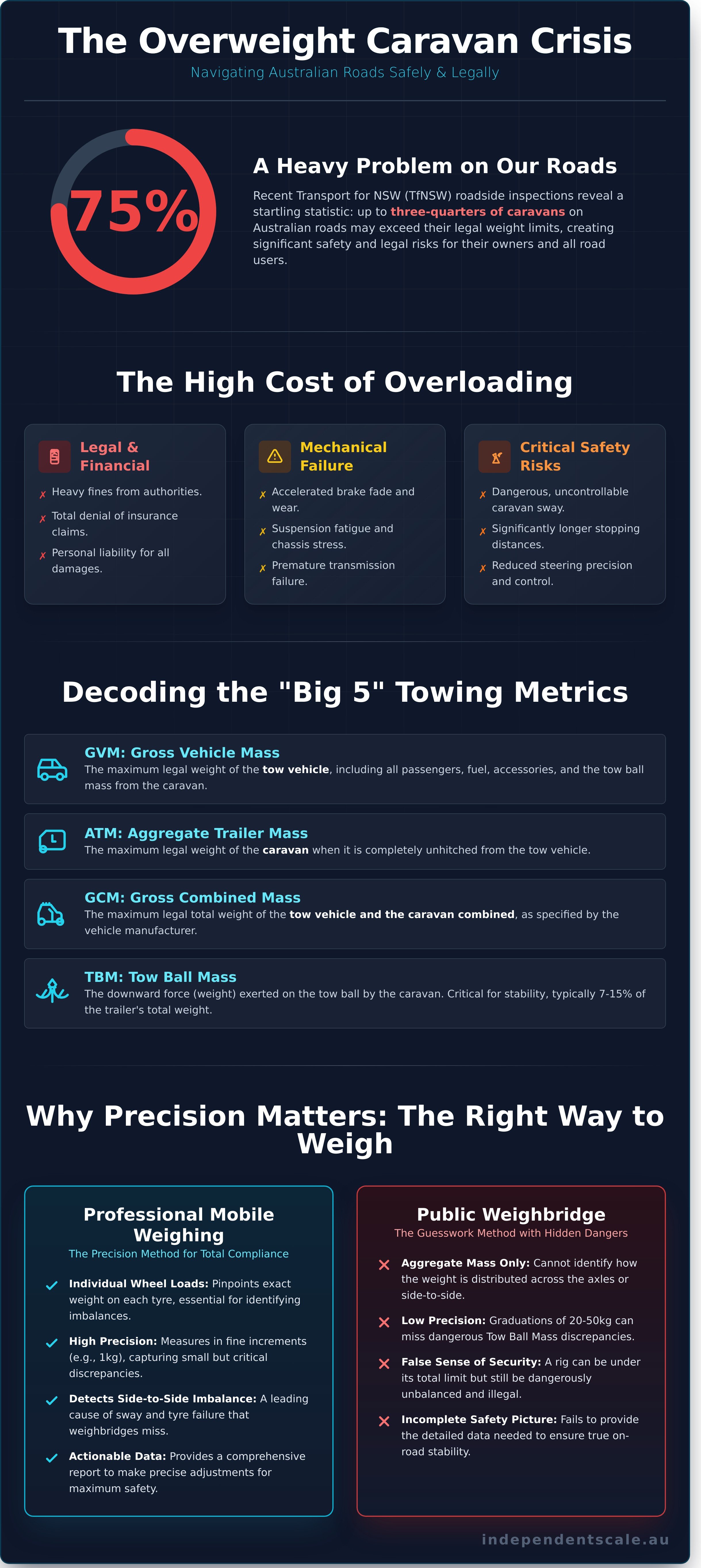
Recent Transport for NSW (TfNSW) roadside inspections indicate that up to 75% of caravans on Australian roads exceed their legal weight limits. Utilizing a professional mobile caravan weighing Sydney service is the most effective way to address the technical confusion surrounding GVM, GCM, and ATM requirements. You likely recognize that safety is your primary responsibility, yet these complex acronyms often lead to accidental non-compliance. It's a risk that results in heavy fines or the total denial of insurance claims following an incident. Driving an overweight vehicle is a legal liability that compromises your vehicle's structural integrity and braking performance.
This guide ensures you master the technicalities of weight distribution and validates that your setup meets industrial-grade precision standards for 2026. We provide the exact data you need to maintain 100% compliance and eliminate dangerous caravan sway. We'll examine the specific metrics required for a comprehensive weight report and offer practical, data-driven steps to redistribute your load for maximum towing stability. Whether you're a full-time traveler or a weekend enthusiast, this technical breakdown provides the peace of mind required for safe passage on Australian roads.
Key Takeaways
- Meet Transport for NSW (TfNSW) compliance standards by understanding the necessity of multi-point mass assessments for road-legal towing.
- Learn why professional mobile caravan weighing Sydney services provide the individual wheel load data that standard public weighbridges cannot capture.
- Master the "Big 5" technical metrics, including GVM, GCM, and ATM, to ensure your setup adheres to industrial-grade safety specifications.
- Follow specific on-site preparation protocols to guarantee your weighing appointment yields precise, actionable data for your next long-haul trip.
- Gain insights into how NATA-accredited expertise and 30+ years of industrial experience ensure unmatched measurement reliability for your caravan.
Why Mobile Caravan Weighing is Essential for Sydney Travellers
Mobile caravan weighing Sydney services provide a technical, on-site assessment of a vehicle's mass at multiple critical points. This process utilizes portable, high-precision scales to measure individual wheel loads, axle groups, and total combinations. It's a precise alternative to the guesswork often found at public weighbridges. Industry data indicates that 70% of caravans on Australian roads currently exceed their legal weight limits. Most owners rely on the manufacturer's VIN plate for guidance, but these figures are often outdated the moment a caravan is loaded with water, gas, and aftermarket accessories.
Transport for NSW (TfNSW) has intensified its enforcement strategy. Mobile weighing stations are now a frequent sight along major transit corridors like the M1 and Pacific Highway. These roadside inspections are designed to identify vehicles that compromise road safety through overloading. Relying on an estimate is no longer a viable strategy for long-distance travel. Professional mobile caravan weighing Sydney ensures your setup meets every technical specification required for safe operation on public infrastructure.
The Risk of Non-Compliance in New South Wales
Operating an overweight vehicle in New South Wales carries immediate legal and financial consequences. TfNSW inspectors enforce strict penalties for exceeding Gross Vehicle Mass (GVM) or Gross Combined Mass (GCM). Fines start at several hundred dollars and scale upward based on the severity of the breach. By 2026, insurance providers are expected to integrate more rigorous weight-data requirements into their policy assessments. If a vehicle is involved in an incident while exceeding its plated limits, the insurer can deem the vehicle unroadworthy and deny the claim entirely. This leaves the owner personally liable for all damages and third-party costs.
Beyond the legal risks, overloading places an immense mechanical toll on the tow vehicle and trailer. Specific components suffer accelerated degradation, including:
- Braking Systems: Increased mass leads to brake fade and significantly longer stopping distances.
- Suspension: Overloaded springs and dampers lose their ability to absorb road shocks, leading to chassis fatigue.
- Transmission: Excessive GCM causes overheating in automatic transmissions, which often results in premature component failure.
Safety Beyond the Law: Stability and Sway
Technical compliance is the foundation of road stability. Incorrect weight distribution is the primary catalyst for dangerous caravan sway. When a load is poorly balanced, the caravan can begin to oscillate, potentially pulling the tow vehicle off the road. This risk is amplified by Sydney’s specific geography, where coastal winds and the steep inclines of the Blue Mountains test the limits of vehicle control. A balanced load ensures the tires maintain a consistent contact patch with the road surface.
Tow Ball Mass (TBM) is a critical metric in this equation. If the TBM is too low, the trailer becomes light at the front and prone to swaying at highway speeds. Conversely, excessive TBM pushes down on the rear of the tow vehicle, which lightens the front axle. This reduces steering precision and compromises the effectiveness of the front brakes. Professional weighing identifies these imbalances before they cause a critical failure on the road.
Mobile Weighing vs. Public Weighbridges: Why Precision Matters
Public weighbridges serve a primary role for heavy commercial transport; however, they lack the granularity required for recreational towing safety. A standard weighbridge provides aggregate mass. It tells you the total weight of the vehicle or the trailer. It cannot identify if your left-side suspension is carrying 180kg more than your right side. This side-to-side imbalance is a leading cause of caravan sway and premature tyre failure. Professional mobile caravan weighing Sydney services utilize portable, high-accuracy load cells to capture data at every individual contact point. This level of detail is essential because a rig that is legally under its Gross Trailer Mass (GTM) can still be dangerously unbalanced.
The equipment used in mobile weighing is calibrated to much finer increments than industrial weighbridges. While a public weighbridge might have a graduation of 20kg or 50kg, specialized mobile scales often measure in 1kg increments. For a caravan owner, a 50kg discrepancy in Tow Ball Mass (TBM) represents the difference between a stable tow and a loss-of-control event. Accuracy is the only metric that matters when your insurance compliance and family safety are on the line.
The Accuracy Gap in Mass Measurement
Individual wheel weighing identifies lateral imbalances that a single platform cannot detect. In a 2023 safety study, 62% of caravans weighed were found to have significant side-to-side weight variances exceeding 100kg. The integrity of these measurements depends entirely on load cell calibration. Independent Scale Service ensures all equipment meets NATA-accredited standards, providing a legally defensible report. Without ISO/IEC 17025 compliant calibration, your weight certificate is merely an estimate. Furthermore, a single weighbridge reading cannot accurately calculate TBM; it requires a multi-step process that mobile technicians perform with millimetre precision.
Convenience and Context
Attempting to maneuver a 7-metre caravan through tight industrial entries in Moorebank or Artarmon is a high-stress task that risks equipment damage. Mobile weighing brings the laboratory to your driveway. This is critical because on-site weighing at your Sydney home is more representative of real-world conditions. When we weigh your rig at home, your 120-litre water tanks are full, your gas bottles are connected, and your fridge is stocked. This "fully loaded" state is the only way to get an honest assessment of your legal standing.
A mobile service allows for real-time load adjustment. If your TBM is too high, you can move your 20kg Weber BBQ or spare tyre from the drawbar to a rear locker and see the immediate impact on the scales. This interactive process turns a simple measurement into an educational consultation. You receive expert advice while standing next to your vehicle, allowing you to understand exactly how your gear placement affects the physics of your tow. Engaging a technician for professional weighing services ensures you leave for your next trip with data-backed confidence rather than guesswork. Our mobile caravan weighing Sydney service provides the precise technical breakdown required to maintain compliance with Australian Design Rules and manufacturer specifications.
Decoding the Technical Metrics: GVM, GCM, and ATM Explained
Compliance with Australian Design Rules (ADR) requires a precise understanding of five core metrics. Overlooking these limits doesn't just risk a fine; it compromises structural integrity and braking performance. Professional mobile caravan weighing Sydney services identify where your rig exceeds these statutory limits before you hit the M1 or the Great Western Highway.
GVM (Gross Vehicle Mass) is the maximum allowable weight of your tow vehicle when fully loaded. This figure is set by the manufacturer and includes the vehicle itself, fuel, passengers, and all aftermarket accessories. If you've added a steel bullbar, a winch, and a drawer system, you've likely consumed 250kg of your available GVM before even hitching the caravan. The Tow Ball Mass also counts toward your GVM, making it the most common point of failure for Sydney drivers.
ATM (Aggregate Trailer Mass) represents the total weight of the caravan when it's uncoupled from the tow vehicle. It's the maximum the caravan can weigh on its own. This includes everything inside the van: water, gas, food, and gear. Exceeding the ATM can lead to chassis cracking or axle failure, especially on corrugated roads.
GCM (Gross Combination Mass) is the absolute maximum weight of the car and caravan combined. It's a non-negotiable ceiling. Many modern 4WDs have a GCM that's actually less than the sum of their maximum GVM and maximum towing capacity. If you load your car to its GVM and hitch a caravan at its maximum towing capacity, you'll likely exceed the GCM by 300kg or more. This is a critical trap for owners of popular dual-cab utes.
Understanding Tow Ball Mass (TBM)
TBM is the downward pressure the caravan's coupling exerts on the tow hitch. For optimal stability, this should fall between 7% and 12% of the total loaded caravan weight. If TBM is too low, you'll experience dangerous trailer sway at speeds over 80km/h. If it's too high, you'll overload the rear axle and lift the front wheels, reducing steering and braking grip. Using high-quality indicators and displays allows for real-time monitoring of weight distribution during the loading process.
GTM and Payload Calculations
GTM (Gross Trailer Mass) is the weight transmitted to the ground through the caravan's axles when it's hitched to the vehicle. It's always lower than the ATM because the tow vehicle carries the Tow Ball Mass. Calculating your actual payload is where most errors occur. You must account for every addition:
- Water: 100 litres of fresh water equals 100kg of payload.
- Gas: A full 9kg bottle weighs approximately 18kg.
- Batteries: A standard 100Ah AGM battery adds 30kg.
- Solar Panels: A modern solar installation adds another 20-50kg, impacting your payload calculations. To learn about keeping these systems efficient for long-term travel, you can read more.
- Personal Effects: Food, clothing, and tools typically average 150kg to 250kg for a couple.
A 2023 industry study found that 60% of caravans exceeded their ATM because the "Tare Weight" listed on the compliance plate was inaccurate. Manufacturers often weigh the van without optional extras like air conditioners, solar panels, or awnings. This leaves you with far less usable payload than the brochure suggests. Accurate mobile caravan weighing Sydney data is the only way to verify your real-world margins and ensure your insurance remains valid.
Preparing for Your On-Site Caravan Weighing Appointment
Achieving a precise measurement during your mobile caravan weighing Sydney appointment requires strict adherence to preparation protocols. Accuracy isn't just a preference; it's a technical requirement for legal compliance. To ensure the data reflects your actual road conditions, you must prepare the vehicle and the site before our technicians arrive at your location. Failure to prepare the unit correctly can result in data that doesn't represent your true GVM or GCM.
- Load for departure: Pack the caravan exactly as it would be for a 1,000km journey. This includes all bedding, kitchenware, tools, and personal effects.
- Fluid levels: Fill all water tanks and fuel reservoirs to 100% capacity. A standard 95-litre water tank adds exactly 95kg to your load, which significantly alters your Gross Vehicle Mass (GVM).
- Site selection: Identify a flat, level surface in your driveway or on the street. High-precision scales require a gradient of less than 1% to maintain calibration integrity.
- Documentation: Locate your caravan's compliance plate and registration papers. Our team needs the VIN and manufacturer-specified ATM, GTM, and TBM limits to conduct a comparative analysis.
- Clearance: Ensure there's at least 1 metre of clear space around every wheel and the hitch assembly. This allows for the safe placement of weighing pads and sensors.
Just as your rig requires technical preparation, so does your body for the physical demands of long-haul travel. Prolonged driving can lead to muscle strain and fatigue, impacting your safety and enjoyment. For travellers wanting to ensure they are physically prepared for the journey, services like MoveMed provide exercise physiology to help prevent injuries and improve endurance on the road.
The "Fully Loaded" Requirement
Weighing an empty caravan provides a false baseline that leads to dangerous overloading. Since 2021, field data suggests that 75% of caravans on Australian roads exceed at least one weight limit when fully packed. You must account for "hidden" aftermarket additions. A steel bull bar adds 45kg to 80kg to the front axle, while a winch adds another 35kg. Roof racks and awnings also shift the centre of gravity. We measure the vehicle in its operational state to ensure your safety and insurance validity.
What to Expect During the Process
The weighing procedure is methodical and follows a strict technical sequence. Our technician begins by inspecting the tow vehicle and caravan setup on level ground. We then deploy high-capacity wireless scales under each wheel and the jockey wheel. During this process, we utilize special purpose pins and industrial-grade sensors to capture individual wheel loads and ball weight accurately. This data is fed into our proprietary software to calculate GVM, GCM, and axle distribution.
Once the physical measurements are complete, we generate a comprehensive digital weight certificate. This report provides a detailed breakdown of your actual weights versus your legal limits. If the data shows you're over the 3,500kg ATM or exceeding axle limits, our technician provides immediate feedback on how to redistribute the load for better stability. You'll receive this document via email within 60 minutes of the appointment completion. This report is essential for proving compliance to authorities or insurance providers in the event of an incident.
Ensure your setup is compliant and safe before your next trip. Contact Independent Scale Service to book your professional mobile caravan weighing Sydney session today.
Choosing Independent Scale Service for Industrial-Grade Accuracy
Independent Scale Service (ISS) brings over 30 years of industrial weighing expertise to the Sydney caravan market. Our professional history isn't rooted in hobbyist towing; it's built on high-precision heavy industry. We've spent decades servicing 98% of concrete plants across Sydney, ensuring strict compliance with AS 1379 standards for major players like Holcim and Boral. This transition from concrete batching plant calibration to consumer safety means you receive industrial-grade precision in your own driveway. We apply a no-nonsense, technical approach to every mobile caravan weighing Sydney service. Whether you're based in the CBD or the outskirts, our commitment remains the same: professional accuracy without the fluff.
Our team understands that a caravan is more than just a trailer; it's a complex weight distribution challenge that requires technical proficiency. We use a methodical process developed from years of industrial load cell testing and gravimetric method calibration. This ensures that every measurement, from individual wheel weights to total aggregate trailer mass, is captured with absolute reliability. We don't guess. We measure using equipment that meets the same standards required by multi-million dollar infrastructure projects. This level of detail is necessary because even a 50kg error can be the difference between a legal rig and an insurance claim rejection.
We've seen the risks associated with inadequate weighing first-hand in the industrial sector. When a concrete batching plant is out of calibration, the structural integrity of a building is at risk. We bring that same level of gravity to your caravan. Our technicians don't just look at the total weight; they analyze how that weight sits across your axles and hitch. This professional rigor ensures your vehicle remains within its engineered limits, protecting your drivetrain and your family. We focus on factual evidence to build trust, providing you with the data needed to travel with confidence.
Metrological Standards in Your Driveway
We utilize the same high-end technology we supply for tank and silo weighing assemblies. Our mobile scales are verified against ISO/IEC 17025 standards, providing metrological traceability most competitors lack. If you're involved in an accident, insurance companies scrutinize weight certificates. A report from a NATA-accredited background holds significant weight, proving you used calibrated equipment. We provide a legally defensible record of your GVM and GCM.
Booking Your Sydney Mobile Weigh
Securing a mobile caravan weighing Sydney appointment is a direct process. We cover the Sydney basin and regional areas, bringing laboratory-standard equipment to your door. Our 24x7 emergency support ethos ensures a responsive service for every traveller. Our technicians arrive on time, perform the weigh efficiently, and provide a comprehensive breakdown of your load distribution. Ensure your caravan is legal and safe with Independent Scale Service.
Secure Your Compliance and Road Safety
Maintaining GVM and GCM compliance is a critical requirement for every Sydney traveller. Relying on estimates or non-certified equipment risks legal penalties and compromises vehicle safety. Independent Scale Service brings industrial-grade precision directly to your driveway, ensuring your setup meets every technical metric from ATM to GTM. With 30+ years of industry experience and currently servicing 98% of Sydney concrete plants, we apply the same rigorous standards to your vehicle that we use for high-volume industrial operations.
Our mobile caravan weighing Sydney service is NATA Accredited to ISO/IEC 17025, providing a level of accuracy that public weighbridges don't offer. We eliminate the guesswork by providing a detailed report that confirms your weights are within legal limits. Don't risk your insurance or your family's safety on the road. Professional calibration is the only way to guarantee your rig is compliant and ready for your next trip. Secure your peace of mind before you head out.
Book Your NATA-Accredited Mobile Caravan Weighing in Sydney
Frequently Asked Questions
Is a mobile caravan weigh-in legally recognized by NSW authorities?
NSW authorities recognize mobile caravan weighing reports as valid evidence of compliance if the equipment meets National Measurement Institute standards. Independent Scale Service uses NATA-accredited equipment to ensure every measurement aligns with ISO/IEC 17025 requirements. While a private report doesn't prevent roadside inspections, it provides proof of due diligence for insurance claims and legal proceedings following an accident.
How long does a mobile caravan weighing appointment take in Sydney?
A standard mobile caravan weighing Sydney appointment typically takes 60 to 90 minutes to complete. This timeframe allows our technicians to weigh each wheel and axle individually using high-precision portable scales. We analyze Gross Vehicle Mass, Aggregate Trailer Mass, and Gross Combination Mass to ensure your setup meets all manufacturer specifications and Australian Design Rules.
Can I be fined if my caravan is overweight during a private mobile weigh?
You won't be fined during a private mobile weigh-in because we're a service provider, not an enforcement agency. Our goal is to identify safety risks and compliance issues before you encounter a NSW Transport inspection station. In NSW, driving an overweight vehicle can result in fines exceeding A$480 and the loss of 3 demerit points, so identifying issues privately is a critical preventative measure.
What is the difference between GVM and GCM for towing?
Gross Vehicle Mass (GVM) is the maximum legal weight of your tow vehicle when fully loaded, including passengers, fuel, and tow ball download. Gross Combination Mass (GCM) is the total allowable weight of the entire rig, including the tow vehicle and the caravan combined. Exceeding either limit violates vehicle standards and often voids your comprehensive insurance policy instantly.
Do I need to empty my water tanks before a mobile weigh-in?
You shouldn't empty your water tanks because the goal is to measure the caravan in its "ready to tow" state. A full 95-litre water tank adds 95kg to your load, which significantly impacts your Aggregate Trailer Mass. We recommend weighing with full tanks, gas cylinders, and all standard touring gear to ensure your mobile caravan weighing Sydney report reflects real-world driving conditions.
How often should I have my caravan and tow vehicle weighed?
We recommend a professional weigh-in once every 12 months or immediately after installing aftermarket accessories like bull bars or lithium batteries. Adding a 30kg winch or a 50kg roof rack changes your vehicle's center of gravity and GVM. Statistics show 65% of caravans on Australian roads exceed at least one weight limit, making regular audits essential for road safety.
Can mobile scales weigh large 5th-wheelers and heavy boats?
Our heavy-duty portable scales can weigh 5th-wheelers, heavy boats, and horse floats with a capacity of up to 3,000kg per pad. The modular design of our equipment allows us to configure the pads to accommodate tri-axle trailers and large American-style pickups. We provide a detailed breakdown of pin weight and axle loading to ensure 100% compliance with heavy vehicle regulations.
What happens if my report shows my caravan is overweight?
If your report indicates an overweight status, our technicians provide immediate technical feedback on load distribution and weight reduction. We help you identify specific items to remove or relocate to balance the ball weight and stay within GVM limits. Once adjustments are made, we can perform a secondary check to confirm the vehicle meets the safety standards required for legal operation on public roads.
