


Measurement Equipment Australia: The Industrial Guide to Accuracy & Compliance
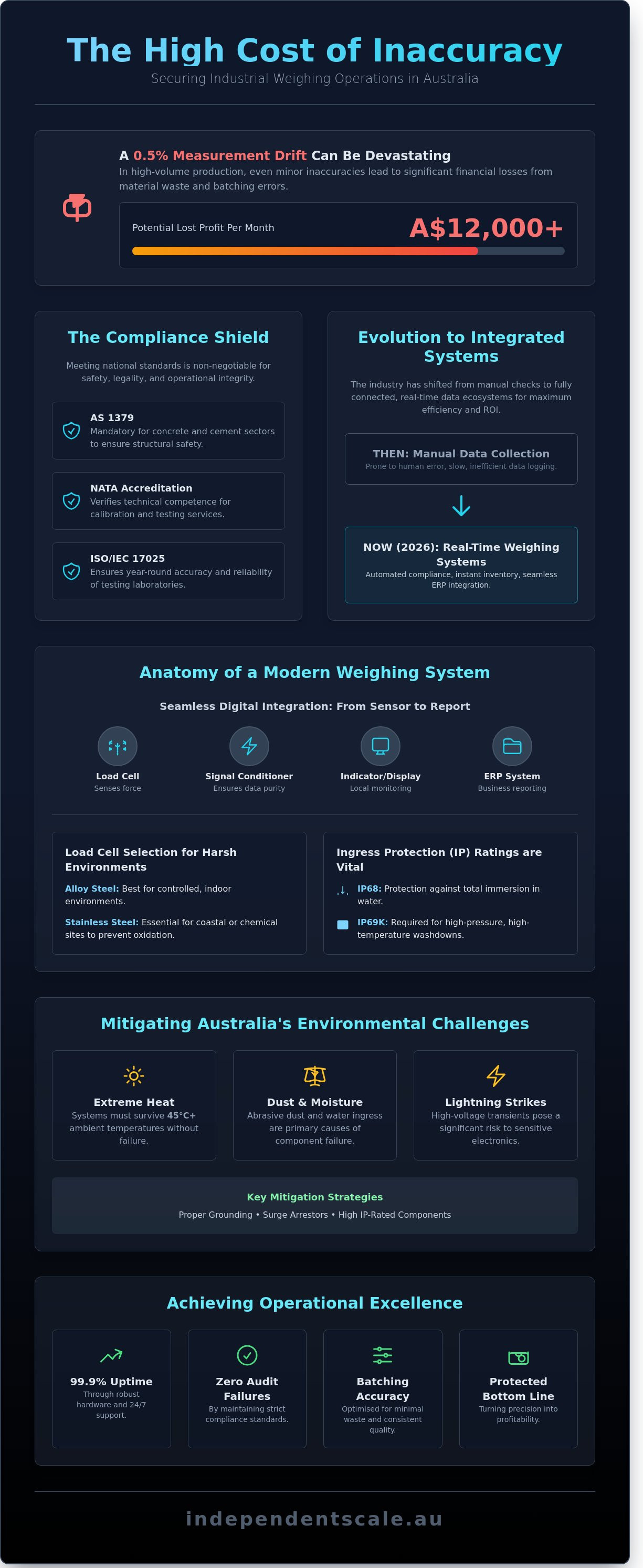
In high-volume industrial production, a 0.5% drift in measurement equipment Australia can result in over A$12,000 of lost profit per month through batching errors and material waste. You understand that precision is the bedrock of your facility. When load cells fail or calibration slips, the consequences aren't just technical; they're financial. Maintaining strict adherence to AS 1379 isn't optional for serious operators who want to avoid the high cost of downtime and batching inaccuracies.
This guide details how to secure your operations against audit failures and equipment fatigue. You'll learn how to select high-precision weighing components and implement a maintenance schedule that meets NATA and ISO/IEC 17025 requirements. We'll examine the technical advantages of gravimetric calibration and how 24/7 technical support ensures 99.9% uptime for your critical infrastructure. By the end of this article, you'll have a clear framework for achieving zero audit failures while optimising your batching accuracy and protecting your bottom line.
Key Takeaways
- Understand the evolution of industrial measurement in 2026, moving from simple data collection to fully integrated, real-time weighing systems.
- Identify the critical mechanics of high-performance load cells and the necessity of specialized mounting for accurate tank and silo weighing.
- Mitigate legal and commercial risks by ensuring your measurement equipment Australia meets NATA-accredited standards and AS 1379 compliance.
- Apply a strategic procurement framework to determine the required accuracy class and evaluate the total cost of ownership beyond the initial purchase price.
- Discover how leveraging over 30 years of NATA-accredited industrial expertise can solve complex weighing challenges and minimize facility downtime.
The Industrial Measurement Equipment Landscape in Australia
Industrial measurement in 2026 Australia has evolved beyond simple weight checks into a sophisticated ecosystem of data integrity. For the 98% of concrete plants across Sydney and the wider manufacturing sector, measurement equipment Australia standards are defined by rigorous compliance and real-time integration. The National Measurement Institute (NMI) provides the framework for these standards, ensuring every Newton of force and kilogram of material is accounted for within the national infrastructure. Accuracy isn't just a technical goal; it's a legal and financial mandate.
The transition from manual data collection to integrated, real-time weighing systems is now a requirement for operational ROI. A single percentage point of inaccuracy in a high-volume batching plant can result in over A$75,000 of lost revenue per year due to material giveaway. Professional-grade hardware is essential because off-the-shelf consumer equipment cannot survive the vibration, dust, and thermal expansion common in Australian industrial sites. It's the difference between a system that fails during a 42°C heatwave and one that maintains ISO/IEC 17025 accuracy levels year-round. Expertly calibrated systems ensure that plants remain AS 1379 compliant, avoiding the heavy penalties associated with non-conforming structural materials.
Key Categories of Industrial Weighing Equipment
Modern facilities rely on specialized hardware designed for high-stress environments. High-capacity load cells are the workhorses for silos and hoppers, often handling loads exceeding 50 tonnes while maintaining linear accuracy. Precision force gauges are equally critical, providing the data needed for tension and compression testing to verify material limits. Finally, integrated weighing indicators and transmitters serve as the command center for automated lines, ensuring that measurement equipment Australia professionals can monitor output with millisecond precision.
The Role of Digital Integration in 2026
Modern indicators and displays bridge the gap between physical hardware and corporate ERP systems. This connectivity allows for instant inventory tracking and automated compliance logging. In noisy environments where electrical interference from heavy machinery is constant, the use of signal conditioners is vital to maintain signal purity. These components ensure data remains clean as it travels from the load cell to the control room, preventing the costly downtime associated with "ghost" readings or signal dropouts. This principle of digital integration for enhanced control and security is also seen in other sectors, with companies like AN Digital Lock pioneering advanced access solutions.
Critical Weighing Technologies for Heavy Industry
Industrial weighing in Australia demands hardware that survives 45°C ambient temperatures and abrasive dust. High-performance load cells convert force into measurable electrical signals with precision, but their mechanical integrity depends on material choice. While alloy steel suffices for controlled environments, stainless steel is the standard for Australian coastal or chemical processing sites to prevent oxidation. In the concrete and cement sector, compliance with AS 1379 is mandatory. Precision isn't just about the sensor; it's about the entire integration of measurement equipment Australia relies on for structural safety and batch consistency.
Load Cell Selection for Harsh Environments
Dust and moisture ingress are the primary causes of load cell failure. Selecting the correct IP rating is vital. An IP68 rating ensures protection against total immersion, while IP69K is required for high-pressure washdowns. For heavy lifting or tension applications, engineers often specify special purpose shackle pins instead of standard compression cells. These pins integrate directly into the load path, saving space and improving safety. Accuracy must be verified against national standards, often involving NMI's calibration services to ensure legal-for-trade compliance. Lightning strikes also pose a significant risk to regional infrastructure. Installing surge arrestors and proper grounding protects sensitive summing circuits from high-voltage transients.
Tank and Silo Weighing Assemblies
Properly installed tank and silo weighing assemblies account for more than just weight. They must manage thermal expansion. A steel silo can expand by 1.2mm per 10 meters for every 10°C temperature rise. Without specialized mounts, this expansion introduces side forces that cause weighing errors. Maintenance protocols should include:
- Checking for "binding" where debris or rigid piping prevents free movement.
- Inspecting stay rods and check links for structural integrity.
- Verifying signal consistency across all cells using a junction box.
Vibration from mixers or nearby machinery can also distort readings. High-quality measurement equipment Australia wide uses digital filtering in indicators to smooth these signals. For plants requiring maximum uptime, an annual calibration schedule is the most effective way to prevent costly batching errors and maintain site compliance.
Why NATA Accreditation and AS 1379 Compliance Matter
Operating uncalibrated measurement equipment Australia wide exposes a business to severe legal and commercial risks. If a structural failure occurs, companies lacking NATA-accredited certification face litigation, heavy fines, and voided insurance policies. You shouldn't confuse a "factory calibration" with a NATA-accredited certificate. A factory check is a baseline performance test, whereas NATA accreditation confirms that the testing laboratory meets ISO/IEC 17025 standards for technical competence and equipment traceability. This traceability is verified by the National Measurement Institute, ensuring your data holds up in court or during a safety audit.
AS 1379 dictates the strict accuracy requirements for Australian concrete batching. It isn't just a suggestion; it's a regulatory mandate for all measurement equipment Australia concrete producers use. Looking toward 2026, the industry expects tighter enforcement of ISO/IEC 17025 standards for both laboratory and field testing. Staying ahead of these changes prevents costly downtime and keeps your facility operational under shifting compliance landscapes. Accurate data is the only way to prove your output meets the design specifications of major infrastructure projects.
The Gravimetric Method: The Gold Standard
Precision industries choose the gravimetric method for liquid flowmeter calibration because it's the most reliable way to verify accuracy. Volumetric methods often fail due to temperature fluctuations or liquid aeration. The gravimetric method uses high-precision weighing to determine mass, which remains constant regardless of environmental variables. This is essential for sectors where a 0.5% error in chemical dosing or water-to-cement ratios can compromise structural integrity or result in product recalls.
Audit-Proofing Your Facility
Maintaining a strict calibration schedule is the primary way to satisfy Australian regulators and auditors. Consistent concrete batching plant calibration ensures mix consistency and prevents the financial loss of rejected loads. You need traceable documentation that proves your equipment met the required tolerances at the time of use. In the event of a structural failure, these records are your only defense. ISS services 98% of concrete plants across Sydney, providing the technical expertise to keep your facility audit-ready. We provide the documentation needed to prove compliance with AS 1379 and NATA requirements, ensuring your operations remain beyond reproach.
A comprehensive approach to being audit-ready extends beyond equipment accuracy to include all areas of operational safety. This includes emergency management and fire safety compliance, where expert services like those from ShieldComply help ensure facilities meet all their regulatory obligations.
Specifying Measurement Equipment: A Procurement Framework
Procuring measurement equipment Australia requires a shift from a lowest-bidder mentality to a rigorous technical assessment of accuracy and long-term reliability. Specifying the correct "Class" of accuracy is the first step. For trade-certified weighing, Class III is the standard under NMI regulations. If your process involves high-precision laboratory analysis or fine chemical mixing, Class II or Class I is required. Using the wrong class results in either excessive hardware costs or legal non-compliance during audits.
Total Cost of Ownership (TCO) often exceeds the initial purchase price by 250% over a five-year equipment lifecycle. This figure includes biannual NATA-accredited calibrations, component wear, and the cost of potential downtime. 85% of industrial operators now prioritise systems with Industry 4.0 capabilities. Integrating IoT connectivity through Ethernet/IP or Modbus TCP allows for real-time health monitoring of load cells. This proactive approach identifies sensor drift before it impacts production quality or causes a total system failure.
Matching Equipment to Application
Choosing between a platform scale and a specialized force gauge depends entirely on the vector of the applied load. Platform scales are engineered for static vertical compression, while force gauges measure dynamic tension or push-pull forces in testing environments. Maintaining signal integrity over distances exceeding 15 metres requires high-quality conditioners and transmitters to convert millivolt signals into robust 4-20mA or digital outputs. Customising these setups for harsh Australian environments often requires specific options and accessories, such as stainless steel mounting kits or lightning protection for outdoor silos.
Evaluating Supplier Expertise
Technical support is non-negotiable for 2026 operations. A supplier without 24/7 emergency response is a liability when a batching plant fails at 2:00 AM. Before procurement, verify that the provider's NATA accreditation scope specifically covers the capacities you intend to use. For example, a provider might be accredited for scales up to 3,000kg but lack the mass standards for a 60-tonne weighbridge. Since Independent Scale Service maintains 98% uptime for Sydney’s major concrete producers, we know that local spare parts availability is the difference between a two-hour fix and a two-week shutdown.
Ensure your facility meets AS 1379 standards today. Book a NATA-accredited calibration assessment
Independent Scale Service: Australia’s Industrial Partner
Independent Scale Service (ISS) delivers over 30 years of technical expertise to the Australian industrial sector. We're a NATA-accredited partner focused on solving the most complex weighing and measurement challenges. Our team services industry leaders like Holcim, Boral, and Hanson, providing the technical reliability required for high-volume operations. When sourcing load cell supply or requesting on-site emergency repairs, clients rely on our strict adherence to ISO/IEC 17025 standards. We understand that accurate measurement equipment Australia is the foundation of quality control and regulatory compliance.
Nationwide Service Capabilities
Downtime is expensive. ISS maintains rapid response teams across Sydney, Melbourne, and regional Australia to keep plants running. Our technicians utilize specialized diagnostic equipment to identify whether a failure is an electrical surge or a mechanical fault. This accuracy prevents the waste of expensive components and reduces repair times. Our service model includes:
- 24/7 emergency breakdown support to minimize production halts
- Advanced fault finding for summing circuits and surge arrestors
- On-site repairs for weighbridges, hopper scales, and industrial platforms
Custom Engineering and Calibration
Standardized tools don't always fit unique manufacturing workflows. We provide tailored force gauge calibration for specialized production lines. For concrete batching plants, our work ensures total compliance with AS 1379. Maintaining precise measurement equipment Australia is critical for meeting these rigorous benchmarks. We currently maintain 98% uptime for concrete plants across major metropolitan areas through methodical preventative maintenance. Our calibration capabilities include:
- Gravimetric method calibration for liquid flowmeters
- NATA-certified testing for tanks and silo weighing assemblies
- Full compliance auditing for Australian regulatory standards
Our approach is methodical and precise. We don't just fix equipment; we optimize it for long-term performance in harsh industrial environments. By combining decades of experience with modern diagnostic tools, ISS remains the trusted authority for Australian weighing infrastructure.
Securing Long-Term Accuracy and Compliance for Your Operations
Maintaining high performance standards in heavy industry requires a technical approach to precision. Selecting the right measurement equipment Australia demands more than just a purchase; it requires a commitment to rigorous maintenance and strict regulatory alignment. Adherence to AS 1379 and NATA accreditation to ISO/IEC 17025 isn't optional for serious operators. These benchmarks ensure every measurement is accurate and remains legally defensible. Independent Scale Service leverages over 30 years of experience to provide these critical services, currently supporting 98% of concrete plants across Sydney. We provide 24/7 emergency industrial support to ensure your facility doesn't face unnecessary downtime. It's a proven framework designed to protect your operational efficiency and your bottom line. When technical competence is the priority, partnering with a specialist who understands the nuances of gravimetric method calibration is the only way forward. We're ready to help you meet every industry requirement with confidence.
Frequently Asked Questions
What is the difference between NATA and standard calibration in Australia?
NATA calibration involves testing by a laboratory accredited to ISO/IEC 17025, whereas standard calibration is a traceable check without the formal NATA endorsement. NATA certificates are mandatory for legal metrology and high-compliance industries like aviation or medical. Standard calibration follows manufacturer specs but lacks the third-party oversight provided by the National Association of Testing Authorities. ISS provides NATA-accredited services to ensure your measurement equipment Australia wide meets the highest regulatory benchmarks.
How often should industrial weighing equipment be calibrated?
Industrial weighing equipment requires calibration every 6 to 12 months to maintain operational accuracy and compliance. High-use environments or sites with high vibration levels often require quarterly inspections. AS 1379 specifies strict intervals for concrete production. Regular scheduling prevents the A$5,000 to A$20,000 costs associated with product giveaway or batch rejection. It's a critical step for maintaining your bottom line.
What Australian standards apply to concrete batching plant accuracy?
AS 1379;2007 (Specification and supply of concrete) governs the accuracy requirements for concrete batching plants in Australia. This standard dictates that scales must be accurate to within 0.5% of the batch weight for cement and 2% for aggregates. ISS ensures 98% of Sydney’s concrete plants remain compliant with these specific tolerances through gravimetric method calibration and routine verification. We use certified test weights to guarantee every batch meets the code.
Can load cells be repaired, or do they always need replacement?
You can repair load cells if the issue involves cable damage or moisture in the junction box, but internal strain gauge failure requires full replacement. 85% of load cell issues stem from environmental factors like lightning strikes or chemical ingress. While external components are fixable, a compromised internal bridge circuit is non-repairable. ISS technicians evaluate summing circuits and insulation resistance to determine if a A$400 repair or a full unit replacement is necessary.
Is on-site calibration available for large silos and hoppers?
Yes, on-site calibration is available for large silos and hoppers using high-capacity test weights or hydraulic force calibration systems. ISS utilizes specialized trucks and 20-tonne weight sets to calibrate bulk storage systems without dismantling equipment. This process minimizes downtime. We verify the entire weighing string, including load cells and mountings, to ensure accuracy in heavy industrial measurement equipment Australia applications across the country.
What are the requirements for ISO/IEC 17025 accreditation in 2026?
The 2026 requirements for ISO/IEC 17025 focus on enhanced risk-based thinking and the mandatory integration of digital data integrity protocols. Laboratories must demonstrate 100% traceability of electronic records and implement automated uncertainty calculations. These updates ensure that all calibration data remains tamper-proof. ISS maintains accreditation by adhering to these evolving standards, providing clients with verified 17025-compliant documentation for every service we perform.
How does temperature affect measurement equipment accuracy in Australia?
Ambient temperature fluctuations in Australia can cause thermal expansion in load cells, leading to measurement drifts of up to 0.1% per 10°C change. Extreme heat in regions like Western NSW often requires temperature-compensated load cells or insulated enclosures. Without proper compensation, a scale calibrated at 20°C may provide incorrect readings when temperatures reach 45°C. ISS selects hardware rated for the Australian climate to mitigate these environmental errors effectively.
What should I do if my weighing system shows inconsistent readings?
If your weighing system shows inconsistent readings, you must immediately inspect the load cell mountings for debris and check the junction box for moisture. 70% of weighing errors result from mechanical binding or "rubbing" where the scale frame touches surrounding structures. If the problem persists, contact our 24x7 emergency service line. We'll deploy a technician to perform a millivolt test on the load cells and verify the summing circuit integrity quickly.
