


Maximising Warehouse Efficiency with Industrial Pallet Scales
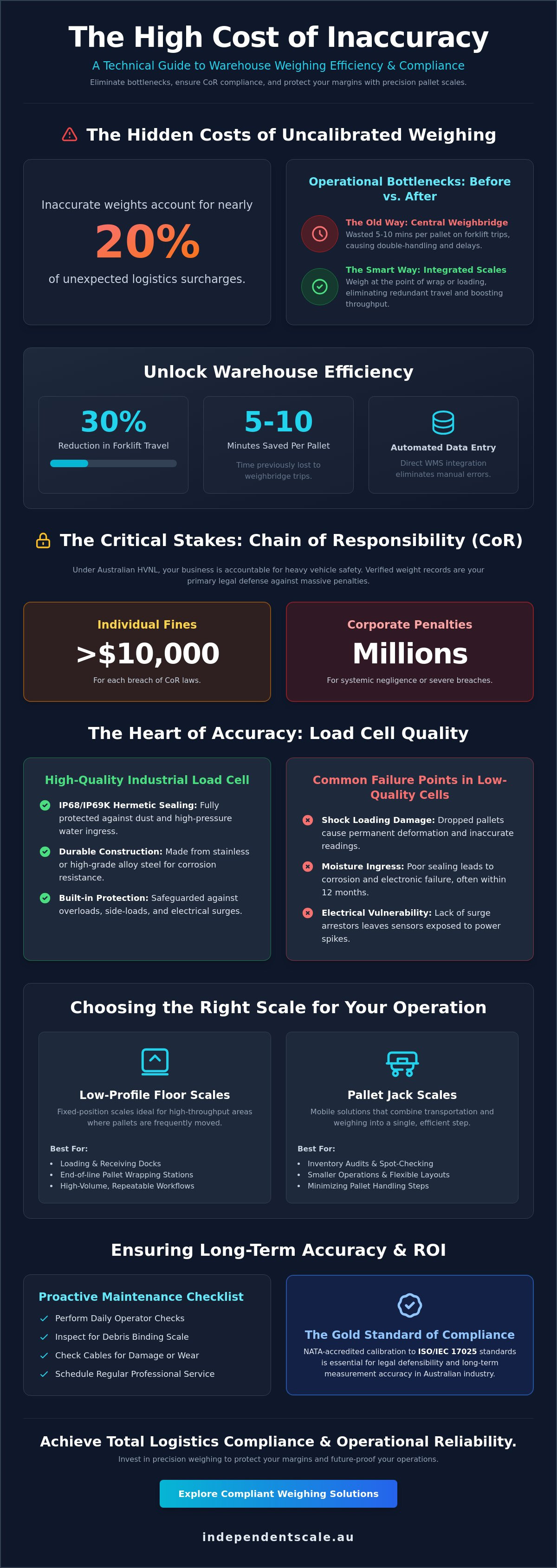
Inaccurate weight readings account for nearly 20% of unexpected logistics surcharges, yet many facilities still rely on uncalibrated equipment or aging load cells. For warehouse managers, these errors don't just cost money; they compromise your standing under Chain of Responsibility (CoR) laws and lead to avoidable equipment downtime. Utilising precise pallet scales for warehouse efficiency is the only way to ensure your dispatch process remains streamlined and your weight data remains 100% accurate for every shipment.
This article provides a technical roadmap for selecting, calibrating, and maintaining your weighing systems to ensure they meet NATA-accredited standards and ISO/IEC 17025 requirements. You'll learn how to eliminate operational bottlenecks and protect your margins by adhering to strict Australian weighing standards. We've compiled these insights from over 30 years of industrial experience to help you achieve total logistics compliance and operational reliability across your entire facility.
Key Takeaways
- Learn how integrating pallet scales for warehouse efficiency eliminates redundant trips to central weighbridges and streamlines logistics.
- Understand the critical role of load cell quality and how to protect these core components from common warehouse hazards like shock loading and moisture.
- Compare the operational benefits of low-profile floor scales against pallet jack scales to determine the most effective solution for your specific material handling needs.
- Discover why NATA-accredited calibration to ISO/IEC 17025 standards is essential for meeting Australian industrial compliance and ensuring long-term measurement accuracy.
- Implement a proactive maintenance regime, including daily operator checks, to prevent debris binding and maximise the return on your equipment investment.
The Role of Pallet Scales in Modern Warehouse Efficiency
Pallet scales function as critical data capture points within the modern supply chain. They're no longer just simple weighing tools; they're integrated nodes that feed real-time information into logistics networks. By implementing pallet scales for warehouse efficiency, facilities eliminate the 5 to 10 minutes of forklift travel time typically wasted on trips to a central weighbridge. This integration removes the need for double-handling palletised goods, which directly lowers labour costs and increases throughput speed.
Accurate weighing is the foundation of freight cost optimisation. Carriers often apply significant surcharges for weight discrepancies. Precise data prevents these back-charges and ensures you aren't paying for unused capacity. The reliability of these measurements depends heavily on load cell quality and rigorous weighing scale calibration. When equipment is maintained to NATA-accredited standards, every kilogram recorded becomes a legally defensible data point for billing and compliance.
Eliminating Logistics Bottlenecks
Positioning scales at the point of wrap or the loading dock reduces forklift travel by up to 30% in high-volume environments. Modern digital indicators connect directly to a Warehouse Management System (WMS) via Ethernet or RS232 protocols. This connectivity eliminates manual data entry, which is responsible for a high percentage of inventory errors. It also prevents overloaded vehicles from leaving the dock. Even a 5% weight error can lead to axle limit violations, causing immediate delays and safety risks at the outbound gate.
Chain of Responsibility (CoR) Compliance
Australian warehouse operators must adhere to strict Chain of Responsibility (CoR) laws under the Heavy Vehicle National Law (HVNL). These regulations mean that any party involved in the transport chain is accountable for heavy vehicle safety. Businesses face fines exceeding $10,000 for individual breaches, while corporate penalties can reach millions for systemic negligence. Verified weight records are essential for legal protection. They provide the documented evidence required to prove that "so far as is reasonably practicable," the business has mitigated the risks of overloading. Accurate pallet scales ensure that every load is compliant before it enters public roads, protecting the business from severe financial and legal repercussions.
Technical Components: Why Load Cell Quality Matters
The load cell functions as the heart of any weighing system. It's the primary transducer that converts physical force into a measurable electrical signal. In high-volume environments, selecting the right load cell is critical for maintaining pallet scales for warehouse efficiency. Low-quality sensors often fail within 12 months due to shock loading or moisture ingress. Shock loading occurs when a forklift operator drops a 1,000kg pallet onto the scale with excessive force, creating a momentary peak load that exceeds the cell's rated capacity. This leads to permanent deformation of the sensor and inaccurate data.
Industrial-grade components are designed to withstand these stresses. High-quality systems include built-in protection against side loads and overloads. To protect your investment, ISS integrates junction boxes and surge arrestors into the weighing circuit. These components shield the sensitive electronics from electrical spikes and ensure the summing circuit remains balanced. Without these safeguards, a single power surge or lightning strike can destroy the entire sensor array, resulting in costly downtime and expensive hardware replacements.
Understanding Load Cell Technology
Within the cell, strain gauges measure the minute deformation of the metal body. For industrial durability, these components require robust environmental sealing. Entry-level scales often use basic potting, while industrial-grade cells utilize hermetic sealing with IP68 or IP69K ratings to prevent water and dust ingress. You can explore our range of industrial load cells to see the engineering standards required for 24/7 operations. These units are built from stainless steel or high-grade alloy steel to ensure long-term stability and resistance to corrosion in damp warehouse bays.
Indicators and Data Transmission
The digital indicator is the interface between the scale and the operator. For maximum warehouse throughput, high-visibility LED or LCD displays are essential for clear reading from a distance. These units must process signals quickly to avoid bottle-necks during peak dispatch times. The integration of conditioners and transmitters ensures signal stability across long cable runs. These devices convert the raw millivolt output of the load cell into a robust digital signal or a 4-20mA analog output for PLC integration.
Forklift safety is significantly improved through wireless display options. This removes trip hazards and prevents cable damage caused by moving equipment. Wired systems remain the standard for static installations where signal integrity is the absolute priority. ISS has provided these technical solutions for over 30 years, ensuring every component meets the rigorous demands of NATA-accredited environments. If your current system provides inconsistent readings, it's often a sign that your weighing scale calibration is overdue or a component is failing.
Comparing Pallet Scale Types for Your Operation
Selecting the correct hardware is vital for maintaining pallet scales for warehouse efficiency. Different operational workflows require specific configurations to ensure measurement accuracy and high throughput. Industrial environments demand equipment that can withstand repetitive loading while providing consistent data for inventory management and freight compliance.
- Low-profile floor scales: These are engineered for permanent weighing stations. They offer maximum stability and high-duty cycles, making them ideal for facilities processing over 100 pallets per day.
- Pallet jack scales: These mobile units integrate weighing into the transport process. By eliminating the trip to a fixed scale, operators save approximately 30 to 60 seconds per pallet during the loading process.
- U-frame scales: These provide a portable alternative for smaller warehouses. Their lightweight design allows for easy storage when they aren't in use, while the open frame accommodates standard pallet entry without the need for ramps.
- Weigh beams: These consist of two separate bars. They offer the highest level of flexibility for weighing non-standard crates or oversized machinery that exceeds the dimensions of a standard 1165mm Australian pallet.
Permanent Floor Scales vs. Portable Solutions
The choice between fixed and mobile weighing depends on your facility's daily throughput and floor layout. High-volume operations benefit from pit-mounted floor scales. These are installed flush with the concrete, which removes the need for ramps and reduces the physical strain on operators using manual hand pallet jacks. Surface-mounted scales are easier to install but require 1.5 to 2 metres of additional clearance for approach ramps to ensure safe loading.
Maintenance requirements also differ significantly. Fixed scales often utilize junction boxes and surge arrestors to protect sensitive load cells from electrical interference and moisture ingress. Portable equipment, such as pallet jack scales, requires more frequent weighing scale calibration. This is due to the constant vibrations and mechanical shocks experienced during transit across uneven warehouse floors or dock levellers.
Selecting Capacity and Resolution
Industrial operations must balance maximum load requirements with the need for precise data. Standard pallet scales for warehouse efficiency typically offer a 2000kg capacity with 0.5kg increments. If your operation handles heavy machinery or bulk liquid containers, 5000kg models are necessary. You'll find that increasing the capacity often results in wider measurement increments, such as 1kg or 2kg, to maintain sensor stability.
Australian warehouses primarily use 1165mm x 1165mm pallets. Scale dimensions must accommodate this footprint with at least 50mm of clearance on all sides to prevent "binding" against surrounding safety rails or walls. For trade-approved applications, ensure your equipment meets NATA-accredited standards. This ensures your business remains compliant with Australian National Measurement Institute (NMI) regulations for commercial transactions.
The Critical Importance of NATA Calibration and Compliance
Standard factory calibration is a baseline, not a guarantee of ongoing accuracy. While a new scale arrives with manufacturer settings, these don't account for local gravitational variables or the rigours of Australian industrial environments. Achieving genuine pallet scales for warehouse efficiency requires a transition from basic testing to NATA-accredited calibration. NATA ensures that measurements are traceable to national standards, which is a legal and operational necessity for many sectors. Without this level of certification, your weighing data lacks the authority required for quality management systems or trade-legal transactions.
NATA Accreditation and ISO Standards
NATA serves as the primary authority for laboratory accreditation in Australia, providing the framework that ensures technical competence. ISO/IEC 17025 is the specific international standard for calibration laboratories, governing everything from technician training to equipment maintenance. Compliance with this standard means your data is defensible during audits or legal disputes. For businesses requiring high-precision results, Professional weighing scale calibration services are the only way to verify that equipment meets these rigorous benchmarks. It's the difference between guessing your weights and knowing them with 100% certainty.
Calibration Intervals for High-Traffic Warehouses
In a facility processing 500 or more loads per day, mechanical drift is inevitable. Load cells experience fatigue, and summing circuits can be affected by moisture or temperature fluctuations. Most industrial operations require calibration every 6 to 12 months, though high-impact environments often require quarterly checks to maintain pallet scales for warehouse efficiency. Using non-calibrated scales for commercial transactions risks violating trade measurement laws and can lead to 15% or higher losses in revenue due to overfilling or shipping errors.
Gravimetric calibration is the most accurate method for industrial scales.
- Usage Frequency: High-volume throughput increases the rate of component wear and potential drift.
- Environmental Factors: Exposure to dust, chemicals, or extreme vibration impacts load cell sensitivity over time.
- Impact Events: Forklift collisions or heavy dropped loads can shift the zero point or damage internal sensors immediately.
- Measurement Integrity: Regular calibration prevents the slow accumulation of errors that lead to significant inventory discrepancies.
Independent Scale Service provides 24/7 emergency support and scheduled maintenance to ensure your equipment never falls out of compliance. We use traceable weights and proven methodologies to keep your operations running within tolerance.
Maintaining Your Pallet Scales for Long-Term ROI
Industrial weighing equipment is a precision asset that requires consistent technical oversight. To ensure pallet scales for warehouse efficiency deliver consistent results, operators must perform daily inspections. Neglecting these checks leads to "binding," where debris like wood splinters, plastic wrap, or gravel accumulates under the platform or between the scale frame. This physical obstruction prevents the load cells from deflecting correctly. Even a small 5mm stone can cause a 2% weight variance on a 2,000kg pallet, which compromises inventory accuracy and freight compliance.
Professional maintenance is the difference between a reliable 10-year asset and frequent, costly downtime. Reactive repairs often cost 15% to 20% more than scheduled preventative programs due to emergency call-out fees and lost productivity. Independent Scale Service supports Australian logistics by providing NATA-accredited expertise that aligns with ISO/IEC 17025 standards. Our technicians focus on technical competence and compliance, ensuring every scale meets the rigorous demands of high-volume distribution centers. With over 30 years of experience, we provide the stability required for serious industrial operations.
Preventative Maintenance Checklist
A structured approach to maintenance extends hardware life. Operators should follow this checklist to identify issues before they cause system failure:
- Visual Inspection: Check junction boxes and cables for moisture ingress, corrosion, or cable fraying.
- Leveling: Scales must sit on flat, non-yielding surfaces. An unlevel scale shifts the load's center of gravity, causing non-linear errors.
- Mechanical Wear: Check for cracked welds or distorted decks indicating the scale has been consistently overloaded.
Expert Repair and Emergency Support
Downtime in a logistics hub impacts the bottom line immediately. Our 24/7 emergency support provides rapid response for faults like signal drift in summing circuits or physical load cell damage. We use diagnostic precision to restore operations and avoid unnecessary part replacements. For expert supply and NATA-compliant calibration, Contact Independent Scale Service. Reliable weighing is critical for maintaining pallet scales for warehouse efficiency across all industrial sectors.
Future-Proof Your Warehouse Weighing Systems
Operational excellence depends on the precision of your hardware and the rigor of your maintenance schedule. High-quality load cells and the correct scale selection for your specific environment are the first steps in eliminating measurement errors. Maintaining NATA accreditation to ISO/IEC 17025 is the only way to guarantee your facility meets strict Australian compliance standards while protecting your commercial interests. Integrating pallet scales for warehouse efficiency allows your team to move goods faster without sacrificing accuracy or safety protocols. Independent Scale Service brings over 30 years of industrial weighing experience to every site visit. We provide NATA-accredited solutions and emergency 24/7 repair services across Australia to ensure your operations never stall. Regular calibration and professional oversight turn your weighing equipment into a high-yield investment rather than a maintenance burden. Don't let uncalibrated equipment compromise your site safety or profit margins. It's time to elevate your facility's standards with technical expertise you can trust. Your warehouse is ready for a more accurate future.
Optimise your warehouse with NATA-accredited weighing solutions from Independent Scale Service
Frequently Asked Questions
How often should pallet scales be calibrated in a warehouse?
Standard industrial practice requires calibration every 6 to 12 months to maintain measurement accuracy. High-volume facilities processing over 500 loads daily should opt for quarterly inspections to prevent measurement drift. Regular servicing ensures compliance with ISO/IEC 17025 standards. Accurate data is essential for pallet scales for warehouse efficiency, as even a 1% error leads to significant inventory discrepancies over a 365-day period.
Can pallet scales be used for legal-for-trade applications in Australia?
Pallet scales can be used for legal-for-trade applications in Australia provided they're National Measurement Institute (NMI) approved. These scales must be verified by a licensed technician under the National Measurement Act 1960. You'll recognize these units by their specific NMI approval number. Using non-verified equipment for trade transactions involving weight-based pricing is illegal and carries penalties under Australian consumer law.
What is the difference between a floor scale and a pallet scale?
A floor scale features a large, flat platform permanently installed on or in the warehouse floor, while a pallet scale is typically a U-shaped frame or a mobile pallet jack with integrated sensors. Floor scales often handle larger dimensions up to 3000mm by 3000mm. Pallet scales are designed specifically for standard 1165mm x 1165mm Australian pallets. This specialized design improves pallet scales for warehouse efficiency by allowing for easier entry with manual pallet jacks.
How do I know if my pallet scale load cell is failing?
You'll identify a failing load cell by inconsistent weight readings or "drifting" where the display changes without a load. If the scale doesn't return to zero after unloading, it's a sign of a mechanical or electrical fault. Check for physical damage to the cable or summing circuit. A 10% variance between corner tests usually indicates a specific cell's failed and requires immediate replacement to ensure system reliability.
Is NATA accreditation necessary for all warehouse scales?
NATA accreditation isn't legally required for every warehouse scale, but it's mandatory for businesses following ISO/IEC 17025 quality management systems. Industries like civil construction or pharmaceuticals require NATA-endorsed certificates to prove traceability to national standards. For standard logistics, a regular calibration report from a competent technician suffices. However, NATA certification provides the highest level of technical assurance for 100% of your weighing data.
Can pallet scales integrate with my existing inventory software?
Modern industrial scales integrate with WMS and ERP systems using RS232, USB, or Wi-Fi connectivity. Most digital indicators support standard protocols like Modbus or Ethernet/IP to transmit data directly into your database. This automation eliminates manual entry errors, which currently account for roughly 3% of data inaccuracies in manual warehouses. Real-time data syncing is a proven method for maintaining precise stock levels across multiple locations.
What is the maximum capacity for a standard industrial pallet scale?
A standard industrial pallet scale typically has a maximum capacity of 2,000kg or 3,000kg. Heavy-duty models can reach 5,000kg for specialized industrial applications. It's vital to select a scale where your average load is approximately 50% to 75% of the total capacity. Exceeding the rated limit even once can cause permanent deformation to the load cells, leading to a 100% loss in measurement accuracy.
How does temperature affect the accuracy of warehouse weighing equipment?
Temperature fluctuations cause metal components to expand or contract, which directly impacts load cell sensitivity. Most industrial scales are rated for operations between -10°C and +40°C. If your warehouse temperature shifts by more than 15°C in a single shift, you'll likely see zero-point drift. High-precision operations in non-climate-controlled environments should use temperature-compensated load cells to maintain a variance of less than 0.1% across the entire thermal range.
