


Managing Calibration for Multiple Sites: The 2026 Industrial Strategic Guide
Over 72% of industrial enterprises now prioritize ISO/IEC 17025-accredited providers, yet many operations still struggle with the logistical friction of maintaining these standards across geographic borders. Managing calibration for multiple sites often feels like a constant battle against drifting schedules and inconsistent regional service quality. You understand that a single missed audit at one remote facility can compromise your entire national compliance framework, especially with the 2026 publication of ISO 10012 as a certifiable, auditable standard.
This strategic guide provides a technical roadmap to master these logistical hurdles. It's designed to help you ensure NATA-accredited accuracy and AS 1379 compliance across every Australian facility you manage. We'll detail how to transition from traditional time-based intervals to a risk-based approach, build a unified asset register for hundreds of load cells, and implement on-site calibration strategies that can improve equipment uptime by 15% to 25%. You'll learn to eliminate the administrative burden of tracking disparate regional providers while maintaining a rigorous, audit-ready stance nationwide.
Key Takeaways
- Identify the "Compliance Gap" inherent in decentralized scheduling that leads to measurement drift and systemic audit failures across facilities.
- Understand the technical hierarchy of metrological traceability required to align site-level equipment with Australian Primary Standards.
- Evaluate the operational efficiency of centralized versus decentralized models for managing calibration for multiple sites.
- Implement a 5-step framework to establish a national asset register and standardize calibration intervals based on equipment usage intensity.
- Leverage NATA-accredited partnerships to maintain ISO/IEC 17025 compliance and ensure consistent accuracy across all geographic locations.
The Logistics of Managing Calibration for Multiple Sites in 2026
Multi-site calibration management is the technical synchronisation of measurement accuracy across geographically dispersed facilities. It isn't merely a scheduling task. It's a logistical strategy to ensure every load cell and weighing scale performs to the same NATA-accredited standard, regardless of location. Managing calibration for multiple sites requires moving beyond individual site autonomy toward a centralized, risk-based oversight model. This shift is no longer optional for serious industrial players.
The "Compliance Gap" remains a significant risk in decentralized models. When site managers independently schedule services, measurement drift often goes undetected until an audit failure occurs. This lack of coordination creates blind spots in national quality frameworks. The February 2026 publication of ISO 10012 has intensified these risks. This standard is now auditable and certifiable. It requires industrial operators to prove a consistent, risk-based approach to measurement processes across all assets. If your sites operate on different protocols, you're likely non-compliant with the latest ISO 10012 requirements.
Uncoordinated service also carries hidden financial penalties. Redundant technician travel fees and staggered downtime periods across different sites inflate operational costs. A unified approach allows for logistical clustering. In this model, multiple facilities in a region are serviced in a single, efficient mobilization. This minimizes the time equipment is offline and reduces the administrative burden on procurement teams.
The Risk of Measurement Drift in Heavy Industry
Environmental stressors like vibration, temperature fluctuations, and dust ingress affect heavy industrial equipment differently at each site. What is Calibration? Fundamentally, it's the process of ensuring an instrument's output matches a known standard. In concrete or chemical production, even minor drift leads to significant batching errors. This compromises structural integrity and regulatory compliance. Ensuring concrete batching plant calibration is consistent nationwide prevents a single out-of-tolerance scale from invalidating an entire corporate quality report. High-stakes industries can't afford the liability of localized errors.
Standardising the Asset Register
Efficiency starts with a unified identification system. Site-specific silos must be replaced with a master corporate asset register. We recommend a standardized nomenclature, such as SITE-EQUIP-001, to track assets across the network. This register must include the make, model, serial number, measurement range, and the last NATA-endorsed date for every unit. This level of visibility is essential for hopper calibration service planning and load cell calibration tracking. It transforms reactive maintenance into a proactive, audit-ready compliance strategy that spans your entire national footprint.
Navigating NATA and ISO 17025 Compliance Across Borders
Compliance in a multi-site environment depends on a rigid hierarchy of metrological traceability. Every piece of equipment, from a remote silo load cell to a laboratory force gauge, must be traceable back to the Australian Primary Standards maintained by the National Measurement Institute (NMI). For organizations managing calibration for multiple sites, this traceability is verified through NATA accredited calibration. NATA accreditation serves as the technical bridge between local measurements and international standards, ensuring that data collected in Western Australia is legally and technically equivalent to data from a facility in Queensland.
The 2026 regulatory environment has shifted toward digital transparency. The updated ISO/IEC 17025:2017 standard and its subsequent 2025 revisions now emphasize software validation and the integrity of digital calibration data. Audit readiness across borders requires more than just paper certificates; it demands a centralized digital repository where NATA-endorsed records are instantly accessible for regional inspectors. This ensures that technical competence remains consistent regardless of the facility's physical location.
ISO/IEC 17025:2026 Standards for Weighing Equipment
Regulatory Compliance for Concrete and Construction
In the construction sector, AS 1379 compliant batching plant services are the baseline for legal operation. This standard dictates specific accuracy requirements for the batching of concrete, which is non-negotiable for Tier 1 infrastructure projects. High-volume environments require frequent hopper and silo calibration to account for the mechanical wear of constant throughput.
Managing these requirements across different Australian states involves navigating varied regional expectations. While AS 1379 provides a national framework, local road authorities often have specific reporting nuances. A centralized management strategy ensures that regardless of the state-based jurisdiction, your equipment meets both national standards and local project specifications. To maintain this level of precision, consider a professional load cell calibration review to identify potential compliance gaps in your current schedule.
Evaluating Management Models: Centralised vs. Decentralised Calibration
Choosing a management model is a critical decision that dictates your organization's long-term compliance stability. The decentralised model grants site-level autonomy, which often seems efficient locally but obscures corporate visibility. This lack of transparency leads to measurement drift and systemic audit failures when local managers overlook NATA deadlines. Conversely, the software-only model centralises data but frequently lacks the necessary technical oversight. It provides a digital dashboard without ensuring that the physical load cell calibration is executed to NATA standards.
The Pros and Cons of Manual Tracking
Manual tracking via spreadsheets is a high-risk strategy that fails once an organisation exceeds three locations. These systems are inherently prone to human error and create dangerous data silos. Risks include:
- Forgotten assets: Mobile equipment or units in remote areas frequently drop off the register.
- Inconsistent data: Different sites often use varied templates or measurement units.
- Audit friction: Retrieving paper-based NATA certificates from local filing cabinets during a national audit causes significant delays.
Administrative teams report that manual calibration scheduling consumes hundreds of labour hours annually across multi-site networks.
The Managed Calibration Partner Advantage
Outsourcing to Independent Scale Service reduces administrative overhead and ensures technical precision. We manage the full lifecycle of your weighing equipment, from initial load cell supply to recurring NATA-endorsed maintenance. Key advantages include:
- Consolidated Reporting: View all NATA certificates nationwide through one unified portal.
- Technical Excellence: Ensure force gauge calibration and industrial scale testing meet ISO/IEC 17025 benchmarks.
- Regional Cost Control: Utilize our service hubs in Sydney and Melbourne to reduce technician travel fees and minimize operational downtime.
This model allows your national quality manager to maintain total visibility without managing the day-to-day logistics of regional service providers.
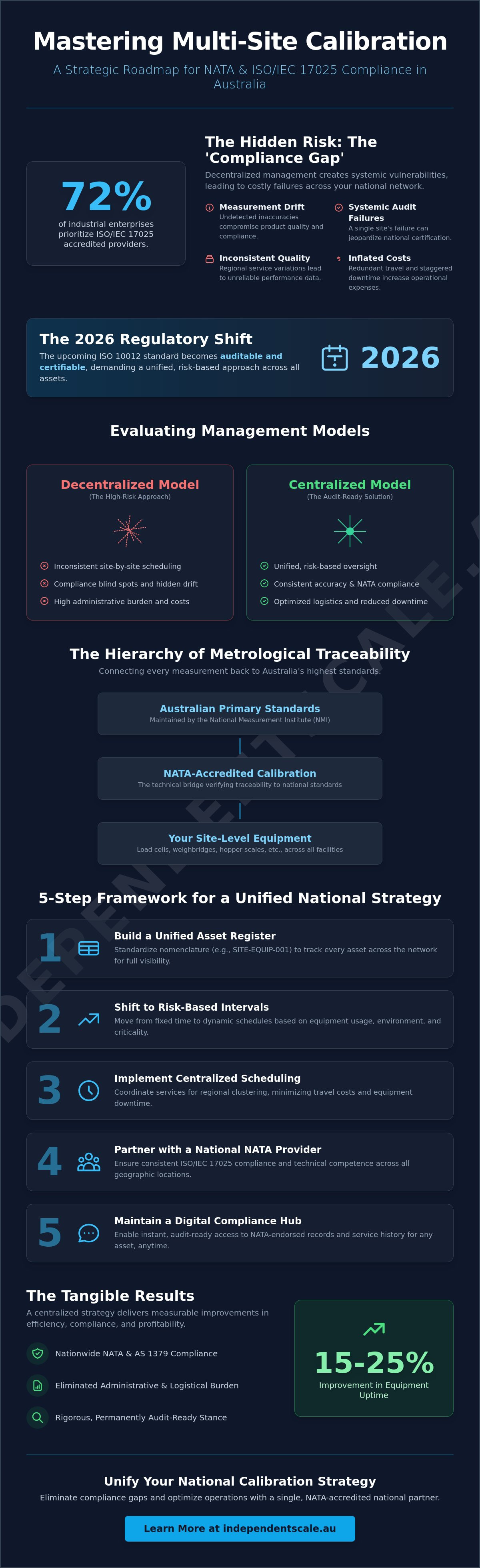
A 5-Step Framework for Multi-Site Equipment Calibration
Successfully managing calibration for multiple sites requires a transition from reactive scheduling to a rigorous 5-step framework. This methodology ensures that technical precision remains uniform across your entire industrial network. A haphazard approach to regional maintenance invariably leads to compliance gaps and increased operational costs. By following a structured national roadmap, you can eliminate these risks while maintaining audit readiness at every facility.
- Step 1: Conduct a National Equipment Audit to establish a baseline asset register across all geographic locations.
- Step 2: Standardise Calibration Intervals based on usage intensity and historical drift, moving away from arbitrary time-based schedules.
- Step 3: Implement Centralised Documentation by integrating digital conditioners and transmitters for real-time data accuracy.
- Step 4: Synchronise Site Visits to cluster regional services, which reduces technician travel fees and maximises mobilisation efficiency.
- Step 5: Establish a Continuous Review Loop to adjust service frequencies based on documented equipment stability over time.
Step 1 & 2: Baselining and Scheduling
The foundation of a multi-site strategy is the categorisation of assets by their criticality to production. Class A assets, such as load cells used in high-precision batching, require tighter tolerances and more frequent oversight. Conversely, Class C assets may only need annual verification. Determining the correct intervals for hopper and silo calibration in harsh environments is particularly vital. These assets are often subject to mechanical fatigue that standard schedules don't account for. Aligning these technical requirements with site-wide maintenance shutdowns ensures that compliance doesn't come at the cost of production volume.
Step 3 & 4: Execution and Data Integration
Modern industrial sites increasingly utilise digital indicators and displays to enable remote monitoring of calibration status. This hardware allows for immediate detection of out-of-tolerance events between scheduled visits. During execution, it's essential that technicians have the capability to perform on-site repairs immediately. This prevent return trips and reduces overall downtime. Every technician must follow the same NATA-endorsed Standard Operating Procedures (SOPs) regardless of their location. This standardisation is the only way to guarantee that a measurement in Perth is as reliable as one in Brisbane.
Establishing a continuous review loop allows you to refine your strategy using hard data. If historical drift analysis shows a specific set of load cells remains stable, you can safely extend intervals, saving on service costs without compromising accuracy. To begin standardising your national network, contact our team for a professional NATA accredited calibration audit of your existing assets.
National Coverage: Partnering with Independent Scale Service
Independent Scale Service provides the technical framework required to maintain measurement integrity across your entire national footprint. Managing calibration for multiple sites shouldn't be a fragmented effort handled by dozens of uncoordinated regional providers. We consolidate your weighing equipment oversight into a single, authoritative service agreement. Our NATA accreditation to ISO/IEC 17025 ensures that every facility in your network operates to the highest international standards of technical competence. This unified approach eliminates the risk of "compliance drift" where different sites adopt varying levels of measurement accuracy.
A primary advantage of our national model is unified reporting. Instead of chasing paper certificates from local filing cabinets, your corporate quality manager accesses all NATA-endorsed records through a single point of contact. This transparency is vital for rapid response during external audits. It ensures that your national quality reports are backed by a consistent, unbroken chain of metrological traceability. We don't just provide data; we provide the assurance that your entire infrastructure is audit-ready at any moment.
Sydney, Melbourne, and Regional Australia Support
Our geographic reach ensures that even remote industrial sites receive the same level of responsive service as those in metropolitan Sydney or Melbourne. We understand that regional logistics often drive up service costs and downtime. Our service hubs are positioned to provide rapid mobilization, reducing technician travel fees and ensuring that critical equipment isn't offline for extended periods.
Consider the case of a multi-site concrete producer operating across three states. By transitioning to our managed service model, they successfully streamlined their national asset register. This move reduced their administrative audit preparation time by over 60% while ensuring 100% compliance with AS 1379 across all batching plants. A single service agreement provides this level of efficiency, allowing your internal teams to focus on production rather than vendor management.
Technical Excellence in Industrial Weighing
Our capabilities extend beyond routine calibration. We specialize in heavy-duty load cell supply and the expert installation of tank and silo weighing assemblies. Our technicians carry sophisticated on-site diagnostic tools and a comprehensive inventory of spare parts. This allows us to perform immediate repairs during the calibration visit, preventing the need for costly return trips.
Minimizing downtime is our priority. Whether you require force gauge calibration in a laboratory setting or a full-scale overhaul of a concrete batching plant, our team delivers methodical, precise results. To secure your national compliance framework and eliminate logistical blind spots, contact Independent Scale Service today for a comprehensive multi-site calibration audit.
Securing Your National Compliance Framework
Effective managing calibration for multiple sites requires a shift from reactive local maintenance to a unified, risk-based national strategy. By adopting a managed service model, you eliminate the technical blind spots that lead to inconsistent data and systemic audit failures. Implementing a centralized asset register and synchronizing regional service visits ensures that your entire infrastructure meets the rigorous benchmarks set by ISO/IEC 17025 and AS 1379. This methodical approach transforms compliance from an administrative burden into a predictable operational standard.
Independent Scale Service provides the technical expertise and geographic reach necessary to maintain this precision across Sydney, Melbourne, and regional Australia. Our NATA-accredited technicians deliver the technical competence required to protect your business from the legal and operational risks of measurement drift. Proactive maintenance and rapid on-site repair capabilities ensure your facilities remain productive while meeting every regulatory requirement. Take the first step toward a standardized national weighing strategy today.
Request a Multi-Site Calibration Strategic Audit to establish a baseline for your national network and ensure zero-downtime compliance for the year ahead.
Frequently Asked Questions
How often should weighing equipment be calibrated across multiple sites?
Calibration frequency is determined by equipment criticality and usage intensity rather than a fixed calendar date. High-volume concrete batching plants or chemical silos typically require quarterly or bi-annual intervals to maintain accuracy. ISO 10012:2026 mandates a risk-based approach; if an asset shows high historical drift, you must increase the frequency to ensure continued compliance and measurement integrity.
What is the difference between NATA-accredited and non-accredited calibration for industrial sites?
NATA-accredited calibration provides legally defensible metrological traceability to Australian Primary Standards. Non-accredited checks are mere performance verifications that lack the technical rigor and independent oversight required for ISO/IEC 17025 compliance. For industrial sites subject to external audits or safety regulations, only a NATA-endorsed certificate proves technical competence and ensures the validity of your measurement data.
Can we use the same asset register for different types of weighing equipment?
Yes, a unified asset register is the most effective way to track diverse equipment types across a national network. Your register should include load cells, hoppers, silos, and force gauges in a single database to ensure corporate visibility. This standardization prevents "forgotten assets" and allows for consistent tracking of serial numbers, measurement ranges, and upcoming NATA service deadlines.
How do we manage calibration for regional sites with limited accessibility?
Managing calibration for multiple sites in regional Australia is most efficient when using a clustered scheduling model. By coordinating service visits for several facilities within the same geographic region, you significantly reduce technician travel fees. This strategy ensures that remote industrial sites receive the same level of NATA-accredited precision as metropolitan facilities without incurring prohibitive mobilization costs.
What happens if one site fails an audit but others are compliant?
A failure at a single facility often triggers a wider investigation into your entire national quality management system. Auditors view localized non-compliance as a potential systemic risk rather than an isolated event. Maintaining standardized, NATA-endorsed protocols across all geographic locations is the only way to protect your corporate accreditation and prevent a single site from compromising your entire operational framework.
How does centralising calibration management reduce overall operational costs?
Centralization reduces costs by eliminating redundant administrative labor and optimizing technician mobilization. Instead of multiple site managers coordinating separate regional vendors, a single managed service agreement allows for volume-based logistics and consolidated reporting. This approach lowers the total cost of ownership for your weighing infrastructure by reducing travel expenses and minimizing the risk of expensive emergency repairs.
Can we integrate our existing maintenance software with Independent Scale Service reports?
Our digital NATA certificates and calibration data are designed for seamless integration with most enterprise asset management (EAM) systems. By utilizing digital record-keeping, your maintenance software can automatically trigger alerts based on our documented service dates. This integration facilitates proactive scheduling and allows your quality team to analyze historical drift data across your entire national network from a single dashboard.
What are the specific requirements for AS 1379 compliance in 2026?
AS 1379 requires all concrete batching equipment to maintain strict accuracy tolerances that must be verified through regular, documented calibration. The 2026 standards emphasize that these verifications be performed by NATA-accredited laboratories to prove technical competence. Documentation must show an unbroken chain of traceability to ensure the structural integrity of batching outputs and meet the requirements of Tier 1 infrastructure projects.
