


Load Cell Repair vs Replacement: The 2026 Industrial Decision Guide
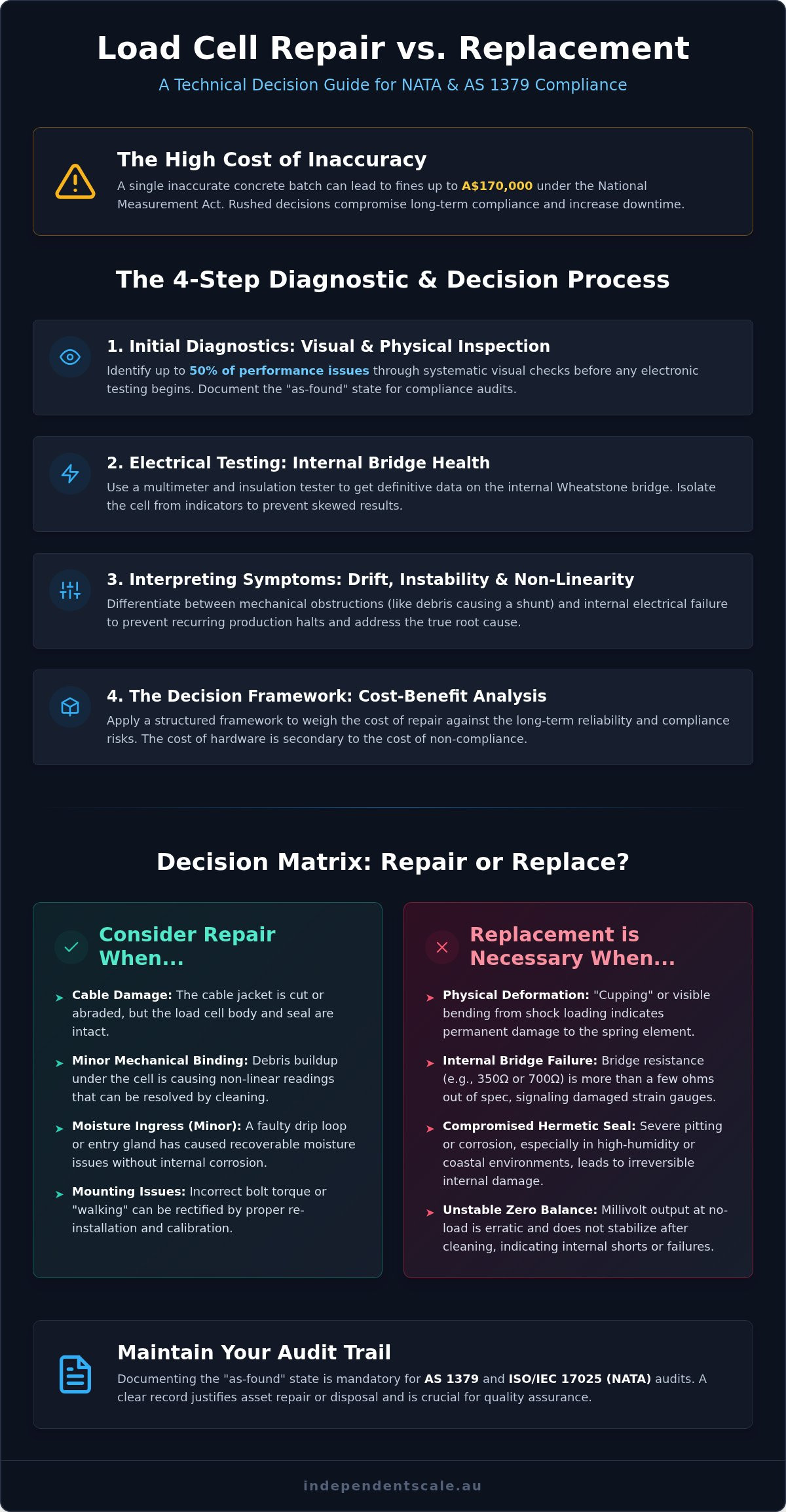
A single inaccurate concrete batch doesn't just stall production; it exposes your operation to fines of up to A$170,000 under the National Measurement Act. When a scale begins to drift, the immediate pressure to restore throughput often leads to rushed decisions that compromise long-term NATA compliance. Deciding on load cell repair vs replacement is a technical risk-management exercise where the cost of the hardware is secondary to the cost of non-compliance and recurring downtime.
You probably recognize that identifying the root cause of measurement failure, whether it's mechanical binding or an electrical bridge imbalance, is the only way to prevent a repeat failure. This 2026 industrial guide provides the technical criteria you need to master the decision between refurbishing existing assets or investing in new load cell supply. We will break down the diagnostic markers for irreparable damage, the necessity of ISO/IEC 17025 standards, and how to maintain AS 1379 compliance without sacrificing operational efficiency.
Key Takeaways
- Identify 50% of performance issues through systematic visual inspection and "as-found" state documentation for compliance audits.
- Execute precise bridge health diagnostics using insulation testers to inform your technical load cell repair vs replacement decision.
- Differentiate between mechanical binding and internal electrical failure to prevent production halts caused by "mechanical shunt" effects.
- Maintain NATA-accredited accuracy and AS 1379 compliance by applying a structured cost-benefit framework for asset disposal.
- Minimise industrial downtime by isolating load cells from indicators to resolve drift and instability before they escalate into regulatory breaches.
Initial Diagnostics: Visual Inspection and Physical Integrity
Approximately 50% of measurement errors in industrial weighing systems are identified through a rigorous visual inspection before any electronic testing begins. When evaluating load cell repair vs replacement, a physical audit serves as the baseline for your technical decision. Before touching the hardware, technicians must isolate all power sources and ensure the structural stability of the hopper or silo. Documenting the "as-found" state is mandatory for maintaining compliance logs under AS 1379 and NATA safety audits. This record provides the evidence needed to justify asset disposal or repair to regulatory bodies and ensures a clear audit trail for quality assurance.
To understand the failure mode, it's helpful to review what a load cell is and how its structural integrity dictates its output. Physical deformation, such as "cupping" on a canister cell or visible bending in a beam, often indicates a severe shock loading event. These signs suggest that the internal strain gauges have been stretched beyond their elastic limit. When the spring element is permanently deformed, the cell loses its ability to return to a true zero. In these scenarios, the decision usually leans toward replacement to ensure future accuracy and site safety.
Cable Integrity and Environmental Wear
Cable damage remains a primary cause of signal instability in harsh industrial environments. Inspect the entire length of the cable jacket for cuts, abrasions, or evidence of rodent damage. In Australian coastal sites, such as facilities in Sydney or Melbourne, salt spray accelerates corrosion at connection points. Check the "drip loop" configuration; without a proper loop, moisture travels directly into the entry gland, causing internal shunting. While stainless steel cells offer superior resistance, tool steel variants in high-humidity environments often show pitting that compromises the hermetic seal. If the cable is compromised but the cell body is intact, specialized load cell calibration and repair may be a viable, cost-effective path.
Physical Deformation and Mounting Checks
Precision measurement requires an unobstructed force path. Use a straightedge to detect even minor bending in beam cells, as internal strain gauge alignment is measured in microns. For single-point load cells, debris buildup in the gap acts as a mechanical shunt, bypassing the sensor and causing non-linear readings. Verify that all mounting bolts are torqued to manufacturer specifications. Over-tightening can distort the cell body, while loose bolts lead to "walking" and inconsistent zero returns. If the physical structure is permanently warped, the load cell repair vs replacement debate ends in favour of new load cell supply to maintain NATA-accredited accuracy and prevent recurring downtime.
Electrical Testing: Determining Internal Bridge Health
If visual inspections are inconclusive, electrical diagnostics provide the definitive data required for the load cell repair vs replacement decision. Precise measurements of the internal Wheatstone bridge reveal whether a cell's performance issues stem from recoverable wiring faults or terminal internal failure. To conduct these tests, you need a high-impedance digital multimeter and a specialized insulation tester, also known as a megohmmeter. These tools allow you to quantify the electrical integrity of the sensor under controlled conditions.
The first step is to isolate the load cell from the indicator or junction box. This prevents external signals or ground loops from skewing your results. Once isolated, you must measure the input and output bridge resistance. These values should be compared directly against the manufacturer's data sheet. If you encounter fluctuating readings during this process, perform a "Tap Test" by gently striking the cell with a rubber mallet while monitoring the resistance. Intermittent jumps in value usually indicate loose internal bonds or moisture-induced short circuits. If your diagnostics reveal unstable electronics, you may need to evaluate new load cell conditioners and transmitters to ensure signal reliability.
Measuring Bridge Resistance and Zero Balance
Most industrial load cells operate with a bridge resistance of 350 or 700 ohms. A deviation of more than a few ohms from the factory specification typically signals a damaged strain gauge or a compromised internal connection. Following the resistance check, you must conduct a zero-balance test to measure the millivolt output at a no-load state. Zero Balance is the millivolt output of a load cell with no weight applied. Industry standards, including those detailed in established load cell calibration procedures, suggest that any shift exceeding 1% of the rated output indicates permanent physical deformation. Such shifts often render the cell non-compliant with AS 1379 standards, making replacement the only viable path to maintaining NATA-accredited accuracy.
Insulation Resistance and Grounding Checks
Insulation testing identifies leakage between the bridge circuit and the load cell body. Using your megohmmeter, apply a low-voltage test (typically 50V) to check the resistance between the bridge wires and the metal housing. Readings below 5000 megohms are a critical indicator of moisture ingress or chemical contamination within the hermetic seal. These leaks create parasitic paths that cause the reading to drift or "hunt" uncontrollably. Finally, verify the integrity of the shield wire. A broken or poorly terminated shield leaves the system vulnerable to RFI and EMI interference, which mimics the symptoms of a failing bridge. When these electrical thresholds are breached, the load cell repair vs replacement analysis shifts toward replacement to prevent recurring production halts.
Interpreting Fault Symptoms: Drift, Instability, and Non-Linearity
Symptom analysis is the bridge between the electrical bridge health tests already conducted and the final decision on load cell repair vs replacement. While a digital indicator might show an error, the cause isn't always a terminal hardware failure. You must differentiate between environmental interference and internal component fatigue to avoid unnecessary replacement costs. "Zero Drift" is a frequent symptom where the scale's starting point shifts without an applied load. While minor drift is expected with temperature fluctuations, chronic drift often points to metal fatigue in a sensor that has reached its service life limit. If accuracy remains high at low weights but fails at high capacity, you're likely facing "Non-Linearity". This indicates that the internal strain gauges are no longer responding proportionally to the force applied, a condition that usually necessitates replacement to maintain NATA-accredited accuracy.
It's also vital to distinguish between "Load Cell Creep" and structural settling. Creep is a change in the output signal while a static load is applied over time. Structural settling, however, involves the physical movement of the mounting, silo, or hopper. Before condemning a sensor, verify that the digital indicator settings, such as motion detection or auto-zero tracking, aren't masking the true performance of the hardware. Misconfigured filter settings can often mimic the symptoms of a failing load cell, leading to incorrect diagnostic conclusions.
Troubleshooting Unstable or Fluctuating Readings
Unstable readings that "hunt" or jump uncontrollably are typically caused by RFI/EMI interference from nearby heavy machinery or variable speed drives (VSDs). High-quality load cell conditioners and transmitters are essential for filtering this electrical noise and providing a stable signal to your PLC or indicator. If the signal remains erratic, inspect the junction box for "intermittent" connections. A loose wire on the summing board or a cracked solder joint can cause signal spikes that appear like a terminal bridge failure. In these cases, a simple wiring repair is often more cost-effective than a full replacement.
Identifying Zero Drift and Hysteresis
Slow, continuous drift is almost always a sign of moisture ingress in the cable or junction box. This moisture creates parasitic resistance paths that skew the millivolt output. You should also test for "Hysteresis", which occurs when the scale doesn't return to zero after a load is removed. This suggests the metal body has lost its elasticity. Utilising robust junction boxes and surge arrestors is the primary defence against these issues, protecting the signal from both environmental contamination and lightning strikes. If Hysteresis is confirmed through repeated testing, the load cell repair vs replacement analysis confirms that the asset is no longer fit for purpose under AS 1379 standards.
Mechanical Obstructions vs. Electrical Failure
Many technicians jump to electrical bridge testing before confirming that the force is actually reaching the sensor. A "Mechanical Shunt" occurs when an alternative load path, such as rigid piping, frozen material, or debris, bypasses the load cell. This effect mimics the symptoms of a failing sensor by causing inconsistent or non-linear readings. Distinguishing between these mechanical factors is a critical phase in the load cell repair vs replacement process. If the sensor is structurally sound but the mounting environment is compromised, hardware replacement will not resolve the underlying accuracy issue.
Verification of "Binding" is essential for large-scale systems. You must ensure the load cell remains the only path for the force by checking that stay rods and check links are not under excessive tension. "Bottoming out" is another common failure mode where debris or concrete buildup under the weigh module prevents the full load from being registered. Thermal expansion presents a unique challenge for tank and silo weighing assemblies during Australian summers, where temperatures in regional sites often exceed 40°C. If your mounting hardware does not account for this expansion, the resulting lateral force will distort your measurement data and potentially damage the internal strain gauges.
Binding, Friction, and Mechanical Shunts
Mechanical interference often originates from poorly maintained flexures or stay rods. In Australian concrete batching plants, the buildup of hardened slurry in the gap of a single-point load cell creates a secondary load path that bypasses the strain gauge entirely. You must clean these areas thoroughly and verify that mounting plates are level and parallel. Any angular misalignment causes side-loading, which introduces measurement errors that calibration cannot fix. If you suspect your system is suffering from mechanical interference, you can schedule an on-site diagnostic audit to verify your plant's AS 1379 compliance.
Environmental Interference and Moisture
Environmental factors frequently dictate the lifespan of industrial sensors. For washdown environments in food or chemical processing, IP68 or IP69K ratings are mandatory to prevent moisture ingress. While some technicians attempt to "dry out" a damp load cell using heat lamps or desiccant, this is rarely a permanent solution for high-precision applications. Once moisture reaches the internal bridge, it leaves behind conductive mineral deposits that cause chronic drift. Chemical corrosion often leads to non-linear output before total failure. When chemical pitting or seal breaches are identified, the load cell repair vs replacement decision almost always favors replacement to ensure long-term reliability and site safety.
The Decision Framework: Load Cell Repair vs Replacement
The final stage in the load cell repair vs replacement analysis requires a structured cost-benefit assessment that balances immediate expenditure against long-term operational risk. For Australian industrial stakeholders, this decision isn't merely an accounting exercise; it's a regulatory necessity. Under the National Measurement Act, the financial penalties for non-compliant weighing equipment are severe. You must evaluate the age of the asset, its historical performance data, and the specific failure mode identified during electrical and mechanical testing. A "Beyond Economical Repair" (BER) status is typically declared when the cost of professional restoration and subsequent recalibration exceeds 60% of the price of a new load cell.
For operations governed by AS 1379, such as concrete production, the margin for error is non-existent. Maintaining concrete batching plant calibration requires sensors that can reliably hold their zero point and linearity throughout a full production cycle. If a sensor shows signs of fatigue or intermittent signal loss, the risk of a batch failure outweighs the savings of a repair. In these high-stakes environments, the decision framework must prioritize NATA-accredited accuracy to ensure legal and structural compliance.
When Repair is the Strategic Choice
Repair is the most efficient path when the technical failure is isolated to external components rather than the internal Wheatstone bridge. If your diagnostics confirmed that the sensor body and strain gauges are pristine, but the signal is unstable due to a compromised cable or a corroded connector, restoration is viable. This is especially true for high-value, specialized load cells where lead times for new units might extend project downtime. Choosing NATA accredited load cell calibration after an external repair provides the necessary certification to return the asset to service with full confidence in its accuracy. If the mechanical integrity is intact, resolving external noise or wiring faults is a sound technical investment.
When Replacement is Mandatory
Securing Industrial Precision and Regulatory Compliance
As AS 1379 compliance specialists, Independent Scale Service provides the technical expertise needed to maintain NATA accredited accuracy to ISO/IEC 17025. We serve Sydney, Melbourne, and regional Australia with a commitment to minimizing client downtime through responsive diagnostic services. You can Request Professional Load Cell Diagnostics and Calibration to ensure your weighing systems meet the highest industrial standards. Accurate measurement is the foundation of your plant's reliability, and we're here to help you maintain it.
Frequently Asked Questions
How do I test a load cell with a multimeter?
Test the sensor by measuring bridge resistance across the excitation and signal pairs while the unit is isolated from the indicator. Compare these measured values to the manufacturer's calibration certificate, which typically specifies 350 or 700 ohms. You should also measure the zero balance in millivolts; any significant shift from the factory-specified zero indicates internal structural damage.
What are the common signs of a failing load cell?
Common indicators include chronic zero drift, non-linear output at high capacities, and a failure to return to zero after load removal. These symptoms are critical markers used to determine the technical necessity of load cell repair vs replacement. Unstable readings that jump uncontrollably regardless of the load are also frequent indicators of a failing internal bridge.
Can a load cell be repaired if it has been overloaded?
A load cell cannot be repaired once it has been physically overloaded. Overloading causes the metal spring element to enter plastic deformation, which permanently alters its elastic properties and measurement accuracy. To maintain NATA accredited accuracy and AS 1379 compliance, you must replace the deformed unit with a new sensor.
Why is my scale reading fluctuating or unstable?
Fluctuations often stem from RFI/EMI interference, moisture ingress in the junction box, or loose cable terminations. Verify that the shield wire is properly grounded and that signal cables are isolated from high-voltage power lines. If the signal remains erratic after checking external connections, the internal bridge has likely reached its service life limit.
What is the difference between zero drift and span drift?
Zero drift is a shift in the scale's starting point when no load is applied, often caused by temperature fluctuations or metal fatigue. Span drift refers to a loss of sensitivity and accuracy at the higher end of the weighing range. Both conditions require a professional diagnostic audit to decide between load cell repair vs replacement.
How often should industrial load cells be calibrated in Australia?
Calibration frequency is dictated by specific industry standards and the National Measurement Act. Concrete batching plants operating under AS 1379 generally require NATA accredited calibration every 6 to 12 months. High-use environments or sites with extreme temperature variations may necessitate more frequent diagnostic intervals to ensure continued compliance.
What does a negative weight reading on the indicator mean?
A negative reading usually indicates a wiring error where signal leads are reversed or a mechanical binding issue. If a hopper or silo is physically resting on a structural point instead of the sensor, the indicator may show a negative value. You should also check for debris buildup or concrete slurry that might be "bottoming out" the weigh module.
How does moisture affect load cell performance?
Moisture creates parasitic electrical paths between the bridge circuit and the sensor body, leading to uncontrollable signal drift. This ingress significantly drops insulation resistance, often below the 5000 megohm threshold. While minor moisture in a junction box can be cleaned, moisture inside a hermetically sealed cell typically necessitates a full replacement to restore system stability.
