


ISO 17025 Calibration: The Gold Standard for Australian Industrial Weighing
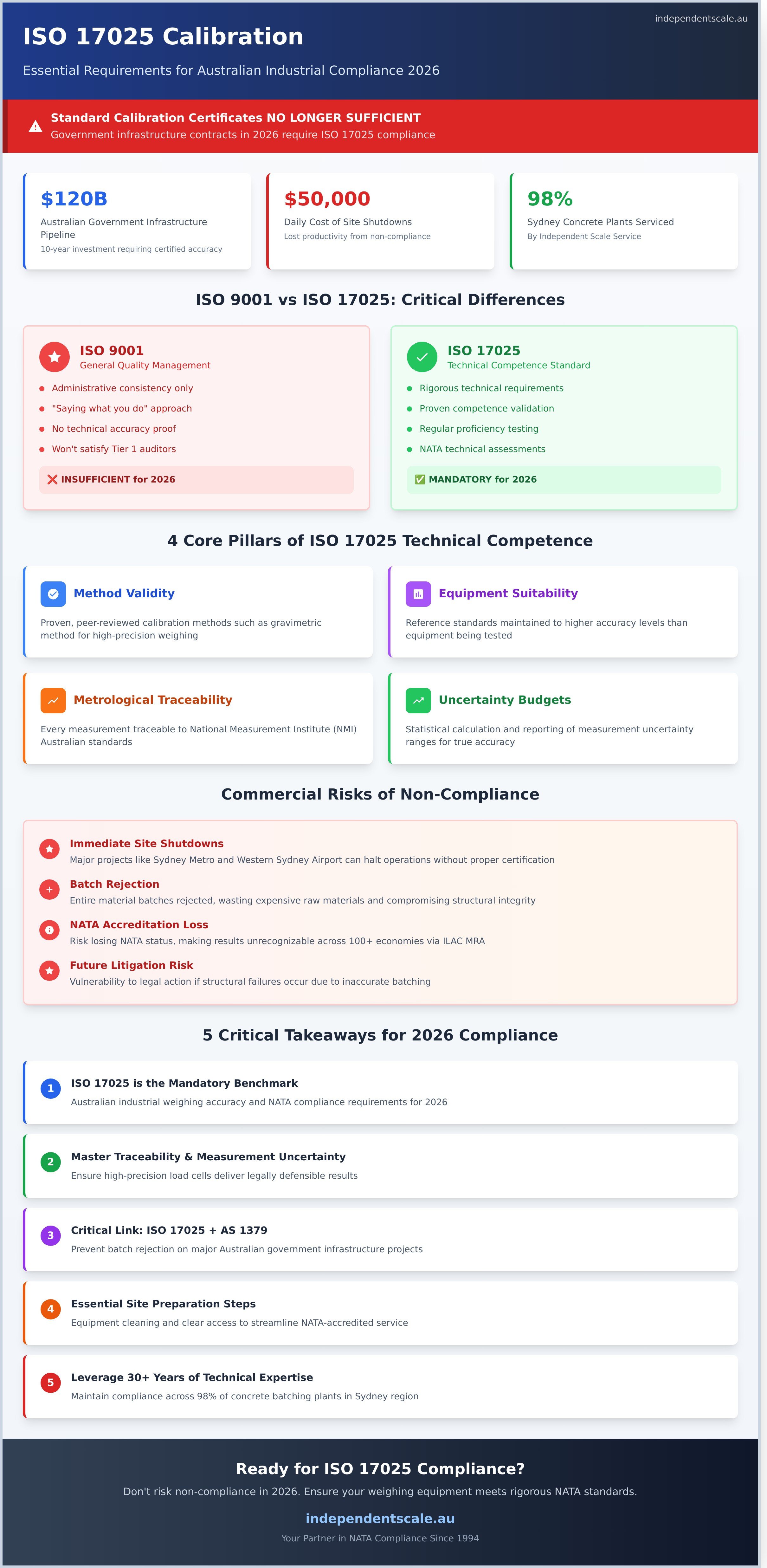
A standard calibration certificate is no longer sufficient for Australian industrial operators seeking to secure major government infrastructure contracts in 2026. You likely recognize that maintaining strict compliance with AS 1379 is essential for operational survival, yet the technical jargon surrounding ISO 17025 calibration and measurement uncertainty often creates more confusion than clarity. Inaccurate batching doesn't just waste expensive raw materials; it compromises the structural integrity of your concrete and risks your NATA accreditation status. Independent Scale Service understands that in high-stakes environments, precision is the only acceptable metric.
This guide will help you master the technical requirements and compliance benefits of ISO/IEC 17025 accreditation to ensure your weighing equipment meets rigorous NATA standards. By implementing these protocols, you'll minimize measurement uncertainty and ensure reliable equipment performance even in harsh industrial conditions. We'll examine the specific steps needed to achieve legal compliance for state and federal tenders while providing a clear roadmap for your 2026 audit requirements.
Key Takeaways
- Understand why ISO 17025 calibration is the mandatory benchmark for Australian industrial weighing accuracy and NATA compliance heading into 2026.
- Learn how to manage traceability and measurement uncertainty to ensure your high-precision load cells deliver legally defensible results.
- Discover the critical link between ISO/IEC 17025 and AS 1379 to prevent batch rejection on major Australian government infrastructure projects.
- Identify the essential site preparation steps, such as equipment cleaning and clear access, to streamline your next NATA-accredited service.
- Leverage over 30 years of technical expertise to maintain compliance across 98% of the concrete batching plants in the Sydney region.
What is ISO 17025 Calibration and Why is it Critical in 2026?
The ISO/IEC 17025 standard represents the global benchmark for the technical competence of testing and calibration laboratories. It's not merely a management guideline; it's a rigorous set of requirements that ensures a laboratory can produce precise, repeatable, and legally defensible data. For Australian industries, the National Association of Testing Authorities (NATA) serves as the sole accreditation body. NATA's endorsement signifies that a facility's ISO 17025 calibration processes meet stringent international criteria, allowing results to be recognized across 100+ economies via the ILAC Mutual Recognition Arrangement (MRA).
Operating without this accreditation in 2026 carries severe commercial risks. The Australian government's $120 billion 10-year infrastructure pipeline has reached a critical phase where regulatory bodies, including the Office of the National Rail Safety Regulator (ONRSR), now demand certified accuracy for every measurement. Contractors working on the Sydney Metro or Western Sydney Airport projects must provide documentation proving their weighing systems are calibrated by a NATA-accredited provider. Failure to provide these certificates can lead to immediate site shutdowns or the rejection of entire batches of material, costing firms upwards of A$50,000 per day in lost productivity.
Global supply chain volatility has also increased the need for certainty. Precise measurements prevent material waste and ensure that high-value components meet exact specifications. In the concrete industry, adherence to AS 1379 requires weighing equipment to maintain strict tolerances. Without a verified ISO 17025 calibration, a plant cannot guarantee its mix designs, leaving it vulnerable to litigation if structural failures occur in the future.
The Core Objectives of the Standard
Technical competence is the primary pillar of this standard. It mandates that personnel performing calibrations possess the specific qualifications and hands-on experience required for the task. It's not enough to follow a manual; technicians must understand the physics of the measurement. The standard also focuses on the following technical requirements:
- Method Validity: Laboratories must use proven, peer-reviewed calibration methods, such as the gravimetric method for high-precision liquid or solid weighing.
- Equipment Suitability: All reference standards used during the process must be maintained to a higher level of accuracy than the equipment being tested.
- Metrological Traceability: Every measurement must be traceable back to the national standards held by the National Measurement Institute (NMI) in Australia.
- Uncertainty Budgets: Laboratories must calculate and report the "Measurement Uncertainty," providing a statistical range of how accurate the result truly is.
ISO 9001 vs. ISO 17025: Understanding the Difference
ISO 9001 is a general quality management system that focuses on administrative consistency and "saying what you do." It confirms that a business has a process for handling orders and complaints, but it doesn't prove that the technical output is accurate. In contrast, ISO 17025 is a specialized technical standard. It requires the laboratory to prove "they are competent to do the work" through regular proficiency testing and external audits by NATA technical assessors.
Industrial weighing demands this higher level of technical rigor. While an ISO 9001 certificate might look good on a wall, it won't satisfy a Tier 1 auditor looking for traceable evidence of scale accuracy. Independent Scale Service (ISS) leverages over 30 years of experience to provide this level of assurance. We currently service 98% of concrete plants across Sydney, ensuring their equipment remains compliant with both AS 1379 and international standards. Choosing 17025 over 9001 isn't just a preference; it's a mandatory requirement for any business serious about precision and regulatory compliance in the current industrial climate.
This principle of specialized, data-driven management extends beyond just calibration. For instance, to meet sustainability goals and ISO 50001 requirements, modern industrial plants also rely on a dedicated 企業能源管理系統 to monitor and optimize power consumption. Just as with calibration, having a robust system for energy management is becoming a key part of maintaining overall operational excellence and compliance.
Technical Requirements: Traceability and Measurement Uncertainty
Calibration isn't a repair process. It's the rigorous comparison of a weighing device against a reference standard of known, higher accuracy to determine the relationship between the indicated value and the true value. While a repair restores a broken component, an NATA-accredited ISO 17025 calibration provides the technical validation required to prove that your equipment is performing within its specified tolerances. Without this distinction, industrial operations risk relying on data that lacks legal or commercial standing in the Australian market.
Metrological traceability is the property of a measurement result whereby it can be related to a reference through an documented unbroken chain of calibrations. This chain ensures your scale's accuracy is linked back to the International System of Units (SI) via the National Measurement Institute (NMI) in Australia. Each link in this chain must be documented with stated uncertainties. If a single link is missing, the traceability is broken, rendering the measurement data invalid for ISO compliance or trade purposes. For businesses operating in high-stakes environments like concrete production or chemical processing, this unbroken chain is the only way to guarantee that a kilogram measured in Sydney is identical to a kilogram measured anywhere else in the world.
Measurement uncertainty quantifies the doubt in a result. It's a statistical range that identifies where the true value lies, which is vital for high-precision load cells. In industrial weighing, an "accurate" reading is insufficient; you must know the margin of uncertainty to manage risk effectively. A result of 500.00 kg with an uncertainty of ±0.05 kg tells a very different story than the same result with an uncertainty of ±2.50 kg. High-precision applications require this level of detail to prevent batching errors and material waste.
Calculating and Reporting Uncertainty
Determining uncertainty involves more than just looking at the scale display. Technicians evaluate three primary variables: environmental conditions, equipment resolution, and repeatability. NATA-accredited reports provide a comprehensive "budget" of uncertainty for your quality records, typically using a coverage factor of k=2 to provide a 95% confidence level. This budget accounts for the performance of the instrument under test and the reference standards used. To ensure your hardware meets these demanding thresholds, see our range of NATA-certified load cells for high-accuracy applications.
Environmental and Equipment Controls
The physical environment significantly impacts weighing precision. Temperature fluctuations of just 10 degrees Celsius can cause a 0.03% shift in sensitivity for uncompensated systems, while vibration and local gravity variations can distort load cell output. Maintaining signal integrity requires high-quality conditioners and transmitters to shield the measurement from electrical noise and interference. Furthermore, the master weights used during the ISO 17025 calibration process must be maintained and certified annually to ensure their own traceability remains intact. Maintaining these standards requires regular oversight, which is why we recommend checking your equipment through a professional calibration schedule tailored to your site's specific throughput and environmental stressors.
ISO 17025 and AS 1379: The Australian Concrete Industry Standard
Adherence to AS 1379, the Specification and Supply of Concrete, is the mandatory benchmark for every batching plant operating in Australia. This standard dictates the precise accuracy limits for weighing systems to ensure structural integrity in the built environment. For major infrastructure projects like the Sydney Metro or Western Sydney Airport, compliance isn't a suggestion; it's a contractual prerequisite. If a plant fails to demonstrate that its scales meet these tolerances, entire batches of concrete can be rejected on-site. This leads to massive financial losses and project delays. ISO 17025 calibration serves as the primary legal proof of accuracy that auditors and Tier 1 contractors demand during site inspections.
A common misconception among plant managers is that a standard service report or a basic technician's verification is sufficient for compliance. It's not. Standard calibrations often lack a documented "uncertainty of measurement." Without this data, an auditor cannot verify the true reliability of the scale under operational conditions. AS 1379 Clause 4.1 requires specific accuracy levels: ±1% for cement and cementitious materials, and ±2% for aggregates and water. Only an ISO 17025 calibration provided by a NATA-accredited laboratory includes the rigorous uncertainty budget required to legally satisfy these Australian Standards. Independent Scale Service has provided this level of technical certainty to 98% of concrete plants across Sydney for over 30 years.
Calibrating Concrete Batching Plants
Precision batching requires the synchronised performance of cement, water, and aggregate weighing hoppers. Each material has a different tolerance level, and the weighing equipment must be calibrated to reflect these variables. High-performance tank and silo weighing assemblies are critical components here. They must withstand harsh vibration and environmental exposure while maintaining accuracy. If a load cell drifts, the entire mix design is compromised. For detailed technical support, plant operators should utilise AS 1379 compliant calibration services to ensure every hopper meets the gravimetric requirements of the project specification.
- Cement Hoppers: Require ±1% accuracy; even minor deviations can weaken the final concrete compressive strength.
- Aggregate Scales: Must maintain ±2% accuracy despite high-impact loading and dust accumulation.
- Admixture Dispensers: Often require specialised volumetric or gravimetric checks to ensure chemical ratios are exact.
Verification Intervals and Compliance Cycles
To remain compliant with Australian Standards, plants must adhere to strict verification intervals. AS 1379 typically requires a full scale check every 6 months, or more frequently if the plant is moved or undergoes significant repairs. There's a vital distinction between a routine 'verification' by a technician and a full 'NATA calibration'. A technician's check confirms the scale is working, but the NATA-accredited ISO 17025 calibration provides the data-backed certification that holds up in a court of law or a government audit.
Managing the documentation trail for multi-site industrial operations is often the most difficult part of compliance. Large-scale operators like Holcim or Boral rely on structured calibration schedules to avoid lapse dates. Digital record-keeping of every calibration certificate is essential for passing surprise audits on government-funded worksites. It's not just about the scale's performance on the day; it's about the historical evidence of precision that a NATA-endorsed report provides. If your documentation doesn't show the uncertainty budget, you're essentially operating without a valid compliance shield.
Preparing Your Site for NATA-Accredited Calibration
Efficiency on a busy industrial site depends on thorough preparation. When our technicians arrive to perform an ISO 17025 calibration, every minute counts toward getting your plant back online. Clear access to the weighing equipment is the primary factor in reducing technician time. If a scale is buried under debris or blocked by machinery, the calibration process slows down, increasing your costs and extending unnecessary downtime. We've found that sites with clear access points reduce their service window by an average of 25%.
You must ensure all equipment is clean before the service begins. Material buildup on hoppers, such as hardened slurry or aggregate crust, can significantly skew 'as-found' results. A mere 10kg of undetected buildup on a 5,000kg cement hopper introduces an immediate error before testing even starts. This isn't just a minor discrepancy; it can lead to non-compliance with AS 1379 standards and affect the structural integrity of your concrete batches. Clean equipment ensures the gravimetric testing reflects the true performance of your load cells.
Identify any known faults or drifting indicators before our team arrives. If your display flickers or the zero point drifts by more than 2kg over an hour, let us know immediately. This technical data helps our experts target specific components like load cells or summing circuits. Addressing these issues during the scheduled ISO 17025 calibration prevents the need for a follow-up emergency call-out. With over 30 years of experience, we know that early communication is the best way to maintain 100% plant uptime.
Coordinate with your site operations team to ensure a total production halt. The gravimetric testing process requires high precision and zero vibration. You can't calibrate a scale while the plant is running. We service 98% of concrete plants across Sydney, and the most successful sites are those that treat calibration day as a planned maintenance window rather than an interruption. This coordination ensures that the technician can work through the testing sequence without being stopped for urgent batches.
Checklist for Hopper and Scale Prep
Follow these steps to ensure your equipment is ready for testing. Small oversights lead to delays that impact your bottom line.
- Isolate all silos and hoppers. You must prevent accidental material discharge during the testing phase to maintain safety and data accuracy.
- Check your indicators and displays for visible error codes, flickering segments, or unstable readings.
- Ensure a stable 240V power supply is available. Electronic weighing components are sensitive to voltage drops which can mimic load cell failure.
- Inspect the physical surrounds of the scale for "binding," where structural elements touch the hopper and interfere with the weight reading.
Logistics of On-Site Calibration
Safety is our priority. We adhere to strict protocols to protect both our technicians and your staff. Logistics must be settled 24 hours before the appointment.
- Provide safe lifting equipment. If your site requires heavy test weights, ensure a forklift and a licensed operator are ready to assist.
- Strictly follow Lock-out Tag-out (LOTO) procedures. All batching plant automation must be locked out to prevent accidental activation during testing.
- Clear a path for service vehicles. Our technicians need to park as close to the weighing equipment as possible to transport tools and standard weights efficiently.
For regional operations, you can request a hopper calibration service to ensure your site meets all NATA requirements without unnecessary delays.
Independent Scale Service: Your Partner in NATA Compliance
Independent Scale Service (ISS) provides the technical framework required for high-precision industrial operations across Australia. We've spent over 30 years refining our calibration processes to meet the most stringent regulatory demands. Our market dominance in the construction sector is clear; we currently service 98% of concrete plants across Sydney. This includes providing critical support for industry leaders like Holcim, Boral, and Hanson. Our reputation as a trusted authority is built on maintaining strict NATA accreditation to ISO/IEC 17025 for both weighing equipment and force gauges.
Reliability in the industrial sector depends on more than just initial accuracy. It requires ongoing, expert maintenance and rapid response. We provide 24/7 emergency repair support to minimize industrial downtime, because we know that a stalled production line costs thousands of dollars per hour. If a load cell fails or a summing circuit malfunctions during a midnight shift, our technicians are available to restore your operations. Beyond our service capabilities, we offer a comprehensive supply of industrial weighing equipment. This inventory includes everything from high-capacity load cells and digital indicators to surge arrestors designed to protect your sensitive electronics.
Achieving precision through ISO 17025 calibration ensures that every measurement your facility records is traceable to national standards. This isn't just about ticking a box for an auditor; it's about the fundamental integrity of your product. Whether you're batching concrete or testing material strength with force gauges, the technical validity of your data is paramount. Our team uses the gravimetric method calibration and other advanced techniques to ensure your equipment performs within specified tolerances under real-world conditions.
Why Choose a NATA-Accredited Provider?
Choosing a NATA-accredited provider is the only way to guarantee the acceptance of your calibration reports by Australian regulators. The National Measurement Institute (NMI) and other governing bodies look for the NATA emblem as proof of technical competence. Our technicians understand AS 1379 and ISO 17025 calibration requirements inside out, ensuring your facility stays ahead of compliance curves. This accreditation provides peace of mind that your measurements are legally defensible and technically valid. You don't have to worry about the validity of your batches during a high-stakes audit or a contract dispute.
Next Steps: Get Your Compliance Quote
The path to total site compliance starts with a professional assessment. You can request a quote for site-wide calibration audits that cover every piece of weighing equipment on your floor. We offer customized maintenance agreements tailored to your specific production volume, ensuring you never miss a mandatory compliance deadline. These agreements are designed to be proactive, catching wear and tear before it leads to a catastrophic equipment failure. Contact our Sydney or Melbourne offices today for immediate assistance. Our team is ready to deploy the expertise needed to keep your plant accurate, compliant, and profitable.
Secure Your Operational Compliance and Measurement Accuracy
Maintaining measurement integrity isn't just a technical requirement; it's a commercial necessity for Australian industrial sites heading into 2026. Adhering to AS 1379 standards ensures your concrete production meets strict quality benchmarks, while rigorous traceability protocols eliminate the risks associated with measurement uncertainty. Independent Scale Service leverages over 30 years of industry experience to provide ISO 17025 calibration that keeps your operations running at peak efficiency.
We currently service 98% of concrete plants across Sydney, providing the technical competence required for high-stakes industrial weighing and gravimetric method applications. Our team ensures your equipment remains compliant with ISO/IEC 17025 standards, reducing downtime and protecting your bottom line. If a critical failure occurs, our emergency 24x7 support line at 0418 243 015 is available to restore your site's functionality immediately. Don't let inaccurate scales compromise your project delivery or regulatory standing.
Book Your NATA-Accredited ISO 17025 Calibration Today
Your path to total measurement certainty starts with a partner who understands the complexities of Australian industrial standards.
Frequently Asked Questions
What is the difference between NATA accreditation and ISO 17025?
ISO 17025 is the international standard that specifies the general requirements for the competence of testing and calibration laboratories. NATA is the Australian authority that audits and grants accreditation to this standard. While ISO 17025 defines the technical benchmarks, NATA provides the formal recognition that a facility like ours consistently meets these global requirements. It’s the difference between a set of rules and the official badge of compliance.
Is ISO 17025 calibration mandatory for all industrial scales?
No, ISO 17025 calibration isn't a legal requirement for every simple industrial scale, but it's essential for compliance with AS 1379:2007 in concrete production. If your facility operates under a strict Quality Management System or requires high precision for batching, this level of calibration is the industry baseline. We find that 98% of our tier-one clients require these accredited reports to satisfy their internal audit protocols and regulatory obligations.
How long does a NATA-accredited calibration report remain valid?
A NATA-accredited calibration report usually remains valid for 12 months, though heavy-use environments often require 6-month intervals. For example, concrete batching plants following AS 1379 standards typically schedule recalibration every 182 days to ensure ongoing accuracy. The specific validity period is often dictated by your industry’s regulatory framework rather than the certificate itself. We track these dates for our clients to prevent compliance gaps.
Can Independent Scale Service calibrate load cells on-site?
Yes, we perform on-site calibration for load cells using the gravimetric method to ensure maximum precision. Our technicians service 98% of concrete plants across the Sydney metro area and regional sites using certified test weights. This process allows us to verify the entire weighing system in its operational environment. It’s a more reliable approach than bench testing because it accounts for structural influences and site-specific vibrations.
What happens if my equipment fails an ISO 17025 calibration test?
If your equipment fails, we issue an "as found" report and immediately perform the necessary technical adjustments or repairs. Our 24x7 emergency response team aims to resolve critical failures in under 4 hours to keep your production line moving. Once the repairs are complete, we conduct a secondary test to issue a final, compliant certificate. This ensures your records show both the initial discrepancy and the corrected state.
How much does a NATA-accredited calibration cost compared to standard service?
A NATA-accredited calibration typically costs between A$150 and A$300 more than a standard service due to the extensive data recording and uncertainty calculations required. This additional investment covers the formal measurement uncertainty budget and guaranteed traceability to national standards. While a standard service confirms a scale is working, only an ISO 17025 calibration provides the legal and technical standing needed for high-stakes industrial applications and audits.
Do you provide calibration for concrete batching plants in regional Australia?
We provide comprehensive calibration services for concrete batching plants throughout regional Australia, extending well beyond our primary Sydney service hub. Our team has over 30 years of experience managing the specific requirements of AS 1379 for major players like Holcim, Boral, and Hanson. We deploy mobile units equipped with certified weights to ensure that regional sites meet the same rigorous accuracy standards as metropolitan facilities.
What information is included in a NATA calibration certificate?
A NATA calibration certificate includes the laboratory’s unique accreditation number, the specific measurement uncertainty, and clear traceability to national standards. It details the "as found" and "as left" data points across the scale’s entire capacity range. You’ll also find records of the environmental conditions during the test and a formal statement of compliance with ISO/IEC 17025:2017. These details provide the technical proof required during a professional audit.
