


ISO 17025 Accredited Labs in Australia: The Industrial Calibration Guide
A single non-compliant calibration certificate can halt production at a concrete batching plant instantly during an AS 1379 audit. For industrial operators, the distinction between a "traceable" report and a certificate from ISO 17025 accredited labs Australia is often the difference between operational continuity and a forced shutdown. You've likely felt the pressure of maintaining absolute accuracy while facing the reality that 98% of concrete plants in Sydney require precise NATA-accredited documentation to remain legally compliant. You understand that equipment accuracy is the backbone of your quality control, yet the technical jargon surrounding NATA standards often makes compliance feel like a moving target.
This guide provides the technical clarity needed to ensure your industrial weighing equipment meets every Australian regulatory requirement without the high cost of excessive downtime. We'll examine how to identify a reliable calibration partner, the specific requirements for concrete batching compliance, and why minimizing measurement uncertainty is critical for your bottom line. By applying these standards, you'll secure your plant's legal standing and maintain the precision that over 30 years of industry experience proves is essential for commercial success.
Key Takeaways
- Understand the critical role of NATA and why ISO/IEC 17025:2017 is the definitive standard for demonstrating technical competence in industrial weighing.
- Learn how metrological traceability and validated calibration methods safeguard your equipment against measurement drift and technical non-compliance.
- Identify the legal and operational risks of non-accredited services to ensure your facility remains compliant with AS 1379 and WorkSafe audit requirements.
- Discover how to use the NATA portal to verify the specific measurement ranges and uncertainties within the scope of ISO 17025 accredited labs Australia.
- Leverage proven industry expertise to maintain high-accuracy weighing systems that meet the rigorous regulatory demands of the Australian construction and industrial sectors.
What is ISO 17025 and Why Does NATA Matter in Australia?
The ISO/IEC 17025:2017 standard serves as the global benchmark for testing and calibration laboratory competence. It doesn't just outline management requirements. It mandates strict technical proficiency. For industrial operators, choosing ISO 17025 accredited labs Australia ensures that every measurement is traceable to national standards. This level of precision is non-negotiable in sectors where a 1% margin of error can lead to structural failure or significant financial loss.
NATA, the National Association of Testing Authorities, is the sole accreditation body in Australia for this standard. Established in 1947, NATA provides the independent oversight necessary to verify that a lab's equipment, staff, and methods meet international criteria. Without NATA's stamp, a laboratory's claims of accuracy lack legal and technical weight in the Australian market. This isn't about simple certification; it's about verified technical capability.
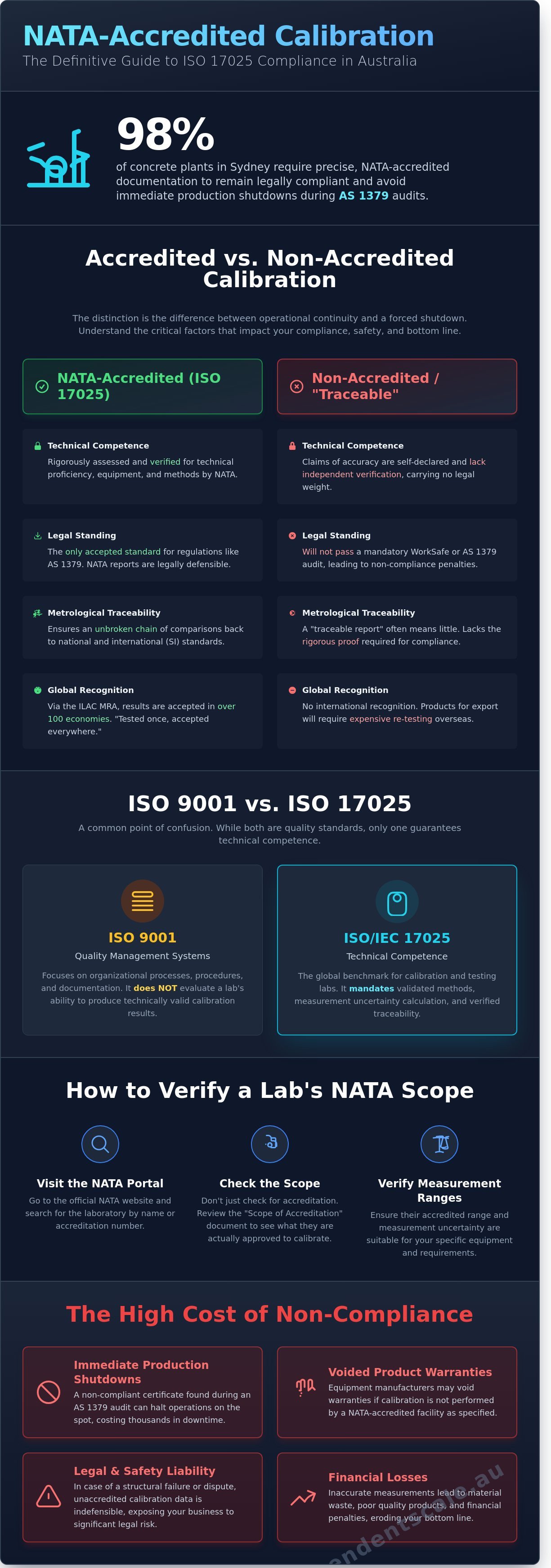
It's vital to distinguish between ISO 9001 and ISO 17025. While ISO 9001 focuses on general quality management systems, it doesn't evaluate technical proficiency. A company can be ISO 9001 certified but still lack the technical skills to perform a precise gravimetric calibration. ISO 17025 specifically assesses the lab's ability to produce valid, repeatable results. This distinction is why 98% of concrete plants in Sydney rely on NATA-accredited providers to maintain their weighing equipment.
Australian industries are governed by strict regulations like AS 1379, the standard for the specification and supply of concrete. This regulation mandates that weighing and dispensing equipment must be calibrated by a NATA-accredited facility. Compliance isn't optional. Using an unaccredited service provider risks voiding product warranties and failing mandatory audits, which can shut down a site immediately. Accuracy is the foundation of industrial safety and profitability.
The Relationship Between ISO 17025 and NATA
NATA is the authority for ISO 17025 in Australia. They conduct rigorous on-site assessments to ensure labs follow the ISO 17025 framework. A key output of this process is the NATA Endorsed Report. This document is a legal powerhouse. It carries the NATA emblem, proving the data is technically sound and meets all Australian standards. In legal disputes or high-stakes audits, this report provides the ultimate evidence of measurement traceability and compliance.
Global Recognition: The ILAC Mutual Recognition Arrangement
NATA's accreditation isn't limited to Australian borders. Through the ILAC Mutual Recognition Arrangement (MRA), NATA-accredited results are recognised in over 100 economies. This global network ensures that industrial components tested in ISO 17025 accredited labs Australia meet international requirements. For manufacturers exporting products to Europe or the US, this "tested once, accepted everywhere" framework eliminates the need for expensive re-testing in the destination country. It saves time and reduces operational costs for Australian exporters.
The Technical Pillars of ISO 17025 Accredited Labs
ISO 17025 accredited labs Australia operate under a rigorous framework that ensures every measurement is technically valid and legally defensible. This standard isn't a simple checklist; it's a comprehensive system that demands metrological traceability to the International System of Units (SI). This means every calibration performed on your site is linked back to a primary standard through an unbroken chain of comparisons. Without this traceability, a measurement result lacks the authority required for high-stakes industrial compliance.
Technical competence within these labs involves more than just owning the right tools. The Technical Pillars of ISO 17025 dictate strict requirements for staff proficiency, environmental controls, and method validation. For instance, in a concrete batching plant or a chemical processing facility, ambient conditions like temperature and vibration can significantly skew results. Accredited labs must either control these variables or quantify their impact on the final measurement. Equipment maintenance is equally disciplined. Reference weights and master load cells aren't merely stored; they're subjected to a scheduled recalibration cycle to detect and correct for "drift" over time.
Understanding Measurement Uncertainty in Industrial Weighing
It's vital to distinguish between error and uncertainty. Error is the difference between a measured value and the true value of a weight. Uncertainty is the quantification of the doubt surrounding that measurement. ISO 17025 accredited labs Australia must calculate a detailed uncertainty budget for every calibration. This budget factors in the resolution of the scale, the repeatability of the readings, and the known uncertainty of the reference weights used during the test.
In industries where 98% of production must meet strict ±1% tolerances, measurement uncertainty is the difference between a pass and a fail. If a lab reports a result of 1,000kg with an uncertainty of ±10kg, the true value could be anywhere between 990kg and 1,010kg. For a high-capacity load cell, failing to account for this margin can lead to significant product giveaway or, worse, structural failures in overloaded systems.
The Importance of Validated Calibration Methods
Accredited labs use two types of methods: standard and lab-developed. Standard methods are industry-recognised protocols, while lab-developed methods are bespoke procedures validated through rigorous testing to ensure they produce accurate results for specific applications. Gravimetric method calibration is the gold standard for many industrial applications. This method involves using known masses to verify the performance of a weighing system across its entire range, rather than relying on electronic simulation which can miss mechanical issues like binding or friction.
Independent Scale Service applies these validated methods when installing and servicing tank and silo weighing assemblies. Whether it's a 20-tonne silo or a 500kg mixing tank, using a validated gravimetric approach ensures the system meets the strict accuracy requirements of AS 1379. This precision is essential for maintaining the structural integrity of concrete and the consistency of chemical batches. If your facility requires 24/7 reliability and technical precision, you can view our calibration service capabilities to see how we apply these technical pillars to your specific equipment.
Accredited vs. Non-Accredited Calibration: The Real-World Risks
Choosing between "traceable" and accredited calibration isn't a mere administrative decision. It's a critical choice in risk management. Many providers claim their results are traceable to national standards, yet without the oversight of ISO 17025 accredited labs Australia, these claims lack independent verification. Non-accredited services often skip rigorous uncertainty calculations, leaving your business vulnerable to measurement errors that remain undetected until a failure occurs. This lack of oversight creates a significant liability during WorkSafe inspections or AS 1379 audits where proof of technical competence is mandatory.
The financial consequences of inaccurate weighing are immediate and measurable. For a high-volume facility, a scale that's out of tolerance by just 0.5% can result in product giveaway or raw material waste costing between A$20,000 and A$60,000 annually. ISO 17025 serves as a technical insurance policy. It guarantees that the equipment used to calibrate your scales is itself verified and that the technicians possess the specific expertise required for high-precision industrial environments.
The principle of using accredited specialists to manage unseen risks extends beyond industrial machinery. Property owners, for example, face different but equally critical compliance challenges, such as ensuring a site is free from chemical contaminants. In New Zealand, a similar emphasis on certified testing is seen where services from Methamphetamine Testing Services NZ Limited are essential for identifying methamphetamine contamination, thereby protecting property value and occupant health.
- Legal Liability: Non-accredited certificates may be deemed inadmissible during legal disputes or safety investigations.
- Operational Downtime: Incorrectly calibrated machinery leads to batch failures and forced production halts.
- Audit Failure: Major tier-one contractors and government bodies often reject suppliers who cannot provide NATA-endorsed documentation.
Compliance Risks in the Concrete and Construction Sector
The Australian construction industry operates under strict regulatory frameworks, specifically AS 1379 for concrete batching plant accuracy. This standard leaves no room for error. Independent Scale Service ensures concrete batching plant calibration meets NATA standards, providing the precise documentation required for plant certification. In one 2022 case, a Sydney-based plant faced a rejected pour of 120 cubic metres because their scales were calibrated by a non-accredited provider. The cost of demolition, disposal, and the subsequent replacement pour exceeded A$280,000. Using ISO 17025 accredited labs Australia prevents these catastrophic financial hits by ensuring mix designs are followed exactly as engineered.
Data Integrity and Audit Trails
ISO 17025 enforces a level of transparency that non-accredited providers cannot match. Every report issued by an accredited lab must include a statement of measurement uncertainty and a clear chain of custody for all data. This standard ensures that calibration data cannot be falsified or "rounded off" to pass a failing machine.
The integrity of these digital records also depends on the reliability of the computer systems that store them. A system crash or data breach can compromise an entire audit trail, creating significant compliance risks. This is why many industrial operators partner with IT support specialists; for example, services from Aspire Computing help ensure that the office infrastructure needed to manage calibration data is secure and operational.
Third-party auditors prioritise NATA-endorsed certificates because they represent a globally recognised benchmark of quality. While internal checks are useful for daily monitoring, they don't carry the weight of a formal endorsement. In the event of a product recall or structural failure, having a NATA-endorsed certificate provides a legally defensible record that your equipment was performing to its stated specifications. It's the difference between guessing your accuracy and proving it through a verified, unalterable audit trail.
How to Verify an ISO 17025 Lab's Scope in Australia
Verification is the only way to guarantee your equipment meets AS 1379 or specific regulatory benchmarks. Do not assume a lab's accreditation covers every piece of equipment in your facility. You must confirm their specific technical capabilities before booking a service. The National Association of Testing Authorities (NATA) maintains the central registry for ISO 17025 accredited labs Australia. Use the 'Find an Accredited Facility' tool on the NATA website to start your search. Enter the lab's name or accreditation number to access their current status and full PDF scope.
Check the accreditation status immediately. It must be listed as 'Active'. If a lab is 'Suspended', their reports carry no weight in a NATA audit. Look at the 'Last Assessment Date' on the registry. NATA typically conducts on-site technical audits every 18 to 24 months. A recent assessment date indicates the lab's processes and equipment are currently aligned with international standards. Request a sample NATA certificate from the provider. Ensure it displays the NATA emblem and a unique accreditation number. This number is your primary reference for traceability during external audits.
Reading the Scope of Accreditation Document
The Scope of Accreditation is a technical document, not a marketing brochure. Focus on the 'Least Uncertainty of Measurement'. This value represents the smallest uncertainty the lab can achieve under ideal conditions. If your internal quality standards require a higher precision than the lab's stated uncertainty, they cannot legally certify your device. This is critical for load cell calibration where precision determines the accuracy of entire batching systems. Note that accreditation for 'mass' (weighing scales) does not automatically cover 'force' (tension and compression). Force measurements require specific hydraulic presses and reference load cells calibrated in Newtons, which many standard scale companies do not possess.
Questions to Ask a Potential Calibration Partner
Direct communication resolves technical ambiguities that a scope document might miss. Ask these specific questions to vet your provider:
- Do you provide on-site NATA-accredited calibration for heavy-duty equipment? Many labs are only accredited for in-house work. For 100-tonne weighbridges or large silos, you need a partner with mobile NATA accreditation.
- What is your turnaround time for force gauge calibration? Industrial operations cannot afford weeks of downtime. Demand a clear window for testing and return.
- Can you provide digital copies of NATA-endorsed reports for our audit portal? Paper-only systems are a liability. Ensure they provide high-resolution, searchable PDF reports that meet the requirements of ISO 9001 or AS 1379 audits.
Confirm the lab's measurement range matches your hardware. If you operate a 60,000 kg weighbridge but the lab's scope only goes up to 20,000 kg, the calibration is technically incomplete. You need a partner with the specific mass standards and test trucks to test the full capacity of your infrastructure. This prevents compliance gaps that lead to costly fines or project shutdowns. Precision is the priority.
Ensure your equipment remains compliant and accurate under Australian standards. Contact Independent Scale Service for NATA-accredited expertise
Independent Scale Service: Your Partner for NATA Accredited Calibration
Independent Scale Service (ISS) brings over 30 years of technical expertise to the Australian industrial sector. We currently service 98% of concrete plants across the Sydney metropolitan area. This market dominance is built on our status among ISO 17025 accredited labs Australia. Our NATA accreditation ensures every calibration we perform meets international metrological standards. It's about operational certainty for high-stakes industrial environments where a 1% error can lead to significant financial loss. We provide full-service capabilities, managing everything from the initial industrial load cell supply to the most complex system repairs. Technical competence is our baseline, but our 24/7 emergency support is what keeps our clients operational during critical production windows.
Comprehensive Industrial Weighing Solutions
Industrial weighing requires a synchronized system rather than just a standalone scale. ISS specializes in the design, installation, and maintenance of load cells, hoppers, and silo weighing systems. We supply high-quality indicators and displays that provide precise monitoring for batching plants and manufacturing facilities. These units are essential for maintaining the tight tolerances required by AS 1379. System longevity is a core focus for our engineering team. We integrate robust junction boxes and surge arrestors into every installation. These components protect sensitive electronics from lightning strikes and power surges, which are common causes of equipment failure in outdoor industrial sites. Our methodical approach ensures that your weighing infrastructure remains stable and accurate under harsh Australian conditions.
- Expertise in load cells: Precision mounting and calibration for hoppers and silos.
- High-quality displays: Real-time data visualization for batching accuracy.
- System protection: Integration of surge arrestors to prevent electrical damage.
- Total compliance: All equipment meets or exceeds Australian metrological standards.
Why Major Australian Contractors Trust ISS
Industry leaders like Holcim, Boral, and Hanson trust ISS because we prioritize technical accuracy over convenience. We've established a proven track record by consistently delivering metrological precision that exceeds basic regulatory requirements. Our maintenance programs are tailored to the specific usage patterns of each site, ensuring that wear and tear don't compromise results. We use the gravimetric method for calibration, which is the gold standard for ensuring batching accuracy in the construction industry. Downtime is the enemy of any industrial operation. That's why we provide 24/7 emergency support. If a silo scale fails at 2:00 AM, our technicians are available to restore functionality and minimize production losses. This level of responsiveness is why we are a preferred partner among ISO 17025 accredited labs Australia. We focus on solving critical business problems through methodical, precise, and reliable service. We don't just provide a certificate; we provide the confidence that your plant is operating at peak performance every single day.
Choosing ISS means you're partnering with a seasoned, no-nonsense expert. Our commitment to the highest standards of metrological accuracy is backed by:
- Over three decades of specialized industry experience.
- NATA accreditation to ISO/IEC 17025 for global compliance.
- Proven reliability with Australia’s largest construction material suppliers.
- Rapid response 24/7 emergency repair services.
Secure Your Compliance and Operational Accuracy
Industrial precision isn't optional; it's a mandatory requirement for regulatory compliance and operational safety. Selecting from the available ISO 17025 accredited labs Australia provides ensures your weighing equipment meets the rigorous NATA standards required for AS 1379 compliance. This specific accreditation guarantees that your calibration data is traceable, repeatable, and legally defensible in any audit. Independent Scale Service brings decades of technical expertise directly to your facility. We currently service 98% of Sydney's concrete plants, providing the specialized reliability needed to keep high-volume production lines moving without interruption. Our technicians are NATA Accredited to ISO/IEC 17025, ensuring your systems remain accurate under the most demanding industrial conditions. If a critical failure occurs, our 24/7 emergency support team responds immediately to minimize your downtime and protect your bottom line. Don't risk the significant legal or financial consequences of using unverified calibration services. You can maintain your competitive edge and ensure total site compliance with precise, expert measurements.
Request a NATA-Accredited Calibration Quote from Independent Scale Service
Your facility's accuracy is our priority, and we're ready to help you achieve full compliance today.
Frequently Asked Questions
Is ISO 17025 mandatory for all Australian laboratories?
No, ISO 17025 isn't legally required for every laboratory, but it's essential for facilities providing results for regulatory compliance or trade. The National Measurement Act 1960 and industry standards like AS 1379 for concrete production demand NATA-accredited results to ensure legal traceability. Without this accreditation, your data lacks standing in technical disputes or safety audits. Most Tier 1 contractors require ISO 17025 accredited labs Australia for all critical site equipment.
What is the difference between NATA accreditation and ISO 9001 certification?
ISO 9001 focuses on general quality management systems, while NATA accreditation to ISO 17025 specifically verifies technical competence and the validity of test results. A lab can be ISO 9001 certified and still lack the technical proficiency to perform accurate calibrations. NATA's 2023 guidelines confirm that accreditation involves rigorous peer review of staff skills and equipment precision. It's the difference between managing a business and proving technical accuracy.
How often should industrial weighing equipment be calibrated by an ISO 17025 lab?
Industrial equipment requires calibration every 6 to 12 months, depending on usage frequency and environmental conditions. AS 1379 specifies that scales in concrete batch plants must undergo calibration at least every 6 months to maintain compliance. High-volume facilities often opt for quarterly checks to prevent measurement drift. Regular intervals reduce the risk of batch errors that lead to costly product rejections or structural failures in construction projects.
Can a lab be ISO 17025 accredited but not NATA accredited in Australia?
Yes, a lab can hold ISO 17025 accreditation through other bodies like IAS or A2LA, but NATA is the primary authority in Australia. Under the ILAC Mutual Recognition Arrangement, NATA recognises specific international accreditations. However, Australian government tenders and major infrastructure projects usually mandate NATA-endorsed reports specifically. Relying on ISO 17025 accredited labs Australia with NATA endorsement ensures your certificates meet local regulatory expectations without friction.
What should I look for on a NATA-endorsed calibration certificate?
You must verify the presence of the NATA logo and the lab's unique accreditation number. The certificate should list the specific Scope of Accreditation to ensure the lab is authorised for your equipment's range. It must include the measurement uncertainty, the date of calibration, and the traceability to national standards. Check that the results are signed by an approved signatory as required by the ISO 17025 standard to ensure document validity.
How much does ISO 17025 calibration cost compared to standard service?
ISO 17025 calibration typically costs 25% to 40% more than a standard non-accredited service. For a standard platform scale, you might pay A$250 for a basic check versus A$350 for a NATA-endorsed certificate. This premium covers the rigorous documentation, equipment traceability, and technical audits required to maintain accreditation. Investing in this service prevents the potential A$10,000 plus costs associated with regulatory fines or re-testing faulty batches.
Does ISO 17025 accreditation cover on-site calibration at my facility?
Accreditation covers on-site services only if the lab's specific NATA Scope of Accreditation includes field calibrations. Many industrial labs are accredited for both laboratory and site-based work to service heavy machinery like weighbridges or silos. You should confirm the lab's status on the NATA website before booking. ISS performs on-site calibrations across NSW to ensure equipment remains compliant without the downtime of transporting it to a lab.
What happens if my equipment fails a NATA-accredited calibration?
The technician will issue an As Found report documenting the inaccuracies before attempting any adjustments. If the equipment can't be brought back into tolerance, it's tagged as Out of Service to prevent use. You'll receive a formal report detailing the deviation from the required standard. Following repair, a second As Left calibration is performed to confirm the equipment meets the necessary accuracy levels for operation.
