


Industrial Weighing System Maintenance: The Complete Guide to Accuracy and Compliance
In the Australian concrete and aggregate sectors, a single batching error resulting from neglected weighing system maintenance can cost an operation upwards of A$5,000 in wasted materials and transport before the fault is even detected. You've likely seen how equipment drift leads to batching inaccuracies that compromise product quality. The risk of failing an AS 1379 audit or facing a total plant shutdown during a high-volume pour is a scenario no facility manager can afford. Precision isn't just a preference; it's a technical requirement for operational survival.
This guide provides the technical framework you need to master industrial calibration and achieve zero unplanned downtime. You'll learn how to implement a rigorous maintenance schedule that ensures full compliance with NATA and ISO/IEC 17025 standards. We'll break down the essential steps for load cell inspection, gravimetric method calibration, and the proactive measures required to reduce equipment failure rates and keep your production running at peak efficiency.
Key Takeaways
- Distinguish between technical verification and preventative failure measures to ensure the continuous reliability of your industrial hardware.
- Identify critical vulnerabilities in load cells and cabling, including moisture ingress and shock loading, to mitigate the risk of sudden system failure.
- Navigate the mandatory requirements of AS 1379 and ISO/IEC 17025 to maintain NATA-accredited compliance for major Australian infrastructure projects.
- Establish a rigorous weighing system maintenance schedule that incorporates daily inspection protocols and monthly structural integrity checks for silo assemblies.
- Utilise 24/7 emergency technical support and 30+ years of industry expertise to eliminate unplanned downtime in high-capacity production environments.
Understanding Weighing System Maintenance in Industrial Environments
Weighing system maintenance is a structured protocol that ensures industrial measurement equipment remains accurate and reliable over its entire operational life. It's not a single task but a multi-layered strategy. This approach combines thorough cleaning, mechanical inspection, and technical verification of electronic components. For Australian industrial operators, this process is essential to mitigate the effects of environmental wear and tear on sensitive equipment. Understanding basic weighing scale principles helps technicians identify whether a fault is mechanical, such as a bound lever or debris build-up, or electronic, such as a failing load cell or a compromised summing circuit. Effective weighing system maintenance keeps these complex systems within their required tolerances.
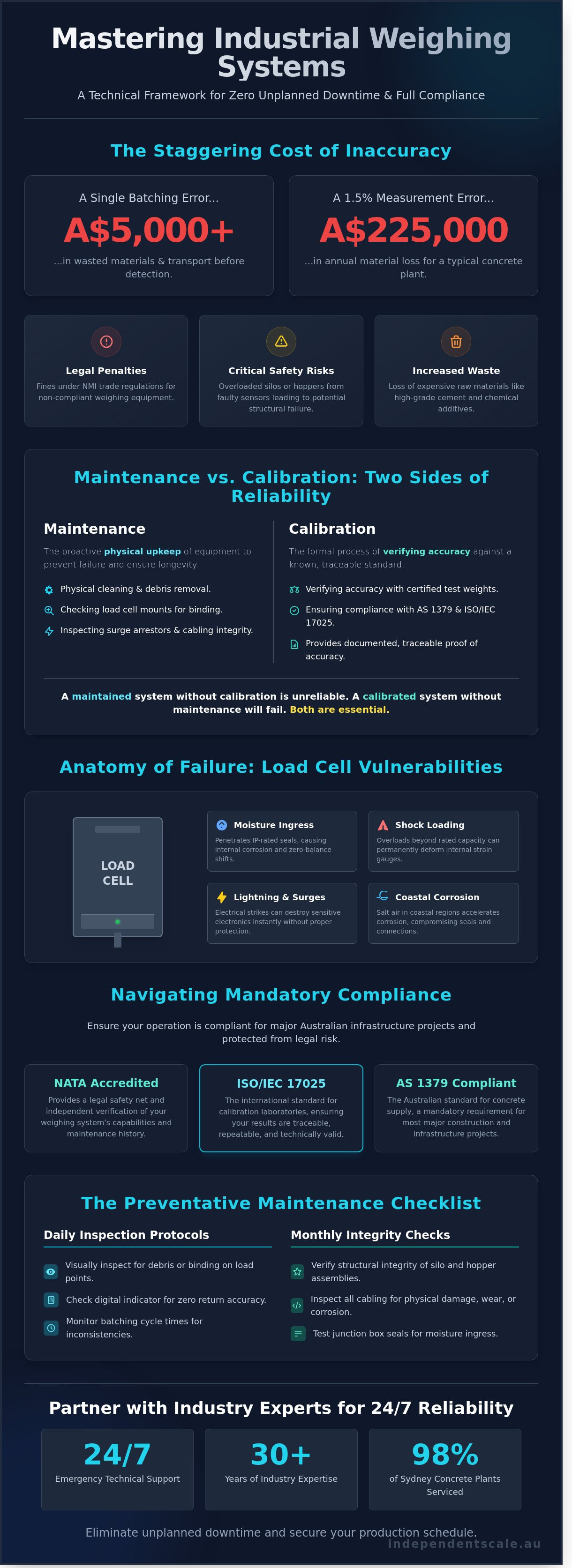
High-volume operations like concrete batching face significant financial risks from "drift." This occurs when a scale slowly loses its accuracy due to vibration, temperature fluctuations, or component fatigue. If a Sydney-based plant produces 150,000 cubic metres of concrete annually at an average cost of A$250 per cubic metre, a 1.5% error in cement measurement can lead to A$225,000 in wasted material costs. Establishing a credible maintenance history through NATA-accredited providers ensures your facility meets the requirements of AS 1379. It provides a legal safety net and proves that your equipment delivers traceable results. With over 30 years of experience servicing 98% of concrete plants across Sydney, ISS understands that precision is the difference between profit and loss.
The Cost of Neglect: Why Accuracy Matters in 2026
By 2026, increased automation in Australian supply chains will make precision even more critical. A 1% error margin results in tens of thousands of dollars in lost revenue and leads to non-compliant product batches. This neglect carries heavy consequences:
- Legal penalties under National Measurement Institute (NMI) trade regulations for non-compliant weighing.
- Safety risks where faulty sensors lead to overloaded silos or hoppers, potentially causing structural failure.
- Increased waste of expensive raw materials like chemical additives or high-grade cement.
Maintenance vs. Calibration: What’s the Difference?
Calibration is the formal process of comparing a scale's output against a known standard, typically traceable through ISO/IEC 17025. Maintenance is the physical upkeep. You can't have one without the other for long-term reliability. Weighing system maintenance involves:
- Calibration: Verifying accuracy using gravimetric methods and certified test weights to ensure compliance with AS 1379.
- Maintenance: Physical cleaning, checking load cell mounts for binding, and inspecting surge arrestors and cabling.
- Interdependence: A system that is calibrated but not maintained will fail prematurely. A maintained system that isn't calibrated provides no proof of accuracy.
Relying on a reactive "fix it when it breaks" mentality is a recipe for downtime. Proactive maintenance identifies issues like moisture ingress in junction boxes or worn pivot points before they cause a total system shutdown. For major industry players like Holcim, Boral, and Hanson, these protocols aren't optional; they're a core part of operational excellence. Ensuring your equipment is NATA-accredited to ISO/IEC 17025 provides the technical assurance required for high-stakes industrial weighing. Our emergency 24x7 support ensures that if a component does fail, your downtime is kept to an absolute minimum.
Technical Components: What Fails and Why
Industrial weighing systems are complex assemblies comprising sensors, high-speed cabling, and digital processors. Accuracy depends on every link in this chain. Regular weighing system maintenance is the only way to identify component degradation before it leads to total system failure or costly non-compliance with Australian standards like AS 1379. When one part of the anatomy fails, the integrity of the entire data stream is compromised.
Load Cell Health and Signal Integrity
Load cells are the frontline components of any scale. They operate in harsh environments where moisture ingress, shock loading, and lightning strikes are constant threats. In coastal Australian regions, salt air can penetrate IP-rated seals, causing internal corrosion that shifts the zero balance. A 20% overload beyond the rated capacity can permanently deform the internal strain gauge, leading to permanent inaccuracies. When performing inspections, technicians look for 'creep' and 'hysteresis.' Creep occurs when the output signal changes while a constant load remains applied. This often indicates a failing bond between the strain gauge and the element. Hysteresis is the difference in readings when a weight is added versus when it's removed. These errors are frequently exacerbated by cable damage. In heavy industrial settings, crushed or frayed cables introduce electrical noise that obscures the millivolt signals. Adhering to ISA maintenance practices ensures these signal integrity issues are caught during routine testing rather than during a critical production run.
Junction Boxes and Mechanical Binds
Signal stability relies heavily on junction boxes and surge arrestors. These components sum the individual millivolt signals from multiple load cells into a single output. Corrosion on terminal blocks or failing summing circuits will cause 'drifting' weights. Data shows that 40% of signal instability issues in outdoor silos stem from moisture in the junction box. Beyond electrical faults, mechanical 'binds' are a leading cause of phantom readings. In hoppers and silos, a bind occurs when a physical obstruction, such as hardened concrete buildup or a misaligned stay rod, creates an alternative load path. This prevents the full weight from reaching the sensors, resulting in errors that can exceed 5% of total capacity. Mechanical binds in silos account for approximately 35% of calibration failures we encounter in the field. Identifying these requires a methodical physical inspection of all clearances and mounting hardware.
Indicators and Digital Controllers
Modern indicators and displays are the processors of the operation. They manage everything from simple readouts to complex data logging for NATA-accredited reporting. Software faults or outdated firmware can lead to processing lags or communication errors with plant-wide systems. Regular firmware updates are necessary to maintain compliance and operational security. For systems requiring integration with a PLC, conditioners and transmitters are critical. They convert raw signals into 4-20mA or digital protocols like Profibus. If these transmitters aren't calibrated to the indicator, the data reaching your control room won't match the reality on the scale. For expert assistance with your technical components, you can book a comprehensive system audit with our service team.
Compliance Standards: AS 1379 and ISO/IEC 17025
AS 1379 (Specification and Supply of Concrete) is the primary regulatory benchmark for the Australian concrete industry. It dictates the tolerances and methods required to ensure structural integrity in construction. For any plant supplying to major infrastructure projects, such as the A$21.6 billion Sydney Metro City & Southwest, compliance isn't optional. It's a contractual mandate. AS 1379 requires strict accuracy for all measuring dispensers; typically +/- 2% for aggregates and +/- 1% for cement and water. A critical component of weighing system maintenance is ensuring these tolerances are met under operational conditions. Many operators mistakenly believe a "factory calibration" certificate for a new load cell provides sufficient cover. This is a dangerous misconception. A factory certificate only confirms the component worked in a controlled laboratory. It doesn't account for structural shifts, vibration, or the complex summing of multiple load cells once installed on-site.
Concrete Batching Plant Calibration Requirements
Australian law dictates that concrete batching plant calibration must occur at intervals no greater than 6 months. We use the gravimetric method for all liquid flowmeters and hoppers to ensure absolute precision. This process involves comparing the system's output against known, traceable test masses. Technicians don't just check the digital indicator; they test the entire weighing chain. This includes inspecting load cell mounts, checking for binding in the hopper, and verifying the integrity of summing circuits. If a single load cell in a four-point system is drifting, the indicator might still show a zero balance, but the batch weight will be dangerously inaccurate. Accurate weighing system maintenance identifies these hidden failures before they lead to rejected batches or structural liability.
NATA Accreditation: The Gold Standard
ISO/IEC 17025:2017 is the international standard for the competence of testing and calibration laboratories. In Australia, NATA (National Association of Testing Authorities) is the body that grants this accreditation. Choosing a NATA-accredited service provider like ISS ensures your calibration reports are legally defensible during third-party audits. There's a significant difference between a standard technician and a NATA-accredited signatory. A standard technician might perform a "check," but only a signatory has the verified authority to issue a NATA-endorsed report that satisfies Tier 1 contractors and government bodies.
By 2026, the documentation requirements for a compliant maintenance logbook will become even more stringent. To remain compliant, your records must include:
- Traceability data for every test mass used, including NATA certificate numbers.
- Detailed "as found" and "as left" data points across the full scale capacity.
- Digital timestamps and GPS-verified service locations to prevent fraudulent logging.
- Documented evidence of the environment's impact on calibration, such as wind or temperature fluctuations.
NATA-endorsed reports protect your business from the financial fallout of non-compliance. When an auditor from a major client like Holcim or Boral requests your records, a standard service sheet won't suffice. You need a document that proves your equipment meets the rigorous standards of ISO/IEC 17025. This level of certification is the only way to guarantee that your measurements are traceable to national standards. It’s about more than just a sticker on a scale; it’s about maintaining the legal right to operate in the Australian construction market.
The Ultimate Preventative Maintenance Checklist
Effective weighing system maintenance follows a strict chronological hierarchy. Neglecting these steps leads to cumulative drift and eventual component failure. Reliability in industrial weighing isn't accidental; it's the result of disciplined, scheduled interventions that address both electronic and mechanical wear. Operators who implement a structured checklist reduce unplanned downtime by approximately 40% over a 12-month period.
Daily checks form the foundation of accuracy. Operators must zero the scale at the start of every shift to clear any residual weight or environmental drift. A visual inspection is mandatory to identify debris buildup in the gaps between the platform and the frame. Even a single stone or a buildup of dried concrete can cause a 50kg discrepancy in a high-capacity system. Ensure all clearance gaps are free from obstruction and that the scale moves freely without friction.
Weekly and monthly routines focus on structural stability and repeatability. This is the time to inspect the structural integrity of tank/silo assemblies. Look for corrosion on mounting bolts or signs of metal fatigue in high-vibration environments. Check for repeatability by placing a known weight on different corners of the scale. If the readings vary by more than the established tolerance, it indicates a potential load cell issue or a mechanical bind that requires immediate attention.
Quarterly and annual requirements move into the professional realm. Quarterly inspections include internal diagnostics, checking summing circuits, and performing load cell balance testing. Annual NATA calibration is a non-negotiable requirement for many industries. This involves full system verification against traceable standards to ensure compliance with ISO/IEC 17025 and AS 1379. These high-level checks identify "hidden" errors that basic field tests cannot detect.
Environmental Protection and Cleaning
Cleaning industrial scales requires a technical approach to protect sensitive electronics. Never use high-pressure water directly on load cells or junction boxes. High pressure often breaches IP68 or IP69K ratings, leading to moisture ingress and signal instability. In regional Australian sites, the 'Australian Factor' is a major variable. Extreme 45°C heat causes thermal expansion in steel structures, while dust ingress can seize moving parts. Always use low-pressure air or soft brushes for cleaning. In rural areas, rodent damage to cabling is a frequent cause of system failure. Installing stainless steel overbraid or conduit is essential to prevent vermin from chewing through signal wires.
This focus on cleanliness is critical not just for specific components but for the entire facility's health and safety. While based in the US, the standards set by professional providers such as Commercial Cleaning Services Long Island Advance Industrial Maintenance offer a valuable benchmark for industrial upkeep that can be adapted anywhere.
This focus on cleanliness is critical not just for specific components but for the entire facility's health and safety. While based in the US, the standards set by professional providers such as Commercial Cleaning Services Long Island Advance Industrial Maintenance offer a valuable benchmark for industrial upkeep that can be adapted anywhere.
Mechanical Troubleshooting for Plant Operators
Mechanical interference is a primary driver of measurement error. Operators should regularly check for 'binding' in hopper calibration setups. Binding occurs when stiff hoses, rubbing covers, or misaligned stay rods restrict the free movement of the weighing vessel. Inspect shackle pins and pivot points for grooves, flat spots, or rust. These worn components increase friction and destroy accuracy. Use the 'Penny Test' or a standard field weight to confirm repeatability. If the scale doesn't return to exactly zero after the weight is removed, a mechanical obstruction or a failing load cell is likely the culprit. Addressing these mechanical issues early prevents the need for expensive component replacements later.
Protect your operational accuracy and maintain compliance by booking a comprehensive weighing system maintenance audit with our NATA-accredited team.
Partnering with Independent Scale Service for 24/7 Reliability
Industrial weighing systems are the heartbeat of Australian infrastructure. A single hour of downtime in a high-volume concrete plant or mining site can cost thousands in lost revenue and logistical delays. Independent Scale Service (ISS) mitigates these risks through an Emergency 24x7 breakdown service. With over 30 years of operational experience in the Australian concrete and mining sectors, ISS provides the technical support required to keep heavy plants running. We serve as the primary technical authority across Sydney, Melbourne, and regional Australia, ensuring your equipment meets strict Australian Standards like AS 1379.
Our service model focuses on total system reliability rather than simple part replacement. Precision in the mining and construction sectors isn't optional; it's a regulatory requirement. By combining deep industry knowledge with a rapid response fleet, we ensure that technical failures don't halt your production. Our team manages everything from load cell repairs to complex summing circuit troubleshooting, providing a level of dependability that serious industrial clients require. We understand the pressure of high-throughput environments where equipment is pushed to its physical limits daily.
This holistic view of maintenance often extends beyond weighing systems. For total plant reliability, maintaining the health of hydraulic and lubrication systems is equally critical. In this specialized field, many Australian industrial operators rely on the expertise of firms like BioKem Oil Services for services such as oil filtration and purification to prevent costly machinery breakdowns.
We provide a comprehensive service contract that includes both routine maintenance and NATA calibration. This dual approach ensures your equipment stays accurate while simultaneously extending its operational lifespan. We don't just fix problems; we prevent them. Our technicians are experts in the gravimetric method and other high-precision calibration techniques necessary for large-scale industrial applications. By centralising your service needs, you reduce administrative overhead and ensure a consistent standard of quality across all weighing assets.
- Emergency 24x7 breakdown support to eliminate extended downtime.
- Over 30 years of specialised experience in AU heavy industry and mining.
- Full compliance with AS 1379 and NATA accreditation standards.
- Technical coverage across major hubs including Sydney, Melbourne, and regional sites.
Custom Maintenance Programs
ISS develops custom weighing system maintenance schedules based on your specific plant throughput and local environmental conditions. Clients benefit from a single provider for force gauge calibration and heavy plant weighing equipment. This integrated approach is why ISS currently services 98% of concrete plants across the Sydney metropolitan area. We provide comprehensive service contracts that combine routine maintenance with NATA-accredited calibration, ensuring your plant remains compliant with ISO/IEC 17025 requirements at all times.
Requesting a Site Audit
Transitioning from reactive repairs to proactive maintenance starts with a professional site audit. Our technicians identify compliance gaps and wear patterns before they lead to catastrophic failure. We evaluate load cells, summing circuits, and surge arrestors to ensure total system integrity. This assessment prevents the A$10,000+ costs often associated with emergency structural repairs or rejected batches. Book your NATA-accredited weighing system maintenance today to secure your plant's accuracy and operational uptime.
Protect Your Production Standards Through Proactive Maintenance
Maintaining industrial weighing accuracy isn't optional for Australian plants operating under strict regulatory frameworks. Precision depends on rigorous adherence to AS 1379 and ISO/IEC 17025 standards to prevent batching errors and material waste. Effective weighing system maintenance ensures that critical components like load cells and surge arrestors function within specified tolerances; this protects your facility from unexpected hardware failure. Relying on reactive repairs leads to expensive downtime that quickly erodes your bottom line.
Independent Scale Service provides the technical expertise required to keep your plant compliant and operational. With over 30 years of Australian industry experience, we understand the specific demands of high-volume environments. Our team is NATA Accredited to ISO/IEC 17025, ensuring every calibration meets the highest international benchmarks. We provide an Emergency 24x7 Breakdown Service to resolve technical issues the moment they arise, keeping your production lines moving without delay.
Secure Your Plant's Accuracy - Contact Independent Scale Service for 24/7 Support
Take control of your plant's reliability today and ensure your equipment remains a precise asset for years to come.
Frequently Asked Questions
How often should industrial weighing systems be calibrated in Australia?
Industrial weighing systems in Australia must be calibrated at least every 6 to 12 months depending on the specific application and industry standards. For concrete batching plants, AS 1379 mandates a maximum interval of 6 months between calibrations. High-volume facilities often schedule quarterly checks to maintain a 99.9% accuracy rate. Regular weighing system maintenance prevents cumulative errors that lead to significant material wastage over a 12-month period.
What is the difference between NATA-accredited and standard calibration?
NATA-accredited calibration provides formal recognition that a laboratory complies with ISO/IEC 17025 standards. Standard calibration is a functional check against known weights but lacks the internationally recognised traceability and rigorous uncertainty calculations required for legal or high-spec projects. Major contractors like Boral or Holcim require NATA-endorsed certificates to satisfy their quality management systems and local regulatory bodies.
Can we perform weighing system maintenance ourselves?
You can perform basic visual inspections and debris removal, but technical weighing system maintenance requires specialised equipment and expertise. Only qualified technicians should handle load cell adjustments or summing circuit repairs. Attempting DIY calibration often voids warranties and leads to non-compliance with AS 1379. We recommend staff limit their involvement to daily zero-point checks and weekly cleaning of build-up around the weigh hoppers.
What are the most common causes of load cell failure in concrete plants?
Lightning strikes and power surges cause 40% of load cell failures in Australian concrete plants. Moisture ingress through damaged cables or junction boxes accounts for another 30% of service calls. Physical overloading and shock loading from aggregate impact also degrade internal strain gauges. Installing surge arrestors and maintaining proper drainage around the scale base reduces these failure rates by approximately 25% annually.
Does AS 1379 apply to all concrete batching plants?
AS 1379 applies to all plants producing concrete for structural purposes in Australia. This standard specifies strict requirements for the accuracy of batching equipment, including a +/- 1% tolerance for cement and water. Compliance is mandatory for any facility supplying concrete to commercial or government infrastructure projects. Failure to adhere to these standards can result in the rejection of entire batches and legal liability for the supplier.
What happens if my weighing system fails an audit?
A failed audit typically results in an immediate suspension of production until the equipment is rectified and re-certified. You'll likely face a A$2,000 to A$10,000 fine depending on the severity of the non-compliance and the specific contract terms. Auditors require a follow-up inspection within 14 days to verify that the weighing system meets the necessary precision benchmarks. This downtime often costs plants upwards of A$5,000 per hour in lost revenue.
How do I know if my load cell is damaged or just needs recalibration?
Damaged load cells usually exhibit drifting readings or fail to return to zero, while a system needing recalibration remains consistent but inaccurate. A technician uses a digital multimeter to check the millivolt output; a reading outside the 0 to 2mV range at zero load indicates internal structural damage. If the scale is repeatable but shows a constant offset, a standard gravimetric method calibration will usually resolve the issue without replacing hardware.
Do you provide emergency repair services for weighing equipment in Melbourne?
We provide 24/7 emergency repair services across the Melbourne metropolitan area and regional Victoria. Our technicians arrive on-site within 2 to 4 hours of your call to minimise operational downtime. We carry a comprehensive range of load cells and summing boxes from brands like Rice Lake and Flintec to ensure immediate repairs. This rapid response capability helps our clients maintain their production schedules during critical project phases.
