


Industrial Weighing System Installation: The Professional Engineering Guide
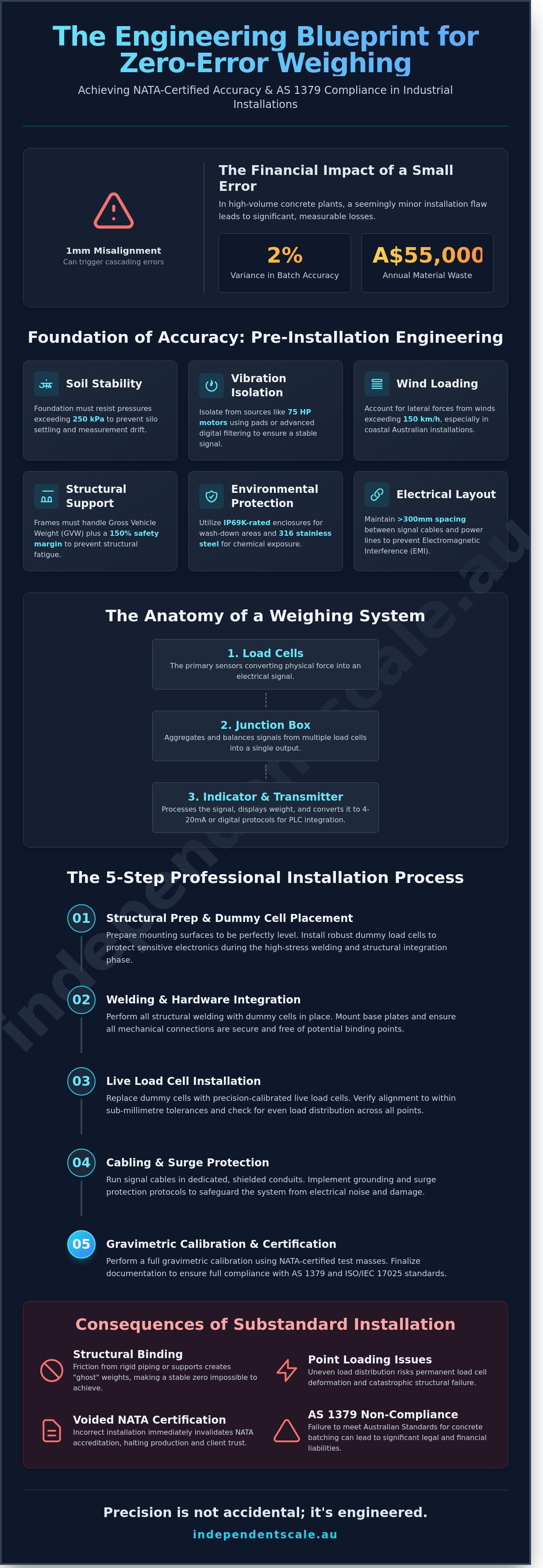
A single millimetre of misalignment during a weighing system installation can trigger a 2% variance in batch accuracy, which often costs high-volume Sydney concrete plants over A$55,000 in annual material waste. You know that in heavy industrial sectors, precision isn't a luxury; it's a strict regulatory mandate. Relying on unverified setup procedures doesn't just threaten your product quality; it creates significant anxiety regarding non-compliance with AS 1379 and the threat of unexpected operational downtime.
This professional engineering guide provides the technical blueprint to achieve zero-error measurement from day one while ensuring your facility remains fully NATA-certified and compliant with ISO/IEC 17025 standards. We'll examine the critical engineering requirements for load cell mounting, the necessity of gravimetric calibration, and the specific surge protection protocols required to maintain long-term system reliability. By following these established Australian standards, you can transform your weighing infrastructure into a dependable asset that guarantees accuracy for every batch produced.
Key Takeaways
- Evaluate critical site engineering factors, such as soil stability and wind loading, to ensure structural integrity before hardware integration.
- Follow a rigorous 5-step engineering process for weighing system installation, utilizing dummy load cells to safeguard components during structural welding.
- Navigate Australian compliance mandates, including NATA accreditation to ISO/IEC 17025 and the specific requirements of AS 1379 for concrete batching.
- Develop a technical maintenance strategy to identify system drift and rapidly differentiate between load cell failures and cabling faults.
What is a Weighing System Installation in an Industrial Context?
In an industrial environment, a weighing system installation is the technical integration of load cells, mounting hardware, and digital indicators into a primary structure to generate accurate gravimetric data. It isn't a simple assembly task. It's a precise engineering process that determines the long-term reliability of your production data. Understanding What is a Weighing System helps clarify that these systems rely on the physics of force transfer. If that transfer is compromised during the initial setup, the entire measurement chain fails regardless of the component quality.
The installation phase represents the most critical link in the "accuracy chain." While high-quality sensors are essential, their performance is capped by the quality of the weighing system installation. Even a load cell with a 0.02% accuracy rating will produce erratic results if the mounting plates aren't level or if thermal expansion isn't accounted for in the structure. ISS leverages over 30 years of field experience to ensure that the physical environment supports, rather than hinders, the precision of the hardware. Precision isn't accidental; it's the result of methodical alignment and environmental control.
A standard industrial setup consists of several key components that must work in unison:
- Load cells: The primary sensors converting force into electrical signals.
- Junction boxes: Summing circuits that aggregate and balance signals from multiple sensors.
- Indicators: The human-machine interface that processes and displays weight data.
- Conditioners and transmitters: Essential devices that convert millivolt signals into 4-20mA or digital protocols for PLC integration.
Types of Weighing Systems We Install
We handle a diverse range of configurations tailored to specific Australian industrial requirements. Static weighing systems involve silos, hoppers, and tank assemblies used for bulk storage and inventory management. These are standard in the 98% of Sydney concrete plants we service. Dynamic weighing systems, such as conveyor scales and flowmeters, measure material in motion on active production lines. For commercial transactions, we install legal-for-trade systems that meet strict National Measurement Institute (NMI) requirements to ensure every A$1 of product is accounted for accurately.
The Consequences of Poor Installation
Substandard weighing system installation leads to immediate and long-term operational failures. Structural binding is a frequent issue where friction from rigid piping or supports creates "ghost" weights, making it impossible to achieve a stable zero. Point loading issues occur when the load isn't distributed evenly across the sensors, risking structural failure or permanent load cell deformation. Crucially, incorrect installation voids NATA certification and results in non-compliance with AS 1379. This can halt production and lead to significant legal liabilities for Australian businesses that require verified accuracy for their output.
Pre-Installation Planning and Site Engineering
Successful weighing system installation starts long before the first bolt is tightened. Site engineering determines whether a scale maintains its NATA-accredited accuracy or fails under environmental stress. Evaluation begins with soil stability. For outdoor silos, the foundation must resist specific pressure thresholds, often exceeding 250 kPa, to prevent settling. Vibration sources, such as 75 HP motors or heavy industrial crushers, require isolation pads or advanced digital filtering in the summing circuit to prevent signal drift. Wind loading is another critical factor in Australia. Coastal installations must account for lateral forces from wind speeds that can exceed 150 km/h to ensure structural stability.
Support frames must handle the Gross Vehicle Weight (GVW) plus a 150% safety margin. Failure to account for dynamic loads during the filling process leads to structural fatigue and weighing errors. Environmental protection is equally vital. In Australian concrete plants, wash-down areas require IP69K-rated enclosures to prevent moisture ingress. Chemical exposure in food or pharmaceutical processing necessitates 316 stainless steel hardware. Planning for extreme temperatures is essential; high-heat environments may require water-cooled load cell jackets to maintain thermal stability.
Electrical layout planning avoids Electromagnetic Interference (EMI) that plagues sensitive electronics. Map cable runs to ensure signal lines stay in dedicated conduits. These should be placed at least 300mm away from high-voltage power lines. This separation prevents "ghost" readings or erratic fluctuations during heavy motor startup. Adhering to the NIST Handbook 44 technical requirements provides a globally recognised framework for understanding tolerances and device performance, ensuring your system meets rigorous industrial standards.
Mechanical Preparation for Load Cells
Precise levelling is non-negotiable for accuracy. Support plates must be coplanar within 0.5 degrees to prevent side-loading. Thermal expansion is a major factor for large outdoor tanks; a 15-metre steel vessel can expand by 10mm or more during a 30°C temperature shift. Designing for this movement prevents binding in the mounts. Every gram of the load must pass through the load cells to ensure 100% load path integrity. Even a single rigid pipe connection or a stiff electrical conduit can bypass the sensors and invalidate the entire weighing system installation.
Tooling and Safety Requirements
Installation teams require specialised hardware including 20-tonne hydraulic jacks, precision laser levels, and torque wrenches calibrated to specific Newton-metres. Safety protocols must be strictly enforced. This includes AS 1891 compliance for working at heights on silo tops and AS 2865 standards for confined space entry in pits. A comprehensive pre-install checklist is used to verify every component against the engineering schematic before work commences. If your facility requires a complex upgrade, it's best to contact our technical team for a detailed site-specific engineering assessment. This methodical approach eliminates downtime and ensures the system is ready for NATA-accredited calibration immediately after commissioning.
The 5-Step Process for Weighing System Installation
A successful weighing system installation requires a methodical approach to ensure long term accuracy and compliance with AS 1379 or NATA standards. Skipping technical steps leads to signal drift and mechanical failure. We follow a rigorous 5-step sequence to eliminate variables that compromise scale performance. This process guarantees that every component, from the foundation to the digital interface, functions as a cohesive unit.
- Mechanical Mounting: This involves the precise positioning of load cell baseplates and securing mounting assemblies to the foundation using high strength anchors.
- Alignment and Levelling: Technicians use dummy load cells during structural welding to prevent heat and current damage to sensitive internal strain gauges.
- Electrical Integration: This step covers the wiring of sensors to junction boxes and surge arrestors to consolidate signals.
- Signal Conditioning: We connect the system to digital indicators or PLC systems for high speed data output and industrial automation.
- Initial Verification: A "dead load" test confirms the system responds to force and identifies any mechanical binding before full calibration occurs.
Mounting Load Cells and Hardware
The physical mounting phase begins with the installation of the baseplates. These must be level within 0.5 degrees to avoid cosine errors that degrade accuracy. Once the baseplates are secured, dummy load cells take the place of live sensors. This is a critical safeguard. You should never weld near a live load cell. Welding current seeks the path of least resistance, which is often through the internal strain gauge, causing immediate and permanent failure. If welding is unavoidable near the mount, the earth clamp must be placed as close to the weld point as possible to bypass the sensor path entirely.
Alongside these physical safeguards, managing the associated welding documentation is crucial for quality assurance, and specialized software like SOCWeld is often used to automate this process.
For outdoor silos or tall vessels, we install stay rods and check links. These components don't carry the weight but provide lateral stability against wind loads, which can exceed 50 metres per second in some Australian regions. Proper installation ensures the vessel won't overturn while allowing the load cell to move freely in the vertical plane. These technical requirements align with the specifications found in the NIST Handbook 44, which details the tolerances required for commercial weighing devices. Final bolt tensioning follows a specific torque pattern to ensure the assembly remains rigid under maximum capacity.
Wiring and Signal Protection
Cable management is the next priority in a weighing system installation. All leads must be housed in flexible conduit to prevent mechanical damage from debris or rodents. We use drip loops at every entry point to stop moisture ingress from reaching the internal electronics. Moisture is the primary cause of signal instability in industrial environments like concrete batching plants or chemical facilities. It's a common issue that leads to costly downtime if the initial shielding is inadequate.
Multiple load cells are balanced using summing circuits within a sealed junction box. This process ensures that a 1,000kg load reads exactly the same regardless of its position on the platform or in the hopper. To protect your investment, we integrate surge protection. Industrial power spikes or lightning strikes can destroy an entire sensor network in milliseconds. High quality surge arrestors divert this excess voltage to the ground before it reaches the PLC or indicator. This setup is essential for maintaining 24x7 uptime and avoiding the A$5,000 to A$15,000 costs associated with full system replacements after a power event. Every weighing system installation we perform prioritises this layer of electrical defence to ensure long term reliability.
Post-Installation: NATA Calibration and AS 1379 Compliance
Physical completion of a weighing system installation is only the first stage of the process. A system isn't truly operational until it's verified. Initial calibration ensures the hardware functions within specified tolerances under real-world loads. Skipping this step risks immediate production errors and costly material waste. In heavy industrial environments, precision isn't optional; it's a legal and operational requirement. You can't trust a system that hasn't been tested against known standards.
NATA accreditation to ISO/IEC 17025 standards provides the technical foundation for this verification. This international standard confirms that a service provider possesses the technical competence and equipment traceability to produce accurate data. For Australian businesses, NATA-endorsed certificates are the only way to guarantee that your equipment meets national metrology requirements. It involves rigorous testing of environmental factors, equipment uncertainty, and technician proficiency.
For the construction industry, concrete batching plant calibration and repair must adhere strictly to AS 1379. This standard dictates the accuracy limits for batching equipment to ensure concrete strength and durability. Specifically, AS 1379 requires cementitious materials to be accurate within ±1%, while aggregates must be within ±2%. Failure to comply leads to rejected batches or structural failures. Every calibration ends with a formal certificate of accuracy. These documents create the mandatory audit trail needed for quality assurance and regulatory inspections.
The Calibration Process
We utilize the gravimetric method for high-accuracy results. This involves applying NATA-certified test weights to the system to verify linearity across the full weighing range. We check for hysteresis, ensuring the scale reads correctly during both loading and unloading cycles. Repeatability tests are equally vital. The system must return to zero and show identical weights every time the same load is applied. We also perform corner testing to balance the system. This ensures the weight remains uniform regardless of where the load sits on the platform or inside the hopper. If a system is out of balance, we adjust the summing circuits or load cell mounts immediately.
Regulatory Standards in Australia
The National Measurement Institute (NMI) sets the rules for trade-certified scales. If you're selling products by weight, your weighing system installation must meet NMI "Trade Approved" status. Most industrial systems require re-verification every 12 months, though high-volume concrete plants often opt for 6-month intervals to maintain peak precision. Independent Scale Service currently maintains 98% compliance for Sydney concrete plants, servicing major players like Holcim, Boral, and Hanson. Our technicians carry the necessary weights and equipment to ensure your plant stays within legal tolerance bands. We don't just test; we provide the technical repairs needed to bring failing systems back into compliance.
Maintenance and Troubleshooting Your Weighing System
Successful weighing system installation is only the first step in achieving long-term accuracy. To prevent the common causes of system drift, you must implement a preventative maintenance schedule. Drift often occurs due to environmental factors or mechanical wear. Establish a monthly inspection routine to check for debris build-up around load points and verify the integrity of summing circuits. A 0.5% error in a high-volume batching plant can result in over A$5,000 in lost material or non-compliant product within a single month. Scheduled NATA-accredited calibration ensures your equipment remains compliant with AS 1379 standards.
Troubleshooting requires a methodical approach to distinguish between load cell failure and cabling issues. Use a high-quality multimeter to measure excitation and signal voltages. A healthy load cell shows a stable millivolt output proportional to the load. If readings are erratic, inspect the cable jacket for abrasions or moisture ingress. Technical data shows that 65% of signal faults originate in the cabling rather than the sensor itself. For legacy systems, consider whether it's time to replace ageing indicators or transition to digital load cells. Modern digital systems offer superior noise immunity and allow for individual cell monitoring, which reduces diagnostic time by 40%.
Emergency repairs are a reality for high-volume industrial sites operating 24/7. When a weighbridge or hopper scale fails, the cost of downtime can exceed A$2,500 per hour in lost productivity. Access to round-the-clock technical support is not a luxury; it's a operational necessity. Rapid response teams equipped with calibrated test weights and replacement components are essential for maintaining the continuous flow of goods and materials.
Common Post-Installation Issues
Weight drift is frequently caused by moisture entering the junction box. Ensure all seals are IP68-rated and use desiccant packs to manage humidity. Non-linearity usually points to mechanical binding. Check that the platform moves freely and no gravel or debris is wedged under the load points. If your indicator and display shows specific error codes, consult the technical manual immediately to identify if the fault is an "Out of Range" signal or a power supply fluctuation.
Partnering with Independent Scale Service
Independent Scale Service brings a 30-year legacy of technical excellence to the Australian industrial sector. We currently service 98% of concrete plants across Sydney and have expanded our expert repair and installation capabilities throughout Melbourne. Our team manages the entire equipment lifecycle, from the initial supply of heavy-duty hardware to NATA-accredited calibration to ISO/IEC 17025 standards. We focus on minimising your downtime through precise engineering and responsive service. Contact our expert team for your next weighing system installation to ensure your facility meets all regulatory and operational benchmarks.
Optimise Your Plant Accuracy and Compliance
Precision in industrial weighing starts long before the first load cell is positioned. A professional weighing system installation requires rigorous site engineering and a methodical five-step execution to guarantee long-term reliability. Independent Scale Service delivers this technical expertise, ensuring your facility meets AS 1379 requirements through our NATA accreditation to ISO/IEC 17025. We currently maintain the infrastructure for 98% of concrete plants across Sydney, providing the data integrity essential for high-volume production.
Operational downtime is a critical risk to your profitability. That's why we provide 24/7 emergency support to resolve technical issues immediately. Our team focuses on eliminating batching errors and ensuring every component, from summing circuits to surge arrestors, functions at peak performance. Don't settle for subpar setups that lead to compliance failures or costly material waste. Secure your facility's future with engineering-grade calibration and support services designed for the toughest Australian industrial environments.
Get a Quote for Professional Weighing System Installation
We're ready to help you achieve total measurement certainty today.
Frequently Asked Questions
How long does a typical weighing system installation take?
Setting up a single silo or aggregate hopper typically takes between 4 and 8 hours to complete. This timeframe includes the physical mounting of load cells, wiring to the summing circuit, and initial calibration. Complex multi-batch plants may require 2 to 3 days for a full system overhaul. ISS technicians prioritise efficiency to ensure your production resumes within the scheduled maintenance window.
Do I need to shut down my plant during the installation process?
You must schedule a plant shutdown for the duration of the physical installation to ensure technician safety. It's impossible to install hardware while machinery is active without creating 100% avoidable safety risks. Attempting this also prevents accurate zero-point setting. We recommend scheduling these works during low-demand periods. Our 24x7 emergency service team can perform installations outside standard hours to minimise your commercial downtime.
What is the difference between NATA-accredited and standard calibration?
NATA-accredited calibration complies with ISO/IEC 17025 standards and is mandatory for legal-for-trade applications and high-spec concrete production. Standard calibration provides a functional check but lacks the rigorous traceability required by NATA. For 98% of concrete plants in Sydney, NATA-accredited certificates are essential to meet AS 1379 requirements. This ensures your weighing system installation provides legally defensible accuracy for all batching operations.
Can I use my own electricians for the weighing system installation?
You can use site electricians for general cable runs and conduit installation, but an ISS specialist must perform the final termination and commissioning. Load cell signals use low-voltage millivolts that are highly sensitive to interference. Incorrect shielding or poor connections by non-specialists lead to a 15% increase in signal drift. Our technicians ensure every summing circuit and surge arrestor is correctly configured to maintain long-term reliability.
What Australian Standards govern weighing systems in the concrete industry?
AS 1379 is the primary standard governing the specification and supply of concrete, which dictates strict accuracy limits for weighing equipment. Specifically, it requires batching accuracy within 0.5% for cement and 2% for aggregates. Additionally, AS 4490 provides the framework for the periodic verification of these systems. ISS ensures all installations meet these benchmarks to keep your plant compliant with Australian building codes and Tier 1 contractor requirements.
What happens if a load cell fails shortly after installation?
If a load cell fails within the first 12 months, it is typically covered by the manufacturer's warranty and our service guarantee. We respond to critical failures via our 24x7 emergency hotline to replace the faulty component and recalibrate the system. 90% of early failures result from lightning strikes or welding surges during site work. We install surge arrestors as standard practice to mitigate these risks and protect your investment.
How do environmental factors like wind affect silo weighing accuracy?
Wind loads can introduce errors exceeding 50kg on tall, outdoor silos by exerting lateral force on the structure. This environmental interference directly affects the vertical load measured by the cells. We mitigate this by using high-quality mounting kits with stay rods and implementing digital filtering within the weight indicator. Proper weighing system installation includes assessing site-specific wind conditions to ensure output remains stable in gusts up to 80km/h.
Is it possible to retrofit an old hopper with a new weighing system?
We can retrofit 95% of existing hoppers and silos with modern gravimetric weighing systems. This process involves lifting the vessel by 10mm to 20mm to insert load cell assemblies between the support legs and the foundation. Retrofitting is a cost-effective alternative to replacing the entire structure. It provides an immediate 10% to 15% improvement in material dosing accuracy compared to older mechanical or volumetric systems.
