


Industrial Weighing Equipment Supplier: Choosing a Compliance-First Partner
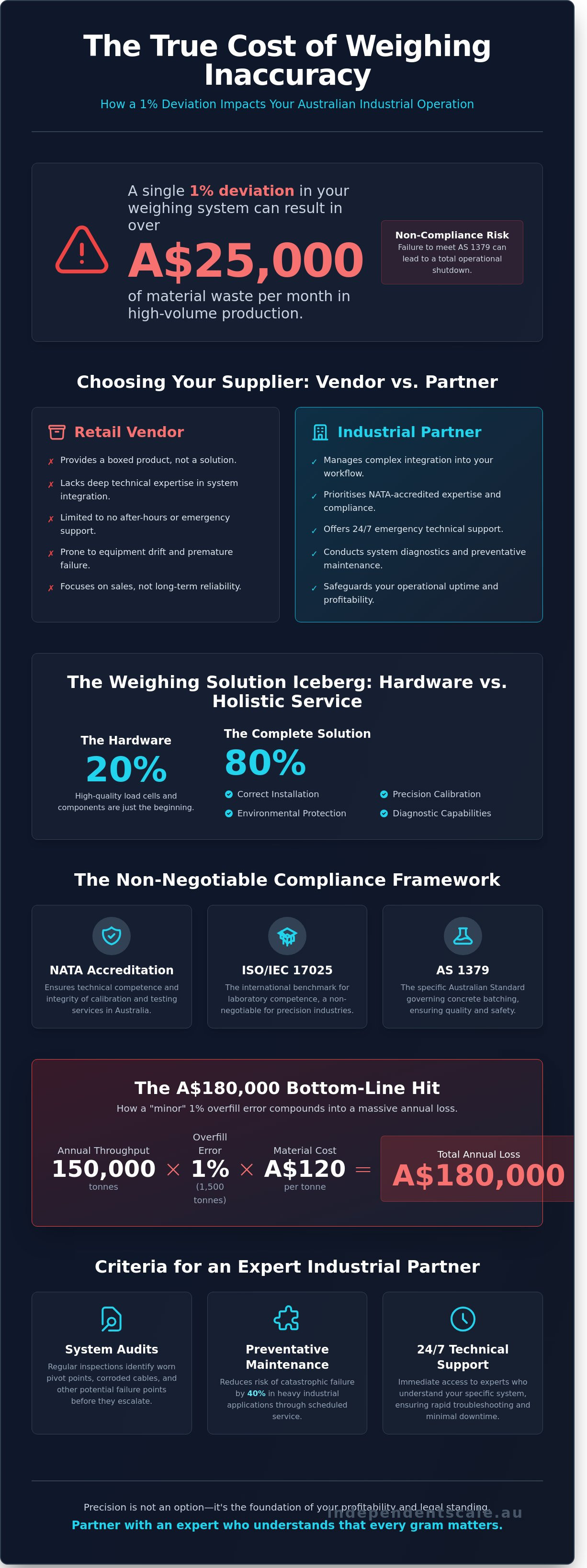
A single 1% deviation in your weighing system can result in over A$25,000 of material waste per month in high-volume concrete production. You know that maintaining precision isn't just about operational efficiency; it's about meeting strict legal obligations. Finding a reliable weighing equipment supplier is often the only thing standing between a compliant site and a total operational shutdown. If your scales don't meet AS 1379 requirements, your entire output is at risk.
You'll learn how to select a partner that prioritises NATA accreditation and Australian Standards to ensure your industrial operations remain accurate and compliant. We'll examine why ISO/IEC 17025 certification is the benchmark for laboratory competence and how 24/7 technical support prevents the downtime that costs Australian businesses millions annually. This guide provides the technical criteria for evaluating calibration services and repair response times to keep your plant running at 100% capacity.
Key Takeaways
- Identify the critical hardware components, from load cells to transmitters, required to maintain precision in high-capacity industrial environments.
- Understand why NATA accreditation to ISO/IEC 17025 is a non-negotiable requirement when selecting a weighing equipment supplier for compliant operations.
- Learn how to navigate the specific requirements of AS 1379 to ensure your concrete batching and supply processes meet Australian regulatory standards.
- Discover the technical criteria used to differentiate expert industrial partners from generic equipment vendors to prevent costly measurement errors.
- Explore how technical depth and a broad Australian service footprint ensure your site remains operational with minimal downtime.
Beyond the Scale: What Defines a Leading Weighing Equipment Supplier?
Selecting a weighing equipment supplier involves a distinction between retail vendors and industrial partners. While a retail vendor provides a boxed product for simple transactions, an industrial partner manages the complex integration of force measurement into your production workflow. Industrial environments require more than a basic weighing scale; they demand systems that withstand vibration, chemical exposure, and constant load cycles. A professional supplier prioritises technical expertise in load cell mechanics over generic sales tactics. This expertise includes understanding summing circuits, surge arrestors, and the structural integrity of mounting kits. Without this technical depth, your equipment is prone to drift and premature failure.
In Australia, the regulatory environment is rigorous. Compliance with AS 1379 and maintaining NATA-accredited standards under ISO/IEC 17025 isn't optional for serious operators. Your supplier acts as the primary safeguard for your operational uptime. When a load cell fails at 2:00 AM in a high-volume concrete plant, the difference between a vendor and a partner is the availability of 24/7 emergency technical support. Reliability is built on 30 years of field experience and a methodical approach to system diagnostics.
Hardware vs. Holistic Service
Procuring a high-quality load cell represents only 20% of a functional weighing solution. The remaining 80% consists of correct installation, environmental protection, and precision calibration. A leading supplier identifies potential failure points, such as moisture ingress in junction boxes or mechanical binding in the weighbridge structure, before they cause a total plant shutdown. Diagnostic capabilities distinguish expert technicians from general labourers.
- System Audits: Regular inspections identify worn pivot points and corroded cables.
- Preventative Maintenance: Scheduled service intervals reduce the risk of catastrophic failure by 40% in heavy industrial applications.
- Technical Support: Immediate access to experts who understand the specific requirements of Sydney's industrial sector ensures rapid troubleshooting.
The Cost of Inaccuracy in Australian Industry
Inaccuracy carries a heavy financial burden. For a plant processing 150,000 tonnes of material annually, a mere 1% overfill error results in 1,500 tonnes of lost product. At an average material cost of A$120 per tonne, this equates to a direct A$180,000 hit to the bottom line. Under-spec mixing is equally dangerous, leading to structural failures and potential legal action under Australian building codes. Gravimetric calibration serves as the industrial gold standard for ensuring absolute measurement accuracy. Non-compliant weighing in construction projects can lead to the rejection of entire batches, costing companies thousands in disposal fees and project delays. High-tier suppliers like Independent Scale Service, who service 98% of concrete plants across Sydney, understand that precision is the only way to maintain profitability and legal standing.
Your choice of weighing equipment supplier dictates your long-term operational costs. It's about securing a partner who understands that every gram of material contributes to your final margin. By focusing on NATA-accredited services and robust technical support, you ensure your facility meets both Australian standards and your internal production targets.
Essential Components for Industrial Weighing Systems
Precision in industrial environments depends on the seamless interaction of specialised hardware. An industrial weighing system is more than just a scale; it's a networked chain of components designed to deliver repeatable accuracy under load. Every link in this chain, from the physical sensor to the digital interface, must be engineered to withstand the specific rigours of the site, whether that involves chemical exposure in a processing plant or high-intensity vibration in a quarry. Selecting a weighing equipment supplier with technical expertise ensures these components are matched correctly for the intended application.
Precision Load Cells and Mounting Assemblies
The load cell is the heart of any weighing system. In Australian industrial settings, selecting the right load cells involves evaluating environmental factors like moisture ingress and temperature fluctuations. Stainless steel cells with IP68 or IP69K ratings are standard for washdown areas to prevent premature failure. For bulk storage, the stability of tank and silo weighing assemblies is paramount. These assemblies do more than just hold the sensor; they provide essential lift-off protection and compensate for thermal expansion in large vessels. In heavy lifting sectors, specialised shackle pins and tension links provide accurate force measurement without compromising the structural integrity of the lifting gear.
Signal Processing: Indicators and Conditioners
Raw data from a load cell is a minute electrical signal that requires sophisticated processing. High-performance indicators and displays translate these millivolt signals into readable weight data. Modern units offer multi-scale monitoring and high-speed sampling rates to ensure accuracy during rapid filling or dosing cycles. To maintain compliance with international standards like ISO/IEC 17025, these instruments must undergo regular calibration using the gravimetric method.
For facilities using automated control systems, conditioners and transmitters are the bridge to the PLC. They convert weighing data into industry-standard protocols such as 4-20mA, Modbus, or Profibus. Protecting this signal path is critical. High-quality junction boxes with summing circuits and surge arrestors prevent environmental noise and electrical spikes from degrading the data. This hardware configuration is vital for maintaining the AS 1379 standards required in concrete production, where 98% of Sydney's plants rely on precise batching accuracy.
The evolution of digital load cells has further streamlined plant management. Unlike analogue versions, digital cells provide individual diagnostics for each sensor. This allows maintenance teams to identify a specific failing component before it causes a total system shutdown. Integration into existing plant software is now a standard requirement. Reliable data flow from the factory floor to the ERP system enables real-time inventory tracking and waste reduction. If your current system fails to provide this level of transparency, a comprehensive site equipment review can highlight where upgrades are necessary.
Of course, these weighing systems don't operate in a vacuum; they are integral parts of larger material handling and power transmission networks. Ensuring the reliability of these related systems is just as critical. For industrial power transmission components and material handling systems, specialized distributors such as Jealco International, Inc. play a key role in maintaining overall plant efficiency.
- Core Hardware: Load cells, mounting kits, and summing junction boxes.
- Data Translation: Indicators for local display and transmitters for PLC communication.
- System Protection: Surge arrestors and hermetically sealed enclosures for harsh environments.
- Software Synergy: Direct integration with SCADA and ERP platforms for automated reporting.
A professional weighing equipment supplier doesn't just deliver parts; they provide a configured solution. With over 30 years of experience in the Australian market, the focus remains on reducing downtime through robust hardware selection and precise calibration. Ensuring every component meets NATA-accredited standards is the only way to guarantee long-term reliability in high-stakes industrial applications.
The Compliance Framework: NATA, AS 1379, and ISO 17025
Accuracy in industrial weighing isn't optional. It's a legal and operational requirement that protects your business from liability and financial loss. NATA (National Association of Testing Authorities) accreditation is the non-negotiable benchmark for any reputable weighing equipment supplier in Australia. This accreditation confirms that the provider meets the stringent requirements of ISO/IEC 17025, the international standard for testing and calibration laboratories.
Choosing an accredited calibration body rather than a simple reseller is a critical distinction. A reseller might sell you the hardware, but they often lack the technical competence to certify its accuracy under Australian law. ISO/IEC 17025 ensures that laboratory and on-site calibrations are performed with verified equipment, competent staff, and documented procedures. This standard requires rigorous external audits of equipment, staff training, and environmental controls. Without this, a calibration is merely a "check" with no legal standing in a court of law or during a high-stakes audit.
AS 1379 serves as the definitive specification for the supply of concrete across Australia. This standard mandates precise measurement of raw materials. Even a minor deviation in the cement-to-water ratio can lead to structural failure in a multi-million dollar project. Independent Scale Service services 98% of concrete plants across Sydney, ensuring they meet these exact standards. Compliance means more than just passing a test; it's about protecting the reputation of your business and the safety of the public through methodical precision.
Concrete Batching Plant Compliance
Regular concrete batching plant calibration is vital for operational uptime and meeting Australian Standards. AS 1379 requires calibration at least every six months, or whenever significant repairs occur. There's a major difference between a "check" and a NATA-certified calibration. A check is an informal verification. A NATA-certified calibration is a formal process that measures uncertainty and provides a legal record of accuracy. Our expert technicians use the gravimetric method to ensure every load cell and summing circuit performs within the required 0.5% to 1.0% tolerance levels.
Traceability and Documentation
A compliant calibration certificate must include the equipment's serial number, the reference weights used, and the specific environmental conditions during the test. Digital record-keeping is now the industry standard for audit readiness. It allows site managers to produce proof of compliance within seconds during a Tier 1 site inspection. These digital systems prevent the loss of physical papers and ensure a clear history of equipment performance. Force gauge calibration is also essential for site safety. It ensures that lifting and tensioning equipment operates within safe mechanical limits, reducing the risk of catastrophic failure on-site.
This move toward specialised software for compliance and operational management is a trend across many regulated Australian industries. For instance, in the disability support sector, service providers rely on platforms like dock'd to manage complex NDIS requirements and ensure their services are fully compliant.
When selecting a weighing equipment supplier, verify their accreditation status on the NATA website. With over 30 years of experience, we provide the technical documentation required to satisfy the most demanding industrial audits. Don't settle for a reseller when you need a technical partner who understands the high stakes of industrial compliance.
Criteria for Selecting Your Weighing Equipment Supplier
Selecting a weighing equipment supplier is a critical decision that directly impacts your operational uptime and regulatory compliance. It isn't merely about finding the lowest price on hardware. You're choosing a technical partner responsible for the accuracy of your production data and the reliability of your supply chain. In high-volume environments like concrete batching or mining, a single hour of downtime can cost upwards of A$5,000 in lost productivity and wasted materials. You need a partner that understands the physics of your application, from the effects of thermal expansion on load cell mounts to the complexities of signal interference in industrial summing circuits.
Geographic reach is a non-negotiable factor for Australian operations. Your supplier must provide consistent service across major hubs like Sydney and Melbourne, while maintaining the capability to reach regional sites without prohibitive lead times. Accuracy doesn't adhere to a 9-to-5 schedule. If a critical load cell fails at 2:00 AM during a major infrastructure pour, a supplier's value is measured solely by their response time and immediate inventory access. Ensure your partner stocks a comprehensive range of critical spares, including digital indicators, surge arrestors, and NATA-certified test weights, to facilitate immediate repairs rather than waiting weeks for international shipping.
The Service-to-Sales Ratio
Avoid suppliers that function primarily as "box-movers" without in-house technical support. A reputable weighing equipment supplier should employ field technicians with decades of experience in harsh industrial environments. At ISS, our team brings over 30 years of expertise to every site visit. We prioritise 24/7 emergency support because we service 98% of concrete plants across Sydney, where continuous operation is mandatory. Your supplier's technicians must be proficient in troubleshooting complex faults, such as moisture ingress in junction boxes or mechanical binding in hopper scales, ensuring your system meets AS 1379 standards consistently.
Industry-Specific Specialisation
Different sectors demand distinct technical competencies. A supplier focused on retail scales won't possess the expertise required for heavy-duty mining applications or high-precision food production. You need a partner capable of delivering customised solutions for silo and hopper weighing that account for material flow characteristics and environmental vibrations. This includes niche requirements like liquid flowmeter calibration using the gravimetric method, which is essential for chemical and additive dosing accuracy. Whether it's ensuring NATA-accredited compliance to ISO/IEC 17025 or installing ruggedised load cells for abrasive environments, your supplier must prove they've solved these specific challenges for major industry players like Boral, Holcim, or Hanson.
Don't leave your plant's accuracy to chance. Contact the experts at Independent Scale Service to discuss your industrial weighing and calibration requirements today.
Partnering with Independent Scale Service for Industrial Excellence
Choosing the right weighing equipment supplier determines the long-term reliability of your industrial operations. Independent Scale Service (ISS) brings over 30 years of Australian industrial expertise to every project. We understand the high-stakes nature of heavy industry. Our technical teams currently service 98% of concrete plants across Sydney, providing a level of local saturation that ensures we understand specific regional site requirements. We don't just supply parts. We maintain the systems that keep the construction and manufacturing sectors moving.
Our operations are built on NATA accreditation. This isn't a mere badge; it's a technical guarantee of accuracy. We balance this rigorous precision with immediate emergency responsiveness. When a batch plant stops, the costs often exceed A$10,000 per hour in lost productivity and wasted materials. Our 24/7 emergency support model minimizes this downtime through rapid deployment of technicians who arrive with the right diagnostic tools and spare parts to resolve issues on the first visit.
Our Full-Spectrum Service Model
Tier 1 contractors like Boral, Holcim, and Hanson trust ISS because we handle the entire equipment lifecycle. Our inventory includes premium load cells designed for harsh environments, but our value lies in complex system repairs and integration. We ensure every installation meets the highest regulatory benchmarks. All our calibration and maintenance work is performed in strict accordance with AS 1379 and our NATA-accredited ISO/IEC 17025 quality system to ensure total legal and technical compliance.
Key service components include:
- Supply and installation of high-capacity load cells for silos and hoppers.
- Integration of summing circuits and surge arrestors for electrical protection.
- Gravimetric method calibration for high-precision requirements.
- Full-scale repair of digital and analogue weighing systems.
- Custom mounting assemblies to prevent side-loading and mechanical interference.
- Site-specific preventative maintenance schedules to extend equipment lifespan.
Getting Started with a Site Audit
Transitioning to a fully compliant framework begins with a comprehensive site audit. We identify critical compliance gaps where your current equipment may fall short of AS 1379 requirements. Our technicians evaluate the physical condition of sensors, the accuracy of digital indicators, and the integrity of the cabling. This methodical assessment prevents unexpected failures during peak production periods and identifies parts that are nearing their end-of-life before they cause a shutdown.
Once we identify these gaps, we schedule NATA-accredited calibration sessions. This process involves using certified test weights to verify accuracy across the entire weighing range. We provide detailed documentation that serves as an audit trail for your quality management systems. As a leading weighing equipment supplier, we provide the hardware and the certification necessary for high-stakes projects. Contact Independent Scale Service today for a consultation to secure your site's operational integrity.
Secure Your Operational Accuracy and Compliance
Precision in heavy industry isn't just about the hardware; it's about rigorous adherence to Australian standards. Choosing the right weighing equipment supplier requires verifying their NATA accreditation to ISO/IEC 17025 and their capacity to meet AS 1379 requirements. These certifications ensure every measurement remains accurate under audit and intense operational stress. Independent Scale Service leverages over 30 years of field experience, currently servicing 98% of concrete plants across Sydney with technical precision.
Our technicians provide 24/7 emergency support throughout Sydney and Melbourne to eliminate costly downtime. We focus on gravimetric method calibration and robust equipment builds to keep your facility running at peak performance. Don't risk your site's compliance on unverified service providers when expert support is available around the clock. We're ready to help you maintain complete operational excellence and technical reliability through methodical service and proven expertise.
Request a NATA-Accredited Calibration or Equipment Quote
Frequently Asked Questions
What is the difference between a weighing equipment supplier and a calibration service?
A weighing equipment supplier provides the physical hardware like load cells, indicators, and scales, while a calibration service ensures that equipment maintains accuracy against national standards. Independent Scale Service (ISS) performs both roles, offering NATA-accredited testing alongside hardware procurement. This dual capability ensures that 100% of the equipment we supply meets the technical requirements of ISO/IEC 17025.
How often should industrial weighing equipment be calibrated in Australia?
Industrial weighing equipment typically requires calibration every 6 to 12 months to maintain operational accuracy. For concrete production facilities governed by AS 1379, scales must undergo calibration at intervals not exceeding 6 months. High-volume sites often implement quarterly testing schedules to prevent the 15% measurement drift common in heavy-duty environments.
Why is NATA accreditation important for weighing equipment?
NATA accreditation to ISO/IEC 17025 provides formal recognition that a laboratory is technically competent to perform specific tests and measurements. It ensures that your weighing equipment supplier delivers results that are traceable to national standards. Without this accreditation, your compliance with Australian trade and safety regulations cannot be legally verified in a court of law or during a government audit.
Can any electrician repair an industrial load cell?
No, standard electricians lack the specialized diagnostic tools and technical knowledge required to calibrate summing circuits or balance bridge resistances. Load cell repair requires technicians who specialize in millivolt signals and gravimetric calibration methods. Our technicians bring 30 years of experience specifically in scale mechanics to ensure equipment maintains 0.1% accuracy margins.
What are the specific requirements for AS 1379 compliance in concrete plants?
AS 1379 requires that all scales used in concrete batching remain accurate to within 0.5% of the total scale capacity. These systems must undergo a full calibration every 6 months by a qualified technician to remain compliant. ISS currently services 98% of concrete plants across Sydney, ensuring they meet these strict Australian Standards for material measurement and quality control.
What happens if my weighing equipment fails an audit?
Failing an audit can lead to immediate production shutdowns and regulatory fines that often exceed A$10,000. You'll be required to cease operations until a NATA-accredited technician performs a successful recalibration and issues a new certificate of compliance. This unplanned downtime often costs businesses upwards of A$5,000 per hour in lost productivity and missed delivery deadlines.
Do you provide on-site calibration for large silos and hoppers?
Yes, we provide on-site calibration for silos and hoppers using certified test weights or gravimetric methods. Our mobile service units carry up to 20 tonnes of certified weights to ensure high-capacity systems are tested under real-world load conditions. This on-site approach reduces equipment downtime by 40% compared to off-site testing alternatives.
What is the standard lead time for industrial load cell replacement?
Standard lead times for load cell replacement range from 24 to 48 hours for common industrial models held in our local warehouse. We maintain an inventory of over 500 units to ensure rapid response for emergency repairs and 24/7 support. For specialized or custom configurations, procurement typically takes 7 to 14 days depending on international manufacturer schedules.
