


Industrial Scales Australia: The 2026 Guide to Selection and Compliance
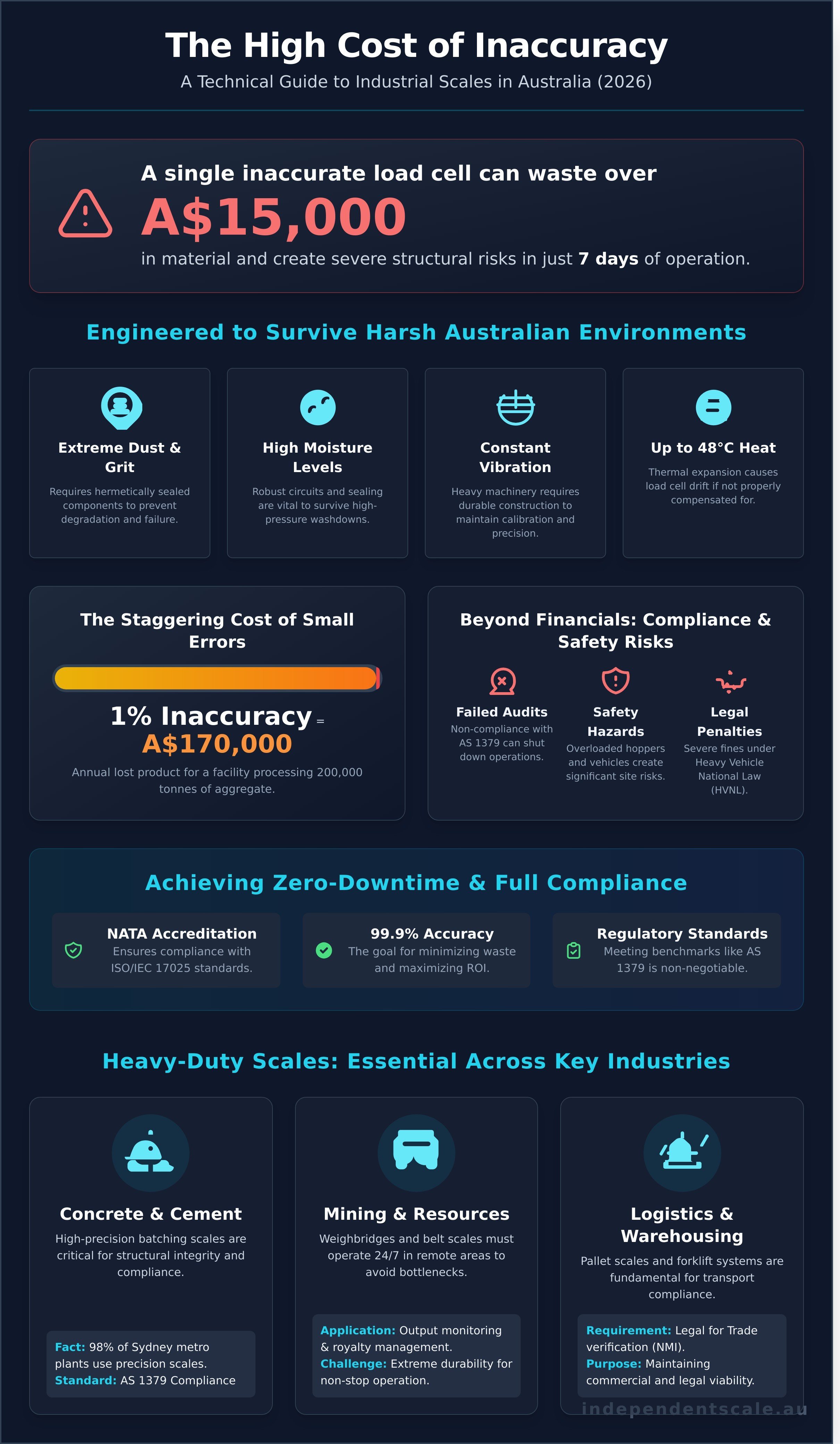
A single inaccurate load cell in a concrete batching plant can result in over A$15,000 of wasted material and severe structural integrity risks in just seven days of operation. You know that maintaining high-capacity industrial scales Australia involves more than basic maintenance; it's about surviving extreme dust, moisture, and vibration while meeting strict regulatory benchmarks. Inaccurate measurements don't just waste resources. They lead to failed audits under AS 1379 and compromised safety protocols that can shut down a site indefinitely.
You've likely experienced how quickly a non-compliant scale or a sudden equipment failure halts production and impacts your bottom line. This 2026 guide delivers a technical framework to master these complexities, ensuring your operations achieve zero-downtime and full NATA-accredited compliance. We'll detail the precise steps to select heavy-duty equipment that meets ISO/IEC 17025 standards, implement gravimetric calibration methods, and secure reliable local support to maintain 99.9% measurement accuracy in the harshest Australian environments.
Key Takeaways
- Identify the optimal industrial scales Australia for high-capacity applications across the mining, construction, and manufacturing sectors.
- Understand the mandatory role of AS 1379 and NATA accreditation to ISO/IEC 17025 in maintaining industry-standard weighing compliance.
- Learn to evaluate technical specifications for load cells and digital indicators to ensure equipment longevity in rigorous Australian industrial environments.
- Access diagnostic strategies for load cell failure and indicator drift to minimise operational downtime and maintain supply chain precision.
- Differentiate between platform, silo, and tank weighing systems to integrate load cells effectively into your existing storage and production structures.
Understanding the Industrial Weighing Landscape in Australia
Industrial scales Australia are high-capacity weighing systems specifically engineered for the heavy-duty demands of mining, manufacturing, and construction. These aren't just larger versions of commercial balances; they're complex instruments designed to handle loads often exceeding 100 tonnes with repeatable precision. In the Australian supply chain, accurate bulk material handling is vital for maintaining profitability and operational flow. Every kilogram of material must be accounted for to ensure that production targets are met and contracts are fulfilled without dispute.
Environmental factors in Australia present unique challenges for weighing equipment that standard retail units can't survive. Extreme temperatures reaching 48°C in regional sites cause thermal expansion in steel structures, which leads to load cell drift if the system isn't properly compensated. Dust, grit, and constant mechanical vibration from heavy machinery will quickly degrade components in non-industrial units. Professional weighing scale systems built for industrial use utilize hermetically sealed load cells and robust summing circuits. These features ensure your equipment survives abrasive environments and high-pressure washdowns without losing calibration or requiring constant repairs.
The Impact of Inaccuracy on Industrial ROI
Measurement errors as small as 1% can devastate a company's bottom line. For a facility processing 200,000 tonnes of aggregate annually at A$85 per tonne, a 1% inaccuracy results in A$170,000 of lost or given away product. As we move toward 2026, the integration of real-time data analytics in Australian factories means that even minor discrepancies will disrupt automated inventory management systems. Accurate weighing reduces material waste by ensuring batching processes are exact, preventing the costly disposal of out-of-spec product. Safety is another critical factor; overloaded hoppers or vehicles create significant mechanical wear and site hazards. Under the Heavy Vehicle National Law (HVNL), Chain of Responsibility penalties for mass breaches are severe, making accurate industrial scales Australia a primary tool for legal risk mitigation.
Similarly, optimizing other industrial processes, such as motor control, offers significant financial benefits. For those exploring wider automation upgrades, specialized suppliers like InstroDirect offer tools and equipment to enhance overall operational efficiency.
Similarly, optimizing other industrial processes, such as motor control, offers significant financial benefits. For those exploring wider automation upgrades, specialized suppliers like InstroDirect offer tools and equipment to enhance overall operational efficiency.
Key Industries Requiring Heavy-Duty Scales
- Concrete and Cement Production: Currently, 98% of concrete plants in the Sydney metropolitan area utilize high-precision batching scales to comply with AS 1379. This standard ensures every cubic metre of concrete meets strict structural requirements.
- Mining and Resource Extraction: Weighbridges and belt scales are essential for monitoring output and managing royalties. These units must operate 24/7 in remote areas where a breakdown causes immediate production bottlenecks.
- Logistics and Warehousing: Transport compliance depends on pallet scales and forklift weighing systems. NATA-accredited calibration to ISO/IEC 17025 is a fundamental requirement for these sectors to maintain legal and commercial viability.
Industrial operations don't have the luxury of downtime. When a scale fails in a high-volume production line, the cost of the stoppage often exceeds the cost of the equipment itself. This is why industrial-grade hardware prioritizes surge arrestors and heavy-duty cabling to prevent electrical failures during storms or power fluctuations. Investing in the right weighing infrastructure is about more than just getting a number; it's about ensuring the long-term resilience of the entire production facility.
Primary Types of Industrial Scales and Their Applications
Selecting the correct weighing equipment is critical for operational efficiency and regulatory compliance. In the Australian manufacturing and logistics sectors, industrial scales Australia must withstand harsh environments while maintaining high precision. Different applications require specific engineering solutions to ensure data integrity and equipment longevity. Independent Scale Service provides technical expertise across four primary categories to keep your operations running without interruption.
Platform and Pallet Scales for Warehousing
Warehouse operations rely on platform and floor scales for heavy-duty pallet weighing. Low-profile platforms allow for easy access via manual pallet jacks, while reinforced steel models handle the concentrated loads of high-capacity forklifts. Accuracy is non-negotiable when goods are sold by weight. The National Measurement Institute (NMI) requires that any scale used for "Legal for Trade" transactions must be NMI-approved and verified by a licensed technician. Integrating these scales directly into forklift workflows or using pallet jack scales can reduce transit time by 15% compared to stationary weighing stations.
- Low-profile scales: Ideal for hand-loaded items and light trolley traffic.
- Heavy-duty platforms: Designed for 3,000kg+ capacities with shock-loading protection.
- NMI Compliance: Essential for any application where weight determines the final sale price.
Specialized Tank and Silo Weighing
Precision in bulk storage requires moving beyond volumetric estimations. Volumetric measurements often fail due to material aeration or density changes. Transitioning to gravimetric measurement using tank and silo weighing assemblies provides real-time inventory data with an accuracy improvement of up to 0.1%. These systems integrate high-capacity load cells directly into the vessel's support structure.
Engineering these systems requires attention to environmental factors. Mount kits are essential for managing thermal expansion and wind loading, especially in outdoor silo installations. ISS services 98% of concrete plants across Sydney, ensuring their batching systems meet AS 1379 standards. This level of precision prevents material wastage and ensures every batch meets strict engineering specifications. If your current inventory levels seem inconsistent, it's often a sign that your load cell assemblies require professional calibration or replacement.
Crane and Hanging Scales
Overhead weighing is necessary for foundries, shipping ports, and heavy engineering shops. Crane scales allow for weighing during the lifting process, eliminating the need to transport items to a floor scale. These units function as both weighing devices and safety tools by monitoring tension to prevent crane overloads. High-visibility LED displays and wireless handheld remotes ensure operators can read data from a safe distance, maintaining site safety protocols.
Vehicle and Weighbridge Systems
Managing mass limits is a legal requirement under Australian road compliance laws. Weighbridge systems are the final checkpoint for bulk transport, ensuring vehicles don't exceed Gross Vehicle Mass (GVM) limits. These systems often utilize heavy-duty concrete or steel decks coupled with digital load cells to resist lightning strikes and moisture ingress. Regular NATA-accredited testing to ISO/IEC 17025 standards ensures these industrial scales Australia remain compliant with Chain of Responsibility (CoR) laws, protecting your business from significant fines and safety risks.
- Full-length weighbridges: For multi-axle heavy vehicle combinations.
- Axle weighers: Portable solutions for checking weight distribution.
- Digital indicators: For automated data logging and driver self-service kiosks.
While the focus here is on industrial applications, the principles of precision engineering and transport logistics extend into other fascinating areas. For professionals interested in how these systems operate on a smaller, more intricate level, the world of model railways offers a compelling hobby. Specialized suppliers like Narrow Minded Railworks provide detailed kits that echo the narrow gauge railways once common in Australian mining and industrial operations.
In the same spirit of finding a break from industrial precision, many find that time on the water provides a perfect escape. For professionals in Melbourne, spending a day on the bay is a fantastic way to unwind from the pressures of managing logistics and compliance. To see what options are available for a day out, you can visit Boat4Hire for local boat hire.
The Compliance Gap: NATA Accreditation and AS 1379
Compliance isn't optional for operators using industrial scales Australia wide. NATA accreditation to ISO/IEC 17025 represents the peak of technical competence for Australian laboratories. It ensures that every measurement is traceable, repeatable, and accurate. For the concrete and construction industries, AS 1379 serves as the mandatory benchmark for the specification and supply of concrete. If your facility doesn't meet these requirements, you risk immediate plant shutdowns and severe legal action. The National Measurement Institute (NMI) oversees Australia's measurement system, providing the framework that ensures trade and safety standards remain consistent across all states.
Operators often confuse a basic "scale check" with a "NATA-certified calibration." A check involves placing a weight on a scale to see if it's roughly correct. It provides zero legal protection and no data regarding measurement uncertainty. In contrast, a NATA-certified calibration involves a rigorous process where the instrument's performance is tested against known standards under controlled conditions. This generates a formal report detailing the uncertainty of measurement. Without this documentation, your business is vulnerable during third-party audits or liability disputes. If a scale is out by just 1%, a plant processing 500 tonnes a day loses 5 tonnes of product. At a market rate of A$150 per tonne, that's A$750 in lost revenue every single day.
Regular calibration prevents these financial leaks and protects your brand from audit failures. Major contractors like Holcim or Boral won't accept materials from plants that can't prove their equipment is compliant. By maintaining a strict calibration schedule, you eliminate the risk of "out-of-tolerance" findings that lead to expensive product recalls or the decertification of your facility. It's about maintaining a legal "safe harbor" by proving you've engaged a third-party expert to verify your industrial scales Australia wide.
The Gravimetric Method Explained
Gravimetric calibration is the most accurate method for industrial weighing verification. This process involves weighing a specific volume of liquid or material to determine its mass, rather than relying on flowmeters alone. For hopper scales and liquid dispensers, this method eliminates errors caused by fluid density changes or turbulence. High-precision test weights, often exceeding 1,000kg for heavy industrial applications, are used to verify the entire weighing range. These weights must be calibrated by a NATA laboratory every 2 years to maintain their own traceability. Using the gravimetric method ensures the system performs under actual working conditions, providing a level of precision that static testing cannot match.
Preparing for an Industrial Scale Audit
Auditors look for specific data points in your weighing scale calibration reports. You must produce certificates that show the NATA logo, the date of testing, and the specific equipment serial numbers. Under AS 1379, concrete plants must re-certify their weighing equipment every 6 months. Missing a single cycle can result in a non-conformance report (NCR) or the loss of major supply contracts. Documentation must be kept on-site and be readily available for inspection. We recommend keeping a digital and physical log of all calibration dates to ensure you're never caught with expired certification. A 182-day re-certification cycle is the industry standard for maintaining total compliance and operational readiness.
Technical Selection Criteria: Load Cells and Indicators
Precision in industrial scales Australia relies entirely on the quality and configuration of the load cells integrated into the weighing system. These transducers serve as the heart of the equipment, converting physical force into measurable electrical signals. We categorise these components into three primary types based on application. Compression cells are the standard for silos and heavy-duty tanks. Tension cells are utilised for suspended hoppers and crane scales. Beam cells, including single-point and shear beam varieties, are the foundation of most platform and bench scales. Selecting the wrong geometry leads to side-loading errors and premature mechanical failure. ISS technical audits show that 15% of weighing inaccuracies in the field stem from incorrect mounting hardware rather than the load cell itself.
Digital indicators and remote displays act as the vital link between raw data and operator action. In harsh Australian environments, standard displays often fail due to extreme UV exposure or moisture ingress. We specify indicators with high-visibility remote displays for sites where operators must view weights from distances exceeding 20 metres. Protection ratings are a critical specification. For food processing, pharmaceutical, or chemical plants, IP68 or IP69K ratings are non-negotiable. These standards ensure the equipment survives high-pressure washdowns at 1450 psi and temperatures up to 80 degrees Celsius. Without these ratings, moisture ingress will cause signal drift and eventual board failure within months of installation.
Electrical reliability is a major concern for Australian industrial sites. Summer storms and unstable power grids frequently cause surges that can destroy sensitive weighing electronics. High-quality junction boxes equipped with gas-discharge tubes and surge arrestors are essential for outdoor installations like weighbridges or grain silos. We recommend summing circuits that use high-precision trimmed resistors to ensure every load cell in a multi-cell system provides a uniform output. This technical rigour prevents the 20% accuracy drift often observed in unshielded or poorly balanced systems. When a single concrete plant failure can cost upwards of A$5,000 per hour in lost productivity, these protective measures are a necessary investment.
Choosing the Right Load Cell
Material selection dictates the operational lifespan of your scale. Alloy steel cells are cost-effective for dry, indoor environments where moisture is minimal. For coastal locations or chemical washdown applications, 17-4 PH stainless steel is the industry standard for corrosion resistance. Cables must be double-shielded to prevent RFI and EMI interference from nearby heavy motors. Explore our range of high-performance load cells to find the correct fit for your specific load requirements. Proper cabling and summing circuit calibration are required to maintain NATA-accredited accuracy levels.
Transmitters and Signal Conditioners
Raw millivolt signals from load cells are not directly compatible with modern industrial control systems. Transmitters and signal conditioners convert these low-level signals into 4-20mA, 0-10V, or digital protocols such as Modbus and Profibus. This allows for seamless integration with PLCs and PC-based monitoring software used in automated batching. View our conditioners and transmitters for system integration options. While wired connections remain the gold standard for reliability in 98% of fixed installations, wireless data transmission is an effective alternative for large-scale plants where cabling costs are prohibitive.
Independent Scale Service provides the technical expertise required to keep your weighing infrastructure compliant with AS 1379 and ISO standards. If your system requires a technical audit or component upgrade, contact our expert team for 24x7 support and professional advice.
Managing Heavy-Duty Weighing Systems: Maintenance and Repair
Australian industrial sectors operate on a 24/7 cycle where precision is the baseline for profitability. When industrial scales Australia fail, the financial impact is immediate. Downtime in a high-volume facility can result in losses exceeding A$8,500 per shift due to logistics bottlenecks and missed delivery windows. Reliability isn't just a preference; it's a structural necessity for the supply chain.
Technicians follow a rigorous diagnostic protocol to identify system failures before they escalate. Common issues like indicator drift or load cell failure often stem from environmental factors or mechanical fatigue. Our diagnostic steps include:
- Mechanical Inspection: We check for debris buildup or structural binding. Even 5mm of material under a weighbridge deck can cause errors exceeding 50kg.
- Cable Integrity: We inspect for moisture ingress or rodent damage in junction boxes, which are the primary causes of fluctuating readings.
- Signal Testing: Technicians measure the millivolt output of each load cell. A healthy cell produces a linear signal; deviations indicate internal strain gauge damage.
- Excitation Voltage: We verify the power supply from the indicator to ensure the summing circuit receives a stable 5V to 10V DC.
Local Australian support provides a definitive advantage over international OEM servicing. Relying on overseas manufacturers often results in 48-hour delays for parts or technical advice. We maintain a local inventory of NATA-traceable test masses and critical components, ensuring that industrial scales Australia are returned to service within hours, not days. This proximity allows for response times under 4 hours for most metropolitan industrial hubs.
Concrete Batching Plant Specialization
AS 1379 compliance is the legal standard for any facility producing structural concrete. Maintaining concrete batching plant calibration requires a specialized approach because aggregate, cement, water, and admixture scales must be verified simultaneously. Independent Scale Service brings 30+ years of expertise to this sector, currently servicing 98% of concrete plants across the Sydney metropolitan area.
Preventative maintenance schedules for these plants occur every six months at a minimum. We use the gravimetric method to ensure every batching system meets stringent civil engineering specifications for tier-one clients like Holcim, Boral, and Hanson. Our technicians check for structural fatigue in hopper mounts and verify that summing circuits are balanced within 0.1% of the total capacity. This proactive approach prevents the indicator drift that leads to out-of-specification concrete mixes and costly site rejections.
Emergency Repair Strategies
Rapid response is essential for critical weighing infrastructure that cannot afford an unscheduled halt. We provide 24/7 emergency support backed by a fleet of heavy-duty test trucks and NATA-accredited technicians. Our service vehicles are mobile workshops, stocked with stainless steel load cells, digital indicators, and surge arrestors to combat lightning strike damage. This strategy allows us to resolve 92% of service calls on the initial visit.
Compliance with ISO/IEC 17025 ensures that every repair meets international quality standards. If your system fails or displays an "Error" code, Contact Independent Scale Service for immediate NATA-accredited support. We prioritize emergency calls to minimize your operational downtime and ensure your equipment remains compliant with Australian trade measurement regulations.
Secure Your Operational Compliance for 2026
Success in the Australian industrial sector depends on the precision and reliability of your weighing infrastructure. Selecting industrial scales Australia requires more than just comparing base models; it demands a deep understanding of load cell specifications and indicator capabilities. Maintaining AS 1379 compliance is essential for any facility looking to avoid regulatory penalties and ensure product consistency. Regular calibration and proactive maintenance aren't just costs; they're vital safeguards against the equipment failures that halt production lines.
Independent Scale Service provides the technical authority your business needs. We're NATA accredited to ISO/IEC 17025 and currently maintain 98% of concrete plants across Sydney. Our technicians are recognized AS 1379 compliance experts with the experience to handle complex repairs and gravimetric method calibrations. It's time to eliminate the guesswork from your weighing processes and rely on over 30 years of proven field experience.
Get a NATA-Accredited Calibration Quote Today
Accurate data ensures your business remains competitive and fully compliant in an evolving market.
Frequently Asked Questions
What is the difference between NATA-accredited and standard calibration?
NATA-accredited calibration complies with ISO/IEC 17025 standards and provides the highest level of legal and technical assurance for industrial scales Australia. Standard calibration verifies accuracy against known weights but lacks the formal accreditation required for high-risk or trade-regulated applications. Businesses in the concrete or pharmaceutical sectors must use NATA-accredited services to ensure their measurements are legally defensible and meet international quality benchmarks.
How often should industrial scales be calibrated in Australia?
Industrial scales should be calibrated every 6 to 12 months depending on the frequency of use and the harshness of the environment. Under AS 1379, concrete plants are required to perform gravimetric calibrations every 6 months to maintain compliance. High-volume facilities often choose quarterly intervals to prevent measurement drift, as even a 1% error can lead to significant material waste or financial loss.
What is AS 1379 and why does it matter for concrete plants?
AS 1379 is the Australian Standard for the specification and supply of concrete, outlining the accuracy requirements for all weighing equipment. It's critical because it ensures the structural integrity of concrete batches across the construction industry. Independent Scale Service supports 98% of concrete plants in Sydney to meet these standards, providing the precise gravimetric calibrations necessary to pass mandatory audits and maintain plant certification.
Can you repair a load cell or must it be replaced?
Load cells are hermetically sealed, precision instruments that almost always require replacement rather than repair when they fail. While external issues like damaged cables or faulty summing circuits can be fixed, internal strain gauge damage is permanent. Replacing a faulty cell ensures the scale returns to its original factory specification and maintains its IP68 rating, which is vital for preventing future moisture ingress.
What IP rating is required for scales used in wet or dusty environments?
Scales used in wet or dusty environments require a minimum rating of IP67, though IP68 is preferred for high-pressure washdown areas. An IP67 rating protects against temporary immersion; an IP68 rating ensures the electronics are protected against continuous submersion and fine dust particles. Selecting the correct rating can reduce equipment failure rates by 45% in demanding sectors like food processing and mining.
How do I choose between a platform scale and a weighbridge?
Choose a platform scale for weighing pallets or smaller loads up to 5,000kg within a warehouse or factory setting. If you're managing bulk logistics involving trucks or heavy vehicles up to 100 tonnes, a weighbridge is the appropriate solution. Platform scales offer mobility and a smaller footprint, while weighbridges are permanent installations designed for high-capacity vehicle throughput and legal-for-trade weight bridge certificates.
What information is included in a NATA calibration report?
A NATA calibration report includes the uncertainty of measurement, traceability to national standards, and the specific environmental conditions at the time of testing. It also lists the equipment's serial number, the technician's credentials, and a detailed table of results showing the scale's performance across its full range. This document provides the formal evidence required to satisfy ISO 9001 audits and National Measurement Institute regulations.
Does Independent Scale Service provide 24/7 emergency repairs?
Yes, Independent Scale Service provides 24/7 emergency repairs to help clients minimise downtime and avoid costly production delays. Our technicians are available 365 days a year to service industrial scales Australia wide, ensuring critical weighing infrastructure remains operational. We understand that equipment failure in industries like concrete or logistics requires an immediate response to keep supply chains moving without interruption.
