


Industrial Scale Repair: Your Guide to Minimising Downtime
In any high-stakes industrial environment, a malfunctioning scale is more than an inconvenience-it is a critical failure point that halts production and erodes your bottom line with every passing minute. Inaccurate readings can trigger significant quality control failures, while the uncertainty of the fault's origin-be it mechanical, electrical, or software-related-leaves your entire operation at a standstill. The pressure to restore functionality is immense, but the risk of engaging an unqualified technician can lead to further delays and compliance issues.
This definitive guide is engineered to navigate the complexities of professional industrial scale repair and minimise costly downtime. Here, you will learn to identify the most common scale faults for rapid diagnosis, understand the methodical process a certified, NATA-accredited technician follows for compliant repairs, and implement actionable strategies to get your equipment calibrated and back online with minimal disruption. The goal is to restore your system's precision and integrity, fast, ensuring your operations resume with complete confidence and audit-ready compliance.
Key Takeaways
- Recognise critical warning signs like inconsistent readings and zero-return errors to diagnose scale failure before it halts production.
- Understand the structured process of professional industrial scale repair, from initial diagnostics to final calibration, to minimise operational disruption.
- Learn why different systems, from weighbridges to hopper scales, have unique failure points that demand specialised technical expertise.
- Implement a preventative maintenance schedule to shift from reactive fixes to a proactive strategy, reducing the risk of costly, unplanned downtime.
5 Common Signs Your Industrial Scale Needs Urgent Repair
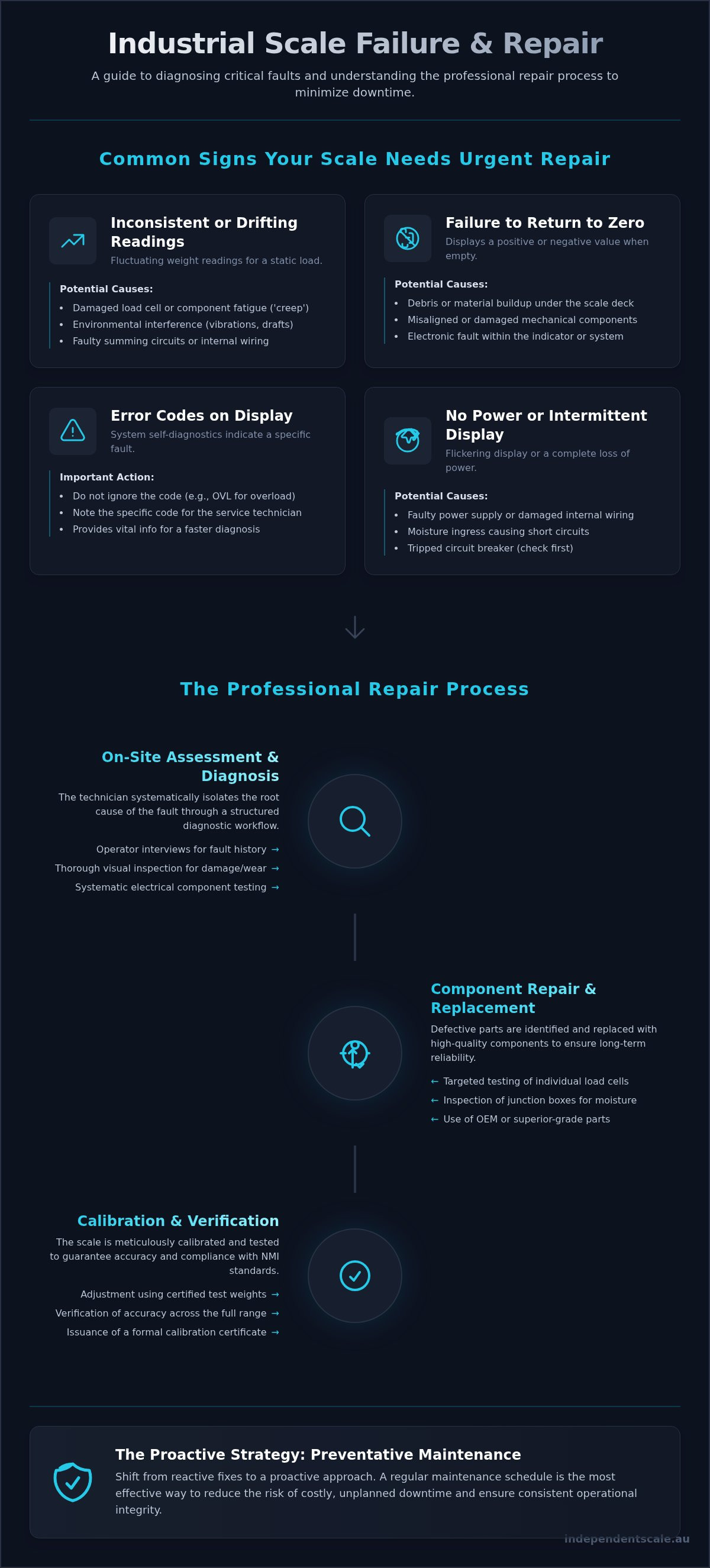
In a high-stakes industrial environment, an inaccurate scale is a direct threat to your operational integrity, compliance, and bottom line. Recognising the early warning signs of malfunction is essential for preventing costly errors and extended downtime. This diagnostic checklist is designed for operators to identify symptoms that require immediate professional assessment. Ignoring these issues can lead to incorrect batching, wasted product, and potential non-compliance with Australia's National Measurement Institute regulations. Prompt action ensures that a minor issue doesn't escalate, saving you time and significant expense on more complex industrial scale repair.
Inconsistent or Drifting Readings
If a static load produces fluctuating or drifting weight readings, it is a critical indicator of a malfunction. This instability points to potential issues such as a damaged load cell, interference from environmental factors like vibration, or a fault within the summing circuits. Understanding the basic principles of how weighing scales work highlights why stable components are essential for accuracy. A related symptom is 'creep'-a gradual change in the reading under a constant load-which often signifies component fatigue and an impending failure.
Failure to Return to Zero
A reliable scale must consistently return to a true zero after a load is removed. If your scale displays a positive or negative value when empty, it compromises every subsequent measurement. Common causes include:
- Debris or material build-up beneath the scale deck.
- Damaged or misaligned mechanical components.
- An electronic fault within the indicator.
A true zero is non-negotiable for accurate batching, inventory control, and trade-approved weighing.
Error Codes on the Display
Modern digital scales are equipped with self-diagnostic systems that communicate faults via error codes. These codes are not to be ignored; they are a direct message from the system that a component is operating outside its specified parameters. When calling for service, be sure to note the specific code displayed (e.g., OVL for overload). This provides our technicians with vital preliminary information for a faster diagnosis, as faulty indicators and displays are a common culprit.
No Power or Intermittent Display
A complete loss of power or a flickering display can halt operations instantly. While it is prudent to perform basic checks like ensuring the power cable is secure and the circuit breaker has not tripped, these symptoms often point to more serious internal problems. A faulty power supply, damaged internal wiring, or moisture ingress can cause such failures. For safety and to prevent further damage, electrical diagnostics and repairs must be performed by a qualified technician undertaking professional industrial scale repair.
The Professional Industrial Scale Repair Process Explained
A successful industrial scale repair is not a quick fix; it is a methodical, diagnostic process designed to restore accuracy, ensure compliance, and minimise future downtime. Unlike a superficial parts replacement, a professional service visit follows a structured workflow that addresses the root cause of the fault. This ensures the repair is both lasting and fully documented, providing you with verifiable proof of your equipment's performance and accuracy.
Step 1: On-Site Assessment and Fault Diagnosis
The process begins the moment our technician arrives on-site. The first step is to gather critical information from your operators about the scale's recent performance and the nature of the fault. This is followed by a thorough visual inspection to identify any obvious mechanical damage, signs of corrosion, wear on critical components, or environmental factors that could be impacting the scale. Finally, the technician performs systematic testing of all electrical and electronic components, from power supplies to indicators, to isolate the source of the malfunction.
Step 2: Component Testing and Replacement
Once the general fault area is identified, we conduct targeted component-level testing. This involves individually checking each load cell for correct output and resistance, as a single faulty cell can compromise the entire system. Summing circuits and junction boxes are also meticulously inspected for moisture ingress, loose connections, or electrical faults. When a component is confirmed as defective, we use only high-quality replacement parts. Sourcing reliable industrial load cells and electronics is essential for ensuring the longevity and accuracy of the repair.
Step 3: Post-Repair Calibration and Verification
A repair is incomplete without comprehensive calibration. After replacing any components, the scale must be recalibrated to ensure it meets legal-for-trade or internal quality standards. Our technicians use NATA-certified test masses to verify accuracy across the scale's entire weighing range. This level of documentation is critical for compliance and aligns with international standards, such as the federal equipment calibration regulations that mandate meticulous record-keeping. Upon completion, we provide a detailed service report and a NATA calibration certificate, which is essential for quality assurance audits, especially in regulated systems like concrete batching plants operating under AS 1379.
Specialised Repair Services for Heavy-Duty Equipment
Heavy-duty weighing systems are the backbone of Australian construction, logistics, and manufacturing operations. Each system, from a 60-tonne weighbridge to a precision batching plant scale, has unique mechanical and electronic failure points. Effective industrial scale repair demands specialised expertise to diagnose and rectify issues quickly, minimising operational downtime and financial loss for our clients.
Our technicians possess deep, industry-specific knowledge, allowing for rapid fault-finding and durable repairs across a range of complex equipment.
Weighbridge and Truck Scale Repair
A malfunctioning weighbridge can halt an entire supply chain. Our technicians are experienced in addressing the common and complex faults that affect these critical assets. Key service areas include:
- Load Cell Damage: Diagnosing and replacing cells damaged by vehicle impact, moisture ingress, or electrical faults.
- Environmental Factors: Rectifying issues caused by pit flooding, debris accumulation, and lightning strikes through robust repairs and the installation of surge arrestors.
- Structural Integrity: Conducting comprehensive checks on foundations, decks, and structural steel to ensure long-term safety and accuracy.
Hopper, Tank, and Silo Weighing Systems
These systems operate in harsh environments where external forces can compromise accuracy. Our repair services focus on isolating the weighing assembly from these influences. We diagnose and correct problems caused by side-loading from attached pipework, material build-up, and thermal expansion. This includes the precise repair or replacement of mounting assemblies and checking rods to ensure the vessel is weighing freely and accurately.
Concrete Batching Plant Weighing Systems
For the Australian concrete industry, accuracy is directly linked to compliance. Our primary goal is to ensure your aggregate, cement, water, and admixture scales are repaired to meet the stringent requirements of Australian Standard AS 1379. Our comprehensive industrial scale repair service for batching plants includes troubleshooting faulty load cells, rectifying indicator programming errors, and resolving complex issues with automated batching controllers to restore compliant, efficient production.
How to Choose a Reliable Industrial Scale Repair Provider
When a critical piece of weighing equipment fails, the focus shifts from the problem to the solution. Choosing the right provider for your industrial scale repair is a vital operational decision that impacts compliance, productivity, and profitability. Use the following checklist to vet potential service companies and ensure you partner with a provider that meets the highest standards of technical competence and reliability.
Accreditation and Compliance (NATA & NMI)
Regulatory compliance is non-negotiable in industrial weighing. Verify that any potential provider holds NATA (National Association of Testing Authorities) accreditation to ISO/IEC 17025 for calibration services. This is the national standard, guaranteeing that procedures and reporting are independently audited for technical competence. Furthermore, for any scales used for legal trade, the provider must be licensed by the National Measurement Institute (NMI). Engaging a non-accredited technician can void your certifications, leading to non-compliance and significant operational risk.
24/7 Emergency Availability and Response Time
Every minute of operational downtime directly impacts your bottom line. A premier service provider must offer rapid-response emergency services to minimise disruption. Before engaging a company, ask critical questions:
- Do they provide genuine 24/7 emergency, after-hours service?
- What are their guaranteed response times for critical failures?
- Do they have sufficient service coverage in key industrial areas like Sydney and Melbourne to ensure a fast on-site presence?
Technician Experience and Parts Availability
The effectiveness of any repair depends on the technician's expertise and their access to necessary components. A qualified provider employs technicians with extensive experience across a wide range of scale brands and models, from weighbridges to hopper scales. Their service vehicles must be well-stocked with common spare parts to facilitate first-visit fixes. Inquire about their supply chain and access to a comprehensive inventory of load cells, indicators, and summing circuits to avoid lengthy delays.
Our experienced technicians are on call 24/7. Request emergency service.
Preventative Maintenance: The Best Way to Avoid Costly Repairs
While our team provides rapid on-site industrial scale repair services 24/7, the most effective strategy for minimising operational downtime and protecting your investment is a proactive one. Shifting focus from reactive repairs to a structured preventative maintenance program is a critical business decision that reduces long-term expenditure and ensures consistent operational output. A well-maintained scale is a reliable and compliant asset.
Implementing a maintenance schedule identifies potential failures before they occur, transforming unpredictable, high-cost emergencies into manageable, budgeted events. The following practices form the foundation of an effective scale maintenance strategy.
Scheduled Calibration and Inspection
Regular professional assessments are essential for sustained accuracy and compliance. We recommend a scheduled calibration check at least annually, or more frequently depending on usage and industry regulations. During these inspections, our expert technicians can identify minor issues such as load cell drift, cable wear, or moisture in a junction box before they escalate into a complete system failure. This ensures your equipment remains accurate and compliant with standards like ISO/IEC 17025. Learn more about our weighing scale calibration services.
Routine Cleaning and Housekeeping
One of the most effective yet overlooked maintenance tasks is simple housekeeping. Debris, mud, and material build-up around and under a scale deck or platform can significantly impact performance. This accumulation can restrict the scale’s movement, leading to inaccurate readings, or cause physical damage to critical components like load cells and mounting hardware. Ensuring these areas remain clear is a simple, no-cost way to extend the life of your equipment.
Operator Training and Best Practices
Your equipment operators are the first line of defence against mechanical damage. Proper training is crucial for preventing the common causes of premature scale failure. Key practices include:
- Avoiding Shock Loading: Training staff to place loads gently onto the scale, rather than dropping them, prevents sudden force that can damage sensitive load cells.
- Preventing Overloading: Ensure all operators are aware of the scale’s maximum capacity and adhere to it strictly to avoid structural strain.
- Identifying Early Warnings: Teach operators to recognise and report issues immediately, such as drifting weight readings, display error codes, or visible damage to the platform or cables.
By integrating these practices and establishing a formal service agreement with Independent Scale Service, you can significantly reduce the likelihood of needing emergency industrial scale repair. Contact us to discuss a preventative maintenance plan tailored to your specific operational needs at independentscale.au.
Ensure Operational Continuity with Expert Scale Repair
Recognising the early warning signs of equipment failure-from inaccurate readings to physical damage-is the first critical step to preventing significant operational delays. As we've detailed, a proactive approach combining diligent monitoring with a structured preventative maintenance schedule is the most effective strategy to minimise costly downtime. However, when breakdowns are unavoidable, swift and expert industrial scale repair is not just a fix; it's an essential service to restore your operational accuracy and compliance.
Choosing a reliable provider is paramount. With over 30 years of dedicated industry experience and full NATA Accreditation to ISO/IEC 17025, Independent Scale Service delivers the certified technical competence your critical operations demand. Our proven processes ensure your equipment is returned to service meeting all regulatory and performance standards.
Don't let a faulty scale compromise your productivity. For immediate assistance, our 24/7 Emergency Breakdown Service is ready to respond. Need Urgent Industrial Scale Repair? Contact Our 24/7 Emergency Team Now. Secure your uptime and maintain the integrity of your operations.
Frequently Asked Questions About Industrial Scale Repair
How quickly can you respond to an emergency scale breakdown in Sydney or Melbourne?
We operate a 24/7 emergency breakdown service to minimise critical operational downtime. For clients within the Sydney and Melbourne metropolitan areas, our technicians are typically dispatched and on-site within 2-4 hours of your call. Response for regional locations is scheduled for the earliest possible time. Our primary objective is to restore your weighing equipment to full operational capacity with maximum efficiency and technical precision.
What does it mean if a scale repair service is NATA accredited?
NATA (National Association of Testing Authorities) accreditation to ISO/IEC 17025 confirms a company's technical competence and quality management systems meet the highest national and international standards. For scale calibration and repair, this is your assurance that our procedures, equipment, and personnel are rigorously audited for accuracy and traceability. A NATA-endorsed report provides legally defensible proof of your scale’s performance and compliance.
Is it more cost-effective to repair or replace my industrial scale?
The decision depends on the scale's age, the nature of the fault, and the cost of replacement components versus a new system. Minor electronic or mechanical faults are typically cost-effective to repair. However, if a critical structural component fails or multiple load cells on an older weighbridge require replacement, the cost may justify a new installation. Our technicians provide a full diagnosis and a transparent cost-benefit analysis to inform your decision.
Do you service and repair all brands of weighing equipment?
Yes. Our technicians possess over 30 years of industry experience and are proficient in servicing and repairing equipment from all major manufacturers, including Mettler Toledo, Avery Weigh-Tronix, Rinstrum, and Ultrahawk. We maintain an extensive inventory of common spare parts to ensure we can provide an effective industrial scale repair solution for your entire facility, regardless of the original equipment manufacturer (OEM).
What documentation do I receive after a scale repair and calibration?
Upon completion of any work, you will receive a detailed Service Report that documents the faults identified, the corrective actions performed, and any parts that were replaced. If a calibration was conducted, you will also be issued a formal Calibration Certificate. For NATA calibrations, this is a NATA-endorsed certificate detailing the "as found" and "as left" accuracy, ensuring your records are complete for quality assurance and regulatory audits.
Can you repair the load cells in my weighbridge or silo?
Load cells are hermetically sealed electronic components and are not typically repairable in the field; a faulty cell must be replaced. Our diagnostic process precisely identifies the failing load cell, inspects associated cabling and summing circuits, and verifies the integrity of surge protection. We then supply and install a high-quality replacement and perform a full system recalibration to ensure the weighbridge or silo returns to accurate and reliable operation.
