


Industrial Scale Repair Services: Minimising Downtime and Ensuring Compliance in 2026
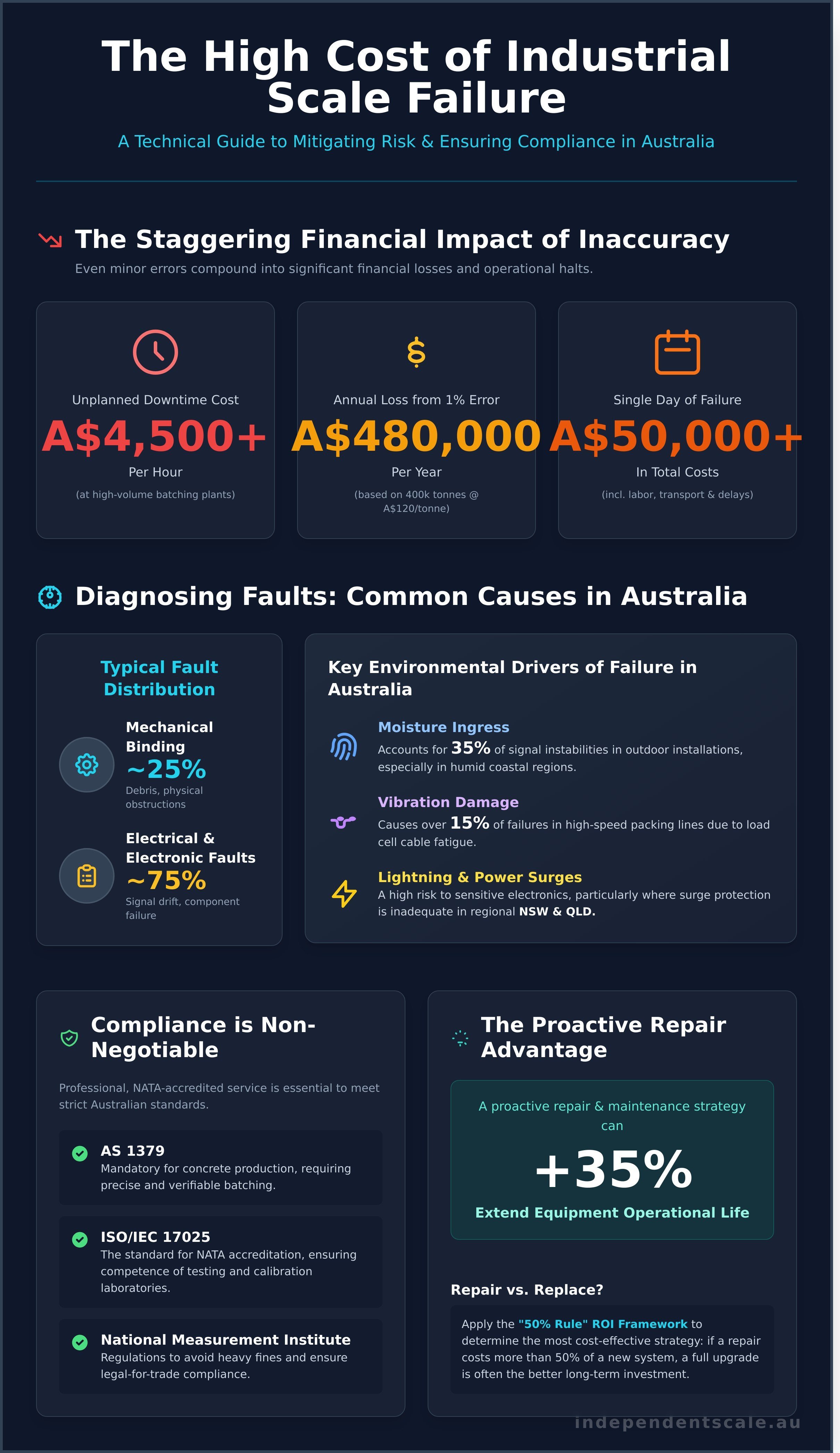
A single hour of unplanned downtime at a high-volume batching plant often results in over A$4,500 in lost revenue and wasted transit mixers. You recognise that weighing inaccuracies do more than just skew your inventory; they threaten your NATA accreditation and risk non-compliance with AS 1379 standards. Securing reliable scale repair services is the only way to mitigate these risks before they compound into a total operational halt.
This guide delivers a technical breakdown for diagnosing complex electronic and mechanical faults in industrial weighing systems. You'll learn to identify failing load cells, troubleshoot summing circuits, and navigate the specific documentation required for ISO/IEC 17025 audits in 2026. We'll also detail how a proactive repair strategy can extend your equipment's operational life by 35% while ensuring every batch meets the precision required for Australia's most rigorous infrastructure projects.
Key Takeaways
- Learn to distinguish between mechanical binding and electrical failures to mitigate the high operational costs associated with even a 1% weighing inaccuracy.
- Apply the "50% Rule" ROI framework to determine when to invest in professional scale repair services and when a full system upgrade is the more cost-effective strategy.
- Navigate the strict requirements of AS 1379 and ISO/IEC 17025 to ensure your concrete batching plant remains compliant with Australian NATA standards.
- Identify how unique Australian environmental factors, such as moisture ingress and lightning strikes, specifically impact the lifespan of load cells and electronic components.
The Critical Impact of Scale Repair Services on Industrial Productivity
Industrial scale repair is a specialized technical discipline required for high-capacity weighing systems. It's not a simple mechanical fix; it's a precision-engineered restoration of system integrity. By 2026, the Australian industrial landscape will demand unprecedented accuracy as raw material costs and regulatory scrutiny increase. Precision is now a primary competitive necessity for any operation handling bulk commodities. A weighing scale that hasn't been professionally serviced becomes a liability rather than an asset.
The financial cost of inaccuracy is staggering. A mere 1% calibration error in a facility processing 400,000 tonnes of material annually leads to 4,000 tonnes of "lost" or over-delivered product. If that material is valued at A$120 per tonne, the business loses A$480,000 every year. These errors also compromise product quality, leading to batch failures in concrete production or chemical blending. Accuracy is the difference between a profitable quarter and a significant operational deficit.
Quantifying downtime reveals an even sharper financial ripple effect. In a mining operation or a high-volume concrete batching plant, a halted scale stops the entire production chain. Downtime costs in these sectors typically range from A$2,500 to A$6,000 per hour. When you factor in transport delays, labor costs for idle crews, and missed delivery windows for major infrastructure projects, a single day of failure can cost upwards of A$50,000. Professional scale repair services minimize these risks through rapid intervention and preventative maintenance protocols.
The need for rapid, expert technical repair to prevent catastrophic downtime is a universal challenge in heavy industry. This issue is just as critical in global maritime logistics, where a single vessel's delay at a chokepoint like the Panama Canal can disrupt entire supply chains. To see how these principles apply in a different but equally demanding environment, you can learn more about Panama Ship Service.
Why Professional Intervention Outperforms In-House Fixes
Relying on in-house maintenance for legal-for-trade equipment is a high-risk strategy. Standard multimeters lack the sensitivity to test load cell bridge resistance or insulation integrity accurately. Professional technicians use specialized simulators and test weights traceable to national standards. This creates the essential paper trail required for ISO 9001 and NATA audits. Without NATA accreditation to ISO/IEC 17025, your repairs won't satisfy Australian regulatory requirements or AS 1379 standards for concrete production.
Common Signs Your Industrial Weighing System is Failing
Identifying failure early prevents catastrophic shutdowns. Drifting measurements, where the zero point shifts over hours, signal a slow creep of inaccuracy. Non-repeatability is equally dangerous; if the same load yields different weights, your load cells or summing circuits are likely compromised. Watch for indicators that "hunt" for a stable reading or display erratic error codes. These signals indicate that your electronics require immediate scale repair services to maintain site compliance and avoid heavy fines under National Measurement Institute regulations.
Technical Fault Diagnosis: Identifying Load Cell and Electronic Failures
Professional scale repair services begin with a rigorous protocol to isolate mechanical binding from electrical failures. Mechanical issues often involve physical obstructions, such as debris packed under a weighbridge or structural binding in a silo scale. These faults account for approximately 25% of weighing inaccuracies encountered in industrial settings. Electrical faults, however, manifest as signal drift, "ghost" weights, or erratic digital displays that don't settle. Distinguishing between these two categories is the first step in minimising downtime and avoiding unnecessary component replacement.
In Australia, environmental factors are a primary driver of equipment failure. Moisture ingress into junction boxes causes roughly 35% of signal instabilities in outdoor installations, particularly in humid coastal regions. Lightning strikes and power surges also pose high risks to sensitive electronics, especially in regional New South Wales and Queensland where surge protection is often inadequate. Vibration damage is another factor in Australian manufacturing plants. Constant mechanical oscillation can lead to fatigue in load cell cables, with over 15% of failures in high-speed packing lines attributed to vibration-induced lead wire fatigue. Beyond technical solutions, managing the financial impact of such unpredictable events is also crucial; to understand how comprehensive coverage can protect against these operational risks, you can learn more about AllCover Insurance Brokers.
Diagnostic procedures must be methodical to be effective. Technicians first verify the excitation voltage from the indicator, which is usually between 5V and 10V DC. They then assess the summing circuit. Signal degradation frequently occurs within the junction box due to terminal oxidation or failing potentiometers. All diagnostic work and subsequent recalibration must align with the standards defined by Australian measurement legislation to maintain legal trade compliance and ensure NATA-accredited accuracy.
Load Cell Diagnostics and Testing Protocols
Zero balance testing is a critical diagnostic step where the technician measures the millivolt output of the load cell at a no-load state. A healthy load cell should return a zero balance within +/- 1% of its rated output. If the reading exceeds this threshold, the internal strain gauge bridge is likely permanently deformed by an overload event. Technicians also measure bridge resistance. For a standard 350-ohm load cell, the input resistance should read between 350 and 450 ohms. Insulation resistance testing is equally vital for identifying moisture contamination. Technicians use a megohmmeter to check the resistance between the bridge circuit and the load cell body. A reading below 5,000 Megohms confirms that moisture has breached the cable or connector seals. Physical inspection often reveals "bottoming out", where the load cell gap is closed by debris or structural shifts. Explore our range of industrial load cells for replacement options.
Indicator and Controller Troubleshooting
When the load cell tests pass, the focus shifts to the digital indicator and controller. Technicians must determine if a fault is a software glitch or a hardware failure on the PCB. Industrial environments often suffer from "dirty power", which refers to voltage spikes and frequency noise that disrupt precision electronics. These spikes can lead to 10% more frequent hardware failures in plants without dedicated surge arrestors. Communication errors across RS232, RS485, or Ethernet protocols often stem from cable interference or incorrect baud rate settings in the controller software. For systems requiring high uptime, Browse professional indicators and displays that offer robust shielding and diagnostic logging. If your system continues to show instability, a professional assessment of your weighing infrastructure can identify hidden bottlenecks and prevent costly downtime. Our team brings over 30 years of experience to every onsite diagnostic call, ensuring your equipment meets the highest accuracy standards.
Evaluating Scale Repair vs. Component Replacement: An ROI Framework
Decision-making for industrial weighing maintenance requires a clinical assessment of Return on Investment (ROI). We apply the '50% Rule' as a primary benchmark for our clients. If a quote for scale repair services exceeds 50% of the capital expenditure required for a modern system, the asset has likely reached its economic limit. For example, spending A$8,000 to refurbish a 15-year-old weighbridge with analog components is often less cost-effective than investing A$16,000 in a new digital system. Legacy equipment carries hidden costs that go beyond the initial invoice. Sourcing proprietary parts for indicators manufactured before 2010 can take weeks, and the labor hours required to troubleshoot complex analog summing circuits are significantly higher than for modern plug-and-play digital interfaces.
The technological gap between old and new hardware is substantial. Modern digital load cells convert weight data into a signal directly at the sensor, which eliminates the signal degradation common in analog cables. This provides 25% better signal stability in environments with high electromagnetic interference. When calculating the Total Cost of Ownership (TCO) over a 5-year maintenance cycle, new systems typically outperform repaired legacy units. A new installation often reduces the frequency of emergency call-outs by 60%, allowing for a predictable preventative maintenance schedule that aligns with AS 1379 and NATA requirements. Accurate data from the NIST Handbook 44 confirms that maintaining tight tolerances is significantly easier with modern hardware that features built-in diagnostic capabilities.
When to Opt for Professional Component Repair
Component repair is the logical choice when the structural integrity of the scale remains high and the faults are isolated. If a system fails a NATA-accredited test due to minor calibration shifts, gravimetric methods using certified test weights can usually restore accuracy without hardware changes. We focus on replacing specific high-wear peripherals to extend system life. This includes:
- Installing essential junction boxes and surge arrestors for system protection to mitigate lightning damage.
- Replacing frayed or rodent-damaged cabling with rodent-proof, stainless steel braided alternatives.
- Performing structural repairs to hopper mounts and silo supports that don't involve the load-bearing sensors themselves.
- Swapping out malfunctioning summing boards while keeping existing load cells intact.
When System Replacement is the Superior Strategy
System replacement is a strategic necessity when repeated failures occur. If scale repair services are required for the same component more than twice in a 12-month period, it indicates a fundamental design flaw or that the equipment is no longer suited for the current workload. Obsolescence is the most common driver for replacement in the Australian concrete and mining sectors. Many older indicators cannot be programmed to integrate with modern PLCs or cloud-based reporting software, creating a data bottleneck. Upgrading provides several immediate advantages:
- Superior hygiene and durability by moving to tank and silo weighing assemblies designed for harsh wash-down environments.
- Full compatibility with modern automation protocols, allowing for real-time inventory tracking.
- Elimination of "ghosting" and signal drift caused by moisture ingress in old analog junction boxes.
- Compliance with the latest ISO/IEC 17025 standards, ensuring your facility passes every external audit.
Compliance and Standards: Navigating AS 1379 and NATA Requirements
Compliance in industrial weighing is a matter of legal necessity and structural integrity. For concrete batching plants across Australia, AS 1379 is the non-negotiable standard. It dictates the strict tolerances required for every ingredient in a concrete mix. If your scales fall outside these tolerances, the structural grade of the concrete is compromised. This leads to rejected loads, site shutdowns, and significant financial liability. Our scale repair services ensure that every component, from load cells to summing circuits, functions within these tight margins.
ISO/IEC 17025 accreditation through NATA is the benchmark for technical competence. There's a critical distinction between a standard service report and a NATA-endorsed calibration certificate. A service report confirms that maintenance was performed. A NATA certificate provides a calculated uncertainty of measurement and maintains a clear chain of traceability to national standards. For high-stakes industrial environments, the latter is the only document that stands up to rigorous legal and forensic scrutiny.
Legal-for-trade requirements are governed by the National Measurement Institute (NMI). If you sell product based on weight, your equipment must be NMI-approved and verified. Using non-compliant equipment for trade is a breach of the National Measurement Act 1960. We ensure your assets meet these statutory obligations through precise testing and verification protocols.
This focus on precise, legally-mandated standards extends beyond just equipment. A comprehensive approach to industrial operations also includes rigorous health, safety, and environmental compliance to prevent costly incidents and ensure a safe working environment. To see how specialized consultancies handle this side of industrial risk management, you can learn more about AFN Industrial Services Ltd.
Concrete Batching Plant Calibration and Repair Specifics
Most major Australian infrastructure projects and site specifications from companies like Holcim, Boral, and Hanson mandate a strict 6-month calibration cycle. Adhering to this frequency is essential for maintaining operational status. We provide specialized concrete batching plant calibration and AS 1379 compliance to keep your facility running without interruption.
Gravimetric testing is the industry standard for verifying aggregate and cement weigh hoppers. This method involves applying known, traceable masses to the scale to check accuracy across its full operational range. It's the only way to identify non-linear errors or friction issues in the hopper suspension. With over 30 years of experience servicing 98% of concrete plants across Sydney, we understand the specific wear patterns that affect these critical weighing points.
Documentation and Audit Readiness
A compliant calibration report must be detailed and data-heavy. It's not enough to state that a scale is "accurate." The documentation must include the "as found" and "as left" data, the uncertainty of measurement, and the environmental conditions at the time of testing. This level of detail is what auditors look for during a NATA or ISO audit. If your documentation lacks these specifics, your entire quality management system is at risk.
Managing an asset register is vital for large-scale industrial sites with 50 or more weighing points. We help clients track the service history and compliance status of every scale on-site. This proactive approach ensures you're never caught with expired certificates during an unannounced audit. Preparing for a NATA audit requires all repairs to be documented according to strict protocols, including the use of certified test weights and verified procedures. We maintain these records meticulously to ensure our clients remain 100% audit-ready at all times.
Ensure your equipment meets all Australian regulatory standards today. Contact Independent Scale Service for NATA-accredited calibration
Emergency 24/7 Scale Repair and Maintenance Solutions
Industrial operations in New South Wales don't adhere to a standard nine-to-five schedule. Logistics hubs and 24-hour manufacturing facilities require weighing equipment that performs consistently under heavy duty cycles. A single equipment failure at a Sydney concrete plant can stall an entire construction project, costing thousands of dollars per hour in lost productivity. Independent Scale Service addresses this risk by providing 24/7 scale repair services designed for rapid response and technical precision.
Our commitment to the industry is evidenced by our 98% service coverage for concrete plants across the Sydney region. We understand the specific demands of AS 1379 compliance and the critical nature of accurate batching. With over 30 years of Australian industrial experience, our technicians arrive on-site with the diagnostic tools and spare parts necessary to resolve faults during the first visit. We focus on minimising downtime because we know that in high-volume logistics, every minute of inactivity impacts the bottom line.
Transitioning from a reactive to a predictive service model is the most effective way to manage operational costs. Reactive maintenance occurs after a failure; this often results in emergency repair fees and unplanned stoppages. Conversely, our predictive model utilises scheduled inspections to identify components showing signs of stress or drift. By monitoring the health of load cells and summing circuits, we replace failing parts during planned maintenance windows. This ensures your facility stays operational when demand is highest.
Strategic Maintenance to Prevent Emergency Breakdowns
Preventative maintenance involves a rigorous assessment of the weighing system's physical and electronic health. Our technicians perform detailed inspections to identify mechanical wear, structural corrosion, and cable fatigue. Given the volatility of the Australian climate, environmental hardening is essential. This includes protecting sensitive electronics from moisture ingress and extreme heat. For heavy-duty applications, we integrate special purpose shackle pins and accessories for heavy-duty environments to ensure the system remains robust under maximum load capacities.
Partnering with Independent Scale Service
Choosing Independent Scale Service means gaining access to NATA-accredited expertise. Our technicians manage the full repair lifecycle, from initial fault find to final verification. We operate a fleet of mobile calibration units equipped with heavy-duty test weights, allowing us to perform high-capacity testing on-site. This ensures all scale repair services meet ISO/IEC 17025 standards and legal metrology requirements. We provide the technical assurance required by Tier 1 contractors and infrastructure providers across Australia.
Reliable weighing equipment is the foundation of your quality control process. Don't let a technical fault disrupt your supply chain. Contact Independent Scale Service for 24/7 emergency repairs or scheduled maintenance to keep your operations running at peak accuracy.
Secure Operational Continuity and Regulatory Compliance
Maintaining industrial weighing accuracy is a critical component of operational efficiency. In 2026, the financial impact of even minor measurement errors is significant, making professional scale repair services an essential investment rather than an optional expense. Adhering to AS 1379 and ISO/IEC 17025 standards ensures your facility meets rigorous NATA requirements while avoiding costly legal penalties or production halts. Independent Scale Service brings over 30 years of industrial weighing expertise to every site. We currently service 98% of Sydney's concrete plants, providing the technical competence needed to resolve load cell failures immediately. Our NATA accreditation to ISO/IEC 17025 guarantees that your equipment remains precise and compliant. Don't let equipment failure compromise your output or regulatory status.
Book an Emergency Scale Repair or NATA Calibration Service Today to eliminate downtime and keep your facility running at peak performance.
Frequently Asked Questions
How quickly can you respond to a scale breakdown in Sydney or Melbourne?
We provide 24/7 emergency response for scale repair services across Sydney and Melbourne to minimize client downtime. Our technicians typically arrive on-site within 2 to 4 hours for urgent breakdowns in metropolitan areas. This rapid response is critical for the 98% of Sydney concrete plants we service, including major sites for Boral and Holcim. We maintain a fleet of fully equipped service vehicles to ensure immediate repairs and technical support.
Is your scale repair service NATA accredited to ISO/IEC 17025?
Yes, Independent Scale Service is NATA accredited to ISO/IEC 17025 for a wide range of weighing equipment. This accreditation confirms our technical competence and the precision of our calibration results. We strictly adhere to these international standards to provide valid, traceable certificates that meet audit requirements for industrial and laboratory environments. Our 30 years of experience ensures every calibration meets the highest regulatory benchmarks.
What is the difference between AS 1379 and general scale calibration?
AS 1379 specifically governs the specification and manufacture of concrete, requiring gravimetric method calibration for all batching plant scales. General scale calibration follows broader ISO/IEC 17025 guidelines but doesn't always meet the rigorous 0.5% accuracy tolerance required by the concrete industry. We perform AS 1379 inspections every 6 months for major producers like Hanson to ensure total compliance with Australian building standards and material quality requirements.
Can you repair weighing indicators from different manufacturers?
We repair weighing indicators from all major manufacturers including Rinstrum, Rice Lake, Mettler Toledo, and Gedge. Our technicians carry a comprehensive inventory of spare parts to resolve issues with summing circuits and digital displays on-site. Since we service diverse industrial sectors, we're equipped to handle proprietary software and hardware configurations across various brands. This multi-brand capability reduces the need for multiple service providers and simplifies your maintenance workflow.
How often should industrial hoppers and silos be calibrated for compliance?
Industrial hoppers and silos should be calibrated every 6 to 12 months to maintain compliance and operational accuracy. For plants operating under AS 1379, a mandatory 6 month interval applies to ensure batching precision. Regular testing prevents cumulative errors that lead to material waste or structural non-compliance. We've managed 500+ calibration schedules annually for over three decades to keep industrial sites running within legal tolerances and peak efficiency.
What are the most common causes of load cell failure in industrial environments?
Moisture ingress and lightning strikes account for 75% of load cell failures in Australian industrial environments. Water entering the cable entry point or internal strain gauge area causes immediate signal instability and system errors. We install surge arrestors and high-quality junction boxes to mitigate these risks. Mechanical overload and shock loading during material discharge are also frequent causes, often requiring immediate load cell replacement to restore system integrity.
Do you provide temporary weighing solutions while a scale is being repaired?
We offer a range of hire scales and temporary weighing equipment to keep your operations running during extensive scale repair services. Our inventory includes platform scales, crane scales, and counting scales available for immediate deployment. Providing these loan units helps clients avoid costly production halts while we source specialized parts or perform complex workshop repairs. This service is a standard part of our commitment to minimizing business downtime.
Can you perform legal-for-trade verification after a major repair?
We perform legal-for-trade verification and re-certification following any major repair or component replacement. As licensed service providers, we ensure your equipment meets the National Measurement Institute (NMI) requirements for commercial transactions. This process includes testing with certified test masses to confirm the scale operates within the Maximum Permissible Error (MPE) limits. We provide all necessary documentation to satisfy regulatory inspectors and internal quality audits.
