


Industrial Scale Calibration NSW: The Authoritative Guide to Compliance and Accuracy
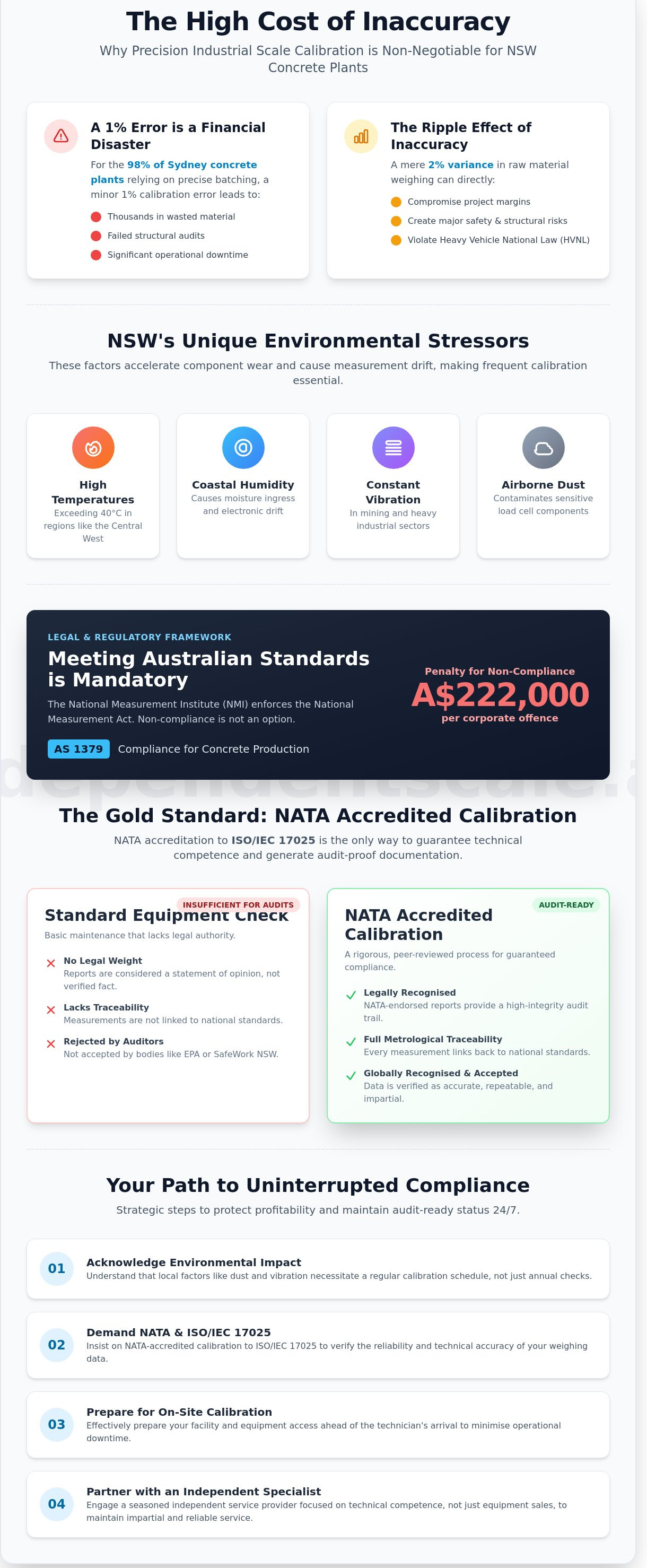
For the 98% of Sydney concrete plants that rely on precise batching, a calibration error of just 1% can result in thousands of dollars in wasted material and failed structural audits. You know that in high-volume production, even a minor measurement drift leads to significant operational downtime and potential safety risks. Securing reliable industrial scale calibration NSW is essential to maintaining the rigorous standards required by major contractors like Holcim and Boral.
This authoritative guide details how to achieve full NATA-endorsed certification and meet AS 1379 compliance without interrupting your 24/7 operations. We've spent over 30 years refining these processes to ensure technical competence and reliability in every measurement. You'll learn the specific technical requirements of ISO/IEC 17025 and the exact gravimetric methods used to ensure your weighing equipment remains audit-ready at all times. We provide the technical evidence and structured approach you need to solve critical weighing problems and eliminate the risk of non-compliance.
Key Takeaways
- Understand how local environmental factors like dust and vibration necessitate regular industrial scale calibration NSW to ensure continuous regulatory compliance.
- Learn why NATA accreditation and ISO/IEC 17025 standards are critical for verifying the reliability and technical accuracy of your weighing data.
- Master the specific calibration requirements for concrete batching plants, focusing on AS 1379 compliance and the gravimetric testing method.
- Discover how to effectively prepare your facility for on-site calibration to minimize operational downtime and protect plant profitability.
- Identify the strategic advantages of partnering with a seasoned independent service provider to maintain audit-ready status for all industrial weighing equipment.
The Role of Industrial Scale Calibration in NSW Regulatory Compliance
Industrial scale calibration NSW is the formal process of comparing the performance of weighing equipment against a known, traceable standard. This procedure determines the accuracy of the device and identifies any deviation from required specifications. For professionals seeking a technical understanding calibration, it's the foundation of metrological traceability. It ensures that a kilogram measured in a Sydney manufacturing plant is identical to a kilogram measured anywhere else in the world.
Operating environments across New South Wales present unique challenges for precision instruments. High ambient temperatures in the Central West often exceeding 40°C, humidity in coastal regions, and constant vibration in mining sectors accelerate component wear. These conditions cause load cells to drift, making frequent weighing scale calibration a technical necessity rather than an optional service. It's vital to distinguish between calibration and verification. While calibration assesses and adjusts the instrument, verification is a legal certification required for equipment used in trade, ensuring it meets the strict criteria defined by Australian law.
Why NSW Industries Demand High-Precision Weighing
Inaccurate measurements have immediate financial consequences. In the construction and civil engineering sectors, a 2% variance in raw material weighing can compromise project margins and lead to significant material waste. Precision is also a safety requirement. Overloaded silos or vehicles pose structural risks and violate the Heavy Vehicle National Law (HVNL). Maintaining accurate records via NATA-accredited calibration is essential for companies operating under ISO 9001 quality management systems, providing the documented proof of accuracy required during external audits.
The Legal Framework: NMI and Trade Measurement
The National Measurement Institute (NMI) regulates weighing standards across Australia. Any scale used to determine the price of goods must be "Legal for Trade" and verified by a licensed service provider. In NSW, heavy industry must adhere to specific standards like AS 1379 for concrete production. Using unverified equipment for commercial transactions is a breach of the National Measurement Act 1960. Penalties for non-compliance are severe, with corporate fines reaching up to A$222,000 per offence. To maintain compliance, facilities must ensure their concrete batching plants are AS 1379 compliant through regular, documented testing and maintenance.
Understanding NATA Accreditation and ISO/IEC 17025 Standards
NATA accreditation is the primary indicator of technical competence for laboratories across Australia. For businesses requiring industrial scale calibration NSW, selecting a provider accredited to ISO/IEC 17025 isn't just a preference; it's a regulatory necessity. This international standard specifies the requirements for the competence, impartiality, and consistent operation of testing and calibration laboratories. It ensures that the data produced during a calibration event is accurate, repeatable, and globally recognized. When a technician performs a NATA-accredited calibration, they're following a rigorous, peer-reviewed process that minimizes human error and equipment bias.
NSW auditors from bodies such as the EPA or SafeWork NSW prioritize NATA-endorsed reports because they provide a transparent, high-integrity audit trail. These reports confirm that the technician has been independently assessed and that the equipment used is fit for purpose. Without this accreditation, a calibration report is merely a statement of opinion rather than a verified technical document. In high-stakes sectors like the concrete industry, where ISS services 98% of plants across Sydney, adherence to these standards is what prevents costly batching errors and structural failures.
Accredited Calibration vs. Standard Equipment Checks
A standard equipment check often results in a simple service sticker or a basic report. While useful for routine maintenance, these documents lack the legal weight of a NATA-accredited report. Accredited calibration requires strict adherence to documented procedures and environmental controls. Traceability is a core requirement; every measurement must link back to national standards maintained by the National Measurement Institute (NMI). This chain of custody mitigates risk during legal disputes or insurance claims. If a batching error occurs, having an accredited report proves that the equipment was compliant at the time of testing. Key differences include:
- Documentation: NATA reports include detailed uncertainty data, whereas service stickers only show a "pass/fail" status.
- Legal Standing: Accredited reports are recognized by Australian courts as evidence of technical due diligence.
- Technician Competence: Field technicians are regularly audited by NATA to prove they possess the skills to perform complex industrial scale calibration NSW.
The Importance of Traceable Test Masses
Professional calibration relies on the use of certified test weights. These masses must be regularly calibrated themselves to ensure their "true" weight remains within specific tolerances. Technical competence also involves calculating the "uncertainty budget." This is a statistical analysis that accounts for variables like air buoyancy, temperature fluctuations, and local gravity. For high-precision industries, understanding these margins is vital for maintaining product quality and profit margins. You can find more details on our specific weighing scale calibration services to see how these standards apply to your facility.
Maintaining compliance is a critical requirement for serious industrial operations. If you're unsure about your current equipment's status, you should review our full range of compliant weighing solutions to ensure your site meets Australian standards and avoids unnecessary downtime.
Specialized Calibration for Concrete Batching Plants and AS 1379
Concrete production in New South Wales is governed by AS 1379, the Australian standard for the specification and supply of concrete. This standard dictates strict tolerances for the measurement of raw materials, including cement, aggregates, water, and chemical admixtures. For any facility providing material to Tier 1 infrastructure projects, adhering to these standards is a legal and structural necessity. Independent Scale Service currently supports 98% of concrete plants in the Sydney region, ensuring their weighing systems remain compliant and operational 24/7.
The relationship between accurate weighing and concrete performance is absolute. If a scale is out of calibration by even a small margin, the water-to-cement ratio is compromised. This leads to issues with compressive strength, workability, and long-term durability. For industrial scale calibration NSW, we focus on eliminating these variables through precise, traceable testing protocols that align with the rigorous demands of the construction industry.
Meeting the Strict Requirements of AS 1379
Compliance with AS 1379 requires regular verification of all weighing equipment. Cement and aggregate scales must be calibrated at specific intervals, typically every six months or as specified by the plant's quality manual. Documentation is a critical component of this process. Every calibration event must produce a detailed report that serves as evidence of compliance during audits. Independent Scale Service provides comprehensive concrete batching plant calibration and repair to keep plants audit-ready. Our technicians verify:
- Cement and fly ash weigh hoppers for zero-point stability and linearity.
- Aggregate scales for repeatability under heavy load conditions.
- Admixture dispensers and water meters for precise dosing.
Our technicians operate under NATA accreditation to ISO/IEC 17025, providing the technical traceability required for legal metrology and high-stakes engineering projects.
Gravimetric vs. Comparative Calibration Methods
When performing industrial scale calibration NSW, the choice of methodology determines the reliability of the data. The gravimetric method is the most accurate approach for liquid flowmeters and hoppers. It involves weighing the actual medium, such as water or admixtures, on a high-precision master scale to verify the meter's reading. This is superior to comparative methods, which may rely on secondary sensors that are prone to drift over time.
Comparative methods often fall short in high-spec construction projects where batch accuracy is scrutinised. Using the gravimetric approach for liquid flowmeter calibration using weighing method provides a level of certainty that volume-based checks cannot match. This technical precision is why major suppliers like Holcim, Boral, and Hanson rely on ISS for their Sydney metropolitan operations. We ensure that every gram of material is accounted for, protecting the integrity of the concrete and the reputation of the supplier.
Preparing for On-Site Calibration to Minimise Industrial Downtime
Industrial scale calibration NSW services are most effective when the site is fully prepared before the technician arrives. Unplanned downtime in high-volume facilities often results in losses exceeding A$5,000 per hour in lost production and wasted labour. Efficient calibration relies on the plant being ready for immediate testing. Independent Scale Service (ISS) leverages over 30 years of experience to streamline this process, ensuring compliance with AS 1379 and ISO/IEC 17025 standards without unnecessary delays.
For 24/7 operations, coordination is the priority. Our emergency 24x7 response team handles urgent repairs, but scheduled servicing prevents these crises. Regular preventative maintenance often extends the reliable interval between formal calibrations. By identifying wear early, you avoid the "out of tolerance" results that force immediate production halts. We currently service 98% of concrete plants across Sydney, where adherence to strict batching schedules is mandatory for profitability.
Before the technician reaches the site, perform basic diagnostics. Check for material buildup around scale pivots or under platforms. These physical obstructions cause 65% of weighing errors before a single electronic component fails. Verify that the scale displays a stable zero and that there's no visible damage to cables or junction boxes. Taking these steps ensures the technician's time is spent on precision adjustment rather than basic cleaning or troubleshooting.
Site Access and Equipment Readiness Checklist
Successful industrial scale calibration NSW requires clear logistical planning. Technicians often arrive with heavy test trucks or specialised lifting equipment requiring stable, level ground.
- Empty and clean all hoppers, silos, and tanks to ensure a true zero reading and accurate span testing.
- Provide clear access for 20-tonne test vehicles or forklifts required to move heavy test masses.
- Complete all site-specific inductions and have Lock-out tag-out (LOTO) permits ready to avoid standby charges.
- Ensure a plant operator is available to run the scale software or batching system during the test.
Managing Load Cell and Component Health
Electronic drift or mechanical binding often mimics calibration errors. Inspecting industrial load cells and assemblies for moisture ingress or cable damage saves significant time during a service call. Our technicians evaluate the integrity of summing circuits and surge arrestors to protect against NSW’s frequent electrical storms and power surges. If a load cell has failed, replacing it before the calibration sequence begins is essential for a valid certificate. We recommend keeping critical spares on-site to reduce the mean time to repair (MTTR) during scheduled visits.
Ensure your equipment meets AS 1379 standards by booking a professional scale calibration today.
Why Independent Scale Service is the NSW Industry Leader
Independent Scale Service (ISS) holds a dominant position in the New South Wales weighing sector, backed by over 30 years of specialized experience in Australian industrial environments. We aren't just another service provider; we're the primary technical partner for 98% of concrete plants across Sydney. Our NATA accreditation to ISO/IEC 17025 guarantees that every industrial scale calibration NSW project meets global accuracy benchmarks. For high-stakes environments like those operated by Holcim, Boral, and Hanson, precision isn't optional. It's a regulatory necessity. We provide the technical competence required to maintain these standards under the most demanding conditions, ensuring your facility avoids the costly pitfalls of non-compliance.
Complete Weighing Solutions: Beyond Calibration
Our expertise extends well past routine checks. We offer end-to-end support that includes the supply and installation of high-performance indicators and displays built specifically for harsh industrial environments. For complex infrastructure, we design and implement custom tank and silo weighing assemblies that integrate seamlessly with existing hardware. Our technicians specialize in expert fault diagnosis, identifying critical electrical or mechanical failures in summing circuits or surge arrestors that others often miss. This methodical approach ensures your industrial scale calibration NSW remains valid and your systems stay compliant with AS 1379 standards.
Responsive Service Across Sydney and Regional NSW
Downtime in critical infrastructure costs thousands of dollars per hour. That's why ISS maintains a 24/7 emergency repair team to service Sydney and regional NSW. We understand the specific pressures of local audits and the rigorous requirements of the National Measurement Institute. Our deep knowledge of NSW-specific regulations means your site stays operational and compliant without the risk of heavy fines or production halts. We don't just fix scales; we provide the assurance that your business meets its legal and operational obligations every day of the year. If your facility requires precision and reliability, contact us today for a NATA-accredited calibration quote.
Secure Your Operational Compliance and Accuracy
Maintaining industrial scale calibration NSW is a non-negotiable requirement for operations demanding precision and legal compliance. Independent Scale Service provides the technical expertise necessary to meet ISO/IEC 17025 standards and AS 1379 requirements for concrete batching plants. We've supported the NSW industrial sector for over 30 years. Our technicians currently service 98% of concrete plants across Sydney, ensuring every measurement stands up to strict regulatory scrutiny.
Don't risk costly downtime or non-compliance penalties. We provide NATA-accredited calibrations and 24/7 emergency support to keep your facility running without interruption. Our methodical approach focuses on gravimetric method calibration and rigorous testing protocols to ensure your equipment remains a reliable asset. By prioritising regular maintenance and professional certification, you protect your bottom line and maintain your reputation for quality.
Request a NATA-Accredited Calibration Quote Today
Your facility deserves the reliability that comes with industry-leading technical expertise.
Frequently Asked Questions
How often should industrial scales be calibrated in NSW?
Industrial scales in NSW should be calibrated every 6 to 12 months depending on your industry and usage frequency. Concrete batching plants must adhere to a strict 6 month interval to remain compliant with AS 1379 standards. Regular industrial scale calibration NSW ensures measurement accuracy and prevents costly production errors in high volume environments.
What is the difference between NATA-accredited and non-accredited calibration?
NATA-accredited calibration provides formal recognition that a facility meets ISO/IEC 17025 international standards for technical competence. Non-accredited services don't offer the same level of traceability or third-party verification. Using a NATA-accredited provider guarantees your results are legally defensible and recognized by global regulatory bodies.
Does my concrete batching plant need to comply with AS 1379?
Yes, every concrete batching plant in Australia must comply with AS 1379-2007 to ensure the quality and consistency of the mix. This standard mandates specific tolerances for weighing systems and requires regular verification by qualified technicians. Failure to comply can result in the rejection of concrete batches on major NSW infrastructure projects.
Can calibration be performed on-site for large silos and hoppers?
Technicians perform on-site calibration for large silos and hoppers using mobile test weights and specialized hydraulic load systems. This process eliminates the need to dismantle equipment, which reduces operational downtime for your facility. Large-scale systems often require 20 tonne test trucks to verify accuracy at high capacities across multiple load points.
What happens if my scale fails a calibration test?
If a scale fails, the technician identifies the mechanical or electronic fault and performs immediate adjustments or load cell repairs. Once the issue is resolved, the unit is re-tested to confirm it meets the required tolerances. You'll receive a report detailing the "as found" and "as left" data to maintain your internal quality compliance records.
Are NATA-endorsed reports required for ISO 9001 certification?
ISO 9001 Section 7.1.5 requires equipment to be calibrated against traceable standards. While not always strictly mandated by the standard itself, NATA-endorsed reports are the most efficient way to satisfy auditors during an inspection. These reports provide clear evidence of traceability to national standards, making the certification process much smoother for industrial scale calibration NSW.
How long does a typical industrial scale calibration take?
A typical calibration takes between 1 and 4 hours depending on the complexity and capacity of the weighing system. Simple platform scales are fast, while large hopper systems with multiple load cells and summing circuits take longer to verify. Technicians focus on efficiency to ensure your operations resume as quickly as possible without compromising on precision.
What is the gravimetric method of calibration for flowmeters?
The gravimetric method is the most accurate way to calibrate flowmeters by weighing the actual mass of liquid passed through the device. This mass is then compared against the volume reported by the meter, accounting for the fluid's specific density. It's a fundamental technique used to ensure high precision in chemical and concrete production environments where volume accuracy is critical.
