


Industrial Scale Calibration Melbourne: The 2026 Compliance & Accuracy Guide
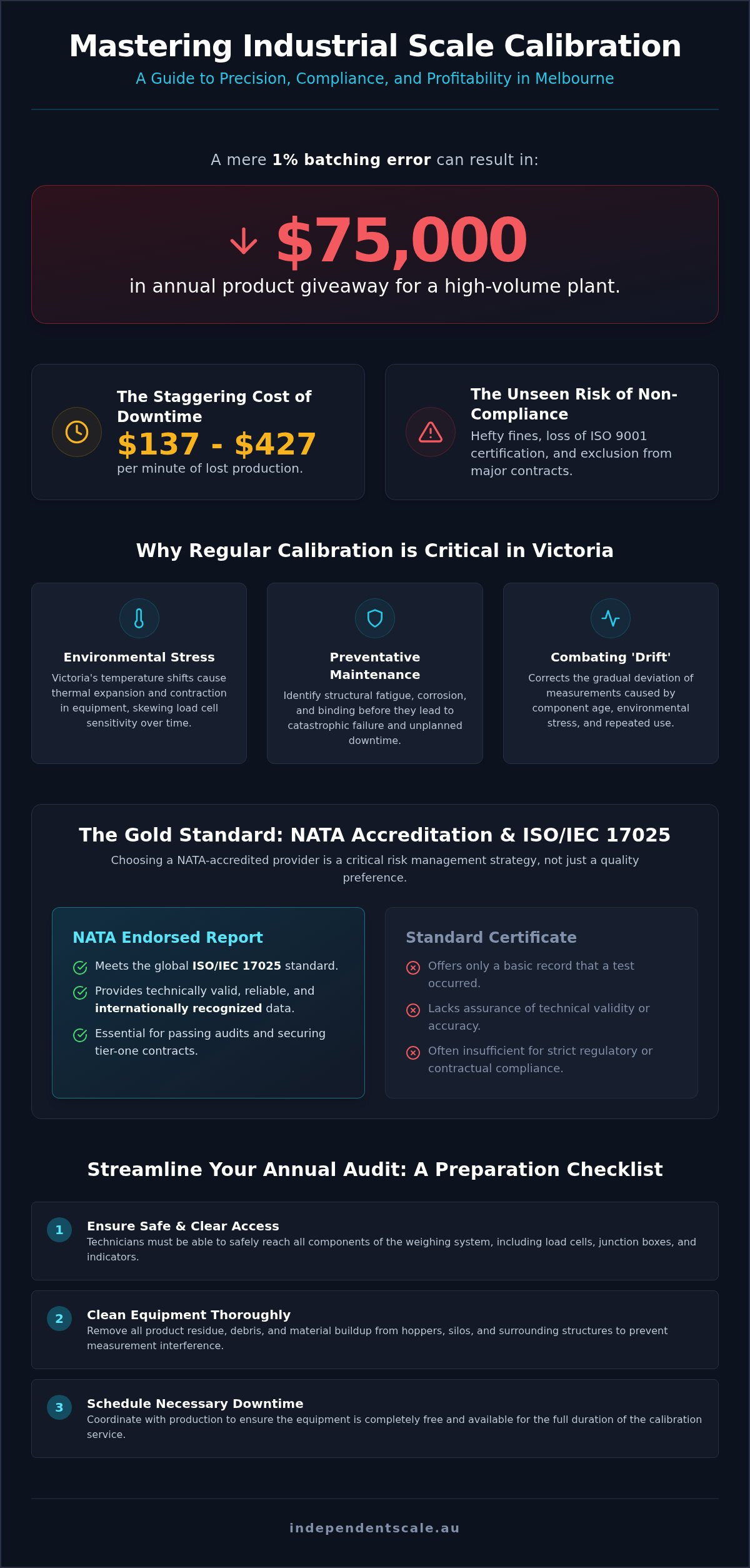
For a high-volume Australian concrete plant, a mere 1% margin of error in batching accuracy can result in over $75,000 in product giveaway annually. It's a staggering figure that highlights why precision isn't just a technical preference; it's a financial necessity. Most facility managers recognize that staying on top of industrial scale calibration Melbourne is critical for operational efficiency, yet the risk of non-compliance during audits remains a constant source of pressure. You're likely already dealing with the challenge of minimizing production downtime, which can cost between $137 and $427 per minute, while ensuring every load cell and hopper meets rigorous Australian standards.
This guide will help you master the complexities of NATA-accredited calibration and ensure your Melbourne facility remains fully compliant with the latest 2026 industrial regulations. We'll provide a technical breakdown of the ISO/IEC 17025:2017 criteria and the mandatory AS 1379 requirements for concrete batching plants. You'll learn how to implement risk-based calibration intervals that prolong equipment lifespan and prevent the costly material waste that erodes your margins. From understanding the 4:1 Test Uncertainty Ratio to navigating the new government fee schedules, this is your definitive manual for precision and compliance.
Key Takeaways
- Understand how Victoria's temperature variations and local environmental factors in manufacturing hubs like Dandenong affect load cell sensitivity and measurement precision.
- Identify why NATA accreditation under the ISO/IEC 17025 framework remains the non-negotiable gold standard for regulatory compliance and technical authority in 2026.
- Compare the logistical benefits of on-site industrial scale calibration Melbourne versus workshop services to minimize production downtime and account for site-specific vibration.
- Implement a streamlined preparation guide for hoppers, silos, and weighbridges to reduce technician billable hours and ensure a successful annual calibration audit.
- Master the specific requirements of AS 1379 to maintain batching accuracy in high-stakes concrete production using specialized tension and compression load cell testing.
Why Melbourne Industries Prioritise Precision: The Impact of Scale Calibration
Melbourne's industrial landscape is anchored by high-output manufacturing hubs in Dandenong and Campbellfield. In these environments, precision weighing is the foundation of operational integrity. Whether you're batching concrete for infrastructure projects or processing bulk chemicals, the accuracy of your measurement systems directly dictates your bottom line. To understand the technical necessity, one must first ask: What is calibration? At its core, it's the verification that an instrument's output matches a known standard. For facilities across Victoria, regular industrial scale calibration Melbourne is essential because environmental factors are constantly working against equipment accuracy.
Victoria's erratic climate introduces significant variables. Temperature fluctuations in the southern regions cause thermal expansion and contraction in steel structures and sensing elements. This thermal cycling affects load cell sensitivity over time, leading to measurement errors that go unnoticed without professional verification. Beyond the sensors, calibration serves as a critical preventative maintenance tool. During a load cell calibration, technicians can identify signs of structural fatigue, corrosion, or binding in hoppers and silos before they result in catastrophic mechanical failure or unplanned downtime.
The financial stakes are high. A 1% margin of error in batching accuracy can lead to over $75,000 in annual product giveaway for high-volume concrete plants. This "giveaway" isn't just lost material; it's lost profit that accumulates with every single load. Professional industrial scale calibration Melbourne identifies these discrepancies early, ensuring that your output remains within strict tolerance levels and protects your revenue stream.
Compliance Requirements for Victorian Businesses
The Cost of Neglecting Calibration
Ignoring scheduled testing carries severe penalties. Regulatory fines are immediate, but the long-term risk of losing ISO 9001 or ISO/IEC 17025 certification can lock a business out of major government and tier-one construction contracts. In chemical and food processing, even minor inaccuracies compromise product consistency and safety. This is often caused by 'drift', which is the gradual deviation of a load cell's output from its calibrated value due to environmental stress, component age, and repeated loading cycles. Without annual intervention, drift ensures your measurements are never truly reliable.
NATA Accreditation and ISO/IEC 17025: The Gold Standard
The National Association of Testing Authorities (NATA) is the authority that assesses the technical competence of testing and calibration laboratories across Australia. For any facility requiring industrial scale calibration Melbourne, choosing a NATA-accredited provider isn't just a quality preference; it's a critical risk management strategy. NATA accreditation signifies that a laboratory has been independently evaluated to meet the stringent requirements of ISO/IEC 17025. This standard is the global benchmark for calibration laboratories, ensuring that the results produced are accurate, reliable, and internationally recognized.
There's a significant distinction between a standard 'Certificate of Calibration' and a 'NATA Endorsed Report'. A standard certificate is often just a record stating that a test occurred. In contrast, a NATA Endorsed Report carries the NATA emblem, providing a high level of assurance that the data is technically valid. This endorsement ensures your data is defensible in a court of law or during a government audit, which is vital for industries operating under Chain of Responsibility (CoR) laws. Our technicians provide specialized industrial scale calibration Melbourne services that adhere to these strict international benchmarks to protect your operational integrity.
What is ISO/IEC 17025 Accreditation?
Accreditation under this standard involves rigorous assessment of lab personnel, equipment maintenance, and environmental controls. A critical component is the 'Uncertainty of Measurement'. This value quantifies the doubt that exists in any measurement. In high-precision industrial applications, such as chemical batching or pharmaceutical manufacturing, knowing the exact uncertainty is vital for maintaining product specifications. If your facility requires defensible data for compliance, consider our NATA-accredited weighing scale calibration services. For a deeper look at these requirements, refer to our ISO 17025 Accreditation Guide.
NATA vs. Traceable Calibration: Which Do You Need?
Choosing between NATA-endorsed services and standard traceable calibration depends on your industry's risk profile. High-risk sectors, export-oriented businesses, and those governed by mandatory standards like AS 1379 require the full weight of a NATA report. Standard traceable calibration may suffice for internal quality control where external regulatory pressure is lower. Regardless of the choice, the service must maintain 'traceability'. Traceability is an unbroken chain of comparisons back to a national or international standard, typically maintained in Australia by the National Measurement Institute (NMI).
On-Site vs. Workshop Calibration: A Comparison for Melbourne Facilities
Choosing between on-site and workshop calibration is a strategic decision for Melbourne's heavy industry. Facilities in Campbellfield or Dandenong often face a choice: transport heavy assets or bring the experts directly to the plant. For high-capacity weighing systems, on-site industrial scale calibration Melbourne is typically the most efficient route. It eliminates the logistical complexity of moving hoppers or silos and ensures that the equipment is tested under actual operating conditions. When you consider that unplanned downtime can cost between $137 and $427 per minute, the ability to perform testing without removing equipment from the production line is a significant financial advantage.
Environmental factors such as industrial vibration, wind loading on tall silos, and even local gravity variations play a significant role in measurement accuracy. Testing equipment in a sterile laboratory doesn't account for the mechanical interference or mounting stresses found in a busy Melbourne factory. To support the region's 24/7 industrial operations, we implement minimum downtime strategies. By performing weighing scale calibration services on-site, we can reduce equipment turnaround time by 45% or more compared to workshop alternatives. This responsiveness is critical for maintaining high-stakes batching accuracy without halting your entire facility.
The Benefits of On-Site Calibration
Performing industrial scale calibration Melbourne in the 'as-used' environment provides the highest level of real-world accuracy. Technicians can immediately identify mechanical interference, such as binding or debris buildup, that a laboratory test would never reveal. This method also eliminates the risk of sensitive load cells being damaged during transit. By testing the entire weighing string, from the load cell to the indicator, we ensure that every component is functioning correctly within its specific operational housing.
When to Opt for Laboratory Testing
Laboratory testing remains the essential choice for certain high-precision instruments. Controlled environments are mandatory for force gauge calibration services where temperature, humidity, and airflow must be strictly regulated to meet NATA standards. Additionally, complex repairs that require specialized stationary machinery or a clean-room setting cannot be performed in a field environment. When precision is measured in fractions of a gram, the isolation of a NATA-accredited laboratory is non-negotiable for maintaining technical integrity.
Preparation Guide: Streamlining Your Annual Calibration Audit
Efficiency on the day of testing is the primary factor in controlling service costs. When scheduling industrial scale calibration Melbourne, facility managers can significantly reduce technician billable hours by ensuring the site is ready before the service vehicle arrives. This preparation minimizes production disruption and ensures the testing process adheres to the strict timelines required for high-volume operations. Given that unplanned equipment downtime costs Australian manufacturers between $137 and $427 per minute, a well-prepared site is a financial imperative.
Start by coordinating with production teams to ensure all hoppers, silos, and weighbridges are empty and available for the duration of the audit. Technicians cannot perform accurate zero-point or span calibrations if residual material remains in the system. For weighbridges, this includes pressure cleaning the pits and T-section rubbers to remove compacted dirt or stones that cause mechanical binding. Additionally, have all previous NATA calibration certificates and equipment manuals organized and accessible. This documentation allows the technician to verify historical performance and specific equipment tolerances without delay.
Site Access and Safety Requirements
Safety is the non-negotiable priority on industrial sites. If the calibration involves silo or tank weighing assemblies, you must ensure safe working at heights infrastructure is in place and recently inspected. Many Melbourne facilities require specific site inductions, hot work permits, or confined space entry protocols. Having these prepared in advance prevents technician idle time. Ensure there is clear, unobstructed access for heavy test-weight vehicles to reach weighbridges or hopper loading points. In busy hubs like Dandenong, coordinating traffic flow is essential to prevent logistical bottlenecks during the testing window.
Mechanical and Electrical Pre-Checks
Perform a physical inspection of all weighing points. Clear away debris, material buildup, or mechanical obstructions around load cell mounts that could cause binding or erratic readings. In concrete plants, hardened slurry around the hopper supports is a common cause of inaccuracy. Inspect all cabling for visible wear, rodent damage, or moisture ingress in junction boxes. Identifying these issues early allows for repairs during the same visit as your load cell calibration, rather than requiring a costly follow-up appointment. Proactive cleaning and inspection ensure the technician can focus exclusively on precision adjustments.
To ensure your facility meets all AS 1379 and ISO/IEC 17025 standards with minimal downtime, book your professional industrial scale calibration Melbourne service today.
Specialised Calibration for Heavy Industry: Concrete and Hoppers
Heavy industrial sectors require a level of technical precision that exceeds standard weighing requirements. For specialized facilities, industrial scale calibration Melbourne must encompass the entire batching sequence to maintain compliance with rigorous engineering standards. Concrete production, in particular, relies on the synchronized accuracy of multiple weighing systems. Any deviation in the measurement of cement, aggregates, or water doesn't just impact material costs; it compromises the structural integrity and safety of the final product. Professional concrete batching plant calibration ensures that every component of the weighing string is verified under high-capacity loads.
Beyond solid materials, the calibration of liquid flowmeters is essential for precise moisture control and chemical additive dosing. While many firms rely on internal meters, the most accurate verification method is the gravimetric or weighing method. This involves diverting the liquid flow into a calibrated vessel on a high-precision scale to compare the actual weight against the meter's reading. It's the only way to eliminate the variables of pressure, temperature, and viscosity that often lead to flowmeter drift. Implementing these advanced industrial scale calibration Melbourne techniques provides the defensible data necessary for high-stakes industrial applications.
AS 1379 Compliance for Concrete Plants
AS 1379 is the mandatory Australian standard that dictates the batching accuracy and verification frequencies for concrete plants. Under this standard, cement, aggregate, and water scales must undergo regular testing to ensure they remain within strict tolerance limits. Failure to meet these requirements can lead to batch rejection and significant liability risks for Victorian construction projects. For a technical breakdown of these specific regulatory demands, refer to our Concrete Batching Plant Guide. Maintaining this compliance is vital for ensuring engineering safety and meeting tier-one project specifications.
Hopper and Silo Weighing Assemblies
Calibrating large-scale industrial vessels presents unique challenges due to their sheer volume and structural complexity. These systems typically utilize high-capacity tension or compression load cells integrated into the vessel's support structure. Utilizing specialized tank and silo weighing assemblies allows for precise inventory management and prevents overfilling or stockouts. Substitution or step calibration is a method used for these high-capacity systems where a known test weight is applied, recorded, and then substituted with a ballast material to allow for the incremental testing of much larger total loads. This technique ensures accuracy across the entire weighing range without the logistical impossibility of transporting tens of tonnes of physical test weights.
Securing Your Facility's Operational Integrity for 2026
Maintaining precision in heavy industrial weighing is a continuous commitment to regulatory compliance and financial stability. NATA accreditation under ISO/IEC 17025:2017 isn't just a certificate; it's your primary defense against audit failure and material giveaway. Whether you operate a concrete plant in Campbellfield or a manufacturing hub in Dandenong, the technical accuracy of your load cells and hoppers directly dictates your bottom line. By prioritizing industrial scale calibration Melbourne, you ensure that your facility remains compliant with AS 1379 standards while maximizing equipment lifespan through proactive maintenance.
Independent Scale Service brings decades of industrial expertise to every audit. Our technicians specialize in the complex calibration of batching plants and high-capacity silos that generic providers often avoid. We're dedicated to minimizing your downtime through efficient on-site testing and rigorous technical standards. Don't leave your regulatory standing to chance. Book Your NATA-Accredited Calibration Service in Melbourne today to secure your facility's future and ensure your measurements remain beyond reproach. We look forward to supporting your long-term operational success.
Frequently Asked Questions
How often should industrial scales be calibrated in Melbourne?
Calibration intervals depend on your specific usage volume and risk profile. While annual testing is the standard baseline for most industries, high-volume facilities or those in high-stakes sectors often require quarterly intervals to mitigate the risk of measurement drift. For concrete batching plants, AS 1379 dictates mandatory frequencies that must be strictly followed to maintain operational certification.
What is the difference between calibration and verification?
Calibration is the technical process of comparing an instrument's output against a traceable reference standard to quantify its accuracy and uncertainty. Verification is the formal process of confirming that the instrument complies with specific legal-for-trade or regulatory requirements. While calibration provides the technical data regarding error, verification provides a pass or fail status based on established legal standards.
Is NATA accreditation mandatory for all industrial scales?
NATA accreditation is not universally mandatory for every internal scale, but it's the essential benchmark for technical competence and data integrity. If your facility operates in high-risk sectors, exports products, or requires legally defensible data for government audits, NATA-endorsed industrial scale calibration Melbourne is non-negotiable. It ensures your measurement data is recognized internationally and remains defensible under legal scrutiny.
Can Independent Scale Service calibrate equipment from other manufacturers?
Yes, we provide calibration and repair services for weighing equipment from all major manufacturers. Our technical expertise focuses on the underlying load cell technology and digital indicators rather than specific brands. This allows us to provide comprehensive service for diverse industrial fleets across Victoria while maintaining the strict standards required for NATA and ISO/IEC 17025 compliance.
What happens if my scale fails its calibration test?
If an instrument fails, we immediately investigate the root cause, which often involves mechanical binding, debris buildup, or load cell fatigue. Our technicians are equipped to perform on-site repairs or adjustments to return the scale to its specified tolerance levels. Once the mechanical or electrical issue is corrected, we re-test the system to ensure it meets the required accuracy before issuing the final report.
How long does a typical on-site calibration take for a concrete plant?
On-site calibration for a standard concrete batching plant generally requires between four to eight hours of technician time. This timeframe covers the testing of cement, aggregate, and water scales to ensure AS 1379 compliance. You can significantly reduce this duration by ensuring all hoppers are empty and providing clear access for our heavy test-weight vehicles before the technician arrives on site.
Are there specific Victorian regulations for weighbridge calibration?
Victorian weighbridge operators must adhere to the National Measurement Act for any legal-for-trade transactions. Additionally, you must maintain accurate weight data to comply with Chain of Responsibility (CoR) laws. Regular industrial scale calibration Melbourne helps prevent the significant fines associated with overloaded vehicles and ensures your facility meets Victorian road safety and transport standards.
Can you provide calibration services for load cells in remote regional Victoria?
Yes, we provide specialized calibration and repair services throughout regional Victoria and across Australia. While we maintain a strong Melbourne base, our mobile technicians are fully equipped to handle complex hopper and silo calibrations in remote industrial areas. This ensures that regional facilities receive the same level of NATA-accredited expertise and responsiveness as metropolitan sites.
