


Industrial Platform Scales for Sale Australia: The Complete Guide to Selection and Compliance
A single inaccurate measurement in a high-volume batching plant can lead to a 15% increase in material waste or the total rejection of a load under AS 1379 standards. When sourcing platform scales for sale Australia, many procurement managers mistakenly prioritise initial cost over the technical durability required for 24/7 industrial environments. This oversight often leads to load cell failure or NATA compliance breaches within the first 12 months of service, resulting in costly downtime and potential legal issues.
We know you require equipment that maintains its calibration under the pressure of heavy loads and corrosive conditions. This guide provides the technical expertise needed to master Australian compliance and select hardware built for sustained accuracy. You'll learn how to evaluate legal-for-trade certification, the necessity of ISO/IEC 17025 accreditation, and the maintenance protocols that ensure your investment remains reliable for years. We'll break down the essential components, from summing circuits to surge arrestors, to ensure your facility operates at peak efficiency without measurement error.
Key Takeaways
- Identify the critical technical distinctions between retail equipment and heavy-duty industrial systems to ensure your hardware handles high-capacity shock loading.
- Master the essential requirements of AS 1379 and NATA accreditation to ISO/IEC 17025 to maintain rigorous Australian compliance and weighing accuracy.
- Evaluate specific capacity and size constraints when sourcing platform scales for sale Australia to ensure equipment durability in high-traffic warehouse environments.
- Implement professional installation and preventative maintenance protocols to eliminate measurement drift and guarantee 24/7 operational uptime for your facility.
Understanding Industrial Platform Scales for Australian Operations
Industrial platform scales are heavy-duty weighing systems designed for high-capacity, high-traffic environments. These aren't standard retail units. Industrial-grade equipment used in AU manufacturing must withstand tonnes of repeated pressure and harsh environmental factors. Precision is critical for sectors like concrete production and bulk logistics. When searching for platform scales for sale Australia, you'll encounter two primary categories: Trade Approved and non-trade scales.
The National Measurement Institute (NMI) regulates Trade Approved scales. If your business sells products by weight, using an NMI-approved system is a legal requirement. Non-trade scales serve internal purposes, such as inventory checks or process monitoring, where legal certification isn't mandatory. A standard Weighing scale used in a home or light retail setting lacks the structural integrity required for 24x7 industrial cycles. Accurate weighing ensures compliance with Australian standards and protects your profit margins from product giveaway or shipping errors.
Core Components of a Heavy-Duty Weighing System
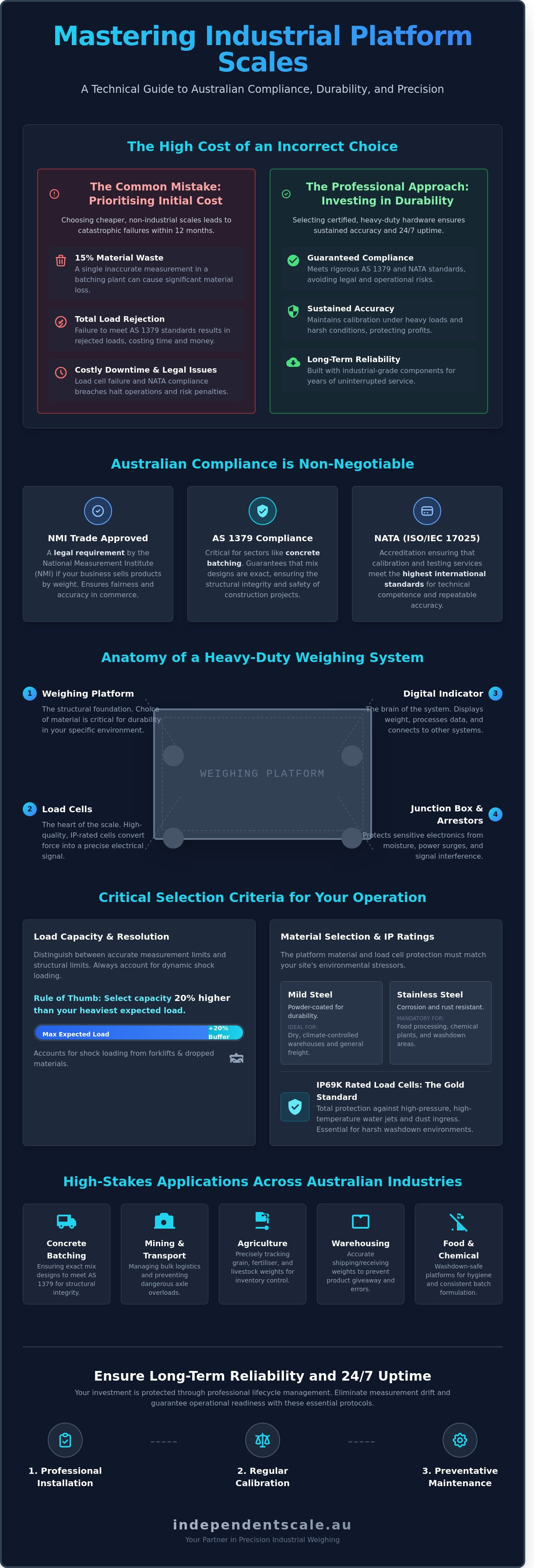
A reliable weighing system consists of three primary elements: the weighing platform, the load cells, and the digital indicator. The platform's material choice is vital for long-term durability. Mild steel platforms suit most dry warehouse applications, while stainless steel is mandatory for chemical or food processing where washdown-safe equipment is required. High-quality junction boxes and surge arrestors are essential for outdoor installations to protect sensitive electronics from moisture and electrical spikes. These components ensure the system remains compliant with ISO/IEC 17025 standards and provides repeatable accuracy under load.
Common Industrial Applications Across Australia
Australian industries rely on platform scales for diverse, high-stakes tasks. Concrete batching plants use them to meet AS 1379 standards, ensuring exact mix designs for structural integrity. Mining sites and transport hubs utilize high-capacity platform scales for sale Australia to manage bulk logistics and prevent dangerous axle overloads. In the agricultural sector, these systems are integrated into hopper and silo monitoring to track grain or fertiliser levels with precision. Chemical and food processing plants require washdown-safe platforms to maintain hygiene while ensuring batch consistency. Every kilogram matters when you're managing high-volume throughput in these demanding sectors.
Selection Criteria: Choosing the Right Platform Scale for Sale
Selecting industrial platform scales for sale Australia requires a rigorous technical evaluation of your operational environment. It isn't merely a matter of finding a deck that fits your floor space; it involves matching structural integrity with precise data output requirements. A failure to account for dynamic loads or environmental stressors leads to premature component failure and costly downtime.
Load Capacity and Resolution Requirements
You must distinguish between "Max Capacity" and "Safe Overload" ratings. Max Capacity defines the limit for accurate measurement, while Safe Overload indicates the structural limit before permanent damage occurs to the load cells. In heavy-duty Australian industrial sites, shock loading from forklifts often exceeds static weight. You should select a scale that handles 20% more than your heaviest expected load to provide a safety buffer. Accuracy is also dictated by resolution. Finer increments are necessary for high-value bulk materials, whereas coarser resolutions suffice for general freight. To ensure your equipment meets legal metrology standards, consult the guidelines provided by the National Measurement Institute (NMI) for trade-approved applications.
Material Selection and IP Ratings for Harsh AU Sites
The choice between mild steel and stainless steel depends entirely on your site conditions. Mild steel with a powder-coated finish is suitable for dry, climate-controlled warehouses. However, for food processing or chemical environments, stainless steel is mandatory to prevent corrosion. In areas requiring high-pressure washdowns, IP69K-rated load cells are the industrial gold standard. They provide total protection against dust and high-temperature water jets. The Australian climate also presents thermal challenges. High ambient temperatures in regional sites can cause signal drift; therefore, using high-quality conditioners and transmitters is essential to maintain signal stability between the platform and the control room.
Digital Indicators and Data Integration
Modern indicators and displays do more than show a number on a screen. They act as the central processing unit for the scale, converting raw millivolt signals from the load cells into digital data. For complex setups, summing circuits are used to equalise the output from multiple load cells, ensuring the scale remains accurate even if the load is off-centre. Connectivity is a key selection factor for modern sites:
- RS232/RS485: Standard for direct printer or PC connections.
- 4-20mA Analog Output: Critical for PLC integration in automated batching plants.
- Wireless Telemetry: Useful for remote monitoring in large-scale yards where cabling is impractical.
If you're unsure which configuration fits your specific workflow, you can view our full range of weighing equipment to compare technical specifications and integration options.
The Critical Role of NATA Accreditation and AS 1379 Compliance
Accuracy isn't a suggestion in industrial weighing; it's a legal mandate. When you browse platform scales for sale Australia, the "factory calibrated" label often creates a false sense of security. This factory setting is rarely sufficient for Australian industrial standards because it doesn't account for local gravity variables or the rigorous requirements of the National Measurement Institute (NMI). For any scale used in trade, where price is determined by weight, the equipment must be verified by a licensed technician after installation at its permanent site to ensure it meets legal metrology standards.
Why ISO/IEC 17025 Accreditation Matters
ISO/IEC 17025 is the global benchmark for testing and calibration laboratories. NATA accreditation to this standard signifies that a service provider possesses the technical competence and equipment to produce valid results. It ensures full traceability to national measurement standards. ISS delivers NATA-accredited weighing scale calibration, providing the documented proof required during quality audits. Without this accreditation, your calibration certificates may not hold up under legal or regulatory scrutiny during a site inspection.
Compliance for Concrete and Construction Sectors
The Australian concrete industry follows the AS 1379 standard, which dictates strict tolerances for batching accuracy. Compliance isn't optional; it's a prerequisite for supplying major infrastructure projects. Under AS 1379, equipment like liquid flowmeters and hoppers must undergo the gravimetric method of calibration. This process involves weighing the actual medium to verify the accuracy of the delivery system. Independent Scale Service provides concrete batching plant calibration that meets these exact specifications. We currently service 98% of concrete plants across the Sydney region, ensuring they meet the biannual requirements common in NSW and VIC.
Maintaining site certification requires a disciplined approach to maintenance. Most plants require calibration every 6 months to stay compliant with state regulations. Failure to meet these standards can result in serious consequences:
- Immediate suspension of site certification and production.
- Legal penalties for non-compliant trade transactions under NMI guidelines.
- Structural failures in construction due to incorrect material ratios.
- Financial losses from overfilling or material waste.
Relying on unaccredited providers or basic factory settings exposes your business to significant risk. ISS brings over 30 years of experience to every site, ensuring that your platform scales for sale Australia investment remains a compliant asset rather than a legal liability. We focus on technical precision to keep your operations running without interruption.
Installation, Calibration, and Maintenance of Industrial Scales
Securing high-quality platform scales for sale Australia is only the first step toward operational precision. Professional installation ensures the equipment functions within its engineered tolerances. We focus on site leveling and structural reinforcement to prevent deck deflection, which can cause weighing errors exceeding 2% of the total load. A foundation that isn't perfectly level introduces side-loading forces that degrade load cell integrity over time.
Professional Installation vs. DIY
Attempting a DIY installation often results in improper mounting and cable management errors. These mistakes lead to side-loading, where horizontal forces interfere with vertical weight measurement, potentially damaging the internal strain gauges. For complex setups, the integration of tank and silo weighing assemblies into existing steelwork requires millimetre-perfect alignment. Our technicians prioritize correct cable routing and the installation of surge protection. This is critical in lightning-prone regions of Australia to prevent catastrophic failure of the summing circuits during electrical storms.
Establishing a Calibration and Service Schedule
Measurement drift is an inevitable reality in heavy industrial environments. We recommend a quarterly calibration cycle for high-intensity 24/7 facilities, while bi-annual checks suffice for standard usage. The process of hopper calibration involves using NATA-traceable test weights to verify accuracy across the entire weighing range. Maintaining these records isn't just best practice; it's a requirement for ISO 9001 quality management and AS 1379 compliance in concrete production. Detailed audit trails provide the factual evidence needed during regulatory inspections.
Diagnostic protocols are essential for minimizing downtime. When a system shows instability, we perform millivolt (mV/V) output testing on individual load cells to identify internal short circuits or moisture ingress. Most electrical issues in weighing systems originate in the junction box or from damaged shielding in the signal cables. Our on-site service teams address these faults immediately, ensuring your platform scales for sale Australia remain a reliable asset rather than a bottleneck.
- Site Leveling: Ensuring the base is within 0.1 degrees of level to maintain axial loading.
- Preventative Maintenance: Scheduled inspections to identify wear in pivot points and load cell mounts.
- Surge Protection: Installing arrestors to shield sensitive electronics from voltage spikes.
- NATA Calibration: Providing certified accuracy that meets Australian national standards.
Independent Scale Service provides the technical expertise required to keep your plant running without interruption. If your equipment is drifting or requires mandatory compliance testing, contact us for certified scale calibration services.
Sourcing High-Quality Platform Scales in Australia with ISS
Independent Scale Service (ISS) is the premier Australian partner for heavy-duty industrial weighing. We bring over 30 years of technical experience to every project. Our 24/7 emergency repair team is a critical resource for the construction and manufacturing sectors, currently supporting 98% of Sydney’s concrete plants to prevent costly production halts. When you browse platform scales for sale Australia, choosing a provider with both supply and NATA-accredited service capabilities is essential for operational continuity. We don't just sell hardware; we provide the technical infrastructure required to keep your business compliant and accurate.
Custom Weighing Solutions and System Design
ISS engineers bespoke weighing systems for complex industrial environments. We provide a single point of contact for the entire process: design, supply, installation, and NATA certification. This integrated approach ensures your equipment meets AS 1379 standards from day one. Our expertise includes special purpose weighing solutions tailored to specific load requirements, such as shackle pins and custom tension links. The trust placed in us by industry leaders like Holcim, Boral, and Hanson reflects our commitment to technical precision. We eliminate the risk of dealing with multiple vendors by managing the full compliance lifecycle in-house.
Comprehensive Support and Repair Services
Our service doesn't end at the point of sale. We provide specialized load cell testing and diagnostics that pinpoint faults before they cause total system failure. This precision often allows for targeted repairs rather than expensive full-scale replacements. We maintain a robust inventory of spare parts and accessories to keep legacy systems running with modern accuracy. You can view our full collection of industrial weighing equipment online to find compatible components for your existing setup.
Our NATA accreditation to ISO/IEC 17025 is a guarantee that our calibration and testing procedures meet the highest international standards. This level of certification is mandatory for many government and large-scale infrastructure projects across Australia. Choosing ISS means securing platform scales for sale Australia backed by a team that prioritizes your uptime and regulatory compliance. We understand that in industrial weighing, an error of a few kilograms can lead to significant financial or safety risks. Our methodical approach ensures those risks are mitigated through expert maintenance and high-quality equipment.
Secure Your Operational Accuracy and Compliance
Selecting the right weighing equipment is a critical decision for your facility's efficiency and regulatory standing. High-quality platform scales for sale Australia must meet rigorous standards, including AS 1379 compliance for concrete production and general industrial use. Accuracy isn't just a preference; it's a legal requirement that protects your bottom line and operational integrity. Independent Scale Service brings over 30 years of Australian industry experience to every installation and maintenance contract. We ensure your equipment remains NATA Accredited to ISO/IEC 17025 standards through precise gravimetric method calibration and expert technical support.
If your systems fail, our emergency 24/7 repair services minimize your downtime immediately. Don't risk your site's productivity with uncertified equipment or delayed maintenance schedules. Our team provides the technical competence needed to keep your business running within legal tolerances and peak performance levels. We're ready to support your next project with reliable, compliant weighing solutions that stand up to the toughest Australian conditions.
Request a Quote for NATA-Accredited Platform Scales and Calibration
Frequently Asked Questions
What is the difference between a trade-approved and non-trade platform scale?
Trade-approved scales are legally required for any commercial transaction where the final price is determined by the weight of the goods. These units must possess a National Measurement Institute (NMI) pattern approval number and undergo verification by a licensed technician. Non-trade scales are intended for internal check-weighing or process monitoring only. Using a non-trade scale for commercial sales violates the National Measurement Act 1960 and can result in significant fines.
How often do industrial platform scales need to be calibrated in Australia?
Most industrial scales require professional calibration every 6 to 12 months to maintain accuracy and compliance. Facilities operating under strict standards like AS 1379 for concrete production often require more frequent quarterly inspections. Regular testing ensures your equipment remains within the tolerances required by your industry. Independent Scale Service manages scheduled maintenance programs to ensure your business never misses a mandatory compliance interval.
Can I install an industrial platform scale myself?
You shouldn't install an industrial scale yourself if you require legal compliance or technical precision. Professional installation ensures the platform is perfectly level, correctly shimmed, and calibrated to the specific gravity of your geographic location. For businesses searching for platform scales for sale Australia, expert setup by our technicians prevents load cell damage and ensures the system meets NATA accreditation requirements immediately upon commissioning.
What IP rating do I need for a platform scale used outdoors?
Outdoor platform scales require a minimum rating of IP67 to protect internal components from dust and heavy rain. If the scale is used in environments with high-pressure washdowns or potential flooding, IP68 or IP69K rated load cells are essential. These ratings provide the highest level of protection against moisture ingress. Selecting an insufficient IP rating leads to premature electronic failure and increased repair costs over the life of the scale.
What is NATA accreditation and why is it important for my business?
NATA accreditation is a formal recognition that a service provider is competent to perform calibrations according to ISO/IEC 17025 standards. It's critical because it provides a globally recognised guarantee of technical competence and data integrity for your weighing results. For the 98% of concrete plants we service across Sydney, NATA-certified reports are the only acceptable proof of accuracy during rigorous quality assurance audits.
Does Independent Scale Service provide 24/7 emergency repairs for platform scales?
Independent Scale Service provides 24/7 emergency repairs to minimise client downtime and maintain production schedules. Our technicians are available at all hours to address critical failures in load cells, summing circuits, or digital indicators. We prioritise rapid response because we know a scale breakdown can halt an entire supply chain. You can reach our emergency support line at any time to dispatch a technician to your site.
What causes a platform scale to lose accuracy over time?
Accuracy loss is usually caused by mechanical wear, debris buildup, or environmental factors like moisture and rust. Shock loading, which occurs when heavy weights are dropped onto the platform, can also permanently damage load cell sensors. Over time, electronic components may drift due to extreme temperature fluctuations. Regular maintenance identifies these issues before they lead to significant measurement errors or non-compliance with Australian standards.
Can my existing platform scale be upgraded with new load cells or indicators?
Most existing platform scales can be upgraded with modern digital indicators or high-capacity load cells to improve performance. Replacing legacy components is often a cost-effective alternative to purchasing an entirely new steel structure. When you look for platform scales for sale Australia, consider if retrofitting your current frame with updated technology provides a better return on investment. We can integrate new electronics with your existing hardware to enhance data logging and measurement speed.
