


Industrial Platform Scales Australia: The 2026 Guide to Heavy-Duty Weighing & Compliance
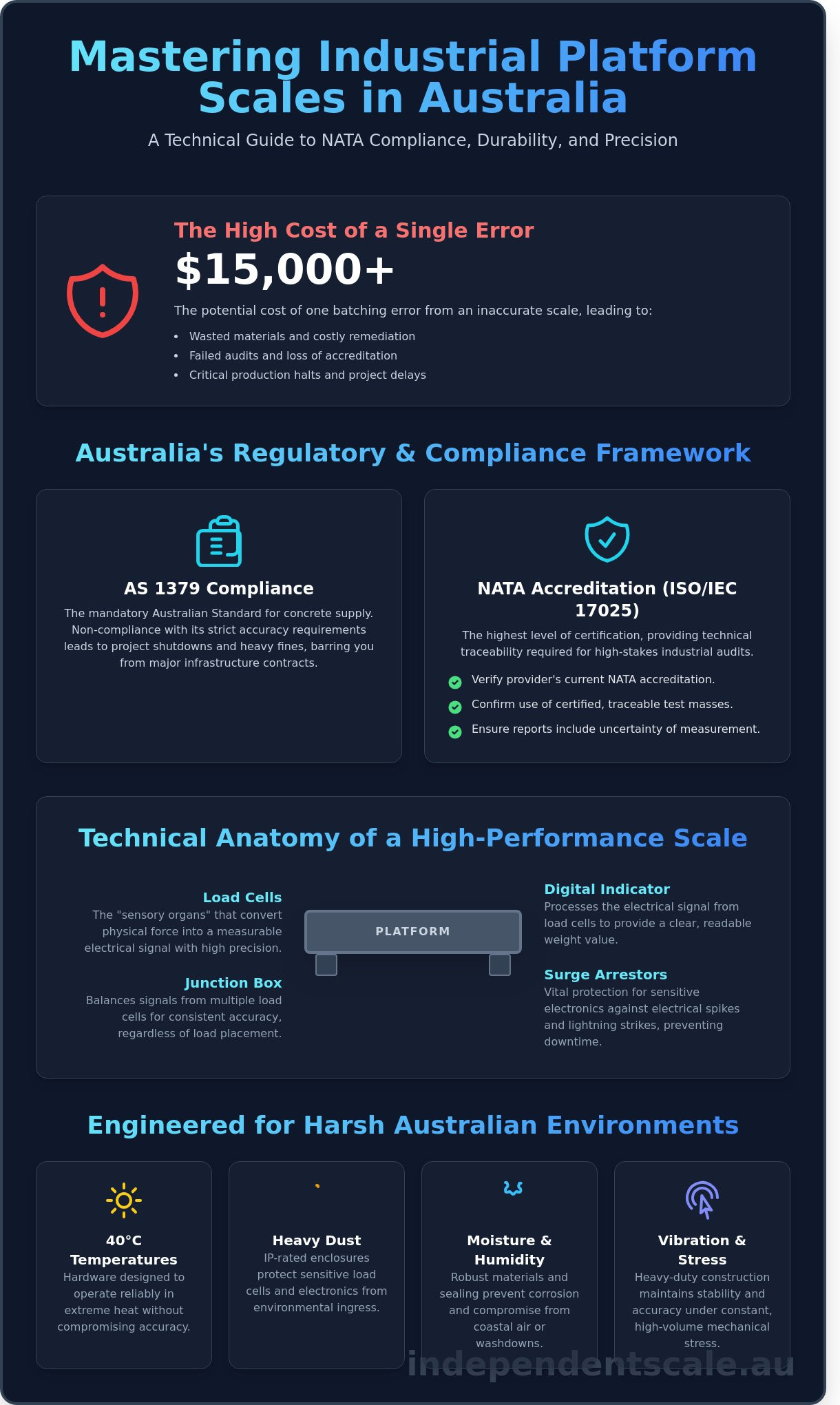
A single batching error in a high-volume concrete facility can cost upwards of $15,000 in wasted materials and remediation. You understand that accuracy isn't just about the numbers on the screen; it's about maintaining NATA accreditation and avoiding the environmental ingress that destroys low-quality hardware. Inconsistent measurements lead to audit failures and costly production halts that your operation cannot afford.
This 2026 guide provides the technical framework to master NATA compliance standards and selection criteria for industrial platform scales Australia wide. By following these specifications, you'll ensure your facility maintains 100% accuracy while securing the 24/7 technical support necessary to eliminate downtime. We'll examine the critical AS 1379 requirements, ISO/IEC 17025 calibration protocols, and the specific IP-rated hardware needed to survive the 40°C temperatures and heavy dust typical of Australian industrial sites. This is the definitive manual for maintaining a compliant, high-performance weighing environment.
Key Takeaways
- Understand the critical role of AS 1379 compliance and how to navigate the Australian regulatory landscape for heavy-duty weighing systems.
- Master the technical anatomy of load cells and digital indicators to ensure your weighing infrastructure delivers consistent, high-precision data.
- Evaluate the best materials and designs for industrial platform scales Australia to withstand extreme environmental challenges like coastal humidity and outback dust.
- Learn the advantages of the Gravimetric Method of calibration for maintaining NATA-accredited accuracy and preventing unplanned facility downtime.
- Gain insights into selecting long-term weighing partners with specialized expertise in concrete batching and industrial scale maintenance.
Industrial Platform Scales in Australia: Navigating the Regulatory Landscape
Industrial platform scales Australia are high-capacity weighing systems built for rugged, high-volume environments where precision directly impacts the bottom line. These systems aren't typical warehouse tools; they're engineered to handle loads exceeding 10,000kg while maintaining accuracy under constant mechanical stress. A heavy-duty weighing scale used in a primary production or construction setting must withstand environmental factors like dust, moisture, and vibration that would instantly compromise retail-grade equipment. Using non-compliant scales in a commercial setting introduces massive liability. If your equipment isn't calibrated to national standards, your data won't hold up during a Tier 1 contractor audit or a government inspection.
Why AS 1379 Compliance Matters for Your Facility
AS 1379 is the mandatory Australian Standard for the specification and supply of concrete. It dictates strict accuracy requirements for batching plant equipment to ensure structural integrity in construction. In NSW and Victoria, the legal and financial implications of using uncalibrated systems are severe, often resulting in project-wide shutdowns and heavy fines. Independent Scale Service currently ensures 98% of Sydney's concrete plants remain compliant through specialized AS 1379 calibration services. Without this certification, you can't legally supply concrete to major infrastructure projects. Accuracy isn't just a preference; it's a contractual and legal necessity for every batching plant operator in the country.
The Role of NATA in Australian Industrial Weighing
NATA (National Association of Testing Authorities) provides the highest level of equipment certification in Australia. While many providers offer a "standard" calibration, only a NATA-accredited report to ISO/IEC 17025 provides the technical traceability required for high-stakes industrial audits. This accreditation proves that the technician has the specific competence and equipment to perform the task correctly. When selecting a provider for weighing scale calibration, use this checklist to ensure compliance:
- Verify the provider holds current NATA accreditation specifically for ISO/IEC 17025.
- Confirm they use certified test masses traceable to national standards.
- Ensure the technician can provide a detailed report including uncertainty of measurement.
- Check for a history of servicing major industry players like Boral or Holcim.
Relying on unaccredited providers saves money upfront but creates a single point of failure during a regulatory audit. Professional facilities prioritize NATA-backed data to mitigate risk and ensure long-term operational reliability.
The Technical Anatomy: Load Cells, Indicators, and Connectivity
Industrial platform scales Australia rely on a triad of core components to deliver legal-for-trade accuracy: the steel platform structure, the load cells, and the digital indicator. The platform provides the structural integrity required to support heavy-duty loads, while the load cells act as the sensory organs of the system. These transducers utilize strain gauges to convert physical force into a measurable electrical signal, typically measured in millivolts. This signal is then processed by the indicator to provide a readable weight value.
Maintaining signal integrity is critical in harsh industrial environments. High-performance systems utilize junction boxes and surge arrestors to protect sensitive electronics. The junction box contains summing circuits that balance the signals from multiple load cells, ensuring the scale remains accurate regardless of where the load is placed on the platform. Surge arrestors are vital for preventing damage from electrical spikes or lightning strikes, which is a common cause of downtime in outdoor or warehouse installations. For seamless automation, integrating high-quality weight transmitters ensures data flows directly into your PLC system without latency.
Selecting High-Performance Load Cells
The choice of load cell determines the scale's durability and precision. Shear beam load cells are the standard for most low-profile platforms due to their excellent side-load resistance. S-type cells are better suited for suspended applications, while compression cells handle extreme capacities exceeding 50 tonnes. In Australian food processing or chemical sectors, IP68 or IP69K ratings are mandatory. These ratings ensure the cells are hermetically sealed against high-pressure washdowns and corrosive cleaning agents. Operators should source specialised load cells that match their specific environmental stressors to avoid premature failure.
Indicators and Digital Displays for Real-Time Monitoring
Modern weighing systems have evolved from simple readouts to advanced indicators and displays that offer comprehensive data logging. These units must comply with Australian trade measurement laws when the scale is used for commercial transactions. Wireless connectivity via Bluetooth 5.0 or Wi-Fi now allows operators to monitor weights from 100 metres away, which significantly improves safety in high-traffic forklift zones. Remote displays with large LED digits are also essential for visibility in loading docks, allowing drivers to see weight data without exiting their vehicles, thus reducing the risk of workplace accidents.
Choosing the Right Scale for Harsh Australian Environments
The Australian climate dictates the operational lifespan of weighing equipment. In coastal regions like Sydney or Brisbane, salt-laden humidity accelerates corrosion in mild steel components within 12 to 18 months. Conversely, in the outback, fine dust ingress can compromise load cell sensitivity and lead to mechanical binding. Selecting the correct industrial platform scales Australia requires a technical assessment of these environmental variables before procurement.
Material choice is the first line of defense. Mild steel platforms are suitable for dry, temperature-controlled warehouses. However, for 100% of chemical processing or food-grade applications where washdown procedures occur, grade 304 or 316 stainless steel is mandatory. It resists oxidation and stands up to caustic cleaning agents that would otherwise strip the powder coating off standard steel.
Capacity planning is another critical factor. Never match your maximum load to the scale's nominal capacity. Impact loads from a dropped pallet or a forklift's sudden braking can exceed static weight by more than 50%. ISS recommends maintaining a 20% to 30% overhead. If your heaviest pallet is 1,500kg, you should install a 2,000kg or 2,500kg capacity system to protect the load cells from permanent deformation.
Logistics hubs in Melbourne and Sydney operate on thin margins where downtime is a significant liability. In these high-traffic environments, scales must handle hundreds of weighments daily. Choosing a platform with robust summing circuits and high-quality cabling ensures the system remains accurate under heavy duty cycles.
Heavy-Duty Platforms for Concrete and Mining
Handling aggregate, cement, and slag requires scales with reinforced structural steel and high IP ratings. These environments are abrasive and prone to heavy vibration. For bulk material storage, the integration of tank and silo weighing assemblies or platform scales for industrial drums from suppliers like Container Authority allows for precise inventory management of raw materials. When optimizing facility space, pit-mounted scales provide a flush surface for vehicle movement but require integrated drainage. Surface-mounted scales are often preferred for easier maintenance access, though they require an additional 3 to 4 metres of floor space for approach ramps.
Warehouse and Pallet Scales for Logistics Efficiency
Efficiency in logistics depends on ease of access. Low-profile industrial platform scales Australia allow pallet jacks and forklifts to transition onto the weighing surface without significant effort. It's vital to distinguish between 'Trade Approved' and 'Non-Trade' scales. If you're charging customers based on weight, Australian law requires an NMI-approved scale. For non-standard lifting or overhead weighing, such as in shipping or crane operations, special purpose shackle pins provide a reliable solution for measuring tension while maintaining the structural integrity of the lift.
This precision is especially vital in the eCommerce fulfillment space. High-volume third-party logistics (3PL) providers, for example, rely on this technology for their core operations. A company like Pik Pak Logistics uses industrial-grade pallet scales to accurately calculate shipping weights for countless online orders, ensuring both efficiency and cost-effectiveness in a competitive market.
Calibration and Maintenance: The Key to Long-Term Accuracy
Precision isn't a one-time setup; it's a continuous requirement for industrial platform scales Australia. High-use environments, particularly those operating 24/7 in the logistics or construction sectors, should schedule professional calibration every three to six months. Independent Scale Service utilises the Gravimetric Method of calibration. This process uses certified, traceable reference masses to verify the scale's performance against known standards. It's the most reliable way to ensure your equipment meets the stringent requirements of AS 1379 and maintains its NATA-accredited status.
Environmental factors directly impact weighing performance. Temperature fluctuations in Australian industrial sites cause load cell sensitivity to shift, leading to zero-point drift. A variance of just 10 degrees Celsius can compromise accuracy in high-precision applications. Routine maintenance must also address mechanical integrity. Debris buildup under the platform or structural wear on the mounting hardware often causes "binding." This physical interference results in inconsistent readings and significant financial discrepancies over time.
The NATA Calibration Process Explained
- Step 1: Technicians perform a thorough visual inspection and ensure the platform structure is level and free from any mechanical interference.
- Step 2: Testing is conducted using certified traceable weights across the full capacity range to identify non-linearity and repeatability issues.
- Step 3: We adjust the conditioners and transmitters for signal linearisation and span correction to ensure the digital output matches the physical load.
- Step 4: Issuing a formal NATA-accredited report to ISO/IEC 17025 standards, providing the necessary documentation for your compliance audits.
Emergency Repairs and Minimising Downtime
For critical infrastructure like concrete batching plants, equipment failure equals total production loss. We provide 24/7 emergency support to keep your operations running. Independent Scale Service currently services 98% of concrete plants across Sydney, proving our capability to handle high-pressure repairs. We've identified the most common failure points in industrial platform scales Australia: moisture ingress in junction boxes, cable damage from site machinery, and load cell fatigue. Proactive maintenance is the only way to mitigate these risks. Schedule your next weighing scale calibration to identify potential failures before they stop your production line.
Why Partner with Independent Scale Service for Your Weighing Needs?
Selecting the right partner for industrial platform scales Australia involves more than just purchasing hardware. It requires a deep understanding of the technical and regulatory landscape. Independent Scale Service (ISS) brings over 30 years of direct experience to the Australian industrial weighing sector. We've built a reputation as a one-stop-shop, providing everything from the initial supply of high-quality components to ongoing NATA-accredited maintenance. Our service footprint covers Sydney, Melbourne, and regional Australia, ensuring that heavy-duty operations stay online and compliant with national standards.
Proven Expertise with Australia's Largest Industrial Players
Our track record includes long-term partnerships with industry leaders such as Holcim, Boral, and Hanson. These tier-one players rely on ISS because we understand the high-stakes nature of industrial weighing. We currently service 98% of concrete plants across Sydney, maintaining strict adherence to AS 1379 standards. Our technicians possess advanced knowledge of summing circuits and load cell diagnostics, allowing us to identify potential failures before they cause costly downtime. The ISS advantage is the intersection of NATA-accredited precision and 24/7 industrial responsiveness.
Custom Solutions for Complex Weighing Challenges
Standard equipment doesn't always fit the unique geometry of a busy site. ISS designs bespoke weighing systems for hoppers, silos, and specialized industrial platform scales Australia users require for non-standard loads. Whether you need to retrofit an existing structure or build a system from scratch, we provide the technical engineering required for gravimetric accuracy. You can explore our full collection of industrial components to see the range of load cells, indicators, and junction boxes available for your next project.
Technical teams focus on delivering systems that meet ISO/IEC 17025 requirements while withstanding the harsh conditions of regional Australian worksites. We prioritize reliability, which is why our emergency 24x7 support is a core part of our service model. Accuracy isn't just a goal; it's a requirement for your legal and operational compliance. Contact Independent Scale Service today for a NATA-accredited calibration or equipment quote.
Future-Proof Your Weighing Infrastructure
Maintaining operational efficiency in 2026 demands a rigorous approach to technical compliance and hardware durability. Selecting the right industrial platform scales Australia depends on understanding load cell specifications and ensuring your equipment withstands the continent's harsh industrial environments. Precision is non-negotiable for sites adhering to AS 1379 standards. Independent Scale Service leverages 30+ years of Australian industrial experience to deliver precise weighing solutions. We're NATA accredited to ISO/IEC 17025, providing the technical assurance required for high-stakes sectors like concrete and mining. Reliability isn't just about the scale; it's about the support behind it. Our team provides emergency 24/7 support for Sydney and Melbourne clients to eliminate unplanned downtime. We've built our reputation on methodical service and technical expertise. You can trust our specialists to maintain your site's accuracy and legal compliance through every season. Let's ensure your facility remains productive and fully compliant today.
Request a NATA-Accredited Calibration or Quote
Frequently Asked Questions
How often should industrial platform scales be calibrated in Australia?
Industrial platform scales Australia require calibration every 6 to 12 months for standard warehouse operations. If your facility operates under AS 1379 standards, such as a concrete batching plant, you must perform these checks every 3 months. Frequent testing ensures your equipment remains within the 0.1% accuracy tolerance required for heavy-duty industrial applications. We provide full documentation for every service to meet your ISO audit requirements.
What is the difference between a trade-approved and a non-trade industrial scale?
Trade-approved scales are mandatory when you sell products by weight, as dictated by the National Measurement Institute. These units undergo rigorous pattern approval and verification to ensure consumer protection. Non-trade scales are strictly for internal check-weighing or inventory monitoring. Using a non-trade scale for commercial transactions can result in fines exceeding $200,000 under the National Measurement Act 1960. It's essential to verify your equipment's legal status.
Can Independent Scale Service calibrate scales on-site at my facility?
Independent Scale Service performs on-site calibration at your facility to eliminate the risk of equipment damage during transport. Our mobile teams use NATA-certified test weights to verify your systems in their actual operating environment. This process typically takes 1 to 2 hours per scale, which significantly reduces your operational downtime. We've serviced over 500 industrial sites across New South Wales using this efficient on-site methodology.
What are the requirements for NATA-accredited scale calibration?
NATA-accredited calibration requires strict adherence to the ISO/IEC 17025 international standard. Technicians must use reference standards with 100% traceability to national primary standards. The process includes calculating measurement uncertainty and maintaining a controlled environment during testing. Our team maintains full NATA accreditation, ensuring every certificate we issue is legally defensible and recognized by all Australian regulatory bodies. This level of precision is vital for high-stakes industrial weighing.
How do I choose between a stainless steel and a mild steel platform scale?
You should select stainless steel platform scales for environments involving high moisture, food production, or chemical exposure. These units utilize Grade 304 or 316 steel to prevent corrosion and maintain hygiene standards. Mild steel is the standard choice for dry warehouse applications and is roughly 35% more cost-effective. It's durable enough for pallet weighing but won't survive the daily wash-down cycles required in meat or dairy processing.
What happens if my concrete batching plant fails an AS 1379 audit?
If your concrete batching plant fails an AS 1379 audit, you must cease production immediately until the weighing systems are rectified. Inaccurate scales lead to poor mix quality and structural integrity issues in finished concrete. Independent Scale Service manages compliance for 98% of concrete plants in the Sydney region. We provide rapid recalibration and repair to restore your plant's certification within 24 hours of a failed audit notification.
Does Independent Scale Service provide emergency 24/7 repair services?
Independent Scale Service provides 24/7 emergency repair services to keep your production lines moving. We understand that an hour of downtime can cost a large-scale facility upwards of $10,000 in lost revenue. Our technicians are available 365 days a year and aim to arrive on-site within 4 hours for metropolitan call-outs. We carry a comprehensive range of load cells and indicators to ensure first-time fix rates for our clients.
What is a load cell summing box and why is it important for platform scales?
A load cell summing box is a junction point that combines electrical signals from multiple sensors into a single output for the weight indicator. It's vital for industrial platform scales Australia because it allows for corner balancing or trimming. This ensures the scale displays the same weight regardless of where the load is placed on the platform. Without a functioning summing box, your scale could show measurement errors exceeding 5%.
