


Industrial Pallet Scales: The Complete Guide to Selection, Calibration, and Compliance
An inaccurate or non-compliant pallet scale is a significant liability for any Australian industrial operation. It directly leads to costly shipping disputes, unexpected equipment downtime that halts your entire warehouse, and critical compliance failures. For many managers, the persistent confusion between NATA accreditation for quality management and NMI approval for legal trade use only compounds the challenge, leaving operations vulnerable to financial penalties and disputes.
This definitive guide provides the technical clarity required to eliminate these risks. We will detail the essential criteria for selecting a robust pallet scale engineered for your specific application and workload. Furthermore, we will outline the correct calibration procedures necessary to maintain unwavering accuracy and explain the specific legal requirements for achieving and maintaining both NATA and NMI compliance. By following this guide, you can ensure long-term equipment reliability, guaranteed compliance for trade use, and minimised operational disruption through precision measurement.
Key Takeaways
- Determine whether a mild steel or stainless steel pallet scale is required for your specific industrial environment to ensure operational longevity.
- Learn how to calculate the correct "Safe Overload" margin to protect high-quality load cells from accidental damage and costly failure.
- Understand the critical difference between routine calibration for process control and NATA-accredited verification required for legal trade use in Australia.
- Identify common failure points, such as junction box moisture and cable integrity, before they lead to inaccurate readings and operational downtime.
Understanding Pallet Scale Types for Australian Industry
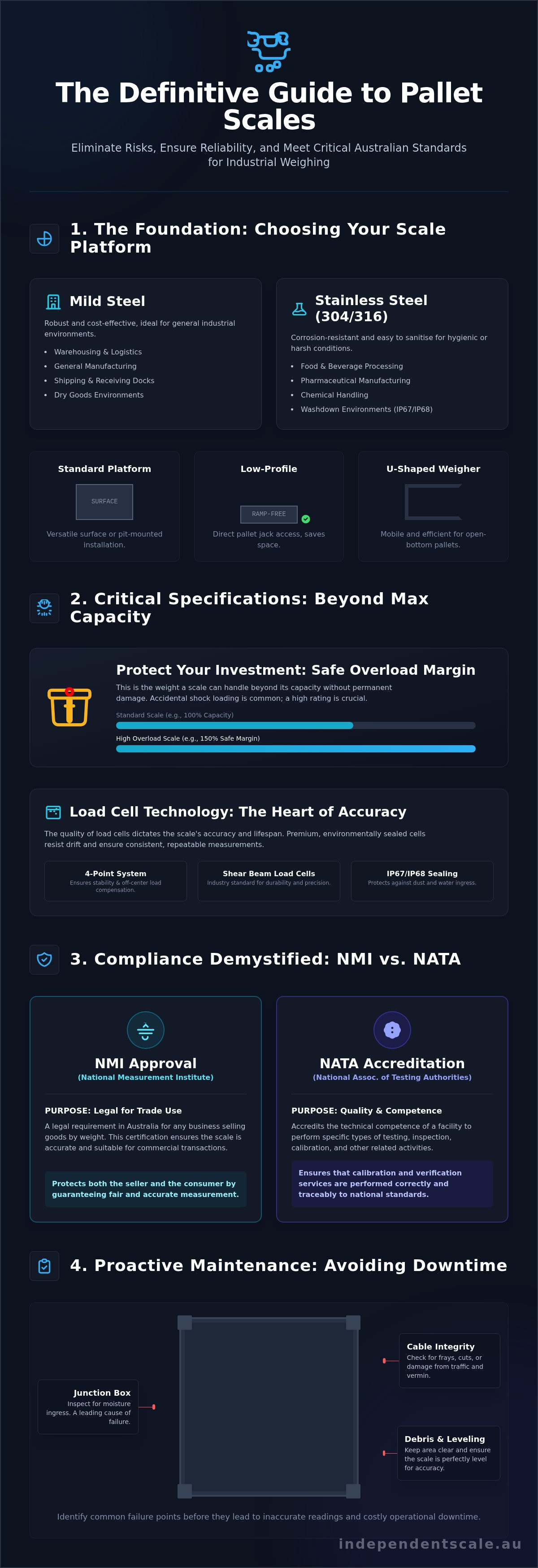
A pallet scale is an industrial-grade, heavy-duty weighing platform engineered specifically for weighing palletised goods. In the demanding environment of Australian warehouses, logistics centres, and manufacturing plants, these scales are fundamental for inventory management, shipping, and receiving. Standard capacities typically range from 1500kg to 5000kg, built from robust mild or stainless steel to withstand constant forklift and pallet jack traffic. Selecting the correct construction and configuration is non-negotiable for operational safety and longevity.
For any business selling goods by weight, obtaining a scale with National Measurement Institute (NMI) approval is a legal requirement in Australia. This certification ensures the device is "approved for trade use" and provides accurate, repeatable measurements that protect both the seller and the consumer. While the standard 1200mm x 1200mm platform size accommodates common Australian pallets, we also supply and calibrate custom heavy-duty dimensions for oversized or unconventional freight requirements, ensuring full compliance and operational efficiency.
Standard Platform vs. Low-Profile Pallet Scales
The structural design of any weighing scale dictates its application. Low-profile pallet scales offer a key advantage by allowing direct access for pallet jacks without the need for a separate ramp, saving floor space and improving workflow. Surface-mounted scales provide installation flexibility, while pit-mounted scales sit flush with the warehouse floor for seamless traffic flow. For maximum mobility and use with open-bottom pallets, U-shaped pallet weighers offer a portable and efficient weighing solution.
Specialized Scales: Stainless Steel and Explosion-Proof
Industries with stringent hygiene or safety protocols require specialized equipment. Food processing, pharmaceutical, and chemical industries mandate the use of 304 or 316-grade stainless steel scales for their corrosion resistance and suitability for sanitary washdowns. An IP rating of IP67 or IP68 is essential, certifying the load cells and electronics are protected against dust and water ingress. For hazardous areas with flammable gases or dust, intrinsically safe scales compliant with ATEX/IECEx standards are critical for preventing ignition and ensuring site safety.
Key Selection Criteria: Beyond the Maximum Capacity
While maximum capacity is the initial specification most businesses consider, the long-term reliability and operational value of a pallet scale are determined by its underlying components and features. Selecting a scale solely on its weight limit overlooks critical factors that prevent downtime, ensure accuracy, and facilitate seamless integration into your workflow. A robust assessment considers durability, data management, and user interface functionality.
An essential but often overlooked specification is the "Safe Overload" rating. This percentage indicates how much weight the scale can withstand beyond its maximum capacity without causing permanent damage to the load cells. In a busy warehouse, accidental shock loading from a forklift dropping a pallet is a common occurrence. A pallet scale with a high safe overload margin (e.g., 150%) is an investment in durability, protecting the core weighing components from costly damage.
Load Cell Technology: The Heart of the Scale
The accuracy and longevity of any industrial scale depend entirely on its load cells. Most industrial pallet scales utilise a four-point system with shear beam load cells for superior stability and off-centre load compensation. The quality of these components is paramount; ensuring they meet the high standards advocated by bodies like the Weighing Industry Association of Australia is critical for operational integrity. Environmental factors such as constant vibration or extreme temperature fluctuations can degrade performance, but premium, environmentally sealed (e.g., IP67-rated) load cells are designed to resist these challenges. Investing in high-quality load cells reduces the frequency of calibration drift, ensuring consistent, repeatable measurements.
Indicator Functionality and User Interface
The digital indicator is the control centre for your weighing operations. The choice of indicators and displays should be dictated by your specific environment and data requirements, from simple weight readouts to complex process control. Key functions that drive efficiency include:
- Tare, Gross, and Net Weighing: Essential for logistics, allowing operators to quickly subtract the weight of the pallet (tare) to get the precise weight of the goods (net).
- High-Visibility Displays: Bright LED or backlit LCD screens ensure weight readings are clear and unambiguous, even in the dimly lit corners of a busy warehouse, reducing operator error.
- Advanced Connectivity: Integration with your Enterprise Resource Planning (ERP) or Warehouse Management System (WMS) is crucial for modern inventory control. Look for indicators offering RS232, Ethernet, or wireless data transfer to eliminate manual data entry and improve accuracy.
- Custom Programming: For specialised applications, indicators can be programmed for tasks like parts counting, batching, or checkweighing, adding significant value beyond simple weight measurement.
Calibration and Compliance: Meeting Australian Standards
In any industrial setting, the accuracy of a pallet scale is non-negotiable. However, maintaining this accuracy involves more than just periodic checks; it requires a structured approach to calibration and, where necessary, legal verification. Understanding the distinction is critical: "Calibration" ensures a scale's accuracy against a known standard for internal process control, while "Verification" is a legal requirement for scales used in trade measurement.
For businesses committed to quality assurance and operational precision, NATA (National Association of Testing Authorities) accreditation to ISO/IEC 17025 is the definitive standard. This accreditation signifies that a calibration provider has been independently assessed for technical competence, ensuring that their procedures, equipment, and personnel meet the highest metrological standards. Engaging a NATA-accredited provider guarantees that your weighing equipment is serviced with traceability and integrity.
NATA Accredited Calibration Process
A professional weighing scale calibration service involves testing the instrument with certified and traceable test masses across its weighing range. The technician records "As Found" data to document the scale's performance before any adjustments. Following any necessary corrections, "As Left" data is recorded to confirm the scale now operates within specified tolerances. The resulting NATA-endorsed certificate provides a transparent and defensible audit trail, essential for quality management systems like ISO 9001.
NMI Trade Approval and Legal Metrology
If your pallet scale is used to determine the price of goods for sale, it must be "Legal for Trade." This is not optional; it is a legal mandate governed by the National Measurement Institute (NMI). Using a non-verified scale for commercial transactions can lead to significant penalties under Australian trade measurement laws. An NMI-approved scale is identifiable by its pattern approval number (e.g., NMI 6/4C/XXX) and must be verified and sealed by a licensed technician to certify its compliance for commercial use.
Determining the correct calibration frequency depends on several factors, including the intensity of use, the harshness of the warehouse environment (e.g., dust, moisture, temperature fluctuations), and the criticality of the measurements to your operation. A typical schedule is annual, but high-use or critical-application scales may require semi-annual or quarterly calibration to ensure consistent accuracy and compliance.
Maintenance and Troubleshooting: Maximising Scale Lifespan
A durable pallet scale is an investment in operational efficiency. To maximise its lifespan and ensure consistent accuracy, a routine of preventative maintenance and prompt troubleshooting is essential. Neglecting this can lead to costly downtime and inaccurate stocktakes. Operators should perform a quick daily inspection before use, as this is the first line of defence against common failures.
This simple checklist can identify issues before they escalate:
- Clear Debris: Remove any dirt, plastic strapping, or foreign objects from under and around the platform that could cause binding.
- Confirm Level: Use a spirit level to check that the scale is perfectly level; an unlevel platform will produce inaccurate readings.
- Inspect Cables: Look for any signs of fraying, pinching, or rodent damage, which can interrupt the signal to the indicator.
These checks help prevent the most frequent faults, such as moisture ingress in summing circuits or signal loss from damaged cables. Protecting the sensitive electronics is paramount; high-quality junction boxes and surge arrestors are critical components that shield load cells from electrical damage and environmental hazards.
Diagnosing Common Weighing Errors
When a scale shows inconsistent readings, specific symptoms point to the root cause. "Corner errors"-where a known weight reads differently on each corner-are a clear indicator of a failing or damaged load cell. Other issues like "drift" (the reading slowly changes with no weight applied) or a failure to return to zero suggest electronic instability or mechanical obstruction. A basic shift test can systematically verify platform integrity and isolate problematic corners.
Professional Repair and Component Replacement
Our expert technicians use specialised equipment, like multimeters, to test load cell resistance and output signals, precisely identifying electrical faults without guesswork. When replacing components, such as a digital indicator, it is not a simple swap. The new unit must be professionally programmed and calibrated to the specific analogue output of the existing load cells to guarantee compliant accuracy. For critical logistics operations where downtime is not an option, our emergency 24x7 repair services are available to get your equipment back online swiftly.
Deciding whether to repair or replace a compromised unit is a key decision. A single faulty load cell or damaged cable is a straightforward repair. However, if the platform has significant structural damage or multiple electronic failures, replacement may be the more economical long-term solution. For an expert assessment of your equipment, contact the team at Independent Scale Service.
The Independent Scale Service Advantage
Selecting the right weighing equipment is only the first step. To truly maximise warehouse efficiency, you need a partner with deep industry expertise and a commitment to long-term reliability. With over 30 years of specialised experience in Australian industrial weighing, Independent Scale Service (ISS) provides end-to-end support for your operations.
Our comprehensive service model covers every aspect of your weighing infrastructure, from initial load cell supply to meticulous, NATA-accredited calibration. We have established a reputation for precision and dependability across diverse sectors, equipping everything from metropolitan Sydney warehouses with a high-performance pallet scale to remote regional concrete plants with robust, compliant systems. Every solution we deliver is backed by an unwavering commitment to AS 1379 and ISO/IEC 17025 compliance, ensuring your operations meet the highest standards of accuracy and safety.
Custom Weighing Solutions
Standard solutions do not always meet complex industrial requirements. Our expertise extends beyond standard equipment to designing bespoke scales for unique applications, such as integrated hopper or silo systems. We can seamlessly integrate data from tank and silo weighing assemblies with your pallet scale data for a unified view of inventory. For heavy lifting applications, we also provide special purpose shackle pins designed for maximum durability and precision.
Reliability and Emergency Support
Operational downtime is not an option. This is why 98% of Sydney’s concrete plants trust ISS for their critical calibration and maintenance needs. We understand the urgency of an equipment breakdown and have built our reputation on rapid, effective response. Our team is structured to provide emergency support that minimises disruption and restores your weighing systems to full operational capacity with validated accuracy.
Ensure your weighing equipment is a genuine asset to your business. Partner with the experts in industrial accuracy and compliance. Contact Independent Scale Service today for a professional quote.
Ensuring Operational Accuracy with the Right Pallet Scale and Service
Selecting the correct industrial pallet scale is a foundational step, but as this guide has detailed, it is only the beginning. True operational efficiency and regulatory compliance depend on a rigorous commitment to professional calibration, adherence to Australian standards, and proactive maintenance. These practices are not just about meeting legal requirements; they are essential for protecting your revenue, ensuring product quality, and maximising the lifespan of your critical weighing equipment.
For industries where precision is non-negotiable, partnering with a proven expert is the most effective strategy. Independent Scale Service is NATA Accredited to ISO/IEC 17025 and is trusted by 98% of Sydney's concrete plants to maintain their operational integrity. With our emergency 24x7 support, you can minimise downtime and secure your compliance. Get Expert Calibration or a Quote for New Pallet Scales and ensure your operations are built on a foundation of accuracy.
Frequently Asked Questions About Pallet Scales
What is the difference between a pallet scale and a platform scale?
The primary difference lies in their physical design and application. A pallet scale, often a U-frame or dual-beam design, is specifically engineered for weighing standard pallets, allowing easy access for pallet jacks or forklifts. A platform scale is a solid, flat surface used for more general-purpose weighing of various items, such as boxes, drums, or carts. While a platform scale can weigh a pallet, the U-frame design of a dedicated pallet scale significantly streamlines the weighing process in a high-throughput warehouse.
How often should I calibrate my industrial pallet scale?
Calibration frequency depends on usage intensity, environmental conditions, and your internal quality assurance requirements. As a minimum standard for industrial use, we recommend professional calibration at least once every 12 months. For scales subjected to heavy use, frequent movement, or operating in harsh environments, a 6-month or even 3-month calibration interval may be necessary to ensure consistent accuracy and compliance with quality systems like ISO 9001. A qualified technician can recommend an appropriate schedule.
Do I legally need an NMI-approved scale for my warehouse?
Yes, if the scale is used for "trade use" in Australia, it must be NMI (National Measurement Institute) approved, also known as trade-approved. "Trade use" refers to any transaction where goods are bought or sold by weight. This includes calculating freight charges, invoicing customers based on product weight, or portioning goods for sale. Using a non-approved scale for these purposes is a breach of Australian trade measurement laws and can result in significant penalties. Internal process weighing does not require NMI approval.
While accurate weighing is crucial for calculating these charges, managing the entire international shipping process requires specialized expertise. For complex corporate or personal moves, professional movers such as Asiatic International Relocation handle the end-to-end logistics, ensuring a smooth transition.
Can a pallet scale be repaired if one load cell fails?
Yes, a single load cell failure does not require a full system replacement. A qualified scale technician can perform diagnostics to isolate the faulty load cell within the summing circuit. The individual component can then be replaced with a compatible, high-quality load cell. Following the physical repair, the entire pallet scale must be recalibrated to ensure the system returns to accurate and reliable operation across its full weighing capacity, ensuring all load cells are working in unison.
What is NATA accreditation and why does it matter for calibration?
NATA (National Association of Testing Authorities) provides independent accreditation to laboratories and technical facilities. For scale calibration, NATA accreditation to ISO/IEC 17025 signifies that the service provider has been rigorously assessed and proven technically competent to perform calibrations to the highest standard. Choosing a NATA-accredited provider ensures your calibration certificates are nationally and internationally recognised, providing traceable and legally defensible proof of your scale's accuracy for audits and quality management systems.
How much weight can a standard industrial pallet scale handle?
Standard industrial pallet scale models typically have a maximum capacity ranging from 1,500kg to 3,000kg, which is sufficient for most common palletised goods. These scales are built for durability in demanding warehouse environments. However, heavy-duty and custom-built models are available for specialised applications, with capacities that can exceed 5,000kg. It is essential to select a scale with a capacity that comfortably exceeds the maximum weight of the loads you intend to measure regularly.
Can I use a pallet scale in a wet or washdown environment?
Yes, but you must select a scale specifically designed for such conditions. Look for models constructed from stainless steel (e.g., 304 or 316 grade) to resist corrosion. Crucially, the electronic components, particularly the load cells and indicator, must have an appropriate Ingress Protection (IP) rating. An IP67 or IP68 rating indicates the components are sealed against dust ingress and can withstand water immersion, making them suitable for frequent cleaning and wet processing areas.
What happens if my scale fails a calibration test?
If a scale fails calibration, a qualified technician will immediately label it "out of service" to prevent inaccurate measurements from impacting your operations. The technician will then diagnose the root cause of the failure, which could range from debris obstruction to electronic component failure. A detailed report and a quote for the necessary repairs will be provided. Once repairs are approved and completed, the scale will be recalibrated to confirm it meets the required accuracy standards before being returned to service.
