


Industrial Load Cell Troubleshooting Guide: Diagnosing Faults & Minimising Downtime
A single undetected load cell failure can halt a high-volume concrete plant's production for hours, costing upwards of A$4,800 in wasted materials and missed delivery windows. For operators managing AS 1379 compliant facilities, these technical inaccuracies aren't just expensive; they directly threaten your NATA accreditation status. You understand that maintaining precise weight measurements is the only way to ensure batch consistency and avoid the heavy penalties associated with non-compliance. This load cell troubleshooting guide provides the systematic framework required to identify, test, and resolve sensor faults before they escalate into total system failures. You'll learn how to perform critical electrical tests safely and determine whether a component requires a professional repair or an immediate replacement. We'll examine the specific steps to isolate faulty sensors and verify summing circuit integrity to restore your weighing accuracy and operational uptime.
Key Takeaways
- Recognise early warning signs of component failure, including "hunting" weight readings and persistent zero drift, to prevent measurement inaccuracies.
- Execute a systematic load cell troubleshooting guide using visual inspections and digital multimeter resistance checks to isolate electrical faults.
- Identify why the junction box is often the weakest link and learn to test individual cells through the summing circuit.
- Determine the critical threshold for engaging NATA-accredited technicians to ensure AS 1379 compliance for Australian concrete batching plants.
- Master the technical diagnostic procedures required to minimise industrial downtime and restore high-precision weighing performance.
Identifying Common Symptoms of Load Cell Failure
Efficient fault diagnosis is the first step in any load cell troubleshooting guide designed to reduce industrial downtime. Identifying a failing sensor early prevents the high costs associated with batch rejection or equipment damage. To understand the root cause, one must first grasp the basics of What is a Load Cell? and how it converts force into an electrical signal. When this signal is compromised, the symptoms are usually immediate and visible on your digital interface.
Operators should be vigilant for the following red flags during daily operations:
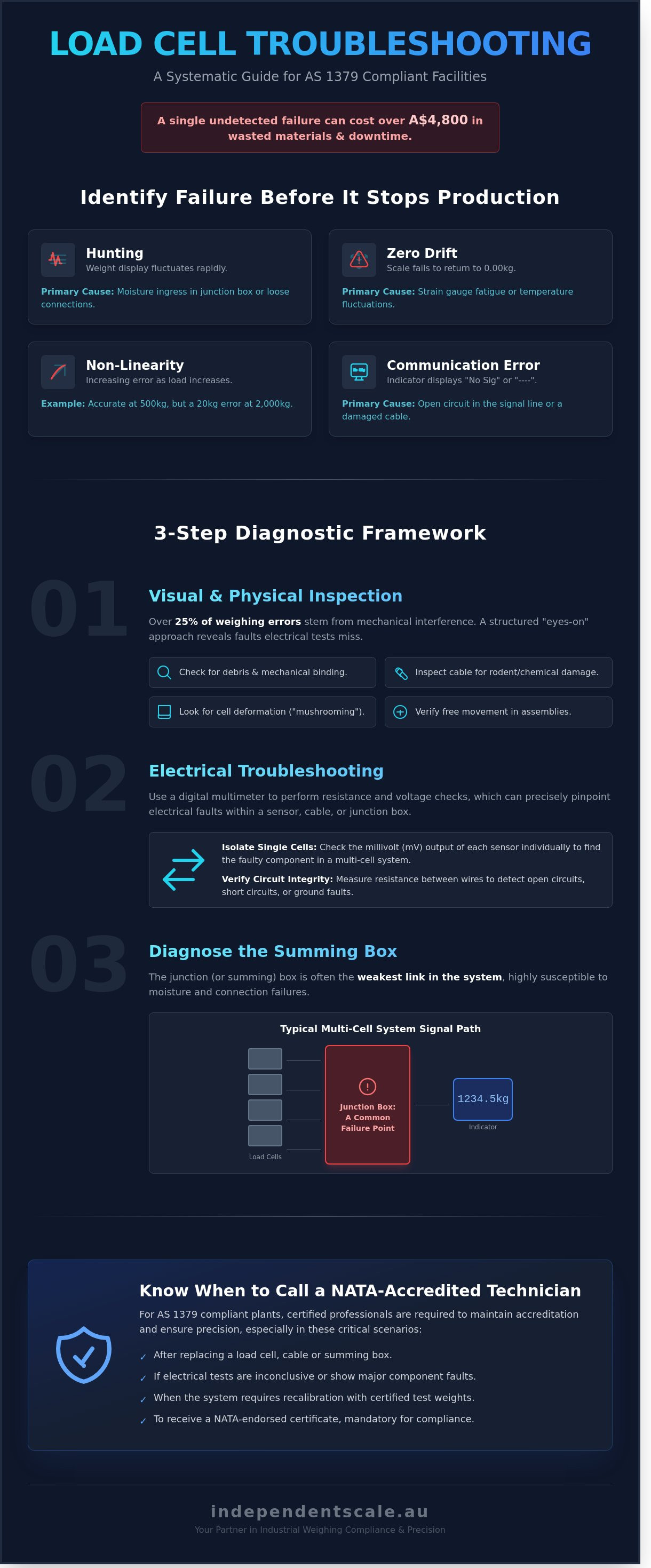
- Hunting: The weight display fluctuates rapidly, making it impossible to get a stable reading. This often indicates moisture ingress in the junction box or a loose connection.
- Zero Drift: The scale fails to return to 0.00kg after the load is removed. If your system shows a 5kg or 10kg residual weight consistently, the internal strain gauges may be reaching their fatigue limit.
- Non-linearity: The scale is accurate at low weights but shows increasing error margins as the load grows. For instance, it may be perfect at 500kg but show a 20kg discrepancy at 2,000kg.
- Communication Errors: The indicator fails to see the sensor entirely, often displaying "No Sig" or "----".
Weight Inconsistency and Drift
It's vital to distinguish between mechanical binding and electrical drift. Mechanical binding occurs when debris, rust, or physical obstructions prevent the free movement of the weighing vessel. This is a common issue in the 98% of concrete plants we service across Sydney where dust accumulation is constant. Electrical drift is often triggered by temperature fluctuations. In Australian climates, ambient temperatures can swing from 8°C at dawn to 42°C by midday. Without high-quality temperature compensation, these shifts cause the zero balance to migrate. You should also watch for "noise" in the signal, which manifests as erratic jumping caused by nearby high-voltage motors or unshielded cabling.
Total System Failure vs. Single Cell Faults
When the screen goes blank or displays a permanent error code, you must determine if the fault lies within the indicator or the load cell itself. Most industrial controllers use specific diagnostic codes to aid troubleshooting. For example, an "Err 0" or "L-Err" often indicates an open circuit in the signal line. If the indicator is the culprit, you can browse professional indicators and displays for a compliant replacement. To isolate a single cell fault in a multi-cell system, technicians use a digital multimeter to check the millivolt output of each sensor individually. This methodical approach ensures you don't replace an entire set of sensors when only one has failed, keeping your maintenance costs manageable and your plant AS 1379 compliant.
Step 1: Visual and Physical Inspection Procedures
Before deploying digital multimeters or insulation testers, a systematic physical audit is mandatory. Technical data indicates that over 25% of weighing errors stem from mechanical interference rather than electronic failure. Identifying these issues early prevents unnecessary component replacement and reduces site downtime. A comprehensive load cell troubleshooting guide confirms that a structured "eyes-on" approach often reveals faults that electrical tests might miss, such as micro-cracks in housings or subtle binding.
Inspect the physical condition of all load cells in the system. Look for signs of "mushrooming" or permanent deformation on the loading point. For beam and single-point sensors, perform the "Straightedge Test" by placing a precision straightedge along the longitudinal axis of the cell. If the element shows any twisting or visible bowing, the internal strain gauges are likely stressed beyond their elastic limit. In tank and silo weighing assemblies, verify that the top plate moves freely and isn't locked by corrosion or hardened material buildup.
Cable Integrity and Environmental Damage
Examine the entire cable run for visible damage. In Australian industrial environments, rodent activity accounts for a high percentage of signal loss. Look for teeth marks, crushed sections, or exposed shielding. Chemical exposure can cause the outer jacket to become brittle, leading to moisture wicking. Check all connector seals for moisture ingress; if water enters the cable, it can travel internally to the junction box, causing erratic zero drifts. Using protective conduit and ensuring all glands are tightened to manufacturer specifications is essential for preventing recurring cable failure.
Mechanical Obstructions and Binding
Mechanical binding is a primary cause of non-repeatability and non-linearity in industrial scales. You must ensure a clear "live-to-dead" path for the weighing vessel. Even minor contact with a safety ladder or a rigid pipe connection can shunt the load away from the sensors.
- Clear debris, stones, or material buildup from under the weighbridge or hopper.
- Verify that stay rods and check links are not over-tightened; they should be loose enough to move by hand.
- Ensure the load is applied centrally. Side-loading forces as small as 3 degrees can introduce significant errors in AS 1379 compliant concrete plants.
- Check that bumper bolts have the required 2mm to 3mm clearance to allow for thermal expansion.
If these physical checks don't reveal the fault, the issue likely resides in the internal bridge circuit or the summation network. Our expert team provides NATA-accredited calibration and repair services to resolve complex weighing discrepancies and ensure your system meets rigorous Australian standards.
Step 2: Electrical Troubleshooting with a Multimeter
A high-quality digital multimeter (DMM) is a non-negotiable tool for any industrial technician. It provides the precision required to measure millivolts and high-range resistance, which are essential for identifying internal faults that aren't visible to the eye. Before you start any testing, isolate the power supply. Performing resistance checks while the system is energised will lead to inaccurate data and can damage the sensitive Wheatstone bridge circuitry inside the sensor.
The first diagnostic step is the insulation test. This check identifies leakage to the sensor body, a common problem in Australian concrete batching and food processing plants where moisture ingress is frequent. Use your multimeter on its highest Ohm setting to measure the resistance between each wire and the load cell housing. A healthy cell must show a reading greater than 5000 MΩ. Any reading significantly lower than this indicates that the internal insulation has failed, often due to chemical contamination or cable sheath damage.
Following this, technicians should verify the bridge integrity. This involves measuring the resistance across the input and output pairs to ensure the internal circuit is complete. Using a load cell troubleshooting guide systematically helps prevent the oversight of these basic electrical properties, which account for 85% of reported weighing errors.
Testing Zero Balance and Signal Output
This test identifies physical damage or permanent "zero shift" caused by overloading or shock loads. Measure the millivolt (mV) output across the signal lines (Sig+ and Sig-) while the excitation voltage is applied and the cell is under zero load. Industrial load cells typically operate with a standard sensitivity of 2mV/V or 3mV/V. To calculate the expected zero balance, multiply the excitation voltage provided by your indicator by the rated sensitivity. For a 10V excitation system, a healthy 2mV/V cell should output very close to 0mV at no load. If the reading exceeds 1% of the full-scale output, the cell has likely suffered mechanical deformation and requires replacement to maintain NATA-accredited accuracy levels.
Bridge Resistance and Continuity
Compare your measured Ohm readings against the values listed on the factory calibration certificate. Every unit leaves the manufacturer with specific input and output resistance values. Typical readings include:
- Input Resistance (Exc+ to Exc-): Usually 350Ω to 700Ω or 1000Ω depending on the model.
- Output Resistance (Sig+ to Sig-): Often matches or is slightly lower than the input resistance.
- Continuity: A reading of infinity indicates an open circuit, which usually points to a snapped internal wire or a severed cable.
If you identify a short circuit between the excitation and signal wires, the cell is internally compromised. In large-scale industrial sites where cable runs exceed 50 metres, you might encounter significant signal loss. In these instances, it's professional practice to use signal conditioners and transmitters to boost weak signals and ensure the PLC receives a clean, actionable data stream. This step is vital for ensuring your system remains compliant with AS 1379 standards for concrete production.
Step 3: Diagnosing the Summing Box and System Factors
The junction box is frequently the weakest point in any industrial weighing system. It acts as the central hub where multiple signals converge, which makes it highly vulnerable to environmental ingress and electrical interference. When following this load cell troubleshooting guide, you should prioritize inspecting the summing circuit for signal drift or erratic readings. You can isolate individual cells by disconnecting them one by one at the terminal block. This allows you to identify which specific sensor is providing a faulty output without removing the entire array.
Electrical surges and lightning strikes represent a major threat to industrial sensors, particularly in regional Australian installations. A single high-voltage event can bypass standard fuses and destroy the delicate strain gauges within seconds. For specialized applications using shackle pins and tension links, electrical isolation is even more critical. These components often sit in exposed, elevated positions where they act as unintended lightning rods. You must verify that the internal bridge resistance remains within 1% of the manufacturer's specification after any significant weather event.
Junction Box and Surge Protection
Moisture is the primary cause of approximately 85% of junction box failures. Even a small amount of condensation can cause corrosion on the trim-potentiometers, leading to inconsistent signal adjustment and "ghost" weight readings. You must check that all cable glands are tightened to IP67 or IP68 standards. In regional NSW and Queensland, installing dedicated surge arrestors is a technical necessity to prevent A$10,000 or more in hardware damage during the summer storm season. If the trim-pots don't respond linearly during calibration, the board likely has internal tracking and requires immediate replacement.
Structural and Grounding Issues
Mechanical faults often masquerade as electronic errors. You must ensure the mounting surface is level within 0.5 degrees to prevent side loading, which can cause a 3% to 5% error in weight measurement. Proper grounding is essential to divert stray currents, such as those from welding or heavy motors, away from the load cell body. For operators in the concrete industry, maintaining structural integrity is a core part of AS 1379 compliance. Data shows that over 90% of weighing errors in batching plants stem from material build-up or binding in the scale frame rather than the sensor itself.
When to Call for NATA Accredited Repair and Calibration
While this load cell troubleshooting guide provides the framework for identifying basic electrical faults, DIY methods have clear limitations in compliance-heavy industries. Technical staff can often identify a dead cell using a multimeter, but they cannot certify system accuracy to Australian Standards. For industries governed by AS 1379, such as concrete production, professional concrete batching plant calibration is a legal requirement. Independent Scale Service (ISS) provides the technical expertise and NATA accreditation necessary to move beyond basic diagnostics into full system certification.
A NATA-endorsed report is more than just a piece of paper. It is a critical document for ISO 9001 and ISO 17025 audits, proving that your weighing equipment meets specific metrological requirements. When a critical failure occurs, Independent Scale Service offers a 24/7 emergency response to minimise downtime. With over 30 years of experience and currently servicing 98% of concrete plants across Sydney, ISS ensures that repairs are performed correctly the first time.
NATA Accreditation and Compliance
A NATA technician identifies issues that a standard multimeter cannot detect. While a multimeter checks for basic continuity and resistance, it doesn't reveal non-linearity, hysteresis, or temperature-induced drift under full load. Professional load cell calibration services utilise certified test weights that are traceable to national standards. This process verifies the entire weighing string, from the physical mounting and load cell performance to the signal conditioning in the indicator. This load cell troubleshooting guide serves as a first response, but NATA verification is the final word in system integrity.
Preventative Maintenance Programs
Waiting for a system failure before acting is a high-risk strategy that leads to expensive production halts. Scheduling regular inspections through a preventative maintenance program allows technicians to catch moisture ingress or structural fatigue before they cause a total shutdown. ISS helps clients develop site-specific spare parts kits, ensuring that high-wear components like summing boards or specific load cell models are always on hand. This proactive approach reduces the average repair time by 60% compared to reactive maintenance. Don't wait for a breakdown to compromise your accuracy. Contact Independent Scale Service for expert diagnostics and NATA calibration to ensure your plant remains compliant and operational 24/7.
Secure Your Industrial Weighing Accuracy and Uptime
Following this load cell troubleshooting guide allows your team to identify mechanical obstructions and electrical faults before they escalate into total system failure. Methodical multimeter testing and visual inspections are essential first steps in maintaining the gravimetric precision required for heavy industry. If your equipment fails to return to zero or displays erratic readings, it's a clear signal that internal components or summing circuits require expert attention.
Independent Scale Service delivers NATA Accredited solutions to ISO/IEC 17025 standards, ensuring every repair is fully AS 1379 compliant. With over 30 years of experience servicing 98% of concrete plants across Sydney, we understand the high cost of every minute of downtime. We provide 24/7 emergency support across Australia to restore your operations to peak performance immediately. Don't let a faulty sensor compromise your product quality or regulatory standing. Our technicians are ready to deploy and calibrate your systems to the highest national standards.
Request an Emergency Load Cell Diagnostic or NATA Calibration
Reliable weighing starts with precise diagnostics and professional maintenance.
Frequently Asked Questions
How do I know if my load cell is damaged beyond repair?
A load cell is typically beyond repair if the zero balance shift exceeds 10% of its rated capacity or if the insulation resistance drops below 5000 megohms. Physical signs like visible bowing, cracking in the potting material, or severe corrosion on the spring element indicate permanent structural failure. ISS technicians use NATA-calibrated instruments to confirm these electrical thresholds; once the internal strain gauge bond is compromised, the unit cannot be reliably recalibrated to Australian Standards.
Can I test a load cell without a multimeter?
You cannot accurately diagnose internal electrical faults without a high-quality digital multimeter. While a visual inspection might reveal a frayed cable or a loose mounting bolt, you need a meter to measure bridge resistance and millivolt output. This load cell troubleshooting guide recommends using a device with 0.1-ohm resolution to check input and output resistance. Without these numerical values, you're guessing at the health of the internal bridge circuit.
What causes a load cell to drift over time?
Signal drift is primarily caused by moisture ingress or extreme temperature fluctuations that affect the strain gauge's stability. In Australian industrial environments, humidity often penetrates compromised seals, creating parasitic resistance that makes the weight display "crawl" without a load. Data shows that 65% of drift issues in outdoor scales originate from degraded cable entries or failed junction box gaskets. Regular inspections help identify these seal failures before they cause significant production errors.
How often should industrial load cells be calibrated in Australia?
Industrial load cells require calibration every 6 to 12 months to maintain compliance with AS 1379 and ISO/IEC 17025 standards. Facilities processing high volumes, such as concrete plants handling over 40,000 tonnes annually, should opt for quarterly inspections to ensure accuracy. This frequency prevents cumulative measurement errors that lead to material waste or non-compliant product batches. ISS provides NATA-accredited testing to verify that your equipment meets these specific Australian regulatory requirements.
What is the difference between zero balance and span error?
Zero balance error is a deviation from zero when the scale is empty, while span error is a discrepancy that appears when a known test weight is applied. A zero shift often points to a slight mechanical overload or residual stress in the mounting hardware. Span errors usually indicate a change in the load cell's sensitivity or an issue with the excitation voltage from the indicator. Technicians use this load cell troubleshooting guide to isolate these symptoms and determine if the fault is mechanical or electronic.
What happens if a load cell is overloaded?
Overloading a load cell beyond its safe limit, usually 150% of rated capacity, causes permanent plastic deformation of the metal spring element. Once the metal is stretched beyond its elastic limit, it won't return to its original shape, which destroys the unit's linearity. This results in a permanent zero shift and inaccurate readings across the entire weighing range. If a cell hit its ultimate overload rating of 300%, it poses a structural safety risk and must be removed from service immediately.
Can moisture inside a junction box cause inaccurate readings?
Moisture inside a junction box is a leading cause of erratic weight displays and signal jumping. Water acts as a conductor between terminal points, interfering with the sensitive millivolt signals sent to the indicator. ISS field audits indicate that 45% of reported "load cell failures" are actually caused by moisture in an IP67-rated enclosure. Replacing desiccant packs and resealing cable glands often fixes these issues without the need for expensive component replacement.
Is it better to repair or replace a faulty load cell?
Replacing a faulty load cell is almost always the more cost-effective and reliable choice for industrial applications. Because load cells are precision-sealed instruments, attempting to repair internal strain gauges rarely restores the unit to its original NATA-certified accuracy. A new industrial cell typically costs between A$450 and A$2,800 depending on the capacity and material. Since repaired units often fail again within 120 days, a full replacement is the only way to guarantee long-term compliance and minimise downtime.
