


Improving Concrete Batch Consistency for Australian Plants
The mix design may be unchanged, but the batch isn’t. When results vary between runs, improving concrete batch consistency starts with finding what changed in production, not adjusting the recipe by guesswork. Aggregate moisture, material feed, weighing accuracy, control settings and mixing conditions can all affect the result. Interruptions in production can make the source harder to pinpoint.
If the cause isn’t clear, it’s difficult to know whether to investigate materials, moisture correction, weighing equipment or the mixing sequence. A repeatable, measurement-led process helps separate these factors and gives your team evidence to guide the next step.
This article explains how to track batch variation, check key process inputs and narrow down likely causes. It also covers when load cell and batching plant calibration or component diagnostics may be relevant. Calibration is one part of process control, not a guaranteed fix for every inconsistency. NATA-accredited calibration to ISO/IEC 17025 can help assess weighing-system performance as part of a broader investigation.
Key Takeaways
- Define consistency by repeatable proportions and process outcomes, then distinguish it from slump, strength, production efficiency and product acceptance.
- Compare batch records with changes in aggregate grading, material sources, mix design and moisture results to narrow down possible causes.
- Use symptoms and supporting evidence to distinguish material or moisture variation from weighing drift, control settings and mixing-cycle differences.
- For improving concrete batch consistency, follow a repeatable checklist and record batch identifiers, recipe versions, material condition, readings and operator adjustments.
- Understand when calibration or load-cell diagnostics may help assess measurement reliability, and how NATA-accredited ISO/IEC 17025 calibration relates to concrete batching plant services aligned with AS 1379.
Improving concrete batch consistency starts with identifying the variation
Concrete batch consistency means repeatable proportions and process outcomes across batches produced to the same mix design. It describes production repeatability, not whether the plant is running quickly, a batch reaches a particular slump or strength, or the finished concrete is accepted. Those are separate measures. A plant can produce batches efficiently while unexplained variation remains, and a consistent process alone doesn’t establish that concrete meets project requirements.
Begin by describing the variation you can see in the records. Look for differences in recorded material quantities, recurring operator adjustments, rejected loads or repeated quality corrections. A change in aggregate condition or moisture, for example, may affect water adjustments. Repeated differences between setpoints and recorded weights may point to another part of the process. These are clues to investigate, not proof of a cause.
Which signs point to a concrete batching consistency problem?
Compare batch sheets for the same recipe and note recurring differences in recorded quantities. Review operator notes, load rejections and repeat corrections alongside the batch records. Then check whether the pattern is isolated to one event or recurs across shifts, recipes or material deliveries. A single discrepancy may have a specific explanation; a repeated pattern calls for a broader investigation.
- Compare recorded material quantities for batches made to the same recipe.
- Look for repeated manual adjustments or corrections, and record when they occur.
- Check whether rejected loads or quality concerns cluster around particular shifts, recipes or deliveries.
Use the project’s requirements and applicable standards to determine quality limits and acceptance criteria. Don’t treat a general observation about variation as a pass-or-fail threshold.
Why measure the whole batching process?
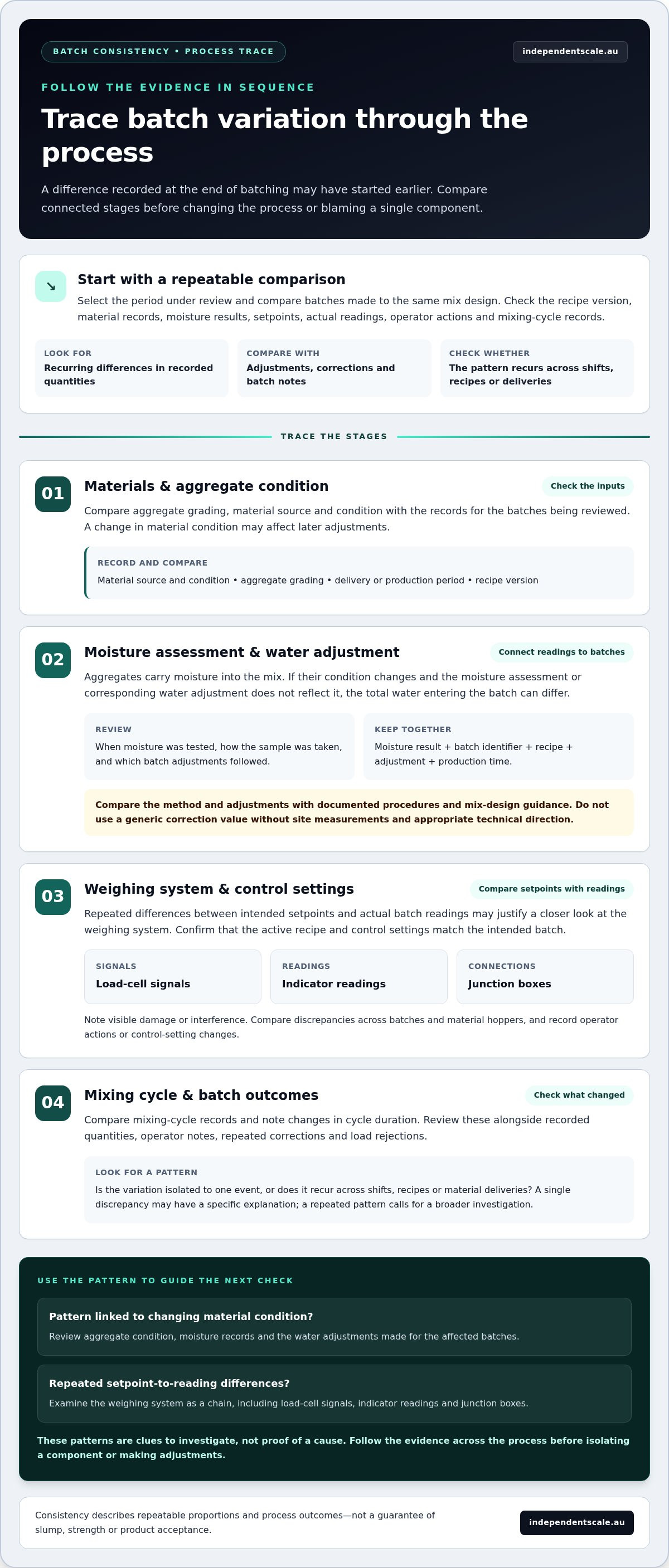
Batch outcomes can reflect connected stages, including material supply and condition, moisture assessment, weighing, control settings and mixing. A concrete batching plant combines these components through its material-handling and control systems. A change at one stage can affect what operators record or adjust later, so investigate the sequence instead of isolating a component too early.
Don’t assume the mixer or load cells are at fault before comparing records and checking evidence across the process. Repeated weight discrepancies may justify closer examination of the weighing system, while a pattern linked to material condition may call for a different check. Batch consistency is the repeatability of material proportions and process outcomes across batches, not a guarantee of slump, strength or acceptance.
Trace batch variation through materials, moisture, weighing, and mixing
Once a pattern appears in the batch records, trace the process in sequence. Changes in material supply or aggregate grading can affect the inputs. Moisture can alter the water contributed by aggregate. Weighing and control settings determine what the plant doses, and the mixing cycle affects how materials are combined. These stages interact, so a symptom recorded at the end of batching may have started earlier.
For the period under review, compare the mix design and recipe version with records of aggregate grading, material source and condition. Check whether moisture readings and water adjustments followed the plant’s documented procedures. Then compare recorded setpoints with actual batch readings, and note changes to control settings, operator actions or mixing-cycle duration. When aggregate moisture changes and isn’t accounted for, it can alter the water balance in the batch.
How can aggregate moisture affect batch repeatability?
Aggregates carry moisture into the mix. If their condition changes but the moisture assessment or corresponding water adjustment doesn’t reflect that change, the total water entering the batch can differ. Review when moisture was tested, how the sample was taken and which batch adjustments followed. Compare those records with the plant’s documented method and mix-design guidance. Don’t apply a generic correction value without site measurements and appropriate technical direction. Maintaining reliable, sediment-free batch water supply is equally critical for process consistency, with industrial liquid management solutions from Liquimech helping operations draw clean water from retention and recycling storage.
Keep the evidence connected: record the moisture result alongside the batch identifier, recipe, adjustment and production time. This helps show whether recurring variation coincides with changing aggregate conditions, rather than prompting an assumption that the weighing system is at fault.
How do weighing components contribute to variation?
When actual readings repeatedly differ from setpoints, examine the weighing system as a chain. Review load-cell signals, indicator readings and junction boxes, and note visible signs of damage or interference. Compare discrepancies across batches and material hoppers. A recurring pattern may justify diagnostic checks, but it doesn’t prove that a particular component has failed. Loughborough University research discusses batching consistency and quality-control procedures, reinforcing the value of systematic checks over isolated adjustments.
Controls and mixing also matter. Confirm that the active recipe and control settings match the intended batch, then check whether mixing-cycle records changed during the same period. A weighing system can measure correctly while an incorrect setting or process change still produces variation. Improving concrete batch consistency means checking each stage against its records before changing settings or replacing components.
For component context during a weighing-system review, see industrial load cell components.
Compare likely causes before changing the batching process
Use repeated batch records to decide what to investigate first. A single unusual reading may result from a one-off event, a recording error or a process interruption. Look for patterns across comparable batches, recipes and shifts before changing settings or replacing components. Match each symptom to supporting evidence, then choose a proportionate next check.
| Observed symptom | Evidence to review | Plausible cause | Next check |
|---|---|---|---|
| Water adjustments vary as aggregate condition changes | Moisture results, sample timing and adjustment records | Moisture variation or an inconsistent correction process | Compare moisture checks and water adjustments with documented procedures and mix-design guidance |
| Recorded material weights repeatedly differ from setpoints | Batch readings, repeat checks and weighing-system records | Possible weighing drift or a component fault | Review measurement performance and investigate the weighing system |
| Similar batches follow different sequences or settings | Recipe versions, control settings and operator records | Control or operator changes | Compare settings and batch sequencing with the approved recipe |
| Variation coincides with changed mixing records | Mixing-cycle records and process instructions | Differences in mixing time or material charging | Check actual practice against approved procedures |
Prioritise checks supported by more than one observation. If weight discrepancies recur while material and recipe records remain stable, investigate measurement performance. If recorded weights align but adjustments track moisture results or recipe changes, focus on those factors first. Don’t diagnose from one reading or treat a plausible cause as a confirmed fault.
When should weighing-system calibration be investigated?
Consider calibration when batch records or repeat checks indicate measurement uncertainty or drift. Calibration assesses measurement performance within a defined scope. It doesn’t verify the entire production process or establish that moisture and mixing are controlled. Document the scope and applicable tolerances for the intended measurement task. For context on plant calibration, see the concrete batching plant calibration and repair services.
When should operators investigate process settings instead?
Compare recipe versions, setpoints, charging sequence and operator changes with production records. Check that mixing time and material charging remain consistent with approved procedures. A calibration result may support confidence in the measurement system within its scope, but it doesn’t prove that moisture correction, control settings or mixing are correct. Improving concrete batch consistency depends on addressing the cause indicated by the evidence, not applying the same fix to every symptom.
Use a repeatable Australian plant checklist to improve batch consistency
A documented investigation helps your team compare like with like and avoid changing several process variables at once. Use the same sequence whenever batch variation appears, and keep the records together so patterns can be reviewed across shifts and recipes.
- Define the symptom. Describe what varies, such as recorded ingredient quantities, water adjustments or repeated quality corrections. Note which recipes, shifts or production periods are affected.
- Collect the records. Gather batch identifiers, recipe versions, batch sheets, operator notes and relevant quality records for the period under investigation.
- Inspect the inputs. Record material sources and condition, aggregate moisture results, sampling details and any water adjustments made under the plant’s documented procedures.
- Check measurement. Compare setpoints with actual readings. Record the identification and calibration status of relevant instruments, and relate each calibration record to the equipment and measurement points within its stated scope.
- Test one change. Where operationally appropriate, adjust one controllable factor, then compare repeat measurements and records with the baseline.
What should a batch consistency investigation record?
Use a consistent log for the date, shift, batch identifier, mix design, recipe version, material condition, moisture results, recorded readings and operator adjustments. Include instrument identification and calibration status in line with site quality procedures. Record corrective actions and subsequent results so the team can determine whether a change affected the observed pattern or variation continued.
Keep calibration records connected to the specific equipment and measurement points they cover. A calibration result provides evidence about measurement performance within its defined scope; it doesn’t establish that every part of the batching process is controlled.
How should corrective actions be verified?
Where the process allows, change one factor at a time and use repeat measurements rather than relying on a single batch. Assess results against acceptance criteria set for the project and the site’s quality procedures. If the pattern remains, revisit the likely cause instead of adding further adjustments without evidence.
AS 1379 relates to the specification and supply of concrete. Apply the current relevant edition and interpretation to the work, and verify the requirements that apply to the project. Don’t assume a universal calibration or test frequency: requirements depend on the applicable context and documented procedures.
For evidence-led support with plant weighing systems, review concrete plant calibration and repair services. A repeatable checklist, measurement records and controlled follow-up give teams a practical basis for improving concrete batch consistency.
When calibration or load-cell diagnostics can support consistent batching
Calibration or load-cell diagnostics are relevant when batch records or repeat checks point to uncertainty in measured weights, readings that drift, or an inconsistent response from a weighing system. Diagnosis can help identify whether a load cell, indicator or associated component needs repair or replacement. Let the evidence guide the work: not every batch variation starts in the weighing system.
Independent Scale Service provides concrete batching plant calibration and repair services aligned with AS 1379. Its calibration services are NATA accredited to ISO/IEC 17025. These services support a measurement-led investigation, but results relate to the equipment condition and defined calibration scope, while other production variables remain relevant. Calibration assesses measurement performance within that scope. It doesn’t verify aggregate moisture correction, recipe settings or mixing practice.
What does a focused batching plant calibration address?
A focused calibration evaluates weighing performance using the agreed scope and documented procedure. Depending on the plant and measurement task, the assessment may relate to load cells, indicators and associated weighing components. Findings help establish how the system performs at the measurement points covered and whether further diagnosis or repair is warranted. See concrete batching plant calibration services for details.
Before acting on a result, compare it with the batch records that prompted the investigation. A measurement issue may explain repeated discrepancies between setpoints and actual readings, but it won’t by itself account for variation caused by material condition, moisture, control settings or mixing cycles. Improving concrete batch consistency requires using calibration evidence alongside production data.
What should happen after calibration or repair?
Review service findings and instrument records alongside the relevant batch, recipe and material records. If a component was repaired or replaced, assess the measurement system within its documented scope and follow the site’s approved quality and production procedures before making operational changes. Then monitor repeat batches against site-defined criteria. This helps verify whether the measurement concern was addressed and identify any remaining process causes.
For Australian plants seeking evidence-led weighing-system support, discuss concrete batching plant weighing support with Independent Scale Service. A clear symptom, relevant batch records and existing calibration documentation help focus the investigation.
Make batch consistency a measurable part of plant control
Improving concrete batch consistency starts with evidence. Compare repeat batches, trace variation through materials, moisture, weighing, controls and mixing, then test a focused corrective action against recorded results. This approach helps distinguish a recurring process issue from a one-off event and shows when weighing-system calibration or load-cell diagnostics may be relevant.
Calibration assesses measurement performance within its defined scope. It’s one part of a wider investigation, not a guaranteed fix for every source of variation. Independent Scale Service provides NATA-accredited calibration to ISO/IEC 17025 and concrete batching plant calibration and repair services aligned with AS 1379. The company operates across Sydney, Melbourne and regional Australia.
If batch records point to a measurement concern, discuss concrete batching plant weighing support. With a repeatable investigation and clear records, your team can make informed adjustments and build more dependable control into production.
Frequently Asked Questions
How can I improve concrete batch consistency?
Improve concrete batch consistency by tracking repeat batches, identifying where results vary and checking the evidence before changing the process. Compare batch sheets, recipe versions, material condition, moisture results, weighing readings and operator adjustments. Look for recurring patterns across shifts or recipes, then test one suitable corrective action at a time. Assess the result using repeat measurements and the project’s applicable acceptance criteria.
What causes concrete batches to vary when the mix design stays the same?
A consistent mix design doesn’t guarantee that every production input and process step remains unchanged. Aggregate grading, material source or condition, moisture, water adjustments, weighing performance, control settings and mixing cycles can all contribute to variation. Compare batch records with production and material records to identify changes that coincide with the symptom. Treat these as possible causes to investigate, not diagnoses based on one unusual batch.
Can aggregate moisture cause inconsistent concrete batches?
Yes. Aggregate moisture can change how much water enters a batch. If moisture results aren’t representative, aren’t recorded at the right time or aren’t reflected in water adjustments, batches may have a different water balance despite using the same mix design. Review sampling practices, moisture readings and corresponding adjustments together. Follow the plant’s documented procedures and mix-design guidance rather than using a generic correction value.
How often should a concrete batching plant be calibrated in Australia?
There isn’t one calibration interval that applies universally to every Australian batching plant. Determine the appropriate interval using the current applicable edition and interpretation of AS 1379, project requirements, site quality procedures, equipment condition and calibration history. Keep the calibration scope and records documented. If batch records or repeat checks indicate measurement uncertainty or drift, investigate the weighing system rather than relying only on a calendar schedule.
Does load-cell calibration guarantee consistent concrete batches?
No. Load-cell calibration provides evidence about measurement performance within its defined scope; it doesn’t verify every stage of production or guarantee batch consistency. Material variation, aggregate moisture, water correction, recipe settings, controls and mixing can still affect results. Review calibration findings alongside batch and material records. If the weighing system is performing as assessed, continue investigating other process factors that could explain the variation.
How do I know whether batch variation comes from weighing equipment or the process?
Compare repeated batch readings with setpoints, then review recipe versions, moisture results, operator adjustments and mixing records for the same batches. Recurring discrepancies between setpoints and actual weight readings may warrant weighing-system checks or calibration. If readings align but variation follows material condition, moisture corrections or process settings, investigate those areas. Use patterns across comparable batches, not a single measurement, to prioritise the next check.
What records should a concrete plant keep when investigating batch variation?
Keep a consistent record of batch identifiers, dates and shifts, mix design and recipe version, material source and condition, moisture results, water adjustments, setpoints and actual readings. Include operator adjustments, relevant quality observations, instrument identification and calibration status under the site’s procedures. Record each corrective action and subsequent results. These records give the team a basis for comparing batches over time and checking whether an intervention changed the variation pattern.
