


How to Calibrate a Concrete Batching Plant: The Authoritative Guide to AS 1379 Compliance
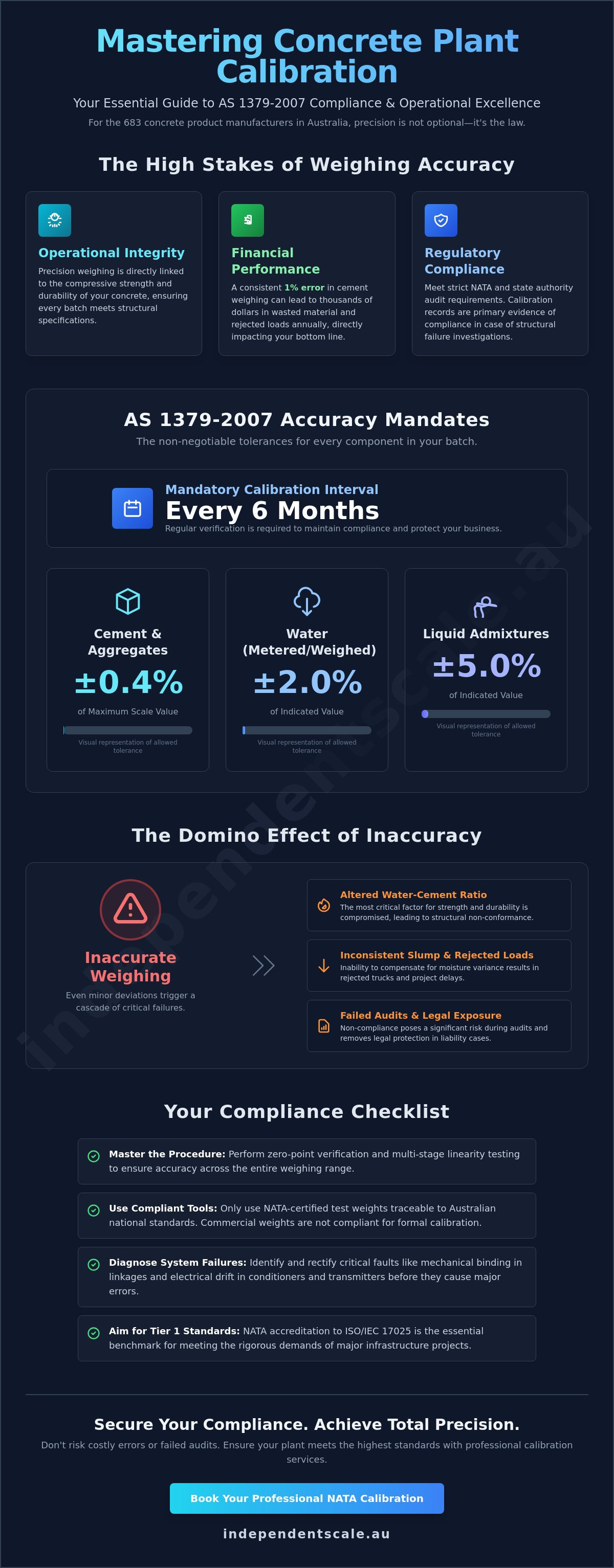
Calibration is not just a weight check; it's a high-precision technical audit that bridges the gap between mechanical performance and regulatory compliance. For the 683 concrete product manufacturing businesses operating in Australia in 2026, mastering how to calibrate a concrete plant is essential for maintaining operational integrity. Inaccurate weighing leads to rejected loads and excessive material wastage that directly impacts your bottom line. You understand that failing to meet the ±0.4% accuracy threshold required by AS 1379-2007 poses a significant risk during NATA or state authority audits.
This guide outlines the technical requirements and step-by-step procedures to ensure your facility meets all Australian regulatory standards. You'll gain a clear understanding of the mandatory six-month calibration intervals and the specific accuracy tolerances for water and liquid admixtures. We provide a methodical breakdown of the calibration process to help you achieve repeatable results and optimized material usage. By implementing these rigorous standards, you can secure full compliance with AS 1379 and minimize the risk of costly production errors.
Key Takeaways
- Understand the direct correlation between weighing precision and concrete compressive strength to ensure batch consistency.
- Master the technical procedure for how to calibrate a concrete plant, including zero-point verification and multi-stage linearity testing.
- Identify the specialized tools required for compliance, including NATA-certified test weights traceable to Australian national standards.
- Learn to diagnose critical system failures such as mechanical binding and electrical drift in conditioners and transmitters.
- Discover why NATA accreditation to ISO/IEC 17025 is the essential benchmark for meeting the rigorous demands of Tier 1 infrastructure projects.
Understanding the Critical Role of Concrete Plant Calibration
Concrete plant calibration is the formal verification of weighing and metering systems against certified, traceable standards. It's a technical necessity for quality assurance, not a discretionary maintenance task. In the Australian construction sector, this procedure ensures that every batch produced meets the exact specifications required for structural integrity. Learning how to calibrate a concrete plant is essential for any operator aiming to maintain AS 1379 compliance. Precision in weighing is directly linked to the compressive strength of the finished product. Because what is concrete depends entirely on the precise chemical reaction between cement, water, and aggregates, even minor deviations in material ratios can lead to structural non-conformance.
Financial performance also hinges on calibration accuracy. "Over-yielding," where cement is over-dispensed due to scale inaccuracies, represents a direct drain on profitability. For a high-volume plant, a consistent 1% error in cement weighing can equate to thousands of dollars in wasted material annually. AS 1379-2007 serves as the primary Australian Standard governing these requirements. It provides the framework for both production quality and legal protection for the 683 concrete product manufacturing businesses currently operating in Australia.
AS 1379 Compliance and Accuracy Limits
Australian standards dictate strict tolerances for all batching components. Weighing equipment for cement and aggregates must maintain an accuracy of ±0.4% of the maximum scale value. Water must be metered or weighed to within ±2.0%, while liquid admixtures require an accuracy of at least ±5.0% of the indicated value. Under current industry norms, you must perform these calibrations at least every six months. Adhering to these intervals protects your business against legal liability. If a structural failure occurs, your calibration records serve as primary evidence that the concrete was supplied according to the specified design and regulatory requirements.
The Impact of Inaccuracy on Mix Design
Modern high-strength mixes leave no room for error. A 2% inaccuracy in cement weighing fundamentally alters the water-cement ratio, which is the most critical factor for durability and strength. Inaccurate scales also prevent effective compensation for aggregate moisture variance. This often results in inconsistent slump and rejected loads. As the industry moves toward more complex "green concrete" and specialized additives, the requirement for tighter calibration windows becomes absolute. Precise measurement is the only way to ensure these advanced mix designs perform as engineered and meet the increasing demand for sustainable construction materials.
Essential Preparation: Tools, Standards, and Safety Protocols
Executing a precise calibration requires more than just a set of weights. It demands a rigorous technical environment where every variable is controlled. Before you begin learning how to calibrate a concrete plant, you must establish a baseline of mechanical and electrical integrity. This preparation phase is the difference between a compliant facility and one that fails an audit due to preventable errors. Safety is the first priority. All technical staff must adhere to Lock-out Tag-out (LOTO) protocols to isolate power sources and prevent accidental discharge of materials. Given the height of many silo structures, working at heights permits and appropriate fall protection are mandatory under Australian OHS regulations.
The technical toolkit for a compliant calibration includes high-resolution indicators, millivolt simulators, and NATA-certified test weights. These tools are the only way to verify that your system meets the strict tolerances of AS 1379. If your current equipment is showing signs of instability, you may need to upgrade your load cells before proceeding with the formal audit. Many operators find that engaging a professional concrete batching plant calibration service is the most efficient way to ensure all equipment meets these high standards without risking plant downtime.
Selecting Traceable Test Weights
Traceability is the cornerstone of regulatory compliance. You cannot use "commercial" weights for a formal calibration; you must use weights that are NATA-certified and traceable to Australian national standards. These weights come with a certificate of accuracy that auditors will demand to see. To properly test linearity, you need enough weight to reach at least 10%, 50%, and 100% of the scale's capacity. When total test weights are limited, "substitution" weighing is used. This involves adding a known amount of weight, recording the reading, replacing the weights with "dummy" material like sand or water to reach that same reading, and then reapplying the certified weights to continue up the scale. This method is common for large-capacity aggregate hoppers.
Mechanical and Electrical Pre-Checks
Calibration fails if the hardware is compromised. You must inspect all tank and silo weighing assemblies for "bridging" or debris buildup. Even a small amount of dried concrete between a hopper and the frame causes mechanical binding, which destroys linearity. On the electrical side, moisture is the primary enemy. Inspect junction boxes and surge arrestors for signs of corrosion or ingress. While Australian standards are the local priority, referencing NRMCA Plant Certification guidelines can provide additional global perspectives on maintaining scale and meter accuracy. Finally, ensure the weighing indicator is zeroed and shows a stable reading for at least 30 seconds before applying the first test weight.
The Step-by-Step Calibration Procedure for Batching Systems
The technical procedure for how to calibrate a concrete plant involves a sequence of rigorous tests designed to verify accuracy under load. Once the pre-calibration checks are complete, you must move into the active testing phase. This process validates that the mechanical response of the system matches the digital output shown on your indicators and displays. Every stage of this procedure must be recorded to generate a compliant calibration report, including "As Found" data before adjustments and "As Left" data upon completion.
A systematic calibration follows these four critical stages:
- Zero-Point Verification: Ensure the empty hopper returns to a stable zero reading consistently. This confirms there is no mechanical binding or residual material affecting the base weight.
- Linearity Testing: Apply certified weights in incremental stages, typically at 10%, 25%, 50%, 75%, and 100% of the scale's capacity. The system must remain within the ±0.4% tolerance required by AS 1379 at every point.
- Repeatability Testing: Apply the same known load multiple times. The indicator must return the same value each time to prove the system's reliability during high-volume production.
- Span Calibration: Verify the full-scale deflection of the system. This ensures the electronic signal from the load cells is correctly scaled to the physical weight applied at maximum capacity.
Calibrating the Cement and Aggregate Hoppers
Hoppers are susceptible to eccentric loading. To test for this, hang certified weights on each corner of the hopper individually. If the readings vary between corners, you must adjust the corner balancing within the junction box to ensure the load is distributed evenly across all sensors. Cement scales present unique challenges due to aeration and vibration from pneumatic filling. These factors can cause "signal noise," making it difficult to achieve a stable zero. You must ensure all flexible connections are loose and not restricted, as even a stiff dust seal can throw the scale out of its required accuracy range.
Water and Admixture Dosing Accuracy
While many plants use flowmeters, the most accurate way to verify these units is through a liquid flowmeter calibration using the weighing method. This involves discharging a set volume of water into a tared container on a certified scale. Since water density is a known constant, the weight provides an absolute reference for the meter's accuracy. This level of precision is even more critical for chemical admixtures. Because admixtures are used in small, concentrated doses, a minor weighing error can significantly alter the set time or air entrainment of the concrete mix.
Troubleshooting Common Calibration Errors and Load Cell Faults
Technical malfunctions during the calibration process often stem from mechanical interference rather than electronic failure. Identifying these issues early is critical when learning how to calibrate a concrete plant effectively. Mechanical binding remains the primary cause of non-linearity. This occurs when a hopper or silo makes physical contact with the surrounding structure, preventing the load cells from sensing the full weight. Even a buildup of hardened concrete or a misaligned safety bolt can create a shunting effect that bypasses the sensors. These physical obstructions must be cleared before any digital adjustments are made to the system.
Electronic instability often manifests as electrical drift. This is frequently traced back to faulty conditioners and transmitters. When these components fail, the weight reading may fluctuate without any change in load, or the system may fail to return to zero. To isolate the root cause, technicians use a millivolt (mV) simulator. By injecting a known signal directly into the indicator, you can determine if the error lies within the display electronics or the load cells themselves. If the simulator produces a stable reading, the fault is located in the field wiring or the sensors. If your system continues to show erratic readings under load, you should request professional load cell repair and calibration to prevent further production delays.
Identifying Load Cell Failure
Load cell damage is often internal and invisible to the naked eye. You can diagnose health by performing a bridge resistance test with a high-quality multimeter. Measure the resistance between the excitation leads and the signal leads; any significant deviation from the manufacturer's data sheet indicates a compromised strain gauge. Moisture ingress is another common failure point, especially in outdoor plants. It often presents as "drifting" weights that change with humidity or temperature. When a sensor fails these tests, you must decide between repair and full replacement. While simple cable damage is fixable, internal gauge deformation usually requires a complete unit swap to maintain AS 1379 compliance.
Environmental and Structural Interference
Outdoor batching plants face unique environmental challenges. High winds can apply lateral force to hoppers, creating false weight readings that fluctuate rapidly. Similarly, thermal expansion of large steel silos during peak summer temperatures can put unexpected stress on mounting assemblies. You must ensure all hopper inlets and outlets utilize flexible "boots" or sleeves. If these connections are too stiff or become caked with cement dust, they act as mechanical springs that fight against the load cells. Furthermore, "ghosting" weights can be caused by electromagnetic interference (EMI). This happens when load cell cables are run too close to high-voltage power lines for large mixer motors, inducing signal noise that corrupts the weighing data.
Ensuring Long-Term Compliance with Professional NATA Calibration
Professional accreditation is the final safeguard for any concrete production facility. While basic operational checks are part of daily routines, they don't replace the legal and technical necessity of a NATA-accredited audit. NATA accreditation to ISO/IEC 17025 is the gold standard for the Australian industry. It ensures that the equipment, methods, and technicians used to verify your plant meet international benchmarks for competence. For operators managing high-stakes infrastructure projects, relying on "in-house" methods for how to calibrate a concrete plant is a significant risk. Internal checks often lack the rigorous traceability and uncertainty of measurement data required to withstand a Tier 1 contractor audit or a state authority investigation.
A compliant Concrete Batching Plant Calibration Certificate must contain specific technical data points to be valid under AS 1379. This includes the identification of the NATA-certified test weights used, the "As Found" and "As Left" results for every scale, and a clear statement of compliance or non-compliance for each component. To minimize calibration drift between official six-month visits, you should implement a preventative maintenance schedule. This involves weekly visual inspections of load cell mounts and monthly "spot checks" using a known weight to ensure the system hasn't shifted due to mechanical wear or environmental factors.
The Value of Independent Verification
Independent verification acts as a technical insurance policy against product failure. If a batch of concrete fails a strength test on-site, your third-party calibration report is the primary evidence that your weighing systems were accurate and compliant at the time of production. These reports are also essential for businesses maintaining ISO 9001 quality management systems, as they provide the objective proof of equipment control required by the standard. Engaging a specialist for hopper and silo calibration ensures that even the largest capacity systems are tested using the correct substitution methods and high-resolution instrumentation. This level of precision protects your reputation and your profit margins.
Next Steps: Booking Your Service
Routine calibration occurs every six months, but certain events trigger the need for an immediate service. You must recalibrate your plant following any major component replacement, such as a new load cell or indicator, or after any structural impact to the hoppers. Independent Scale Service provides comprehensive on-site support across Sydney, Melbourne, and regional Australia to minimize your operational downtime. Our technicians arrive with the necessary NATA-certified equipment to perform full-scale audits that satisfy all AS 1379 requirements. If your plant is approaching its next compliance deadline, contact our technical team today to request a formal quote or consultation.
Secure Your Plant's Operational Integrity and Compliance
Maintaining a compliant concrete batching facility requires a commitment to technical precision and rigorous documentation. You now understand the essential steps for how to calibrate a concrete plant, from the initial zero-point check to the final linearity verification. Adhering to the ±0.4% weighing tolerance specified in AS 1379-2007 isn't just about passing an audit; it's about protecting your structural integrity and bottom line. By identifying mechanical binding and electrical drift early, you prevent material wastage and ensure every load meets the design mix requirements.
Independent Scale Service provides the professional expertise needed to maintain these high standards. Our expert technicians serve Sydney, Melbourne, and regional Australia with NATA-accredited solutions that are fully compliant with ISO/IEC 17025. We ensure your facility remains methodical and reliable in its production. Your plant's success depends on precision. Request a NATA-Accredited Concrete Plant Calibration Service Today to secure your operational future. Achieving peak accuracy in every batch is within your reach.
Frequently Asked Questions
How often does a concrete batching plant need calibration under AS 1379?
Weighing and metering equipment must be calibrated at least every six months. This interval is the mandatory minimum requirement under AS 1379-2007. More frequent testing may be necessary if the plant undergoes major repairs, component replacements, or if structural impacts occur. Regular intervals ensure that the ±0.4% accuracy threshold for weighing systems is maintained consistently throughout the production cycle.
Can I calibrate my own concrete plant using test weights?
You can perform internal verification checks, but official compliance for NATA or state authority audits requires professional certification. Learning how to calibrate a concrete plant internally is useful for preventative maintenance between official visits. However, high-stakes infrastructure projects demand third-party NATA-accredited reports to satisfy ISO 9001 quality systems and legal liability requirements. Independent verification provides the necessary traceability to Australian national standards.
What is the difference between calibration and verification?
Calibration is the technical process of comparing an instrument's reading against a known standard and making necessary adjustments to correct errors. Verification is a simpler check to determine if the equipment is still operating within its specified tolerances. While verification confirms current status, only a full calibration ensures the system is optimized for linearity and repeatability across its entire weighing range.
What accuracy tolerances are required for cement weighing?
Cement weighing equipment must be accurate to within ±0.4% of the maximum scale value. This strict tolerance is essential because cement is the most critical component in determining the final compressive strength of the mix. Even minor deviations can significantly alter the water-cement ratio and durability. Adhering to this limit is a core requirement for any facility operating under current Australian standards.
What happens if my concrete plant fails a NATA calibration audit?
If a plant fails to meet the required tolerances, you must immediately identify and repair the underlying mechanical or electrical fault. Production of compliant concrete cannot continue until the system is re-tested and brought within the ±0.4% limit. Failure during an official audit can lead to the rejection of batches, project delays, and potential loss of certification for major infrastructure supply contracts.
How long does a typical full plant calibration take?
A comprehensive calibration usually takes between four and eight hours to complete. This timeframe depends on the number of hoppers, the complexity of the admixture systems, and the physical accessibility of the weighing assemblies. Technicians must perform zero-point checks and repeatability trials for each scale. Efficient scheduling helps minimize plant downtime during this essential compliance procedure for how to calibrate a concrete plant.
Do I need to calibrate the water flowmeter separately from the hoppers?
Yes; water and liquid admixture dispensers require their own specific calibration procedures and have different accuracy tolerances. Water must be metered or weighed to an accuracy of at least ±2.0%, while liquid admixtures require ±5.0%. Using the weighing method to verify flowmeter accuracy is the most reliable way to ensure these liquid components are dispensed correctly into the mix according to the design specifications.
What documentation is required to prove compliance for a major infrastructure project?
You must provide a NATA-endorsed calibration certificate that includes "As Found" and "As Left" data points. This document must list the certified test weights used and confirm their traceability to Australian national standards. Detailed records of the calibration date, technician credentials, and specific equipment identification are mandatory to satisfy the quality management requirements of Tier 1 construction projects and government authorities.
