


Hopper and Silo Calibration Cost: 2026 Industrial Pricing & Compliance Guide
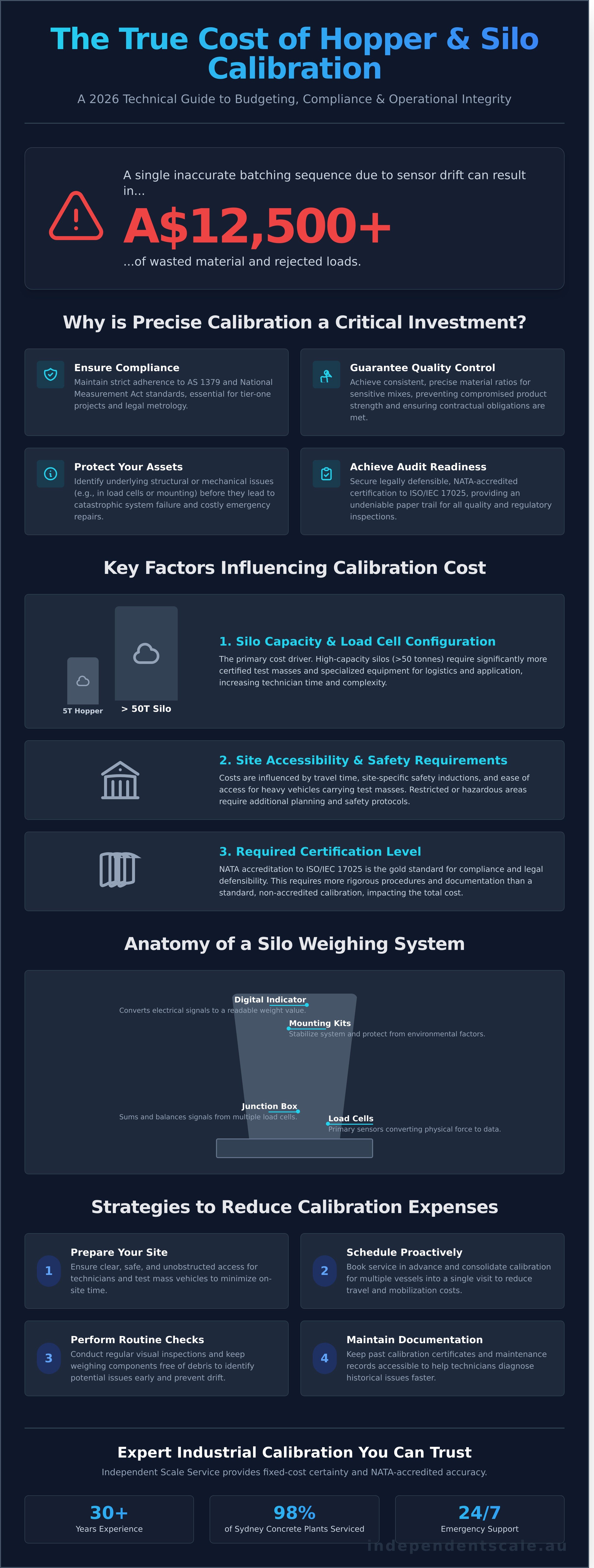
A single inaccurate batching sequence can result in over A$12,500 of wasted material and rejected loads before your site team even detects the sensor drift. Calculating the total hopper and silo calibration cost involves more than just a service fee; it's a critical safeguard against the financial loss of inaccurate batching and the risk of project rejection due to non-compliance. You recognize that precise weighing is the backbone of your operational profitability, yet balancing maintenance budgets with the strict requirements of AS 1379 remains a constant logistical challenge.
This 2026 guide provides the technical clarity you need to manage your maintenance budget with fixed-cost certainty while ensuring NATA-accredited accuracy. You'll discover the specific technical factors, methodology choices, and Australian regulatory requirements that determine your total investment. We examine the pricing differences between gravimetric and electronic calibration, the impact of ISO/IEC 17025 compliance on audit readiness, and proven strategies to reduce operational downtime during your next scheduled service.
Key Takeaways
- Understand the critical role of gravimetric verification in maintaining AS 1379 compliance and legal metrology standards for Australian industrial storage vessels.
- Identify how weighing assembly complexity and site accessibility requirements dictate the total hopper and silo calibration cost for your operations.
- Compare various calibration methodologies to determine the optimal balance between measurement accuracy and operational expenditure.
- Discover practical site preparation and maintenance strategies designed to reduce technician on-site time and extend intervals between major recalibrations.
- Ensure your facility meets global benchmarks through NATA-accredited procedures compliant with ISO/IEC 17025 quality standards.
Understanding Hopper and Silo Calibration Requirements
Hopper and silo calibration is the technical process of verifying the accuracy of weighing systems within large storage vessels. This procedure involves applying certified test masses to the structure to confirm that the digital readings match the physical load. For a foundational overview of these measurement principles, operators can consult What is Calibration? to understand the history and necessity of measurement standards. In the Australian industrial sector, this isn't a discretionary task. It's a critical requirement for legal metrology and quality control. Precise measurement ensures that every batch produced meets engineering specifications and contractual obligations.
The hopper and silo calibration cost for a facility is a direct investment in operational integrity. Australian industries including concrete production, mining, agriculture, and chemical processing rely on these systems to manage high-value bulk materials. Inaccurate scales lead to material wastage, compromised product strength, and financial losses. Independent Scale Service (ISS) leverages over 30 years of experience to ensure these systems remain within strict tolerance levels. We service 98% of concrete plants across Sydney, providing the technical competence required for heavy-capacity weighing.
The consequences of compromised product strength ripple throughout the construction industry. End-users, from tier-one contractors building skyscrapers to specialists like Rod Cameron Pools constructing durable swimming pools, rely on concrete that meets these exact specifications for structural integrity and longevity.
By 2026, the link between calibration frequency and operational risk will become more pronounced. Regulatory bodies are increasingly moving toward data-driven compliance models. This means that businesses failing to maintain a regular service schedule face higher insurance premiums and increased scrutiny during audits. High-volume sites often require quarterly or bi-annual checks to mitigate the risk of signal drift. A proactive approach to maintenance reduces the likelihood of emergency repairs and minimises client downtime. Our emergency 24x7 support reflects the urgency required when these systems fail.
- Legal Metrology: Ensures compliance with the National Measurement Act.
- Quality Control: Guarantees consistency in material ratios for sensitive mixes.
- Asset Protection: Identifies structural or mechanical issues before they cause system failure.
- Audit Readiness: Provides a paper trail for NATA and ISO inspections.
AS 1379 and ISO/IEC 17025 Compliance
Concrete batching plants must adhere to the AS 1379 standard, which dictates the accuracy requirements for batching equipment. Compliance is non-negotiable for tier-one contractors like Holcim, Boral, and Hanson. NATA accreditation to ISO/IEC 17025 is the benchmark for ensuring that calibration certificates are legally defensible and valid for government infrastructure projects. If a site operates with expired or non-compliant certificates, it risks immediate closure and significant legal liability. ISS provides the gravimetric method calibration necessary to meet these rigorous Australian standards, ensuring your hopper and silo calibration cost covers the highest level of certification available.
Identifying Weighing System Components
A standard silo weighing system consists of several integrated parts that must work in unison. High-precision load cells are the primary sensors, converting physical weight into electrical data. These are connected via summing circuits and junction boxes, which balance the signals from multiple mounting points to provide a single, accurate reading. Environmental factors like windage, vibration from nearby machinery, and thermal expansion can distort these signals. Professional technicians use surge arrestors and specialised mounting kits to stabilize the system. Expert calibration accounts for these variables, ensuring that external forces don't compromise the accuracy of your bulk material inventory.
Key Factors Influencing Hopper and Silo Calibration Cost
Calculating the total hopper and silo calibration cost involves more than a simple service fee. Industrial weighing systems are complex, and their maintenance costs are dictated by technical specifications, site safety requirements, and the level of certification needed for regulatory compliance. Every project begins with a technical assessment to determine the specific logistics required for accurate gravimetric method calibration.
Silo Capacity and Load Cell Configuration
Silo capacity is a primary driver of expense. High-capacity silos, specifically those exceeding 50 tonnes, require extensive test mass logistics. Calibrating a 60T cement silo is significantly more resource-intensive than a 5T hopper because the technician must apply a larger percentage of the scale's capacity in certified weights to ensure linearity. This often necessitates heavy vehicle transport to move tonnes of test masses to your facility.
The complexity of tank and silo weighing assemblies also impacts the time required on-site. Systems with four or more load cells require individual corner adjustments and summing circuit balancing to prevent eccentric loading errors. Our service includes comprehensive diagnostic checks of indicators and transmitters. We verify that signal outputs remain consistent across the entire weighing range, adhering to NIST Handbook 44 requirements for technical tolerances and scale performance. If a load cell shows signs of drift or a surge arrestor is compromised, addressing these during the calibration visit prevents future emergency call-out fees.
Site Location and Response Time
Geography plays a major role in mobilization rates across Australia. While sites in metropolitan Sydney and Melbourne benefit from proximity to our central hubs, remote regional sites in areas like the Hunter Valley or the Riverina incur higher travel and accommodation costs. To mitigate these expenses, many industrial clients utilize multi-unit discounts. Calibrating three or four hoppers during a single site visit reduces the per-unit hopper and silo calibration cost by spreading the mobilization and heavy weight transport fees across multiple assets.
Urgency also dictates pricing. We provide 24/7 emergency breakdown services for critical infrastructure where downtime costs thousands of dollars per hour. Choosing a standard scheduled maintenance window is the most cost-effective approach, but emergency response is available for immediate load cell failures or system errors. Our technicians have serviced 98% of concrete plants across Sydney, providing the technical competence required to restore AS 1379 compliance rapidly.
Physical accessibility is the final major variable. If a silo's weighing assembly is located at height or in a confined space, specialized lifting equipment or scissor lifts may be required. These safety requirements are essential for the secure placement of test masses. We also differentiate between standard commercial reports and NATA-endorsed certification. A NATA-accredited calibration to ISO/IEC 17025 provides the highest level of legal and technical assurance, though it carries a premium over standard verification reports due to the rigorous data recording and equipment traceability involved.
For a precise breakdown of expenses tailored to your plant's specific configuration, you can request a technical consultation with our service team to discuss your compliance needs.
Calibration Methods: Comparing Accuracy and Price Points
Selecting a calibration method involves a direct trade-off between absolute measurement uncertainty and the total hopper and silo calibration cost. For high-volume operations like those servicing 98% of concrete plants across Sydney, the choice of procedure dictates both the immediate service fee and the long-term reliability of batching data. Every method must align with your specific Quality Management System (QMS); whether that's ISO/IEC 17025 or AS 1379 standards. Precision isn't just a technical requirement; it's a financial safeguard against material wastage and compliance failures.
The volume of test masses required on-site is the primary driver of logistics expenses. Bringing 20 tonnes of NATA-certified weights to a facility requires specialized heavy-duty crane trucks. These mobilization fees often range from A$800 to A$1,500 per day depending on the site's distance from the service hub. While physical masses provide the highest level of confidence, the sheer scale of high-capacity silos often makes full-scale mass testing logistically impossible or prohibitively expensive.
Time-on-site varies significantly between techniques. A standard gravimetric test for a 10-tonne hopper typically concludes within 2 to 4 hours. In contrast, a 100-tonne silo utilizing the substitution method can demand 8 to 12 hours of active testing. This extended duration increases labor costs, which are generally billed at specialized technician rates between A$150 and A$220 per hour. Efficient planning ensures that the chosen method satisfies your quality audit requirements without incurring unnecessary downtime.
Gravimetric vs. Substitution Methods
The Gravimetric Method remains the gold standard for NATA-traceable accuracy. It involves applying full-scale test masses to the vessel, ensuring the linear performance of the weighing system. For vessels over 20 tonnes, the Substitution Method is more cost-effective. This technique uses a smaller set of known masses combined with a 'make-up' material, such as water or sand. It reduces the hopper and silo calibration cost by limiting the number of heavy weights transported to the site, though it requires more time to manage the material transfer.
Electronic Calibration and Load Cell Testing
Electronic calibration utilizes conditioners and transmitters to verify signal integrity from the load cells to the indicator. This simulation is an excellent diagnostic tool but it doesn't account for mechanical binding or structural shifts in the silo. Physical mass testing remains mandatory for legal-for-trade applications and AS 1379 compliance. If a fault is detected, replacing a standard 20-tonne load cell during a calibration cycle typically adds A$1,200 to A$3,500 to the invoice, depending on the brand and mounting hardware required. Detecting these failures early prevents the catastrophic cost of a batching error that could ruin 100 cubic metres of concrete.
- NATA-Traceable Gravimetric: Highest accuracy, highest transport cost, best for smaller hoppers.
- Substitution Method: Lower transport costs, higher labor hours, ideal for 50t+ silos.
- Electronic Verification: Fast diagnostics, low cost, but lacks physical structural validation.
Reducing Calibration Expenses Without Sacrificing Compliance
Managing the hopper and silo calibration cost requires a shift from reactive repairs to strategic asset management. While the initial invoice for a technician is a visible expense, the true cost often lies in site delays and equipment downtime. Since the 2023 updates to AS 1379, compliance requirements for concrete production have become more stringent. Meeting these standards doesn't have to be a financial burden if you address the mechanical health of your weighing systems between scheduled visits.
Investing in high-quality hardware is the most effective way to lower long-term expenditure. Lower-grade load cells often suffer from moisture ingress or signal drift, necessitating frequent recalibrations that inflate your annual budget. By installing stainless steel load cells with built-in surge arrestors and robust summing circuits, you extend the period of stability. This technical reliability ensures that when a NATA-accredited technician arrives, they're verifying an already accurate system rather than performing hours of billable troubleshooting.
Site Preparation Checklist
Labor accounts for a significant portion of the total hopper and silo calibration cost. In Australia, specialized technicians often bill at rates exceeding A$180 per hour, meaning every minute spent waiting for site clearance is wasted capital. To maximize efficiency, ensure all silos are empty or at the specific levels requested by the service provider. You must provide clear, unobstructed access for test mass delivery vehicles and forklifts. Having a dedicated site staff member ready to assist with material transfers or gate operations can reduce a standard six-hour job to four, directly lowering your final bill.
- Confirm all weigh hoppers are cleaned of residual buildup before the technician's arrival.
- Ensure power and pneumatic supplies are fully operational to avoid diagnostic delays.
- Provide current safety inductions digitally to prevent on-site administrative bottlenecks.
The ROI of Accurate Weighing
The financial impact of "material giveaway" is the hidden killer of profitability in high-volume production. Consider a concrete plant producing 50,000 cubic metres annually. If the aggregate hopper is out of calibration by just 1%, the plant effectively gives away 500 cubic metres of material for free. At current market rates in Sydney or Melbourne, this represents a loss of tens of thousands of dollars. Professional NATA-accredited calibration pays for itself by eliminating this waste and ensuring every gram of material is accounted for.
Avoid the "Solar Cowboy" trap. These are non-accredited service providers who offer lower upfront prices but lack the ISO/IEC 17025 certification required for legal compliance in many Australian industries. Using an unaccredited service often leads to failed audits, forcing you to pay for a second calibration from a legitimate provider. This doubles your costs and puts your contracts with major clients like Boral or Holcim at risk. Accuracy isn't an optional extra; it's a fundamental requirement for maintaining your operating license and protecting your margins.
Expert Industrial Calibration from Independent Scale Service
Independent Scale Service (ISS) delivers over 30 years of specialized technical experience to the Australian industrial sector. We currently maintain and certify 98% of concrete plants across the Sydney metropolitan area, ensuring their weighing systems remain compliant with AS 1379 standards. Our team understands the rigorous demands of high-output production environments where precision is non-negotiable. We hold NATA accreditation to ISO/IEC 17025, which ensures every calibration we perform complies with both global standards and local regulatory requirements. This accreditation represents the highest level of technical competence recognized in Australia. It provides our clients with legally defensible results and absolute measurement traceability for every batch produced.
Our service goes beyond basic testing. We offer comprehensive support that spans from the initial supply of high-capacity load cells to 24/7 emergency repairs. We recognize that equipment failure doesn't follow a standard 9-to-5 schedule. Our rapid response teams are equipped to handle critical mechanical or electronic breakdowns at any hour, keeping your plant operational and your delivery schedule on track. To help clients manage their overheads effectively, we provide tailored service agreements. These contracts allow for predictable annual budgeting, ensuring your total hopper and silo calibration cost remains transparent and manageable throughout the fiscal year. By locking in scheduled maintenance, you eliminate the risk of unexpected price hikes and ensure your facility stays compliant without administrative delays.
Our End-to-End Service Model
We manage every aspect of your weighing infrastructure through a structured, methodical process. Our technicians begin with a detailed site audit to inspect summing circuits, surge arrestors, and mounting assemblies for signs of fatigue. After identifying any wear or potential points of failure, we perform precision calibrations using certified test weights. We then issue NATA-endorsed certificates that satisfy all regulatory and quality assurance audits. To prevent extended downtime, we stock a massive inventory of spare parts and accessories for immediate installation. Major industry players like Holcim and Boral trust our model because it prioritizes uptime and accuracy. We don't just tick a box; we ensure your equipment performs at its peak efficiency under heavy load conditions.
Request a Tailored Quote for 2026
Forward-thinking plant managers are already preparing their maintenance budgets for the 2026 calendar year. To obtain an accurate, fixed-price quote, our team requires specific site details including the number of vessels, their individual capacities, and your required frequency of certification. This precision in quoting ensures your hopper and silo calibration cost aligns perfectly with your operational scale and output volume. If your facility utilizes specialized instrumentation, contact our technical team for force gauge or flowmeter calibration needs. Our expertise extends across the full spectrum of industrial measurement, providing a single point of contact for all your compliance requirements. Contact Independent Scale Service today for a compliance-ready calibration quote.
Protect Your 2026 Production Targets with Certified Calibration
Managing hopper and silo calibration cost for the 2026 period requires a proactive approach to technical maintenance. Maintaining AS 1379 compliance ensures your facility avoids the heavy penalties associated with batching inaccuracies, while regular testing prevents the 2% to 5% material giveaway often seen in uncalibrated systems. Precision isn't just a regulatory hurdle; it's a financial necessity for any Australian industrial operation. Independent Scale Service delivers the technical expertise required to sustain peak performance across all weighing systems. As a NATA Accredited provider to ISO/IEC 17025 standards, we provide the documentation and accuracy needed for rigorous auditing. Our team offers 24/7 emergency breakdown support, ensuring your plant stays operational even during unexpected hardware failures. Don't wait for a compliance audit or a mechanical breakdown to address your weighing infrastructure. Taking action now secures your equipment's reliability and protects your profit margins for years to come.
Secure your 2026 calibration schedule with Independent Scale Service
Frequently Asked Questions
How much does a standard hopper calibration cost in Australia?
A standard hopper calibration cost in Australia typically ranges from A$600 to A$1,200 per unit. This pricing covers technician labour and the use of certified test weights for a basic gravimetric method calibration. Costs increase if the hopper has a capacity exceeding 50 tonnes or requires specialised rigging. ISS leverages over 30 years of experience to provide competitive rates for Sydney and regional NSW industrial sites.
How often should industrial silos be calibrated to remain compliant?
Industrial silos must be calibrated every 6 to 12 months to maintain compliance with Australian standards. Specifically, concrete batching plants must adhere to AS 1379, which mandates a 6-month calibration interval for weighing systems. Regular intervals prevent 5% to 10% inaccuracies that occur due to mechanical wear or load cell drift. Neglecting this schedule risks non-compliance during audits and compromises product quality.
What is the difference between a standard calibration and a NATA-endorsed one?
A standard calibration provides a certificate for internal quality control, while a NATA-endorsed calibration meets ISO/IEC 17025 requirements. NATA accreditation ensures the measurement is traceable to national standards and is legally defensible. This process involves more rigorous testing protocols and documentation. For many high-spec projects, NATA-endorsed certificates are a mandatory requirement to satisfy Tier 1 contractors and government infrastructure bodies.
Does the location of my plant affect the calibration price?
Location significantly impacts the final hopper and silo calibration cost due to travel and equipment mobilisation fees. Technicians travelling to remote sites in regional Australia may charge a flat mobilisation fee ranging from A$200 to A$500. For sites outside major hubs like Sydney or Melbourne, transport costs for heavy test weights also increase. ISS minimises these expenses by servicing 98% of concrete plants in the Sydney basin with local crews.
Can calibration be performed while the silo is partially full?
Calibration cannot be accurately performed while a silo is partially full because the system requires a verified zero point. The hopper must be empty to establish the initial balance and then tested through its full operating range using certified weights. Attempting calibration with material inside results in a 15% margin of error or higher. Technicians must verify the entire weighing assembly, including summing circuits and load cells, starting from an empty state.
What happens if my weighing system fails calibration during the test?
If a system fails calibration, our technicians immediately perform diagnostics on the load cells and summing circuits. Common failures involve worn surge arrestors or moisture in junction boxes. We provide on-site repairs to minimise downtime, as we understand the urgency of 24x7 operations. Once the mechanical or electrical fault is corrected, we re-test the system to ensure it meets the required accuracy tolerance before issuing a compliance certificate.
Are there additional costs for calibrating concrete batching plants under AS 1379?
Calibrating concrete batching plants under AS 1379 incurs additional costs due to stricter tolerance requirements and mandatory documentation. These audits require 100% compliance with specific accuracy limits for cement, water, and aggregate scales. Expect to pay 20% more for these services compared to general industrial calibrations. This investment ensures the plant remains operational and avoids the A$50,000 plus fines associated with producing non-compliant concrete batches.
How long does a typical silo calibration take to complete?
A typical silo calibration takes between 2 and 4 hours to complete per unit. This timeframe includes the setup of test weights, incremental loading, and final documentation. Larger plants with multiple hoppers can often be completed in a single 8-hour shift if the site is properly prepared. Efficient scheduling reduces the total hopper and silo calibration cost by allowing technicians to work through the site without interruptions or material delivery delays.
