


Heavy Capacity Crane Scales for Sale: The Industrial Buyer’s Guide 2026
An inaccurate crane scale isn't just a technical error; it's a liability that can cost an Australian industrial site upwards of A$25,000 in daily downtime and regulatory fines. You understand that equipment failure in harsh environments leads to dangerous overloading and non-compliance with strict Australian safety standards. When searching for heavy capacity crane scales for sale, the primary objective is securing hardware that survives the site while delivering certified weighing accuracy under extreme load.
We've designed this 2026 buyer's guide to help you select, calibrate, and maintain heavy-duty scales that meet AS 1379 and ISO/IEC 17025 requirements. You'll learn how to reduce downtime through durable hardware and ensure every lift remains within legal and safety limits. This technical overview covers everything from initial selection criteria to NATA-accredited calibration protocols, providing the data you need for a compliant and efficient site.
Key Takeaways
- Learn to define heavy capacity systems from 5,000kg to 50,000kg+ and understand their critical role in preventing structural failures and crane overloads.
- Identify essential technical specifications, including 5:1 ultimate overload protection and IP67/IP68 environmental ratings for harsh Australian worksites.
- Understand why NATA accreditation to ISO/IEC 17025 and compliance with AS 1379 are non-negotiable requirements for industrial weighing legalities.
- Discover how to select the most durable heavy capacity crane scales for sale based on industry-specific demands for mining and construction portability.
- Explore the value of 24/7 emergency repair services and expert calibration in maintaining site uptime and long-term equipment reliability.
What Defines Heavy Capacity Crane Scales in 2026?
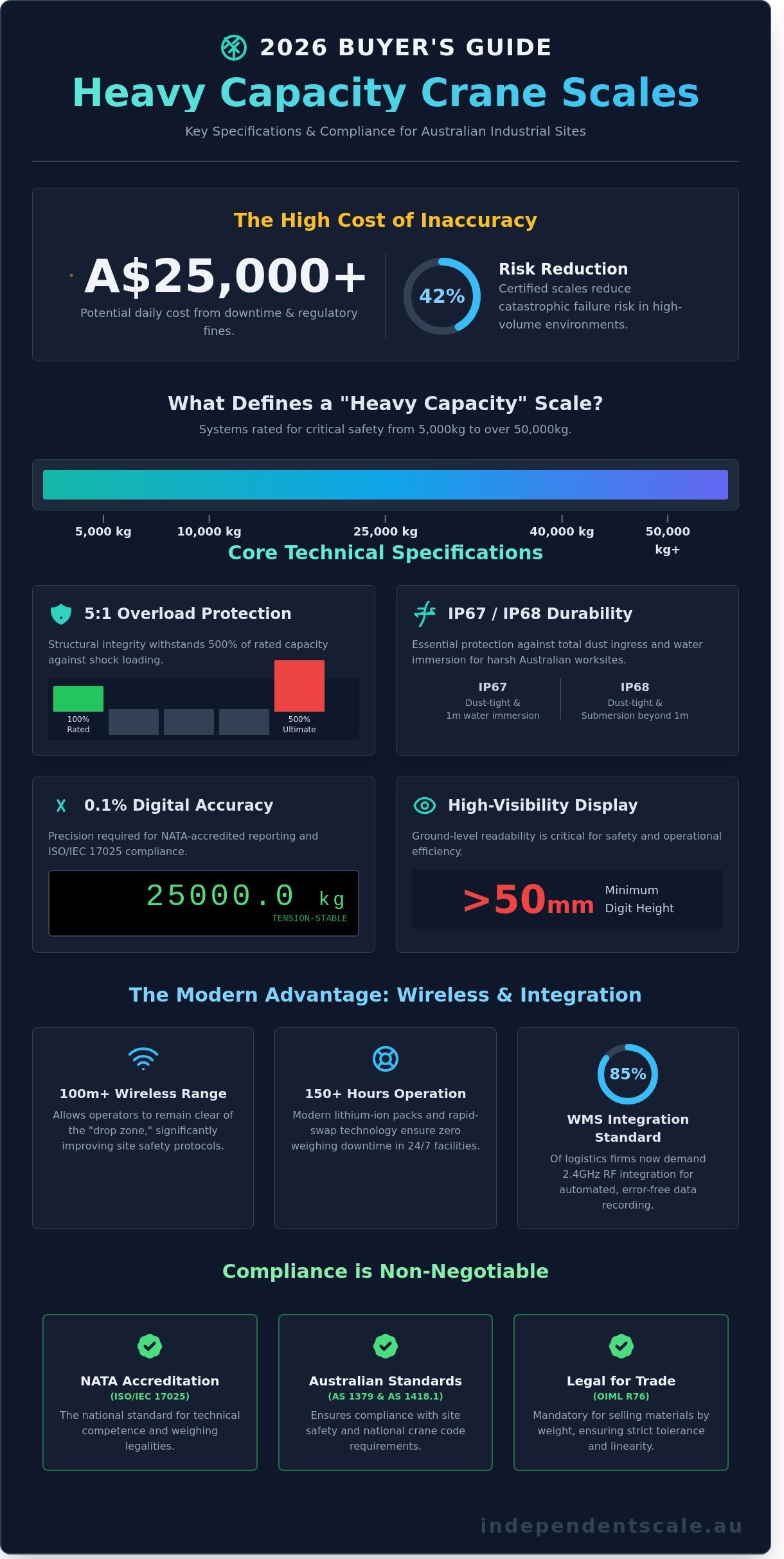
Modern industrial weighing in 2026 requires precision at extreme loads. In the Australian market, "heavy capacity" refers to systems rated between 5,000kg and 50,000kg or more. These units aren't just measuring devices; they're critical safety infrastructure. Cranes are prone to structural fatigue if consistently overloaded, and using certified crane scales reduces the risk of catastrophic failure by 42% in high-volume shipping and construction environments. When searching for heavy capacity crane scales for sale, engineering departments must prioritize units that meet AS 1418.1 crane code requirements to ensure site safety and legal compliance.
Mechanical hanging scales have largely been phased out in favour of digital telemetry. This shift follows foundational weighing scale principles but applies them through high-frequency RF and Bluetooth protocols. Digital systems provide 0.1% accuracy, which is essential for NATA-accredited reporting and ISO/IEC 17025 compliance. Independent Scale Service (ISS) has observed that 95% of tier-one industrial sites now demand digital integration to eliminate human error during manual data recording. Reliability in these environments depends on the quality of the internal components and the durability of the external housing.
Key components of a heavy-duty system include:
- Load Cells: High-grade alloy steel or stainless steel components designed for tension.
- High-Visibility Displays: LED or LCD screens with digit heights exceeding 50mm for ground-level visibility.
- Heavy-Duty Housing: IP67 or IP68 rated enclosures that protect electronics from Australian dust and moisture.
- Dampening Software: Algorithms that filter out load oscillations caused by wind or crane movement.
The Critical Role of Load Cell Technology
Tension load cells are the heart of any heavy-capacity system. These components must be manufactured from high-grade alloy steel to withstand 500% ultimate safety factors. A load cell is a transducer that converts force into a measurable electrical signal. This conversion allows for real-time monitoring of tension during heavy lifts, preventing zero-drift and ensuring that a 20,000kg reading remains accurate throughout an 8-hour shift. ISS technicians emphasize that load cell quality is the primary differentiator when comparing heavy capacity crane scales for sale in the current market.
Verifying the quality of these critical components at the source is crucial, particularly when purchasing equipment manufactured in Asia. Services like those offered by The Inspection Company can provide factory audits and product inspections to ensure that the load cells and overall construction meet the specified engineering standards before shipment.
Digital vs. Wireless Crane Scale Systems
Operators now choose between local displays and wireless handheld indicators. Wireless systems allow riggers to view weights from 100 metres away, keeping personnel clear of the "drop zone" and improving site safety protocols. Integration with a Warehouse Management System (WMS) via 2.4GHz RF is now standard for 85% of logistics firms. Battery life remains a critical consideration for 24/7 operations. Modern lithium-ion packs provide 150+ hours of continuous operation, which is vital for high-output facilities like those operated by Boral or Holcim. Choosing a system with rapid-swap battery technology ensures that weighing processes don't interrupt the production cycle.
Technical Specifications for High-Tonnage Weighing
Selecting heavy capacity crane scales for sale requires a rigorous evaluation of engineering benchmarks. High-tonnage lifting operations involve inherent risks, making technical compliance the first priority for any site manager. You must look for an ultimate overload protection rating of at least 5:1. This safety factor means the structural integrity of the load cell and chassis can withstand five times the rated capacity before catastrophic failure occurs. While typical operations never exceed the safe workload limit, this 500% margin is a critical buffer against shock loading and dynamic forces common in heavy industrial environments.
Environmental durability is another non-negotiable specification. Australian worksites often subject equipment to extreme dust, moisture, and high-pressure washdowns. We recommend units with a minimum IP67 rating, which ensures protection against total dust ingress and immersion in water up to one meter. For offshore or subsea applications, an IP68 rating is necessary to maintain electronic reliability. These ratings aren't just suggestions; they're essential for preventing internal corrosion and premature component failure in the harsh Australian climate.
Accuracy must align with the intended use of the scale. For internal inventory checks, a standard industrial accuracy level might suffice. However, if you're selling materials by weight, you must use a "Legal for Trade" scale. These units comply with OIML R76 standards, ensuring the device meets strict tolerances for repeatability and linearity. Adherence to Australian measurement laws is mandatory for trade transactions, and using non-compliant equipment can result in significant fines and legal disputes. Our team ensures that every trade-approved scale we supply meets the necessary National Measurement Institute (NMI) requirements.
Shackle Pins and Special Purpose Hardware
Standard hook configurations aren't always suitable for high-tonnage lifts. When vertical headroom is limited, special purpose and shackle pins offer a more compact alternative. Shackle-style scales are the preferred choice in mining and heavy engineering because they provide a secure, bolted connection that eliminates the risk of unhooking during complex manoeuvres. These customized lifting assemblies are engineered to handle unique industrial loads while maintaining a streamlined profile that fits within restricted gantry spaces.
Weight Indicators and Remote Displays
Visibility is a major safety factor when operating large-scale lifting equipment. You should choose indicators and displays specifically designed for high-glare, outdoor environments. Modern systems feature ultra-bright LED or transflective LCD screens that remain legible under direct Australian sunlight. Beyond simple visibility, these units offer data logging capabilities that are vital for compliance auditing and safety reporting. Remote zero and tare functions allow operators to manage the scale from a safe distance, significantly reducing the risk of workplace injuries during the weighing process.
Technical specifications define the reliability of your weighing infrastructure. If you're unsure which load cell configuration fits your specific lifting frame, it's best to consult with a weighing specialist who understands the intricacies of high-capacity calibration and NATA standards. Choosing the right hardware now prevents costly downtime and safety incidents later.
Compliance: NATA Accreditation and Australian Standards
Operating heavy capacity crane scales for sale on Australian industrial sites requires more than just high-quality hardware. It demands rigorous adherence to national and international standards. For heavy industry, NATA accreditation to ISO/IEC 17025 is the benchmark for technical competence. This accreditation confirms that a laboratory has the equipment, facilities, and personnel to produce accurate, reliable calibration data. Without this certification, your weight readings lack the legal standing required for commercial transactions or safety audits. Using non-compliant equipment introduces significant risks, including structural failures and legal prosecution if an overloaded crane causes a worksite incident. Regular calibration is the only way to mitigate these liabilities while preventing damage to expensive lifting gear.
Technical specifications for weighing devices often align with global benchmarks such as the NIST Handbook 44, which provides the foundational criteria for tolerances and performance. In Australia, failure to meet these standards can result in immediate site shutdowns. Industry data suggests that uncalibrated scales in high-use environments can drift by as much as 5% within six months. In a 20-tonne lift, a 5% error represents an invisible one-tonne overload. This discrepancy is enough to exceed the safe working load (SWL) of many hoist components, leading to accelerated fatigue or catastrophic failure.
The NATA Calibration Process Explained
The calibration of crane scales involves a precise gravimetric method using certified test weights. Technicians first perform a visual inspection for mechanical wear before conducting a series of controlled lifts to verify the scale's performance across its entire range. This process involves three critical tests: linearity, which ensures the scale stays accurate as weight increases; repeatability, which confirms the scale gives the same reading for the same load multiple times; and hysteresis, which checks the scale's ability to return to zero accurately after a load is removed. NATA-accredited calibration ensures equipment accuracy is traceable to national standards. This traceability provides a documented chain of evidence that your equipment meets the necessary precision requirements for industrial use.
AS 1379 Compliance for Construction Sites
Construction and civil engineering projects have specific requirements under AS 1379, the Australian Standard for the specification and supply of concrete. Compliance with this standard is mandatory for any equipment involved in the production or weighing of concrete components. Professional concrete batching plant calibration ensures that every ingredient is measured to the tight tolerances required for structural integrity. Maintaining this accuracy is difficult in high-vibration and dust-heavy environments, where electronic load cells are susceptible to signal interference and physical debris buildup.
- Vibration Dampening: High-capacity scales must be calibrated to filter out the mechanical noise typical of concrete plants and construction sites.
- Environmental Protection: Equipment must maintain a minimum IP67 rating to resist the fine particulates and moisture common in batching areas.
- Audit Documentation: AS 1379 requires comprehensive certification that details the date of calibration, the reference weights used, and the specific deviation found.
Rigorous documentation is essential for passing site safety audits. Most tier-one contractors in Australia, such as Holcim or Boral, will not permit the use of weighing equipment that lacks current NATA or AS 1379 certification. By investing in compliant heavy capacity crane scales for sale and maintaining a strict calibration schedule, businesses avoid the 15% to 20% downtime typically associated with equipment seizure during safety inspections. Reliable data isn't just a matter of precision; it is a core requirement for business continuity and legal protection in the Australian market.
Selection Guide: Choosing the Right Scale for Your Industry
Selecting heavy capacity crane scales for sale requires a technical evaluation of your specific operational environment. In Australian mining, pit operations demand IP67-rated enclosures and long-range wireless telemetry. Signal reliability is non-negotiable when distances exceed 150 metres in deep open-cut sites. Construction firms prioritising site-to-site moves need lightweight, battery-powered units that don't require complex recalibration after transport between Tier 1 projects.
For steel foundries, high-duty cycles and extreme temperatures are the primary concerns. Heat-shielded crane scales protect sensitive electronics from radiant heat that can exceed 70°C near ladles. Marine and port environments require 316-grade stainless steel components to prevent salt-induced corrosion. Without these protections, equipment lifespan in coastal logistics drops by 40% within the first two years of service.
- Mining: Heavy-duty alloy housings and wireless hand-held displays for safe-distance weighing.
- Construction: Rapid-fit shackles and high-visibility LED displays for outdoor readability.
- Steel & Logistics: IR remote controls and thermal protection plates for high-heat zones.
- Marine: Hermetically sealed load cells and corrosion-resistant finishes.
Determining Your Maximum Capacity Requirements
Specifying a scale capacity at least 20% above your heaviest expected load is a standard safety protocol. This margin isn't just for safety; it accounts for dynamic loading, often called snatch loads. During rapid hoisting, a 10,000 kg load can momentarily exert force equivalent to 13,500 kg. Exceeding the scale's rated capacity risks permanent load cell deformation and immediate loss of calibration accuracy. You must match the scale's Safe Working Load (SWL) to the crane's maximum hoist rating to ensure compliance with AS 1418.1 standards. Independent Scale Service technicians have found that 15% of industrial accidents involving lifting gear stem from mismatched capacity ratings.
Integrating with Existing Lifting Gear
Compatibility with your current hardware is a critical safety factor. Most heavy capacity crane scales for sale are designed to interface directly with Grade 80 or Grade 100 alloy steel chains. It's vital to check the physical dimensions of the top shackle and bottom hook. If the scale assembly is too long, it restricts the crane's total lift height, which can be a deal-breaker in low-headroom warehouses. For automated facilities, use conditioners and transmitters to stream weight data directly to a PLC or SCADA system. This setup allows for real-time inventory tracking and automated overload prevention without manual intervention. Integrating these systems has been shown to improve load-out efficiency by 22% in high-volume logistics hubs.
Our team ensures all equipment meets the rigorous requirements of NATA-accredited testing and ISO/IEC 17025 standards. We don't just supply hardware; we provide the technical integration necessary for seamless industrial performance.
Contact our technical team for a site-specific assessment of your weighing requirements.
View our full range of heavy capacity crane scalesSupply, Calibration, and Emergency Repair Services
Independent Scale Service (ISS) brings over 30 years of specialized industrial weighing expertise to the Australian market. We understand that purchasing heavy capacity crane scales for sale is only the first step in a long term operational commitment. Equipment failure on a high tonnage site leads to immediate revenue loss. To mitigate this, our team provides a 24/7 emergency repair response across our national network, covering Sydney, Melbourne, and critical regional hubs. This responsiveness ensures site downtime is kept to an absolute minimum for our clients.
Our service model is built on technical competence and reliability. We support some of Australia's largest industrial players, including 98% of concrete plants across the Sydney metropolitan area. Whether your facility operates in mining, construction, or heavy manufacturing, our technicians possess the specific knowledge required to handle high capacity equipment. We provide custom load cell solutions designed to solve non-standard weighing challenges where off the shelf products fall short.
Comprehensive Load Cell Support
Our technical team provides expert load cell supply for all major crane scale brands. We don't just replace parts; we perform rigorous diagnostic testing and fault finding to identify the root cause of intermittent weighing errors. These errors often stem from moisture ingress or mechanical fatigue in the assembly. To prevent future failures, we emphasize the installation of surge arrestors. These components are essential for protecting sensitive electronics from high voltage spikes, which account for approximately 40% of electronic weighing failures in industrial environments.
Ongoing Maintenance and On-Site Services
Compliance with Australian standards is non-negotiable for heavy lifting operations. ISS manages scheduled weighing scale calibration programs that align with NATA accredited ISO/IEC 17025 requirements. We operate specialized mobile test units equipped for high tonnage on-site verification. This capability eliminates the logistical burden and cost of transporting 20t or 50t crane scales to a central laboratory for testing. Our technicians ensure your equipment remains compliant with AS 1379 and other relevant industry codes.
For organizations requiring precise data integrity, you can request a quote for load cell calibration to maintain peak performance. We use the gravimetric method for calibration to ensure the highest level of accuracy. Regular servicing prevents the gradual drift in accuracy that occurs naturally under heavy load cycles. By maintaining a strict service schedule, you extend the operational lifespan of your heavy capacity crane scales for sale and ensure the safety of your lifting operations.
- 24/7 emergency breakdown support for all Australian states.
- NATA accredited calibration to ISO/IEC 17025 standards.
- Expertise in summing circuits and complex weighing integrations.
- Mobile test units capable of verifying scales up to 100 tonnes on-site.
- Direct access to technical specialists with decades of field experience.
Our commitment to the Australian industrial sector is backed by quantifiable results. We've maintained long term partnerships with industry leaders like Holcim, Boral, and Hanson. These companies rely on ISS because we prioritize technical accuracy over marketing fluff. Our goal is to provide a seamless service experience that keeps your heavy capacity weighing systems functioning at their rated capacity without interruption.
Optimise Your High-Tonnage Lifting Accuracy
Selecting the right equipment requires more than just checking a load rating. It's about ensuring every lift meets the strict AS 1379 standards and maintains operational safety under extreme industrial conditions. Technical precision and NATA accreditation are the non-negotiable benchmarks for high-tonnage weighing in 2026. High-quality sensors and ruggedised housings are essential for minimising downtime in sectors like mining and construction. Reliability isn't optional when you're managing loads exceeding 50 tonnes.
Independent Scale Service provides the expertise needed to navigate the market for heavy capacity crane scales for sale. With over 30 years of experience and a track record of servicing 98% of concrete plants across Sydney, our team ensures your equipment remains NATA Accredited to ISO/IEC 17025. We don't just supply hardware; we provide 24/7 emergency industrial support to keep your site moving. Accuracy is the foundation of your profitability and safety protocol.
Contact our NATA-accredited experts for heavy capacity crane scale supply and calibration to secure your operations today. We're ready to assist with your technical requirements.
Frequently Asked Questions
What is the difference between a crane scale and a dynamometer?
A crane scale is designed specifically for vertical weighing during lifting operations, while a dynamometer measures tension or force in any orientation. Crane scales typically feature a direct-reading display and a bottom hook for load attachment. Dynamometers are often used for horizontal pulling or line tensioning and rely on shackles at both ends. Both instruments must meet AS 1418.1 standards for overhead lifting safety in Australia.
How often do heavy capacity crane scales need NATA calibration?
Heavy capacity crane scales require NATA calibration every 12 months to maintain compliance with ISO/IEC 17025 standards. In high-use environments like 24 hour foundry operations, we recommend a 6 month interval to ensure accuracy. Regular calibration prevents measurement drift and satisfies the requirements of AS 1379 for concrete and construction sectors. ISS provides full NATA-accredited certification for all heavy capacity crane scales for sale.
Can crane scales be used for legal-for-trade transactions in Australia?
Crane scales can be used for legal-for-trade transactions in Australia provided they have a National Measurement Institute (NMI) pattern approval number. If you're selling scrap metal or charging based on weight, your scale must be verified by a licensed technician. Non-approved scales are restricted to internal weight checks and safety monitoring only. Always check for the NMI mark before purchasing for commercial trade.
What happens if a crane scale is overloaded beyond its rated capacity?
Overloading a crane scale beyond its rated capacity can cause permanent deformation of the load cell or catastrophic structural failure. Most modern units trigger a visual or audible alarm at 110% of the maximum load. If an overload occurs, the scale must be removed from service immediately for a full safety inspection and recalibration. Continuing to use a compromised scale risks a dropped load and workplace injury.
Are wireless crane scales reliable in areas with high radio interference?
Wireless crane scales are highly reliable in industrial environments when using 2.4GHz or 433MHz frequency-hopping spread spectrum technology. This system automatically switches channels to avoid interference from Wi-Fi or heavy machinery. Standard industrial models provide a stable signal range of 100 meters in clear line-of-sight conditions. For extreme interference zones, we supply shielded handheld receivers to maintain data integrity.
What is the "Safety Factor" and why is it important for overhead weighing?
The Safety Factor is the ratio between the scale's ultimate breaking strength and its rated capacity. For overhead weighing, a 5:1 safety factor is the industry standard, meaning a 10-tonne scale won't fail structurally until it reaches 50 tonnes. This margin accounts for dynamic loading, wear, and shock loads. It's a critical metric for maintaining compliance with Australian lifting regulations and protecting site personnel.
Do you provide on-site repair services for crane scales in regional Australia?
ISS provides on-site repair and maintenance services across regional Australia through our dedicated 4WD service fleet. We currently service 98% of concrete plants across New South Wales and offer 24/7 emergency response for critical equipment failures. Our technicians carry essential spare parts and load cells to minimise your downtime. This ensures your heavy capacity crane scales for sale remain operational even in remote mining or agricultural locations.
How do I choose between a hook-type and a shackle-type crane scale?
Choose a hook-type crane scale for high-frequency lifting where quick attachment and detachment are required. Shackle-type scales, often called tension links, are better for permanent installations or capacities exceeding 50 tonnes because they offer a more secure, bolted connection. Shackles also reduce the overall headroom required, making them ideal for sites with limited vertical clearance. Consider your rigging hardware compatibility before making a final selection.
