


Guide to Industrial Scale Types: Selection, Capacity & Australian Standards
An uncorrected calibration drift of just 1% can silently drain upwards of A$75,000 to A$100,000 annually in material discrepancies from a continuous processing facility. Plant managers and engineers know that industrial weighing isn't simply a matter of platform dimensions or gross capacity ratings. Premature strain gauge failure from dynamic shock loads, washdown moisture ingress, or an unexpected non-compliance notice from the National Measurement Institute can instantly freeze your site throughput. This practical guide to industrial scale types examines the engineering principles needed to deploy dependable hardware across demanding Australian operating environments.
You shouldn't have to absorb chronic downtime caused by under-rated load cells or navigate ambiguous legal-for-trade verification rules alone. In this guide, you'll discover how to determine the exact scale category for your bulk materials, evaluate structural ingress protection under AS 60529, and configure assemblies to handle harsh cyclic stress. We review the mechanical anatomy of heavy-duty platform, hopper, and vehicle scale architectures, outlining the operational benchmarks required to satisfy both AS ISO/IEC 17025 NATA calibration protocols and statutory trade measurement compliance.
Key Takeaways
- Use this practical guide to industrial scale types to match platform capacity, division values, and duty cycles to your facility's operational throughput.
- Differentiate structural architectures across hoppers, silos, and floor platforms to isolate load cells from thermal expansion, mechanical binding, and dynamic shock.
- Select sensor configurations and AS 60529 ingress protection levels that resist aggressive chemical washdown, extreme moisture, and industrial dust.
- Distinguish between internal process control via AS ISO/IEC 17025 NATA-accredited calibration and statutory legal-for-trade verification under National Measurement Institute rules.
- Establish rigorous field calibration protocols compliant with specific industry benchmarks, such as AS 1379 accuracy tolerances for concrete batching plants.
Industrial Scale Classifications: Comparing Operational Architectures
Selecting measurement hardware requires understanding that an industrial scale is not merely an enlarged commercial balance. While light commercial units prioritise fine resolution in temperature-controlled spaces, industrial units must absorb severe mechanical shock loads, resist chemical ingress, and maintain structural rigidity under constant cyclic stress. A comprehensive guide to industrial scale types must distinguish systems based on gross capacity, minimum verification division value (e), operational duty cycles, and underlying load-sensing engineering. Every system relies directly on precision strain gauge load cells paired with heavy-duty structural mount assemblies designed to isolate the transducers from parasitic side loads.
Static vs. Dynamic Industrial Weighing
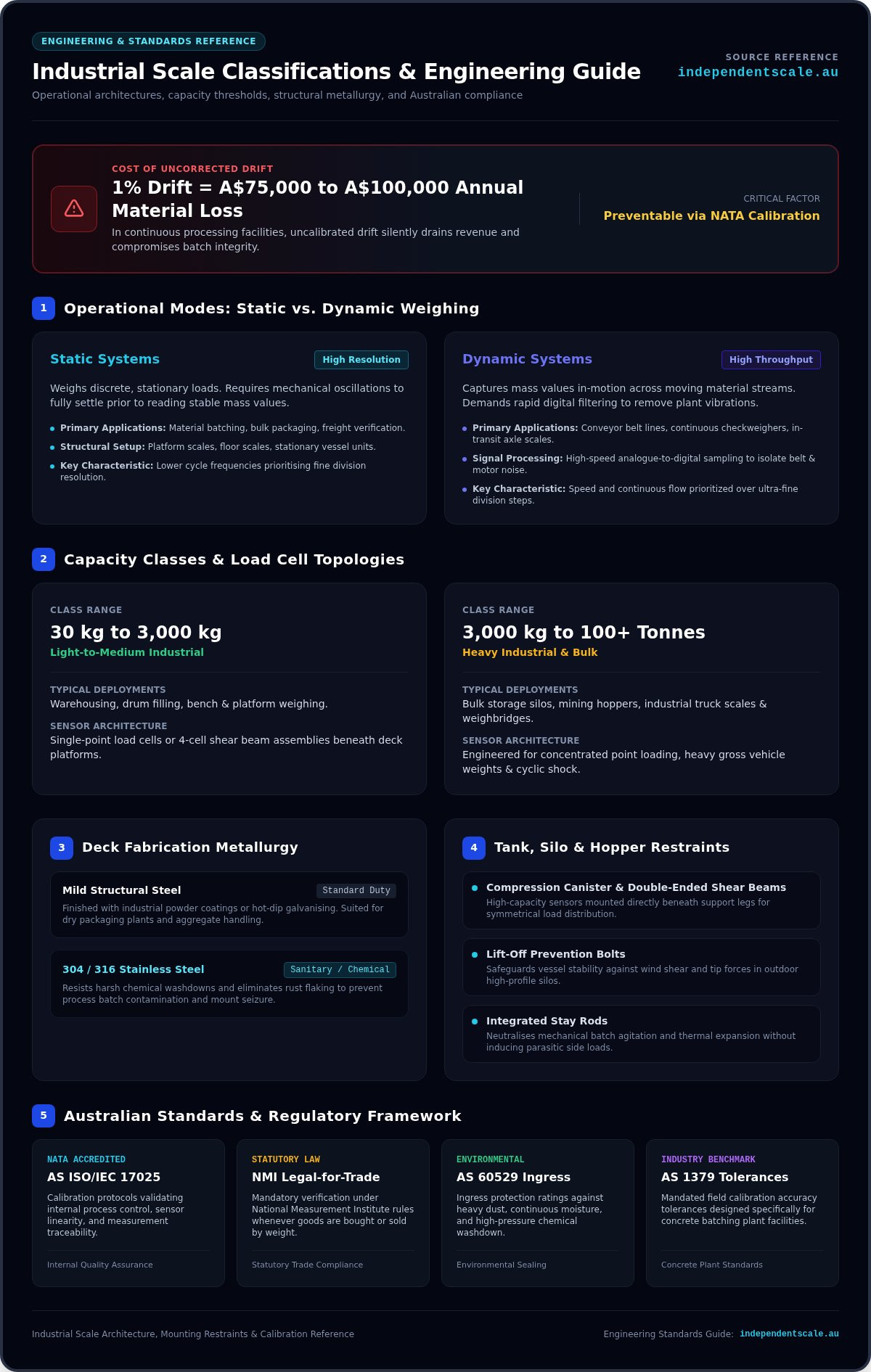
Static scales weigh discrete, stationary loads for material batching, bulk packaging, and freight verification. These units allow mechanical oscillations to settle before reading a stable mass value. In contrast, dynamic systems capture mass values in-motion across conveyor belts, continuous checkweighers, and in-transit axle scales. Dynamic configurations demand rapid analogue-to-digital sampling rates and advanced digital filtering to filter out plant vibration, belt tension variances, and mechanical motor noise.
- Static systems: Optimised for high resolution and lower cycle frequencies, including platform, floor, and stationary vessel scales.
- Dynamic systems: Built for continuous processing lines where throughput speed takes priority over ultra-fine division steps.
- Long-term stability: Severe operating vibration rapidly degrades uncalibrated strain gauges, making regular field testing essential to prevent measurement drift.
Capacity Classes and Structural Deck Engineering
Capacity classes dictate both the load cell architecture and the fabrication metallurgy required for the deck:
- Light-to-Medium Industrial (30 kg to 3,000 kg): Common in warehousing and drum filling. These systems employ single-point or four-cell shear beam assemblies beneath mild steel or stainless platforms.
- Heavy Industrial (3,000 kg to 100+ tonnes): Built for bulk silos, mining hoppers, and industrial truck scale and weighbridge systems that handle immense gross vehicle weights and concentrated point loading.
Structural longevity depends on the material grade chosen for the operating environment. Mild structural steel finished with industrial powder coatings or hot-dip galvanising works well in dry packaging plants and aggregate handling. Conversely, corrosive chemical manufacturing and sanitary food processing demand 304 or 316 grade stainless steel. These alloys resist chemical washdowns and eliminate rust flaking that could contaminate process batches or seize mechanical mounts. Using this guide to industrial scale types ensures your structural design matches both your plant's dynamic loads and environmental realities.
Bulk and High-Capacity Systems: Hoppers, Silos, and Weighbridges
High-capacity industrial operations require weighing mechanisms integrated directly into processing equipment. Instead of moving materials onto a standalone platform, these engineered systems transform structural silos, mixing hoppers, and vehicle transit lanes into continuous measuring assets. Following this guide to industrial scale types helps operators understand how mechanical load transfer directly impacts both data precision and structural stability across heavy processing sectors.
Tank, Silo, and Hopper Weighing Assemblies
Vessel weighing systems rely on purpose-built mounting kits placed directly beneath structural support legs. These assemblies use compression canisters or double-ended shear beam load cells, engineered with lift-off prevention bolts and stay rods. These mechanical restraints neutralise thermal expansion, wind shear, and batching agitation without introducing parasitic side-loads that distort data. Sourcing complete tank and silo weighing assemblies ensures that load distribution remains symmetrical across all support points. Scheduling regular routine verification through a professional hopper calibration service preserves inventory reconciliation and batch consistency.
Weighbridge Systems: Above-Ground vs. Pit Installations
Heavy haulage operations rely on weighbridges for gross-tare axle reconciliation and regulatory axle-mass compliance. Pit installations sit flush with the surrounding concrete deck, saving crucial yard footprint and simplifying heavy vehicle turning paths. However, pit designs demand comprehensive drainage infrastructure and sump pumps to prevent water pooling, requiring confined-space protocols during maintenance. In contrast, above-ground weighbridges eliminate below-grade drainage risks and simplify technician access, though they require substantial reinforced concrete approach and departure ramps. Both configurations must align strictly with National Measurement Institute trade measurement standards if weight readings determine haulage invoices or commercial royalties.
Concrete Batching Plants and Aggregate Bins
Concrete manufacturing presents an extreme weighing environment where aggregate bins, cement weigh hoppers, water weighers, and chemical admixture dispensers operate under constant mechanical vibration. Transducers must withstand abrasive dust and continuous shock loading from aggregate gates. Signal integrity depends on fast-sampling digital transmitters and mechanical dampening mounts that prevent false threshold trips. To ensure mix design integrity and structural compliance, facilities require routine concrete batching plant calibration compliant with Australian Standard AS 1379. When outfitting or retrofitting severe-duty processing facilities, consulting specialists at Independent Scale Service ensures each structural scale integrates seamlessly with your batching PLC.
Floor, Platform, and Material Handling Scales
Material handling environments depend on rugged floor and mobile weighing systems to verify palletised shipments, manage drum filling lines, and sort warehouse inventory. Selecting equipment across these categories involves matching structural stiffness to fork traffic while preventing process bottlenecks. Our comprehensive guide to industrial scale types examines how standard platforms, mobile transport units, and suspended systems resolve common logistics challenges.
Platform and Low-Profile Floor Scales
Standard industrial platform scales employ a four-cell shear beam architecture wired to a summing junction box. This layout ensures corner-loading accuracy regardless of whether a forklift places a pallet dead-centre or off-axis. Low-profile floor decks feature either drive-on ramps or pit-mounted installations set flush with the slab:
- Drive-on ramps: Eliminate civil floor modifications, though they require additional perimeter clearance and risk damage from angled forklift impacts.
- Pit installations: Remove trip hazards and reduce maneuvering time for manual pallet jacks, but they require proper sub-floor framing and routine debris clearing.
- Washdown specifications: Chemical processing and food packing areas demand IP68 or IP69K laser-welded stainless steel load cells, whereas dry transport depots operate reliably using mild-steel decks with powder-coated finishes.
Pallet Truck and Mobile Scales
Integrating strain gauges directly into the chassis of a hydraulic pallet jack transforms transit routes into active weighing stations. Warehouse operators verify incoming freight mass directly at the unloading dock rather than transporting goods to a distant static deck. These mobile units rely on reinforced steel fork frames to prevent chassis flex under eccentric loading. Onboard digital indicators feature rechargeable battery systems and ruggedised, shock-mounted housings designed to handle transit over uneven concrete expansion joints. Confirming pallet masses before staging directly mitigates axle-load discrepancies before haulage vehicles depart.
Crane Scales and Hanging Dynamometers
Where floor space is restricted or materials arrive in irregular geometries, overhead crane scales and tension dynamometers measure suspended loads during lifting cycles. Heavily utilised across steel distribution yards, foundries, and rigging operations, these units integrate high-tensile alloy steel or specialised tension pins directly into the crane hook train. Specifying tension systems requires clear distinctions between safe working overload limits (typically 150% to 200% of capacity) and ultimate mechanical yield thresholds (frequently 400% to 500%). Integrated wireless handheld telemetry allows doggers and crane operators to capture stable mass readings at a safe standoff distance from suspended freight, preserving worksite safety during high-capacity lifts.
Critical Selection Criteria: Load Cells, Ingress, and Instrumentation
Every weighing deck depends entirely on the electromechanical sensors housed within its frame. Structural steel provides mechanical support, but the conversion of physical load into a traceable digital value happens at the strain gauge. Treating the platform and the sensing elements as a unified system is essential when applying this guide to industrial scale types. Plant engineers must evaluate transducer geometry, environmental sealing under Australian standard AS 60529:2025, and downstream signal transmission to prevent measurement failure.
Load Cell Selection and Mechanical Protection
Matching the transducer geometry to the mechanical loading vector prevents premature mechanical deformation and signal drift:
- Single-point cells: Compensate for off-centre loading across small platform decks up to 800 mm.
- Shear beam and bending beam cells: Deliver high side-load rejection, making them the standard for four-cell floor scales and light vessel hoppers.
- Compression canisters: Handle high-tonnage bulk storage and weighbridges where gross mass reaches tens or hundreds of tonnes.
- Tension links and S-beams: Measure hanging hoppers, crane hooks, and tensile testing apparatus.
You can source direct replacements or new engineering components from a comprehensive load cells inventory. For outdoor installations, weighbridges, and tall silos, high transient voltages from regional lightning strikes can instantly destroy Wheatstone bridges. Protecting these circuits requires rugged junction boxes and surge arrestors to suppress voltage spikes before signals enter sensitive instrumentation.
Environmental Ratings and Washdown Standards
Moisture ingress remains the leading cause of zero-point drift and erratic signal jumping. General dry warehouses operate reliably with IP65 or IP66 enclosures, which resist airborne dust and low-pressure hose sprays. In contrast, meat processing, chemical synthesis, and dairy plants subject equipment to daily sanitation using chemical detergents. These settings require IP68 continuous-submersion protection or IP69K ratings. Under AS 60529:2025, IP69K equipment withstands washdown pressures between 80 and 100 bar at temperatures up to 80°C. For areas with combustible dusts or volatile vapours, assemblies must carry hazardous area classifications compliant with the AS/NZS 60079 series, utilising intrinsically safe (Ex i) barriers to eliminate ignition risks.
Digital Indicators, Transmitters, and Data Integration
Industrial scale terminals do more than show a gross reading. High-visibility indicators and displays give operators immediate batch status on the plant floor. Behind the panel, high-speed conditioners and transmitters convert weak microvolt signals into stable process variables. Modern facilities integrate these units directly into site SCADA and PLC architectures using Modbus TCP, Profibus, EtherNet/IP, or isolated 4-20mA current loops. If you need to upgrade an unverified system or replace failing strain gauges, request expert technical support from Independent Scale Service to specify and install your plant's instrumentation.
Australian Compliance: NATA Accreditation, AS Standards, and Calibration
Deploying industrial weighing equipment in Australia demands strict adherence to domestic statutory and quality frameworks. While overseas manufacturing standards offer structural baselines, local site operations must align with the National Measurement Institute (NMI) and the National Association of Testing Authorities (NATA). This final section of our guide to industrial scale types clarifies the boundary between trade-approved transactions, industry-specific technical standards, and ISO-accredited calibration regimens.
Trade vs. Non-Trade Verification (NMI Standards)
Under the National Measurement Act 1960, any scale determining a transaction cost, freight tariff, or commercial royalty must be legally verified for trade. Trade approval requires a two-step process: the instrument design must hold an active NMI Pattern Approval certificate, and an NMI-licensed Servicing Licensee must verify the physical unit on-site using certified reference standards. Using an unverified scale for commercial transactions exposes corporations to significant regulatory penalties. With the Commonwealth penalty unit indexed at $364 as of July 2026, corporate fines under trade measurement legislation can quickly exceed A$220,000 for serious non-compliance. Non-trade scales used strictly for internal inventory control or checkweighing do not require NMI marks, though they still need routine testing to safeguard yield.
Australian Standard AS 1379 for Concrete Batching
Concrete production requires specialised verification exceeding standard manufacturing metrics. Australian Standard AS 1379 mandates tight batching tolerances across constituent materials:
- Cementitious binders: Batching accuracy must maintain tolerances typically within ±1% to ±2% of target mass.
- Aggregates and sand: Multi-bin weigh systems must record raw inputs within ±2% to ±3%.
- Water and admixtures: Batching dispensers demand consistent calibration within ±1% to prevent structural slump failures.
Routine site audits require systematic testing schedules to maintain structural mix accreditation. Engaging professional batching plant calibration services ensures full audit readiness and preserves concrete compressive strength compliance.
NATA ISO/IEC 17025 Calibration and Preventative Maintenance
NATA calibration to AS ISO/IEC 17025:2018 is the national benchmark for verifying measurement uncertainty, linearity, repeatability, and corner-load eccentricity using primary traceable standards. Unlike an NMI trade stamp, NATA-endorsed certificates provide documented proof of technical competence for internal QA audits, asset safety management, and ISO 9001 compliance. Facilities operating high-throughput batching plants or automated manufacturing lines should establish recalibration intervals based on shift frequency and operating environments. You can review detailed on-site testing protocols across Sydney and Melbourne by booking specialized field testing with accredited weighing scale calibration engineers. For technical equipment supply or accredited field service, contact Independent Scale Service to secure your facility's long-term weighing reliability.
Optimising Measurement Integrity Across Your Plant
Selecting the proper weighing equipment is a decisive engineering choice that safeguards plant uptime and commercial accuracy. As outlined in this guide to industrial scale types, choosing the correct structural geometry, AS 60529 ingress rating, and load cell mounting hardware prevents premature mechanical failure and measurement drift. Maintaining compliance with National Measurement Institute legal-for-trade requirements and AS 1379 batching tolerances ensures your site avoids crippling regulatory fines and material waste.
With over 30 years of industrial weighing experience across Australia, Independent Scale Service delivers end-to-end systems engineering and responsive field support. Whether your facility operates heavy-capacity aggregate bins, process vessels, or logistics weighbridges, maintaining traceability under AS ISO/IEC 17025 guarantees audit-ready performance. Don't let unverified equipment compromise your product yield. Upgrade your weighing systems or book NATA-accredited calibration with Independent Scale Service today to secure durable, precision measurement across your operations.
Frequently Asked Questions
What is the difference between a trade-approved and a non-trade industrial scale?
A trade-approved scale is legally certified under the National Measurement Act 1960 to calculate prices, commercial freight tariffs, or transaction invoices. It requires National Measurement Institute (NMI) pattern approval and on-site verification by an NMI-licensed technician. Non-trade scales are designed strictly for internal inventory control, checkweighing, or in-house process monitoring. Using an unverified scale for commercial billing risks severe regulatory penalties under Australian trade measurement laws.
How do I determine the right load capacity for an industrial platform scale?
Calculate your maximum anticipated gross tare mass and add an engineering safety margin of 20% to 30% to absorb dynamic shock loading. Lowering heavy pallets via forklift generates dynamic impact forces that easily exceed static weight ratings. As detailed in our guide to industrial scale types, sizing the platform correctly ensures that individual shear beam load cells comfortably distribute corner loads without causing structural deflection or transducer fatigue.
Can standard platform scales withstand daily high-pressure chemical washdowns?
Standard powder-coated mild steel platform scales cannot endure high-pressure chemical sanitation. Caustic detergents strip standard industrial finishes and compromise entry seals, resulting in rapid moisture ingress and load cell failure. Facilities requiring daily sanitation need 304 or 316 grade stainless steel assemblies built to IP68 or IP69K standards under AS 60529:2025. These hermetically sealed units withstand water jet temperatures up to 80°C and pressures reaching 100 bar.
What happens if our concrete batching plant fails an AS 1379 calibration check?
Failing an AS 1379 accuracy verification halts structural concrete certification and invalidates batch records for major civil projects. Batching dispensers for cement, water, aggregate, and chemical admixtures must operate within strict ±1% to ±3% tolerance limits. Independent Scale Service technicians identify mechanical binding, inspect transducer health, and conduct immediate mechanical recalibration using traceable test masses to restore plant compliance and prevent concrete structural defects.
How often should industrial scales undergo routine calibration in Australia?
Most industrial facilities should schedule calibration every six to twelve months, though operating harshness and duty cycles dictate exact frequency. High-throughput concrete plants governed by AS 1379 mandate semi-annual or quarterly audits. Severe environments with vibration, heavy shock loads, or aggressive washdown induce measurement drift much faster than dry warehousing. Regular preventative calibration protects product yields and prevents costly operational downtime.
Is it possible to convert an existing storage tank or hopper into a scale?
Yes, existing static vessels can be retrofitted into accurate gravimetric weighing systems using purpose-built tank and silo weighing assemblies. Compression load cells or tension links install directly beneath support legs or suspension brackets. Referring to this guide to industrial scale types helps site engineers choose mounting kits with integrated tie rods and lift-off protection, which isolate the sensors from thermal expansion and agitator vibration.
Why is NATA accreditation under ISO/IEC 17025 critical for calibration reports?
NATA accreditation to AS ISO/IEC 17025 confirms that a calibration provider demonstrates verifiable technical competence and uses reference masses traceable to national standards. While non-accredited checks provide internal checks, NATA-endorsed certificates provide legally defensible proof of measurement accuracy and uncertainty calculations. This formal documentation satisfies stringent supplier audits, structural building codes, and ISO 9001 quality management systems.
