


Expert Weighbridge Repair Companies in NSW: Ensuring Accuracy and Compliance
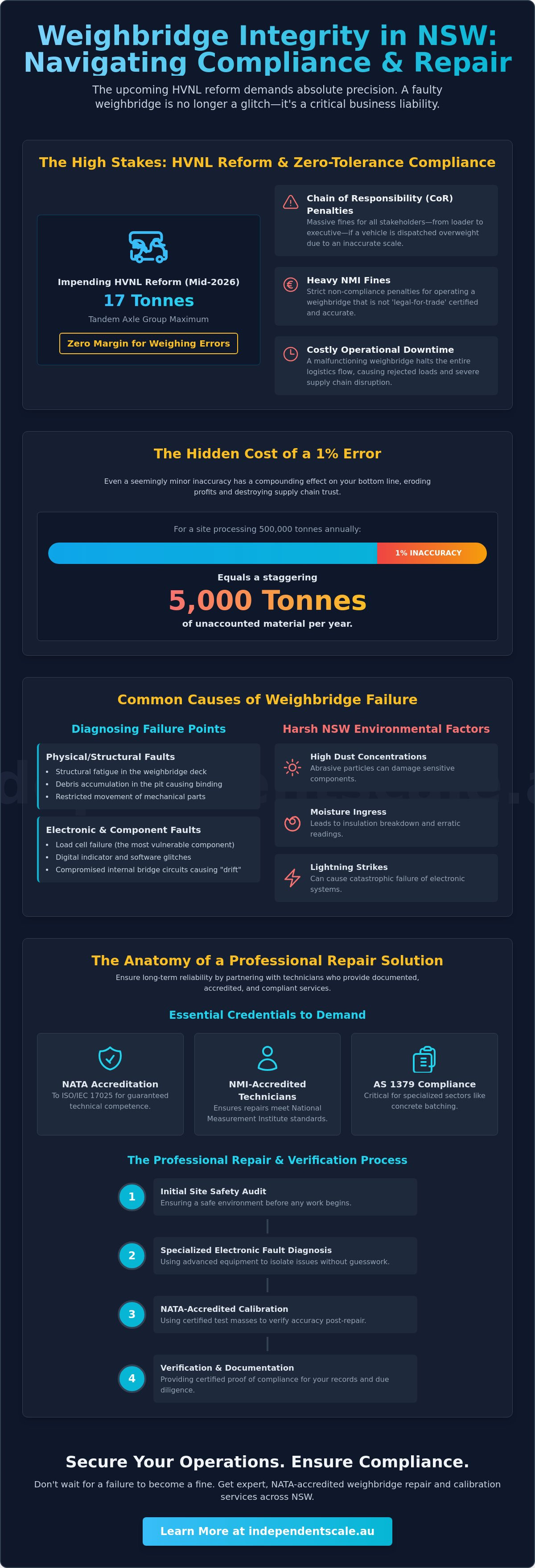
The impending Heavy Vehicle National Law (HVNL) reform in mid-2026 will increase tandem axle group maximum mass to 17 tonnes, leaving zero margin for weighing errors. You already know that a malfunctioning weighbridge is more than a technical glitch; it's a liability that causes costly downtime and risks heavy NMI non-compliance fines. Finding reliable weighbridge repair companies NSW that can service remote locations and provide NATA-accredited results is often a significant logistical hurdle during peak logistics periods. You need a partner who understands that precision is a legal requirement, not an option.
This article identifies the most dependable repair solutions to restore your weighing operations rapidly while ensuring every component, from load cells to indicators, meets strict ISO standards. You'll learn how to secure documented compliance and maintain the long-term reliability of your load cell supply and industrial scales. We'll examine the critical role of NMI-accredited technicians, the impact of upcoming legislative changes on mass limits, and the technical requirements for maintaining accuracy in high-capacity environments such as concrete batching plants, silos, and hoppers.
Key Takeaways
- Understand the critical link between weighbridge accuracy and Chain of Responsibility (CoR) laws to mitigate legal and financial liabilities.
- Identify common physical and electronic failure points caused by NSW environmental factors such as dust, moisture, and lightning.
- Evaluate weighbridge repair companies NSW based on NATA accreditation to ISO/IEC 17025 to ensure technical competence and regulatory compliance.
- Learn the professional repair and verification process, from initial site safety audits to specialized electronic fault diagnosis.
- Discover how NATA-accredited calibrations and compliance with AS 1379 standards maintain the long-term reliability of industrial weighing systems.
The Critical Role of Weighbridge Accuracy in NSW Industry
A weighbridge serves as the definitive point of measurement for NSW industrial operations. In logistics, mining, and bulk material handling, these high-capacity systems are the primary tools for determining commercial value and ensuring regulatory compliance. Maintaining legal-for-trade status isn't a recommendation; it's a legal necessity for any business conducting transactions based on weight. When accuracy drifts, the entire operation faces exposure to financial loss and legal scrutiny. Engaging professional weighbridge repair companies NSW ensures that these critical assets remain within the strict tolerances required by the National Measurement Institute (NMI).
Chain of Responsibility (CoR) and Weighbridge Compliance
NSW operators face rigorous legal obligations under the Heavy Vehicle National Law. With the mid-2026 HVNL reform set to raise General Mass Limits (GML) to match current Concessional Mass Limits (CML), precision becomes even more vital. A NATA-accredited, certified weighbridge provides the primary defense against overloading litigation by proving that a vehicle was within legal limits at the point of dispatch. Regular maintenance and calibration demonstrate "due diligence" to regulators. If a system fails to record mass accurately, every stakeholder in the supply chain, from the loader to the executive, risks massive penalties under CoR legislation. Accurate data is the only shield against the increased penalties for safety-related offenses introduced by the latest regulatory updates.
Financial Impacts of Weighbridge Inaccuracy
Inaccuracy often hides in plain sight. Consider a high-volume site processing 500,000 tonnes annually. A seemingly minor 1% inaccuracy results in 5,000 tonnes of unaccounted material. Whether this manifests as "giving away" product or overcharging clients, it erodes profit margins and destroys supply chain trust. In specialized sectors, such as infrastructure, this precision is non-negotiable. For instance, concrete batching plant calibration must adhere to AS 1379 standards to ensure structural integrity and inventory control. Precision isn't just about the scale; it's about the bottom line.
Faulty weighing equipment does more than just skew numbers; it disrupts the entire logistics flow. It leads to rejected loads at delivery points and causes friction in client relationships. Relying on expert weighbridge repair companies NSW to maintain load cell sensitivity and indicator performance is the only way to prevent revenue leakage. Constant monitoring and rapid restoration of weighing operations are essential to maintain the long-term reliability of industrial weighing operations and protect the integrity of your data.
Common Weighbridge Faults: Diagnosing Failure Points
Reliable diagnostics are the foundation of effective repair. Weighbridge systems are subjected to extreme mechanical stress and environmental exposure, leading to two distinct failure categories: structural and electronic. Physical issues often manifest as structural fatigue in the weighbridge deck or debris accumulation in the pit, which restricts movement and causes binding. Electronic failures are more nuanced. They involve precise components like load cells and indicators that require specialized testing equipment to isolate. Professional weighbridge repair companies NSW must differentiate between these failure modes to prevent unnecessary part replacements and minimize operational downtime.
Load Cell Failures and Environmental Damage
Load cells are the most vulnerable components in any weighing system. In regional NSW, harsh environmental factors such as high dust concentrations, moisture ingress, and lightning strikes are primary causes of failure. Moisture entering the load cell housing or cable jacket leads to insulation breakdown, causing erratic readings or "drift." Drift occurs when the weight display fluctuates without a load present, indicating a compromised internal bridge circuit. Technicians prioritize testing load cells during the diagnostic phase to verify millivolt output and insulation resistance. Analog cells often show gradual degradation, while digital load cell failure modes might result in total communication loss or specific error codes transmitted to the indicator.
Digital Indicator and Software Glitches
The indicator serves as the brain of the weighbridge, translating raw signals into readable data. Troubleshooting industrial indicators and displays involves interpreting manufacturer-specific error codes that signal anything from over-capacity to load cell excitation failure. Electronic stability depends heavily on the integrity of junction boxes and surge arrestors. These components act as a critical line of defense against power spikes and lightning damage common in open NSW industrial sites. While some issues stem from software glitches or calibration drift that a simple update can fix, persistent errors often point toward hardware failure in the A/D converter or internal power supply. If you suspect a component failure, securing a high-quality load cell supply is essential for restoring technical competence to your weighing operations.
Identifying whether a fault is structural or electronic requires a methodical approach. Binding in the mechanical assembly can mimic load cell failure by preventing the deck from moving freely. Conversely, a faulty junction box can produce symptoms that look like a damaged indicator. Experienced weighbridge repair companies NSW use specialized simulators to bypass the weighbridge and test the indicator independently, ensuring the repair strategy targets the actual failure point. This precision in diagnosis prevents the "shotgun approach" of replacing parts until the system works, saving significant costs and ensuring the system returns to its NATA-accredited state quickly.
Evaluating Weighbridge Repair Companies in NSW
Selecting a service provider for heavy-capacity weighing equipment requires a rigorous vetting process that extends beyond comparing hourly labor rates. The technical complexity of modern load cell systems and the legal weight of compliance necessitate a partner with specific credentials. High-stakes industrial environments in NSW cannot afford the risk of using unaccredited technicians who may lack the specialized equipment or knowledge to restore a system to its legal-for-trade state. When assessing weighbridge repair companies NSW, the focus must remain on technical competence, regulatory adherence, and the ability to provide documented proof of accuracy.
The Significance of NATA Accreditation and ISO 17025
NATA accreditation to ISO/IEC 17025 is the definitive benchmark for technical competence in the weighing industry. This international standard ensures that a laboratory or field service team has the proficiency to produce valid, traceable results. For NSW operators, this means every load cell calibration is performed using standards traceable to national measurement bodies. Without this accreditation, your weighing data may not hold up during a regulatory audit or a Chain of Responsibility investigation. Traceable standards provide the necessary evidence that your equipment operates within NMI-approved tolerances, protecting your business from the legal consequences of inaccurate mass readings.
Regional Service Capabilities and On-Site Support
NSW logistics, mining, and agricultural hubs are frequently located in regional areas far from metropolitan service centers. A provider's local presence or their ability to deploy to remote sites is a critical factor in minimizing downtime. You should evaluate whether a company maintains fully equipped service vehicles capable of performing on-site repairs. These vehicles must carry a sufficient load cell supply and specialized testing tools to resolve issues in a single visit. It's also vital to verify the availability of emergency support. While some providers offer rapid response, you must confirm their specific service hours and geographic reach to ensure they can meet your operational requirements during peak periods.
Technical proficiency across multiple brands is another essential trait. NSW industrial sites often utilize a variety of industrial weighing scales and indicators from different manufacturers. A seasoned technician should demonstrate the ability to troubleshoot and repair both legacy analog systems and modern digital interfaces without being restricted by proprietary software. Finally, consider the long-term value of a preventative maintenance contract over one-off repairs. Regular weighing scale calibration and mechanical inspections identify potential failure points before they lead to catastrophic system downtime. This proactive approach ensures consistent compliance and maintains the structural integrity of your weighing assets.
The Professional Weighbridge Repair and Verification Process
Professional weighbridge restoration follows a rigorous, non-linear protocol that integrates mechanical engineering with electronic precision. Unlike general maintenance providers, specialized weighbridge repair companies NSW treat the repair and re-verification as a single, unified workflow. This approach ensures that once a physical fault is corrected, the system is immediately returned to its legal-for-trade status. The process begins with a comprehensive site safety audit and a mechanical inspection to identify binding, debris build-up, or structural fatigue that could compromise load distribution across the deck.
Fault Diagnosis and Component Replacement
Electronic fault diagnosis requires isolating individual components within a multi-cell system. Technicians use specialized millivolt simulators to test indicators independently before checking the integrity of each load cell. If the signal remains unstable, the focus shifts to the signal path, where faulty conditioners and transmitters are often identified as the source of data corruption. Using high-spec OEM or equivalent parts is critical for maintaining long-term stability and resistance to regional NSW environmental stressors. In complex industrial setups where weighing is integrated into storage, we also verify the structural integrity of tank and silo weighing assemblies to ensure the mounting hardware hasn't compromised the load cell's sensitivity.
Re-Verification for Trade Use
National Measurement Institute (NMI) regulations are explicit: a servicing licensee must verify the weighbridge after any major repair or adjustment. This isn't an optional safety check; it's a legal requirement for any scale used for trade. A NATA-accredited technician performs a series of repeatability, eccentricity, and linearity tests using certified test masses. Once the system meets the required tolerances, the technician issues a Regulation 13 certificate. This document serves as your primary evidence of compliance during audits and is a mandatory requirement for public weighbridge operators who must hold a valid public weighbridge licence under current NSW law. Accurate documentation protects your business from the increased penalties for safety-related offenses introduced in recent regulatory updates.
The most proficient weighbridge repair companies NSW understand that a repair is only complete when the system is legally compliant. This methodical process prevents the recurrence of faults and ensures your equipment can handle the increased mass limits associated with the mid-2026 HVNL reforms. For businesses requiring immediate technical intervention or high-accuracy components, exploring a comprehensive industrial weighing scale supply ensures your facility remains operational and compliant with all Australian standards.
Choosing Independent Scale Service for NSW Weighbridge Repairs
Independent Scale Service provides the technical expertise required to maintain heavy-duty weighing systems across the state. With decades of experience servicing the logistics, mining, and concrete industries, our team understands the operational pressures of peak transport periods. We operate as one of the premier weighbridge repair companies NSW, focusing exclusively on restoring accuracy and ensuring full compliance with Australian regulatory standards. Our service model is built on responsiveness and technical proficiency, ensuring your facility experiences minimal downtime when critical faults occur.
Reliability is underpinned by our comprehensive NATA accreditation. We provide documented evidence of accuracy that meets the stringent requirements of ISO/IEC 17025. By maintaining strategic service hubs across Sydney and regional NSW, we ensure that specialized technicians are available for rapid deployment to remote sites. Our service vehicles carry an extensive inventory of components, allowing for immediate on-site replacement of faulty parts rather than waiting for shipping from metropolitan centers.
Specialized Support for Concrete Batching and Heavy Industry
Industrial plants require specialized calibration services that go beyond standard truck scales. We seamlessly integrate concrete batching plant calibration with our weighbridge services to provide a holistic maintenance solution for infrastructure providers. This expertise extends to hopper and silo calibration, where precision is essential for inventory management and mix integrity. We provide a single point of accountability for all weighing assets within your facility. We are strictly committed to ensuring every concrete batching operation we service remains fully compliant with AS 1379 standards for NSW operators.
The Independent Scale Service Advantage
Our approach to industrial weighing problems is direct and methodical. We don't rely on guesswork; we use factual evidence and precision testing to solve complex technical issues. For custom industrial requirements, we maintain access to a full range of special purpose and shackle pins. These components are essential for custom load cell builds and high-capacity force measurement applications. Whether you're dealing with a simple indicator error or a total system failure, our technicians have the diagnostic tools and parts inventory to restore operations immediately.
Maintaining a high-capacity weighbridge is a continuous requirement for legal and financial security. Engaging with proven weighbridge repair companies NSW protects your business from the risks of non-compliance and revenue leakage. Contact our NSW team today for a comprehensive weighbridge health check and ensure your weighing infrastructure is ready for the upcoming HVNL regulatory changes.
Securing Your Weighing Infrastructure for Future Compliance
Maintaining a high-capacity weighbridge in peak condition is a technical necessity for risk mitigation and financial stability. As the mid-2026 HVNL reforms approach, the margin for weighing error will disappear, making technical competence more critical than ever. Professional weighbridge repair companies NSW provide the proficiency required to diagnose complex load cell faults and execute NATA-accredited re-verifications. This process ensures your data remains legally defensible under Chain of Responsibility laws and National Measurement Institute regulations.
Independent Scale Service maintains a rigorous commitment to precision. We're NATA Accredited to ISO/IEC 17025 and ensure all projects are AS 1379 Compliant for Concrete Plants. Our technicians serve Sydney, Melbourne, and Regional NSW with a focus on minimizing industrial downtime through rapid component replacement and expert calibration. Don't let technical failures compromise your legal-for-trade status or operational efficiency.
Request an urgent weighbridge repair or compliance audit from Independent Scale Service. Investing in precision today protects your operational integrity and ensures long-term reliability for your weighing assets.
Frequently Asked Questions
How often should a weighbridge be professionally calibrated in NSW?
Professional calibration should occur every 6 to 12 months depending on your site volume and environmental conditions. For weighbridges used in trade, National Measurement Institute (NMI) guidelines require regular verification to maintain legal accuracy. High-throughput sites or those in harsh regional environments may require quarterly inspections to prevent accuracy drift and ensure ongoing compliance with Chain of Responsibility laws.
Can a weighbridge be repaired without a full replacement of the deck?
Most weighbridge faults are resolved through component repair or mechanical adjustment without requiring a full deck replacement. Structural fatigue is rare compared to electronic failures like load cell damage or junction box corrosion. Professional technicians assess the deck's integrity and typically focus on restoring the weighing electronics or clearing debris from the pit to return the system to service efficiently.
What is the difference between a standard repair and a NATA-accredited repair?
A NATA-accredited repair is performed to ISO/IEC 17025 standards, providing documented traceability to national measurement standards. Standard repairs may restore functionality but lack the certified evidence required for regulatory audits or legal-for-trade transactions. Choosing weighbridge repair companies NSW with NATA accreditation ensures your weighing data is legally defensible and technically valid during any regulatory inspection.
How much does a typical weighbridge repair service call-out cost in NSW?
Call-out costs for weighbridge repair in NSW vary significantly based on the provider's location and the technician's technical credentials. You should check if the fee includes travel to regional sites or specialized diagnostic equipment. Most reputable firms provide a transparent breakdown of labor rates and travel expenses before dispatching a service vehicle to your facility to ensure there are no hidden costs.
What are the signs that my weighbridge load cells are failing?
Primary indicators of load cell failure include weight readings that drift or fluctuate while the deck is empty. You might also notice inconsistent weights for the same load or specific error codes on your digital indicator. Physical signs such as moisture in the junction box or frayed cable insulation often precede these electronic symptoms, eventually leading to total communication loss in digital systems.
Is it legal to use a weighbridge for trade after a repair has been made?
It's only legal to use a weighbridge for trade after it has been re-verified by an NMI-accredited servicing licensee. Any major adjustment or component replacement, such as a load cell swap, voids the previous verification. The technician must perform a series of accuracy tests and issue a Regulation 13 certificate to restore the system's legal-for-trade status according to Australian law.
Can Independent Scale Service repair weighbridges from different manufacturers?
Our technicians possess the technical proficiency to repair weighing systems from all major global manufacturers. We maintain an extensive inventory of load cells and indicators compatible with various analog and digital architectures. This multi-brand capability ensures that your specific industrial weighing scales can be restored to NATA-accredited accuracy regardless of the original equipment provider or the age of the system.
How long does a typical on-site weighbridge repair take to complete?
A typical on-site repair usually takes between two and six hours depending on the complexity of the fault. Simple electronic diagnostics and indicator programming are completed quickly, while multi-cell replacements and full re-verifications require more time. As one of the leading weighbridge repair companies NSW, we prioritize the rapid restoration of weighing operations to minimize downtime during peak logistics periods.
