


Crane Scale Overload Protection: A Guide to Industrial Safety and Compliance
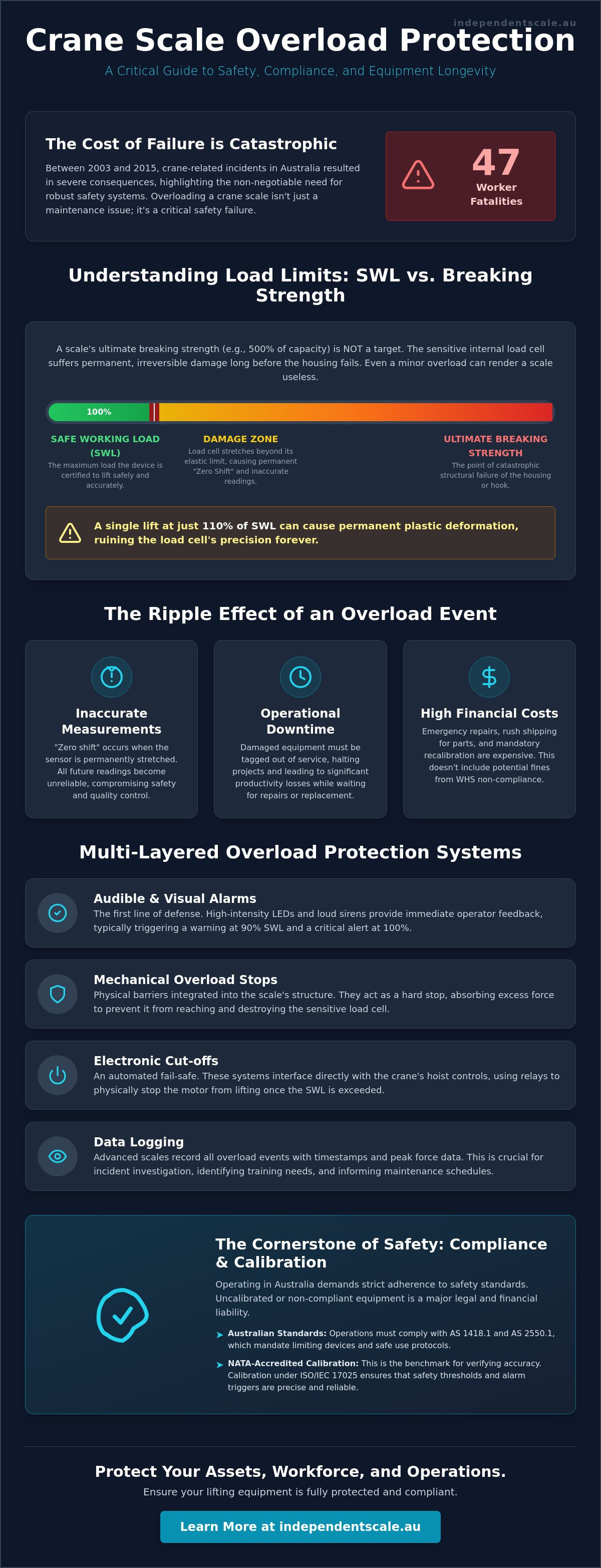
Between 2003 and 2015, 47 workers were killed in incidents involving cranes across Australia. This statistic highlights the severe consequences of equipment failure in high-risk industrial sectors. You likely recognize that maintaining operational safety while meeting tight project deadlines is a constant challenge. Effective crane scale overload protection isn't a luxury; it's a fundamental requirement for protecting your assets and your workforce from the risks of structural collapse or load cell damage.
This guide provides the technical expertise you need to understand how these systems function to prevent catastrophic failure. You'll learn how to ensure your lifting operations comply with Australian Standard AS 2550 and why NATA-accredited calibration, conducted under ISO/IEC 17025, is the benchmark for verifying sensor accuracy. We'll also cover the mechanics of mechanical stops and digital alarms, demonstrating how proactive safety measures reduce site downtime and long-term maintenance costs.
Key Takeaways
- Differentiate between Safe Working Load (SWL) and ultimate breaking strength to maintain a high factor of safety in lifting operations.
- Explore how integrated crane scale overload protection systems, including mechanical stops and audible alarms, provide multiple layers of equipment defense.
- Review the mandatory requirements for limiting devices and safe use as outlined in Australian Standards AS 1418.1 and AS 2550.1.
- Understand the necessity of NATA-accredited load cell calibration for ensuring the precision of safety thresholds and alarm triggers.
- Identify critical factors for equipment longevity, such as IP ratings and environmental shielding, specifically for Australian industrial sites.
What is Crane Scale Overload Protection and Why is it Critical?
Crane scale overload protection consists of the integrated mechanical and electronic systems designed to stop a weighing device from exceeding its rated capacity. These systems provide a critical fail-safe for industrial lifting. While the underlying Weighing Scale Principles are well-established, crane applications require higher durability to withstand extreme tension. This protection is a calibrated barrier between safe operation and catastrophic equipment failure.
Every industrial scale is built with a defined "Factor of Safety." This represents the ratio between the Safe Working Load (SWL) and the ultimate breaking strength. A scale might possess a 500% breaking strength, but this does not permit usage above the SWL. The internal electronics and load cells are sensitive instruments. They will suffer permanent damage long before the metal housing actually snaps. Protecting these components is vital for maintaining the integrity of your measurement data.
The primary objective of these protection systems is to prevent "zero shift." This occurs when a sensor is stretched so severely that it cannot return to its original state, rendering all subsequent measurements inaccurate. Ignoring these limits leads to severe economic consequences:
- Unplanned operational downtime while waiting for replacement parts.
- High costs associated with emergency load cell repairs and recalibration.
- Loss of productivity due to equipment being tagged out of service for safety audits.
The Mechanics of Load Cell Damage
Load cells utilize internal strain gauges to convert physical tension into electrical signals. When force exceeds the elastic limit of the load cell material, it causes plastic deformation. The metal is permanently stretched. Even a single event where a scale is subjected to a 10% overload can ruin its precision. Shock loading presents an even greater risk. This happens when a load is dropped or jerked, creating a momentary dynamic force that is significantly higher than the static weight of the object. Sustained over-capacity lifts cause gradual fatigue, but shock loads cause immediate, irreversible failure.
Safety Implications for Personnel
Failure to utilize crane scale overload protection puts every worker on the site at risk. Dropped loads frequently result from hook failure or snapped rigging when weights are underestimated. In complex operations like tandem lifts, where two cranes coordinate to move a single object, scales are the only way to ensure weight is distributed correctly. If one crane carries too much, it can trigger a structural collapse. Australian WHS laws mandate a strict duty of care for site managers. To meet these obligations, many rely on specialized technical consultancy and support packages from providers like dlsafety.ie to maintain safety in industrial environments. Operating with uncalibrated or unprotected equipment is a major legal liability that can lead to heavy penalties and site closures.
Types of Overload Protection Mechanisms in Modern Scales
Modern industrial sites require more than a simple visual readout. Multi-layered crane scale overload protection ensures that if one safety measure fails, another is ready to intervene. This redundancy is essential for high-risk environments where human error or environmental factors can lead to accidental overloading. Effective protection strategies utilize a combination of immediate operator feedback and automated hardware responses.
- Audible and Visual Alarms: These provide the first line of defense. High-intensity LEDs and sirens activate when the load reaches a pre-set percentage of the Safe Working Load (SWL), typically at 90% for a warning and 100% for a critical alert.
- Mechanical Overload Stops: These are physical barriers integrated into the scale's internal structure. They act as a safety net by absorbing excess force and preventing it from reaching the sensitive sensor once the capacity is exceeded.
- Electronic Cut-offs: These systems use internal relays to interface with the crane's hoist motor control circuit, physically preventing the operator from lifting any further.
- Data Logging: Advanced digital scales record every "overload event," including the date, time, and peak force. This data is vital for post-incident investigation and informing maintenance schedules.
Electronic vs. Mechanical Protection
Electronic systems rely on indicators and displays to process signals from the load cell and trigger programmed set-points. These are highly precise and adjustable but require a consistent power source. Mechanical protection often involves special purpose and shackle pins that feature physical safety margins built into the metallurgy and design. In Australian mining and construction sectors, a hybrid approach is the industry standard. This combines the real-time feedback of electronics with the failsafe physical security of mechanical components. If the electronics fail, the mechanical stop prevents structural deformation.
Automatic Shutdown Systems
For the highest level of safety, scales should be integrated directly into the crane's control circuit. High-performance conditioners and transmitters convert the load cell signal into a standard industrial output that communicates with the crane's PLC. If the weight exceeds the safety threshold, the system triggers a "fail-safe" relay that opens the hoist contactor. This design ensures that if a wire is cut or power is lost, the crane defaults to a safe state and cannot perform a lift. Integrating these systems with wireless remotes allows operators to manage these shutdowns from a safe distance, well away from the potential fall zone.
Ensuring these integrated components function correctly requires regular verification. You can maintain site safety by booking a NATA-endorsed calibration to confirm your alarm set-points remain accurate and compliant.
Australian Standards and Regulatory Compliance
Adhering to Australian Standards isn't a suggestion; it's a statutory requirement under national Work Health and Safety (WHS) laws. While many international manufacturers provide general safety guidelines, Australian site managers must meet specific domestic benchmarks to ensure crane scale overload protection is legally defensible. The primary technical standard, AS 1418.1, mandates the use of limiting devices on cranes and hoists to prevent structural failure. This standard requires that any device used for load limiting must be reliable and capable of withstanding the harsh environmental conditions found on Australian industrial sites.
Complementing this is AS 2550.1, which governs the safe use of cranes. This standard emphasizes that accurate weighing is a mandatory safety requirement for lifting operations. Proving "due diligence" in the event of a workplace incident depends entirely on your ability to produce NATA-accredited calibration reports. NATA (National Association of Testing Authorities) accreditation, specifically under ISO/IEC 17025, is the only benchmark for technical competence recognized by Australian regulators. Non-accredited testing lacks the rigorous traceability and independent oversight required to stand up in a workplace incident inquiry or a Safe Work Australia audit.
Compliance for Concrete and Construction
In the construction sector, overhead weighing accuracy directly impacts the quality and safety of materials. Precise measurement is essential for concrete batching plant calibration, where meeting AS 1379 standards is non-negotiable. If your crane scales are used to weigh raw materials or pre-cast elements, any inaccuracy can lead to structural instability in the finished product. Site safety audits in New South Wales and Victoria strictly examine these calibration records to ensure that all weighing equipment used in production meets the required tolerance levels.
The Legal Cost of Non-Compliance
The financial risks of operating without functional crane scale overload protection extend far beyond equipment repair costs. Regulatory bodies can issue significant fines and prohibition notices for operating cranes without functional limiting devices. Perhaps more critically, insurance providers often include clauses that void industrial policies if equipment is found to be uncalibrated or non-compliant at the time of an accident. Australian law requires periodic verification of all safety-critical weighing devices. Neglecting this schedule leaves your business exposed to unlimited liability and potential criminal charges for reckless endangerment of personnel.
The Role of NATA Calibration in Overload Safety
Integrated crane scale overload protection is only as effective as the calibration supporting it. If a scale's "zero" point or "span" has drifted due to environmental factors or heavy usage, the safety system cannot reliably identify an over-capacity event. A scale that under-reads by 15% will allow a 10-tonne crane to lift 11.5 tonnes without triggering an alarm. This drift effectively disables your primary safety barrier, exposing the site to the structural risks discussed previously.
Professional load cell calibration is the process used to verify and adjust these electronic set-points. Technicians apply known, traceable loads to the sensor to ensure that the "trip point" activates exactly when required. Industry standards typically require the crane to stop or alarm at 100% or 110% of the rated capacity. Without this verification, your safety devices are merely decorative. Testing these triggers under controlled conditions is the only way to guarantee they will perform during a real-world overload event.
Determining the correct testing frequency depends on your operational intensity. While annual testing is the baseline for most industrial applications, high-cycle environments like shipping ports or busy manufacturing plants often require semi-annual verification. Regular testing ensures that mechanical wear or electronic fatigue hasn't compromised the safety thresholds.
NATA Accredited Testing Procedures
Traceability to national standards is the core of reliable safety testing. ISO/IEC 17025 is the international benchmark for calibration laboratory competence. When you receive a NATA-endorsed certificate, it provides documented proof that the equipment was tested using methods that meet rigorous Australian criteria. A valid certificate must include the specific test points used, the uncertainty of measurement, and a clear statement confirming that the overload protection triggers were activated at the correct thresholds.
On-Site vs. Laboratory Calibration
Most industrial clients prefer weighing scale calibration performed on-site to minimize operational downtime. This allows technicians to test the scale in its actual working environment, accounting for local factors like temperature and mounting configurations. However, laboratory testing remains the superior choice for high-precision tension link scales where a controlled environment is necessary to achieve the lowest possible uncertainty levels. Independent Scale Service manages both on-site and laboratory testing across Sydney and Melbourne, providing the technical responsiveness needed to keep your fleet compliant without extended outages.
Don't leave your site safety to chance. You can request a NATA-accredited calibration quote today to ensure your safety systems are fully functional and legally compliant.
Sourcing and Maintaining Protected Crane Scales
Procuring a crane scale requires a strategic assessment of your operational ceiling. A common mistake is selecting a scale with a capacity that exactly matches your maximum intended lift. This leaves no margin for error and increases the likelihood of triggering the crane scale overload protection during routine work. Industry best practice suggests sourcing equipment with a capacity at least 20% higher than your heaviest planned load. This buffer protects the internal components from the fatigue and shock loading risks described in previous sections.
Australian industrial environments demand hardware that can withstand extreme heat and moisture. When selecting scales, verify the Ingress Protection (IP) rating. Equipment rated at IP67 or higher is necessary for outdoor construction and mining sites to prevent water and dust from compromising the electronics. For foundries or high-heat applications, integrated heat shields are essential. Electronic safety is further reinforced through the use of high-quality junction boxes and surge arrestors. These components protect the system from voltage spikes and lightning strikes, which are frequent causes of safety system failure on large-scale outdoor cranes.
Maintenance Checklist for Site Managers
Routine maintenance ensures that your safety systems remain responsive between scheduled NATA calibrations. Site managers should implement the following protocols:
- Daily Visual Inspections: Examine hooks, shackles, and housing for signs of deformation, hairline cracks, or metal fatigue.
- Weekly Alarm Verification: Perform a test cycle to confirm that audible and visual overload alarms are functioning and clearly perceptible in noisy environments.
- Battery Management: Monitor power levels closely. Low battery voltage can cause erratic sensor readings or a failure of the electronic cut-off to trip when required.
Why Partner with Independent Scale Service?
Selecting the right partner for load cell supply and maintenance is a decision that impacts your long-term liability. Independent Scale Service provides the technical competence required for high-risk lifting environments. Our expertise extends beyond simple weighing; we provide specialized force gauge calibration and heavy-duty industrial support across regional Australia. With a service footprint covering Sydney, Melbourne, and beyond, we ensure your downtime is minimized through rapid response times and methodical testing procedures. Choosing our NATA-accredited services provides the documented proof of compliance required by Australian regulators and insurers.
Contact Independent Scale Service for NATA-accredited crane scale calibration today.
Securing Your Lifting Operations for Long-Term Compliance
Maintaining operational safety requires a proactive approach to equipment verification. You now understand that crane scale overload protection is not a single component; it's a comprehensive system of alarms, stops, and electronic cut-offs. These mechanisms only provide a reliable defense when backed by precise calibration and strict adherence to Australian Standards. Neglecting these requirements risks structural failure, legal liability, and significant financial loss through site downtime.
Independent Scale Service provides the technical expertise necessary to keep your fleet operational and compliant. We're NATA Accredited to ISO/IEC 17025, ensuring every calibration meets the highest benchmarks for accuracy and traceability. Our team ensures full compliance with AS 1379 and AS 1418, providing Australia-wide service coverage across Sydney, Melbourne, and regional areas. This commitment to precision measurement protects your personnel and your bottom line.
Request a Quote for NATA-Accredited Calibration and Repairs today to ensure your facility remains a safe and productive environment.
Frequently Asked Questions
Does Australian law require overload protection on all crane scales?
Australian Work Health and Safety (WHS) laws require cranes to be fitted with limiting devices as specified in AS 1418.1. These systems ensure that lifting operations remain within safe parameters. While the scale itself is a measurement tool, its integration into the crane's safety circuit as a load-limiting device is a mandatory requirement for compliance with the safe use standards in AS 2550.1.
What is the difference between SWL and the overload trigger point?
Safe Working Load (SWL) is the maximum mass the equipment is rated to lift under normal conditions. The overload trigger point is the specific weight threshold, typically set at 100% or 110% of the SWL, where the electronic system activates an alarm or physical cut-off. Calibration ensures these two values align perfectly to prevent structural strain and maintain a consistent factor of safety.
How often should I calibrate my crane scale’s overload protection system?
You should calibrate your crane scale overload protection system at least every twelve months to maintain compliance with Australian Standards. High-use industrial sites or harsh environments, such as shipping ports and mines, often require semi-annual testing. Regular verification identifies sensor drift that could otherwise prevent a safety trip during a critical overload event.
Can I install an overload protection kit on an existing crane scale?
Yes, many existing crane scales can be retrofitted with electronic or mechanical protection. This involves integrating external indicators with relay outputs or replacing standard pins with specialized load-sensing shackle pins. Any modification must be followed by a NATA-accredited calibration to verify that the new safety triggers function according to the required industrial specifications.
What happens if my crane scale is overloaded without protection?
An unprotected overload event typically results in "zero shift," where the internal strain gauge is permanently deformed. This ruins the scale's accuracy and requires a full load cell replacement. Beyond equipment damage, an overload can lead to catastrophic structural failure, dropped loads, and the immediate voiding of your industrial insurance policies and legal compliance status.
Is NATA calibration mandatory for crane scales used on construction sites?
NATA calibration is the recognized benchmark for technical competence and is essential for demonstrating due diligence. On Australian construction sites, auditors and safety officers look for NATA-endorsed reports under ISO/IEC 17025. Non-accredited certificates often fail to provide the legal traceability required during a Safe Work Australia incident inquiry or a formal site audit.
How do I know if my load cell has been damaged by a previous overload?
The most common sign of damage is a persistent "zero shift," where the scale fails to return to zero after a load is removed. You might also notice non-linear readings, where the scale is accurate at low weights but becomes increasingly incorrect as the load increases. A professional technician can perform a bridge resistance test to confirm if the internal sensors are compromised.
Can an overload alarm be integrated with my existing crane remote control?
Modern crane scale overload protection systems allow for seamless integration with existing crane remote controls. By using industrial conditioners and transmitters, the scale can send a wireless signal to the crane's PLC. This can trigger a vibration in the remote handset or activate a visual warning on the operator's display, ensuring the rigger is immediately aware of an approaching limit.
