


Cost of a New Weighbridge in Australia: 2026 Pricing and Investment Guide
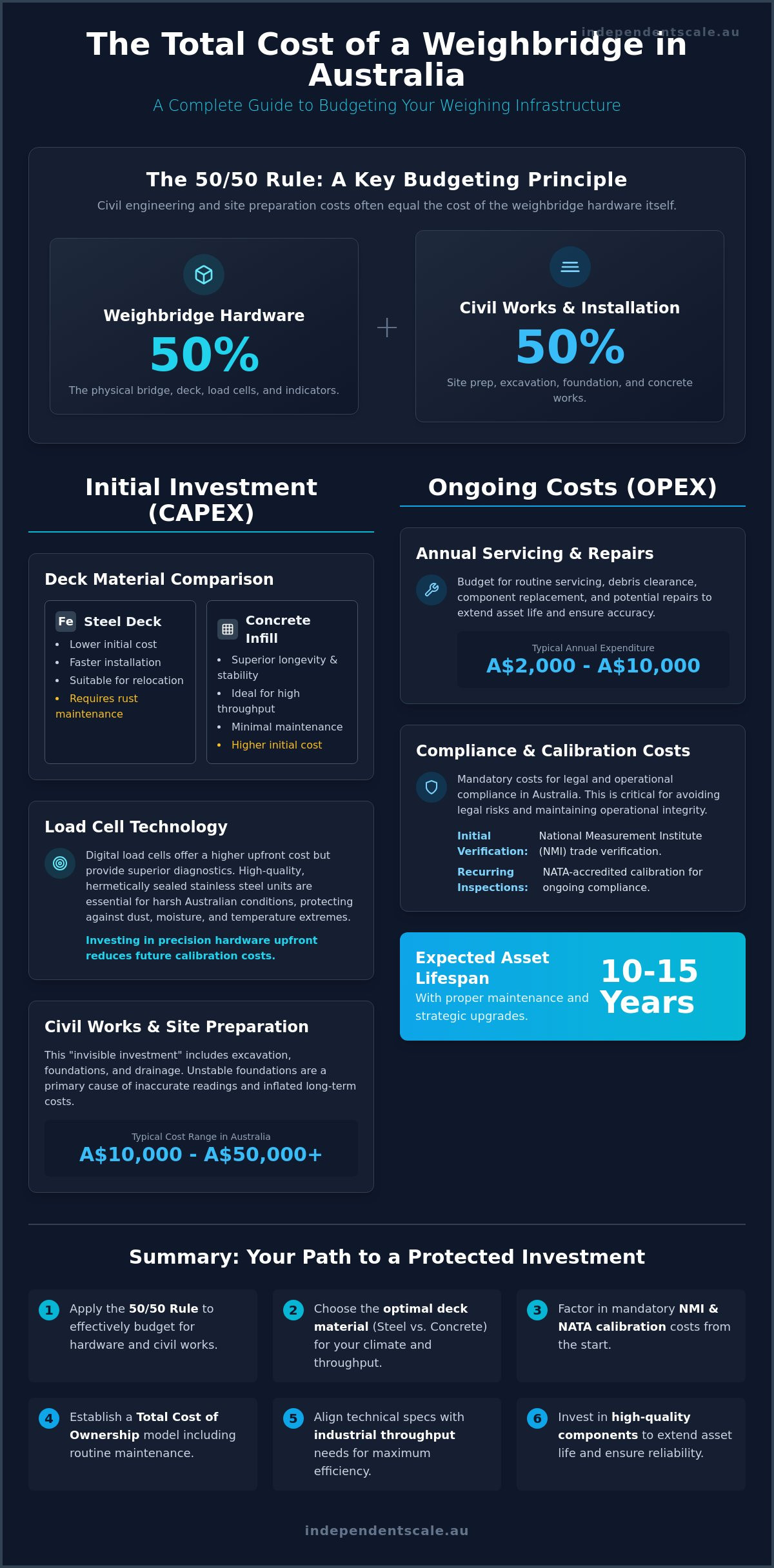
The purchase price of a weighbridge is often the least complex component of the total investment. In the Australian market, site preparation and civil engineering for a pit-mounted system can exceed A$50,000 before the hardware is even commissioned. Industrial operators frequently face budget overruns due to a lack of clarity regarding the ongoing weighbridge calibration cost Australia requires for NATA compliance and NMI trade verification. We acknowledge that navigating these technical requirements is essential for maintaining operational uptime and avoiding the legal risks associated with inaccurate measurement.
This guide provides an authoritative framework for budgeting your weighing infrastructure, detailing the 2026 pricing for hardware, software, and installation. You'll find a clear breakdown of the A$2,000 to A$10,000 annual expenditure typical for routine servicing and repairs. We also explain how to choose between steel and concrete decks based on specific site conditions and outline the impact of the National Trade Measurement Regulations 2009 on your long-term compliance strategy. This analysis ensures your investment is protected against the harsh realities of the Australian industrial landscape.
Key Takeaways
- Budget effectively by applying the 50/50 Rule, where civil engineering and site preparation often equal the cost of the weighbridge hardware.
- Determine the optimal deck material for your facility by comparing the technical performance of steel and concrete infill in harsh Australian climates.
- Account for the total weighbridge calibration cost Australia mandates, including initial NMI trade verification and recurring NATA-accredited inspections.
- Establish a total cost of ownership model that incorporates routine debris clearance and strategic component replacement to extend asset life.
- Align technical specifications with specific industrial throughput requirements to ensure regulatory compliance and maximum operational efficiency.
Hardware and Construction: Defining the Initial Weighbridge Price
The initial capital expenditure for a Truck scale (weighbridge) is primarily dictated by the physical dimensions of the platform. Standard Australian configurations for B-double vehicles typically require an 18-metre deck, while road train applications necessitate lengths of up to 30 metres. Width is another critical driver; while 3.5 metres is standard, wider decks for oversized mining or agricultural machinery significantly increase the amount of structural steel or concrete required, pushing the base hardware price higher. For facilities like concrete batching plants, these dimensions must be precisely matched to the site's traffic flow to prevent bottlenecks and ensure accurate measurement of raw materials.
Load cell technology represents the second major hardware cost. Digital load cells generally command a higher upfront price than analogue alternatives, but they offer superior diagnostic capabilities and simplified cabling. High-quality, hermetically sealed stainless steel sensors are a non-negotiable investment for Australian sites exposed to dust, moisture, and extreme temperature fluctuations. Industrial operators often overlook how these initial hardware choices impact the future weighbridge calibration cost Australia requires for NMI compliance, as cheaper components often drift out of tolerance more frequently.
Steel vs. Concrete: Which Material Fits Your Budget?
Steel weighbridges offer a lower initial cost and faster installation times. They're often prefabricated in modules, making them suitable for sites that might require relocation in the future. However, steel requires diligent maintenance to prevent rust, particularly in coastal or corrosive environments. Concrete infill decks provide superior longevity and mass, which aids in stability and accuracy over time. While the upfront investment for a concrete deck is higher due to the onsite pouring and curing requirements, the long-term durability often justifies the cost for high-throughput industrial facilities. For those interested in how specialized concrete techniques are applied to ensure structural integrity and aesthetic quality, you can learn more about Scott Patterned Concrete. Choosing the wrong material for your specific climate can lead to premature deck failure and increased downtime.
The Role of Load Cells in Hardware Pricing
Precision measurement starts with the quality of the load cells installed beneath the deck. Entry-level sensors may seem attractive for budget-conscious projects, but they lack the robust environmental protection of industrial-grade units. Premium load cells feature lightning protection and surge arrestors, which are essential for preventing catastrophic electronics failure during Australian summer storms. These features protect your initial equipment quote from becoming a liability. Furthermore, the accuracy of these components directly influences your ongoing compliance. Investing in high-precision hardware from the outset simplifies the process of achieving ISO/IEC 17025 calibration standards, ensuring your weighbridge remains a reliable asset for its entire 10 to 15 year service life.
Finalising the hardware package involves selecting appropriate indicators and displays. Basic terminals provide simple weight readouts, but modern industrial operations increasingly require integrated software solutions for data management and RFID vehicle identification. These systems streamline the weighing process and reduce human error, though they add to the initial hardware CAPEX.
Civil Works and Installation: The Invisible Investment
Industrial operators frequently underestimate the complexity of the ground beneath their weighing hardware. While the bridge itself is a significant capital item, the civil works required to support it often follow the 50/50 Rule. This industry benchmark suggests that site preparation, excavation, and concrete works typically account for up to 50% of the total project budget. For a standard installation in Australia, site preparation and installation costs generally range between A$10,000 and A$50,000, depending on the complexity of the terrain and existing infrastructure. Neglecting the foundational engineering doesn't just risk structural failure; it directly inflates the long-term weighbridge calibration cost Australia mandates, as unstable soil leads to platform shifting and frequent measurement errors.
Effective civil engineering begins with comprehensive soil testing and compaction. A weighbridge must remain perfectly level under the stress of a fully loaded B-double, which can exert massive point-load pressure on the load cell mountings. Proper drainage is equally critical. Stagnant water or debris build-up in a weighbridge pit can submerge load cells, leading to electronic failure and immediate downtime. Ensuring your site meets these rigorous engineering standards is the first step toward a reliable measurement system. You can consult with experts regarding technical site requirements and compliance to avoid these common pitfalls.
Above-Ground vs. Pit Installations
Above-ground weighbridges are the most cost-effective option for sites with ample surface area. These systems require less excavation but necessitate long, level approach and departure ramps to accommodate B-double vehicle combinations. Conversely, pit-mounted systems are installed flush with the ground level. While they save significant yard space and allow for easier vehicle access, they require extensive excavation and integrated drainage systems, which increases the initial civil investment. Semi-pit options serve as a middle-ground solution, providing some space-saving benefits without the full cost of a deep-pit excavation.
Regional Logistics and Site-Specific Variables
Logistics for regional Australian sites in Western Australia or Northern Queensland introduce unique cost variables. Shipping 18-metre steel modules or transporting heavy pre-cast concrete sections to remote locations requires specialized heavy-haulage permits and equipment. Contractor mobilisation fees also escalate in these areas. Additionally, environmental factors like high-rainfall coastal conditions demand specialized concrete mixes and enhanced drainage solutions to prevent corrosion. Operators must also account for concrete curing times, which can take up to 28 days to reach full structural strength, potentially extending operational downtime before the final NMI verification can occur. For those managing complex industrial relocations that extend beyond local site prep, you can check out Silver Knight Haulage & Machineries Ltd for expert machinery moving and installation services.
- Soil testing and compaction are mandatory to prevent platform subsidence.
- Approach ramps must be long enough to ensure vehicles are level before weighing.
- Drainage systems must be designed to handle local peak rainfall events.
- Mobilisation of cranes and specialised labour adds to remote site expenses.
The Cost of Compliance: NMI Verification and NATA Calibration
Operating a weighbridge for trade purposes in Australia requires strict adherence to the National Measurement Act. Any system used to determine the price of goods must be an NMI-approved type and verified by a licensed service provider before use. This initial verification ensures the equipment meets the required tolerances for trade. However, legal verification is only the baseline. For industrial clients, the weighbridge calibration cost Australia mandates often includes ongoing NATA-accredited inspections. These inspections provide a higher level of technical assurance, essential for satisfying ISO 9001 quality systems and mitigating corporate liability in the event of a measurement dispute.
Specific industries face additional layers of regulation. For example, concrete batching plant calibration must comply with AS 1379 standards. This requires specialized testing procedures to ensure that the weighing of cement, aggregates, and water remains within the strict percentage tolerances defined by Australian building codes. Failure to maintain these standards doesn't just risk a fine; it can lead to structural failures in the finished concrete, resulting in catastrophic legal and financial consequences for the supplier.
NATA vs. Standard Calibration: Budgeting for Precision
A standard verification confirms that a scale is "legal for trade," but it doesn't provide the comprehensive measurement uncertainty data found in a NATA-certified report. Budgeting for ISO/IEC 17025 calibration ensures your facility utilizes internationally recognized testing methods. While the frequency of calibration depends on your throughput, most trade-approved systems require a professional check every 6 to 12 months. High-use sites, such as those integrated with concrete batching plants, often require more frequent intervals to account for the vibration and wear caused by heavy machinery. Using specialized heavy test weights is the only way to verify performance at the upper end of the bridge's capacity.
Regulatory Documentation and Record Keeping
The cost of compliance extends into administrative overhead. Under the National Trade Measurement Regulations 2009, which remain in force following a 2026 exemption, operators must maintain accurate records of all weighings. Automated Measurement Ticket systems and cloud-based software have become standard for managing this data securely. These systems reduce the risk of human error during bi-annual audits by the National Measurement Institute. Investing in robust compliance software adds to your operational expenditure but protects the business against the "invisible" costs of non-compliance, such as product shrinkage or the legal fallout from inaccurate weighing tickets.
- NMI Trade Verification is mandatory for any bridge used to determine the price of goods.
- NATA accreditation is the industry standard for risk management and quality assurance.
- AS 1379 compliance is critical for the construction and concrete supply sectors.
- Regular calibration intervals prevent measurement drift and ensure long-term accuracy.
Total Cost of Ownership: Maintenance, Repairs, and Upgrades
The lifecycle cost of a weighbridge is heavily weighted toward operational expenditure (OPEX). While the initial CAPEX is significant, the annual investment for routine maintenance, calibration, and repairs typically ranges between A$2,000 and A$10,000. Neglecting basic upkeep, such as routine cleaning, is the primary cause of measurement inaccuracy. Debris build-up under the deck or around the load cell mounts creates "binding," which prevents the platform from moving freely. This directly inflates the weighbridge calibration cost Australia requires for NATA compliance, as technicians must spend billable hours clearing obstructions before testing can commence.
Electronic components like indicators and displays generally require replacement or upgrading every 7 to 10 years. These units are the interface of your weighing system and are susceptible to environmental wear and power surges. For 24/7 operations, the cost of unscheduled downtime far exceeds the price of the parts. Emergency repair fees and the potential for lost revenue during a system failure make a proactive replacement strategy a financial necessity rather than an optional upgrade.
Preventative Maintenance Contracts
A structured maintenance contract provides a measurable return on investment by identifying "load cell creep" or structural fatigue before it leads to total system failure. A professional maintenance checklist must include an inspection of all cabling, load cell mounts, and earthing straps to ensure protection against lightning strikes. Regular load cell calibration is the core pillar of this strategy. These scheduled inspections ensure the bridge remains within the tolerances required by the National Measurement Institute (NMI), preventing the legal and financial risks of out-of-tolerance weighing tickets.
Upgrading Legacy Systems
Many Australian industrial sites operate legacy weighbridges that are structurally sound but technologically obsolete. Retrofitting these systems with modern digital conditioners and transmitters is often more cost-effective than a full system overhaul. This allows for seamless integration into existing PLC systems and enables automation features like RFID vehicle identification and CCTV. These upgrades reduce long-term labour costs and improve data accuracy by removing manual entry from the weighing process. If your current system is showing signs of drift or inconsistent readings, you should request a technical assessment of your weighing infrastructure to determine the most viable upgrade path.
- Routine cleaning prevents debris binding and maintains measurement linearity.
- Digital retrofitting extends the service life of existing structural decks.
- Earthing and surge protection are critical for preventing electronics failure.
- Scheduled inspections reduce the frequency of emergency call-out fees.
Optimising Your Investment with Independent Scale Service
Selecting the correct hardware and managing civil works are only the first stages of a successful weighing infrastructure project. To ensure a measurable return on investment, industrial operators must align their equipment with specific throughput requirements and regulatory mandates from the outset. Independent Scale Service provides the technical expertise required to navigate these complexities, from initial load cell supply to the final NMI verification. Our approach focuses on minimising your total cost of ownership by ensuring your system is engineered for reliability in the most demanding Australian environments.
A critical differentiator in our service delivery is our focus on specialised industrial applications. We provide comprehensive concrete batching plant calibration and repair, ensuring full compliance with AS 1379. This level of technical proficiency is essential for facilities where measurement accuracy directly impacts product quality and structural integrity. By integrating high-precision load cells and advanced digital transmitters from the start, we help clients manage the long-term weighbridge calibration cost Australia requires for NATA compliance and NMI trade verification.
Why a Professional Audit Saves Money
Site-specific risks, such as poor drainage or inadequate soil compaction, frequently lead to budget blowouts during the installation phase. Our professional audit process identifies these variables before construction begins. We customise weighing solutions that don't just meet current needs but scale with your business growth. Whether you're operating a high-volume regional grain bunker or a metropolitan waste facility, our technical consultations provide the data-driven insights needed to optimise your CAPEX. You can request a technical consultation to review your project specifications and compliance requirements.
The Independent Scale Advantage
With decades of experience in the Australian industrial weighing sector, Independent Scale Service has established a reputation for methodical precision and utter reliability. We support installations and maintenance across Sydney, Melbourne, and key regional hubs, providing a national reach with localised technical expertise. Our commitment to NATA accreditation and NMI standards acts as a constant stamp of authority for our clients. We don't rely on emotive claims; we rely on hard data and a proven track record of solving critical business problems for serious industrial clients. For a professional assessment of your weighing needs, Contact Independent Scale Service for a Custom Quote.
- NATA-accredited expertise ensures your facility meets international measurement standards.
- Specialised support for AS 1379 compliance in concrete batching environments.
- National service coverage supports operations in metropolitan and regional locations.
- Methodical audit processes prevent unexpected civil engineering costs.
Securing Your Industrial Weighing Infrastructure
Securing your facility with a robust weighbridge requires precise planning of both hardware selection and civil infrastructure. The total investment is more than a simple purchase price; it's a long-term commitment to accuracy and regulatory adherence. By prioritising high-quality load cells and professional site preparation, you reduce the risk of platform subsidence and electronic failure. Maintaining your asset through NATA-accredited inspections ensures you meet ISO/IEC 17025 standards and remain AS 1379 compliant. Managing the inevitable weighbridge calibration cost Australia requires is a fundamental part of a professional operational budget.
Independent Scale Service provides the technical competence needed to support your operations across Sydney, Melbourne, and regional hubs. Our focus on reliability and precision measurement helps you avoid the hidden expenses of downtime and non-compliance. We're ready to assist with your next project, whether you're installing a new bridge or retrofitting a legacy system with modern digital transmitters. We provide the methodical expertise necessary to protect your capital investment.
Get an Accurate Quote for Your New Weighbridge System
We look forward to engineering a solution that meets your specific industrial requirements.
Frequently Asked Questions
How much does a standard 18m truck weighbridge cost in Australia?
The total investment for an 18-metre weighbridge is determined by the deck material and the complexity of the load cell technology. Steel deck systems generally require a lower initial capital outlay and offer faster installation, while concrete infill decks involve higher upfront costs due to onsite curing requirements. You must also account for the width of the platform; wider decks for oversized vehicles significantly increase the structural steel and concrete requirements. Accurate budgeting should focus on the total cost of ownership rather than just the initial hardware price.
Does a new weighbridge require NMI verification before use?
Yes, any weighbridge used for trade purposes in Australia must be verified by a servicing licensee before it's commissioned. This is a mandatory legal requirement under the National Measurement Act to ensure the device is accurate and meets the approved type specifications. Verification must be repeated after any major repair or adjustment to the system. Operating a non-verified bridge for trade can result in significant fines from the National Measurement Institute.
What is the difference between a pit and an above-ground weighbridge in terms of cost?
Above-ground weighbridges typically have lower civil engineering costs because they require minimal excavation, though they need significant space for approach and departure ramps. Pit-mounted systems are more expensive to install because they require extensive excavation, reinforced retaining walls, and sophisticated drainage systems to prevent load cell submersion. While pit systems involve a higher initial investment, they're often necessary for sites with limited yard space where vehicles need to turn across the platform.
How often should I calibrate my weighbridge to remain compliant?
Trade-approved weighbridges should undergo professional calibration every 6 to 12 months to maintain accuracy and compliance. High-throughput sites or facilities operating in harsh industrial environments often require more frequent testing to manage the weighbridge calibration cost Australia necessitates for risk mitigation. Regular intervals help identify measurement drift early, preventing product shrinkage and ensuring the system remains within the strict tolerances required for NMI trade verification.
Can I install a used weighbridge to save on costs?
While installing a used weighbridge is possible, it often leads to higher long-term expenses and compliance risks. You must verify that the specific model still holds a valid NMI pattern approval and that the structural integrity of the deck hasn't been compromised by corrosion or fatigue. Relocation, refurbishment, and recalibration fees can quickly erode any initial savings. Most industrial operators find that the reliability of new hardware justifies the investment over the asset's 10 to 15 year lifespan.
What are the hidden civil works costs I should budget for?
Soil testing and compaction are the most common "hidden" costs in weighbridge projects. If the ground is unstable, you may need additional piling or reinforced foundations to prevent the platform from sinking under the weight of a loaded B-double. Drainage is another critical factor; inadequate water management can lead to silt build-up and electronic failure. Budgeting for these foundational elements is essential to prevent platform binding and structural failure during the first few years of operation.
How long does a typical weighbridge installation take from start to finish?
A standard installation usually takes between 4 and 8 weeks depending on the site conditions and deck material. This timeline includes the initial excavation and civil works followed by the mandatory 28-day curing period for concrete foundations or infill decks. Once the concrete reaches its full structural strength, the hardware is installed, commissioned, and verified by a licensed technician. Planning for this downtime is vital for maintaining operational continuity during the transition to a new weighing system.
Is NATA accreditation necessary for all industrial weighbridges?
NATA accreditation to ISO/IEC 17025 is not a legal requirement for all trade weighbridges, but it's a critical standard for high-level quality assurance. Many corporate contracts and ISO 9001 quality systems mandate NATA-certified calibration reports because they provide detailed measurement uncertainty data. While standard NMI verification makes the bridge "legal for trade," NATA accreditation offers a higher degree of technical technical competence and is often required for industrial liability protection.
