


Concrete Pumps: A Complete Guide for Construction Professionals
On any modern construction site, project delays are unacceptable and safety breaches are non-negotiable. Yet, an incorrect concrete pump selection, a poorly formulated mix, or an on-site blockage can lead to significant financial loss and operational downtime. These challenges, compounded by strict Work Health and Safety (WHS) regulations, demand a precise and informed approach to concrete placement to maintain project momentum and ensure full compliance.
This comprehensive guide is engineered for Australian construction professionals who require operational certainty. We will systematically detail the different types of concrete pumps-from truck-mounted booms to static line pumps-and their specific applications, ensuring you make the correct equipment selection for any project scope. You will gain a technical understanding of the critical safety standards essential for WHS compliance and the precise mix quality requirements for achieving an efficient, uninterrupted pour. The objective is to equip you to deliver projects safely, on schedule, and to the highest engineering specifications.
Key Takeaways
- Understand the critical differences between boom and line pumps to select the correct equipment for your project's scale and site access.
- Learn why concrete mix design is the single most important factor in preventing blockages and ensuring a smooth, efficient pour.
- Mitigate high-risk operational hazards by implementing the essential safety best practices required for any concrete pump setup, as per Safe Work Australia.
- Ensure your concrete supply is compliant with Australian Standard AS 1379 to guarantee consistent quality and pumpability, preventing costly project delays.
What is a Concrete Pump and How Does it Work?
A concrete pump is an essential piece of machinery on modern Australian construction sites, designed specifically for the high-volume transfer of liquid concrete. Its primary function is to place concrete with exceptional precision in areas that are difficult or impossible to reach using conventional methods. This technology provides a significant operational advantage over older, labour-intensive techniques such as wheelbarrows or crane buckets, which are slower, less accurate, and increase the risk of material segregation. For a detailed technical overview, see this comprehensive guide on what is a concrete pump. The core of this machinery is a sophisticated twin-cylinder hydraulic system, which must be the central focus of any effective maintenance program.
The Core Components of a Concrete Pump
Understanding the main components is the first step toward effective maintenance. Each part plays a critical role in the machine's overall function, safety, and operational reliability.
- The Hopper: This is the receiving funnel where ready-mix concrete trucks discharge their load. It is equipped with an agitator to maintain the concrete's homogeneity and prevent blockages before it enters the pump system.
- The Pump System: Comprising two parallel hydraulic cylinders, this is the engine of the operation. These powerful cylinders work in opposition to draw concrete from the hopper and force it into the pipeline under immense pressure.
- The Pipeline and Hoses: A system of hardened steel pipes and flexible, heavy-duty rubber hoses that transports the concrete from the pump to the point of placement. The integrity of these components is critical for site safety.
- The Boom: On truck-mounted pumps, the boom is a remote-controlled, multi-jointed robotic arm. It allows operators to position the discharge hose with high accuracy, even at significant heights or horizontal distances.
The Pumping Mechanism Explained Simply
The pumping action relies on a powerful and efficient principle of hydraulic displacement. The two pistons within the pump system operate in a continuous, reciprocating motion. As one hydraulic cylinder retracts, it creates a vacuum that draws liquid concrete from the hopper. Simultaneously, the other cylinder extends forward, pushing its full volume of concrete out into the pipeline. A critical component, typically an S-valve or rock valve, pivots between the two cylinders. This valve's function is to seal off one cylinder from the pipeline while opening the other, ensuring a near-continuous flow of concrete and directing it from the active cylinder into the delivery line.
Types of Concrete Pumps and Their Applications
Selecting the appropriate concrete pump is a critical decision that directly impacts project timelines, safety, and budget. The choice primarily depends on project scale, site accessibility, and the required vertical or horizontal reach. The two primary categories of equipment are truck-mounted boom pumps and trailer-mounted line pumps, both of which are essential for modern construction efficiency and require diligent maintenance to ensure operational readiness.
Truck-Mounted Boom Pumps: For Height and Volume
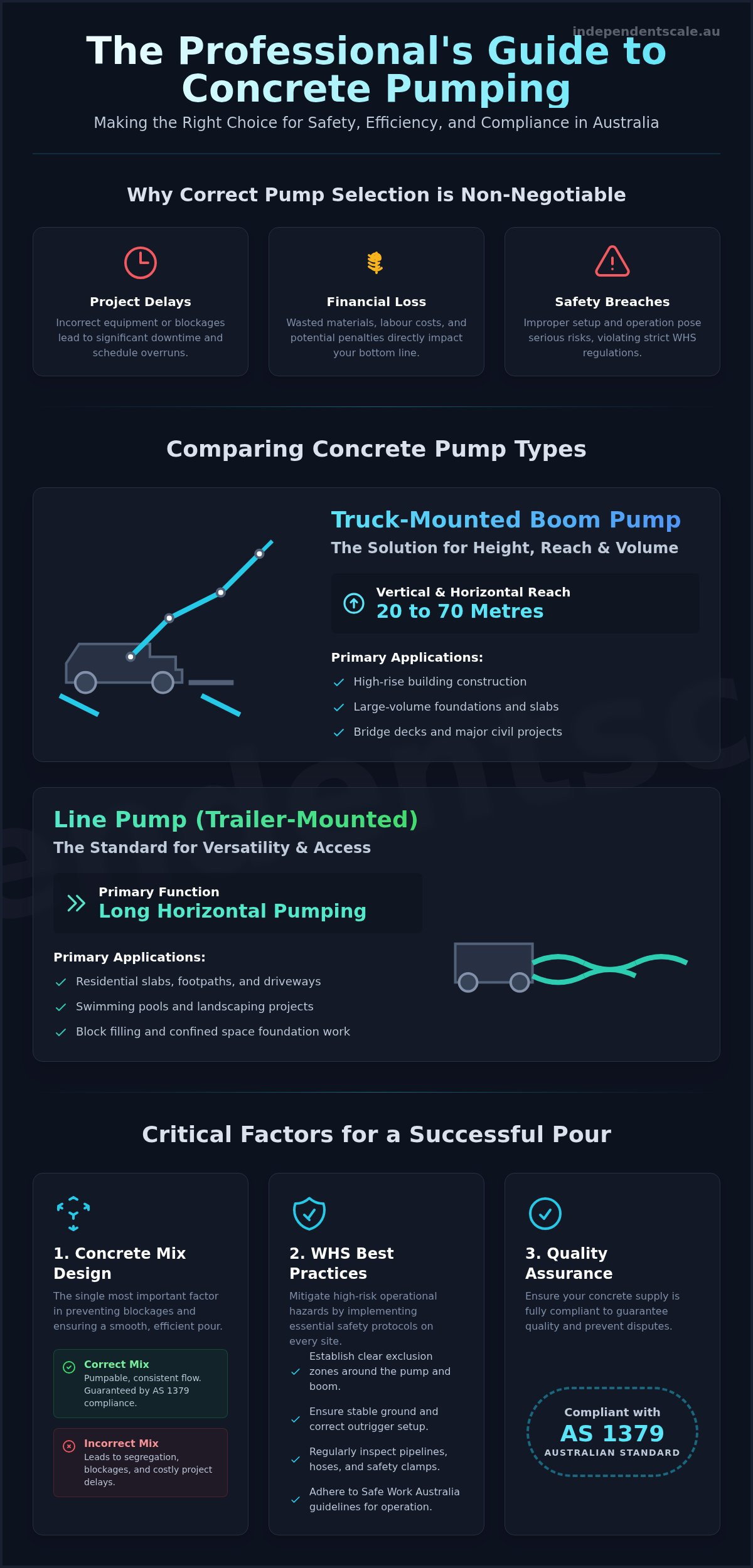
A truck-mounted boom pump integrates a high-pressure pump and an articulating robotic boom onto a single mobile chassis. This design provides exceptional mobility and reach, making it indispensable for large-scale projects. The boom, which typically ranges from 20 to 70 metres in Australia, allows for the precise placement of high volumes of concrete at significant heights. Operating this heavy machinery requires strict adherence to rigorous safety protocols, such as those outlined in global benchmarks like the OSHA safety standards, to mitigate operational risks.
- Primary Applications: High-rise building construction, large-volume foundation pours, bridge decks, and major civil engineering projects.
Line Pumps (Trailer-Mounted): For Ground-Level and Horizontal Pumping
Line pumps, often mounted on trailers or skids, are stationary units that pump concrete through a series of steel or rubber hoses connected on-site. Their primary advantage is versatility in locations with restricted access where a large boom truck cannot manoeuvre. These pumps excel at moving concrete over long horizontal distances and are the standard for most ground-level applications, offering flexibility and precision where it's needed most.
- Primary Applications: Residential slabs-on-ground, swimming pools, footpaths, block filling, and foundation work in confined spaces.
Specialised Concrete Pumping Equipment
Beyond the two main categories, specialised equipment exists for niche applications. Shotcrete pumps, for example, are designed to pneumatically project concrete at high velocity for constructing retaining walls, tunnel linings, and pools. For smaller-scale repair or hard-to-reach jobs, compact pumps mounted on skid-steers offer a highly mobile and precise solution, demonstrating the adaptability of modern concrete placement technology.
The Critical Link: Concrete Mix Quality and Pump Performance
A high-performance concrete pump is only as effective as the material it is designed to move. An improperly designed or batched concrete mix is the number one cause of pipeline blockages, a situation that not only causes significant downtime but also introduces safety risks during clearing procedures. Adhering to established guidelines, such as the ACPA Safety Procedures, is critical when dealing with such operational hazards. Ultimately, 'pumpability' is paramount not just for operational efficiency but also for the final structural integrity of the concrete, as a poor mix can lead to defects in the finished product.
Why Mix Design is Crucial for Pumping
Achieving a pumpable mix requires a precise balance of several factors. A mix that is too stiff will not flow, while one that is too fluid can segregate under pressure. Key considerations for the mix design include:
- Slump and Workability: The mix must have sufficient slump to flow easily through the pipeline without requiring excessive pump pressure, yet be cohesive enough to prevent aggregate from separating from the cement paste.
- Aggregate Size and Shape: The maximum aggregate size must be appropriate for the pipeline diameter. Well-graded, rounded aggregates pump more easily than angular or poorly graded ones, which are prone to interlocking and causing blockages.
- Admixtures: Chemical admixtures, such as plasticisers, are essential for improving flow characteristics without increasing the water content, which could compromise strength.
- Water-Cement Ratio: This ratio dictates the concrete's final strength and must be carefully managed to provide lubrication for pumping without weakening the final structure.
The Role of Accurate Batching in Achieving the Perfect Mix
A perfect mix design on paper is meaningless without precise execution at the batch plant. Every component-cement, aggregates, sand, water, and admixtures-is specified by weight. This accuracy depends entirely on the performance of precisely calibrated load cells within the plant's weighing systems. In Australia, this level of accuracy is not just best practice; it is mandated by Australian Standards to ensure consistent, high-quality concrete production.
From Batch Plant to Pump: Ensuring Consistency
Consistency is the bridge between a good mix design and the reliable performance of your concrete pump. Inconsistent batching, caused by uncalibrated weighing equipment, creates variations between loads. One batch may pump perfectly, while the next causes a blockage. This variability leads to significant on-site delays, wasted labour, and rejected materials, directly impacting project profitability. The only way to guarantee this consistency is through a regular, compliant concrete batching plant calibration program, ensuring every batch meets exact design specifications.
Essential Safety and Operational Best Practices
The operation of a concrete pump is a high-risk activity that demands competent, trained personnel and rigorous safety protocols. A failure in equipment or procedure can result in serious injury or fatality. For authoritative guidance, plant managers must adhere to the standards outlined by Safe Work Australia, particularly the Guide to Concrete Pumping. A comprehensive Safe Work Method Statement (SWMS) must be developed and implemented for every pour, addressing risks specific to the site and task.
Safety management must cover all phases of the operation: setup, the pour itself, and post-pour clean-up. Each stage presents unique and significant hazards that require specific control measures.
This holistic approach to safety management extends beyond the immediate task to include coordination with all critical trades on a construction site. For instance, a comprehensive site plan must account for underground utilities to prevent costly and dangerous damage during heavy equipment operation. This is where engaging with professional commercial plumbing services becomes essential. While based in the US, firms like Division One Plumbing serve as a good example of the specialists required to manage a site’s complex water and sewage infrastructure safely.
Pre-Pour Safety Checklist
Before pumping commences, a systematic site and equipment assessment is mandatory to mitigate foreseeable risks. This non-negotiable checklist forms the foundation of a safe operation.
- Site Assessment: Verify the ground is stable and capable of supporting the fully loaded concrete pump and its outriggers. Identify and maintain a safe distance from overhead power lines and other aerial hazards.
- Equipment Inspection: Conduct a thorough visual inspection of all hoses, pipes, and couplings for wear or damage. Confirm that all safety latches on couplings are functional and properly engaged. Check boom hydraulics for leaks.
- Exclusion Zones: Establish and clearly mark exclusion zones around the pump and along the pipeline to keep all non-essential personnel at a safe distance.
- Communication: Confirm that the pump operator and the line hand have established clear, unambiguous communication signals before the pour begins.
For larger or noisier sites where visual signals are insufficient, a reliable communication system is a critical safety control. Equipping teams with professional-grade equipment from experienced commercial two way radio installers nz ensures that instructions are clear and immediate, significantly reducing the risk of accidents during high-pressure operations.
Safe Operation During the Pour
Constant vigilance is required from all personnel during the concrete pour. The system is under immense pressure, and complacency can lead to catastrophic failure.
- Never allow any personnel to stand directly over or on a pressurised pipeline. A hose or coupling failure can be explosive.
- Follow established, safe procedures for clearing a blockage. Never use compressed air to clear a hardened blockage, as this can create a projectile.
- Continuously monitor the pump’s pressure gauges. A sudden spike or drop can indicate a blockage or line failure.
- Ensure outriggers on truck-mounted pumps remain stable on their pads and that ground conditions have not changed.
Post-Pour Cleaning and Maintenance
The cleaning process presents acute hazards, primarily from residual pressure in the delivery lines. Depressurising the system is the most critical step before any cleaning or maintenance begins. All personnel involved in clean-out must wear appropriate Personal Protective Equipment (PPE), including high-impact eye protection, gloves, and protective clothing. Regular, scheduled maintenance is not just for operational efficiency; it is a critical safety function to prevent mechanical failures that endanger your entire team.
Compliance and Quality Assurance: The Role of AS 1379
For any concrete plant manager in Australia, AS 1379 Specification and supply of concrete is the foundational standard governing your product. Its purpose is clear: to ensure every batch of concrete is consistent, reliable, and fit for its intended purpose. This is not merely best practice; compliance with AS 1379 is a standard contractual requirement for commercial, industrial, and government projects. The quality of concrete leaving the agitator truck and entering the concrete pump is directly tied to this initial batching accuracy.
Ultimately, compliance begins at the most fundamental point of your operation: the weighing equipment in your batch plant. Without verified and documented accuracy here, you cannot guarantee the quality or performance of your final product.
What AS 1379 Mandates for Batching Accuracy
AS 1379 sets strict, non-negotiable tolerance levels for weighing the constituent materials of a concrete mix. These are designed to ensure the specified strength and workability are achieved consistently. The key tolerances for batching are:
- Cementitious Materials: ±1% of the required mass
- Aggregates: ±2% of the required mass
- Water: ±1% of the required mass
- Chemical Admixtures: ±3% of the required mass
Meeting these narrow margins is impossible without a regularly and professionally calibrated weighing system. The entire system, from the load cells under the bins to the digital indicators and displays used by the batcher, must be proven accurate. Maintaining detailed records of this calibration is essential for internal quality control and for providing evidence of compliance during audits.
Why NATA-Accredited Calibration is the Gold Standard
While any calibration is better than none, NATA-accredited calibration provides the highest level of assurance. NATA (National Association of Testing Authorities) accreditation is an independent verification that a service provider is technically competent to perform specific calibrations to the ISO/IEC 17025 standard. A NATA-endorsed certificate offers irrefutable, legally defensible proof that your equipment is accurate and your measurements are traceable to national standards. This is critical for mitigating risk and is often a non-negotiable prerequisite for supplying concrete to major infrastructure projects and government contracts, where quality assurance is paramount.
To ensure your concrete pump receives a compliant, high-quality mix every time, trust the experts. For NATA-accredited calibration services that guarantee AS 1379 compliance, visit independentscale.au.
From Pump to Pour: Ensuring Quality and Compliance
Mastering the operation of a concrete pump is a critical skill, but its performance is fundamentally tied to the quality of the mix it handles. Achieving a consistent, pumpable concrete while adhering to strict safety protocols are the cornerstones of any successful project. Ultimately, compliance with standards like Australian Standard AS 1379 is not optional-it is the bedrock of quality assurance, preventing costly delays and ensuring structural integrity from the batch plant to the final pour.
To guarantee your concrete mix meets these exacting standards, the precision of your weighing equipment is non-negotiable. With over 30 years of industry experience, Independent Scale Service delivers the expertise required to maintain compliance. As a provider NATA Accredited to ISO/IEC 17025, we ensure your systems are calibrated for absolute accuracy. Ensure your concrete meets AS 1379 specifications. Contact Independent Scale Service for NATA-accredited calibration services.
By prioritising precision in your operations, you invest in the safety, efficiency, and success of your entire construction project.
Frequently Asked Questions
What is the difference between a concrete pump and a cement mixer?
A cement mixer, or concrete agitator truck, is designed to combine cement, aggregates, and water to create concrete and keep it in a liquid state during transport. In contrast, a concrete pump is specialised equipment used to transfer this ready-mixed concrete from the mixer to the precise point of placement. The mixer produces the material, while the pump is the high-pressure delivery system used for efficient and accurate pouring on-site.
How far can a concrete pump move concrete?
The transfer distance varies significantly based on the pump's specifications. A truck-mounted boom pump typically has a vertical reach of 20 to over 60 metres. For horizontal distances, a stationary or line pump is used and can push concrete well over 300 metres. High-performance systems can even exceed 1,000 metres, though the concrete mix design and aggregate size are critical factors that directly impact the maximum achievable distance for any pump.
Do you need a special license to operate a concrete pump in Australia?
Yes, a specific High Risk Work Licence is mandatory. To operate a truck-mounted concrete placing boom of 11 metres or more, the operator must hold a licence with the 'PB' class endorsement. This is a national requirement under Work Health and Safety (WHS) regulations, enforced by state bodies like SafeWork NSW or WorkSafe Victoria. Operating this machinery without the correct certification is a serious regulatory breach with significant penalties.
What is the most common cause of a concrete pump blockage?
The most common cause of a blockage is an unsuitable concrete mix design. A mix with an incorrect water-to-cement ratio, insufficient fine material for lubrication, or aggregates that are too large or angular will not flow correctly through the pipeline. Other frequent causes include kinks in the delivery hose, foreign material entering the hopper, or allowing the mix to sit idle for too long, causing it to begin setting inside the pump system.
How often should the weighing equipment in a concrete batch plant be calibrated?
To maintain compliance with Australian Standard AS 1379, weighing equipment in a concrete batching plant must be professionally calibrated at least every six months. This calibration must be performed by a NATA-accredited technician to ensure accuracy and traceability. More frequent verification may be required depending on the plant's production volume and quality control procedures to guarantee consistent and compliant concrete batches.
Can all types of concrete be pumped?
No, not all concrete mixes are pumpable. A mix must be specifically designed for pumping, with adequate cement and sand content to create a lubricating paste that reduces friction in the pipeline. Concrete with very large or sharp aggregates, low water content, or certain types of fibres can be extremely difficult or impossible to move through a concrete pump. The mix design must always be matched to the pumping equipment and the requirements of the pour.
