


Concrete Proportions Mix: The Definitive Guide to Ratios and Structural Integrity
Volume-based batching is a liability that has no place on a professional Australian worksite. While the "bucket method" might suffice for a garden path, structural integrity relies on the uncompromising precision of weight-based measurements. You understand that even a minor deviation in your water-cement ratio leads to surface cracking, inconsistent batches, and the high risk of regulatory non-compliance with AS 1379-2007. Every kilogram of material matters when your reputation and the safety of a structure are on the line.
This guide provides the technical expertise needed to master cement, sand, and aggregate ratios for standard grades from 20 to 50 MPa. You'll learn exactly how load cell accuracy affects concrete strength by preventing the measurement drift that compromises structural durability. By focusing on NATA-accredited calibration and precise weight limits, you can minimize material waste and ensure every pour meets rigorous Australian standards. We will examine the transition from volume to weight-based batching and the critical role of weighing equipment in achieving long-term structural performance. This methodical approach ensures your project remains compliant, durable, and structurally sound.
Key Takeaways
- Master the precise weight-based ratios required for standard Australian MPa strength grades to ensure structural integrity and long-term durability.
- Discover how load cell accuracy affects concrete strength by maintaining strict batching tolerances and preventing the material inconsistencies that lead to structural failure.
- Ensure full regulatory compliance with AS 1379-2007 by implementing NATA-accredited calibration for all concrete batching plant weighing equipment.
- Eliminate the technical inaccuracies of volumetric batching by transitioning to weight-based measurement to account for sand bulking and material density variations.
- Learn to leverage admixtures and Supplementary Cementitious Materials (SCMs) to optimize mix performance and minimize material waste in industrial applications.
The Science of Concrete Proportions: Why Ratios Matter
Concrete is a sophisticated composite material where each constituent serves a specific structural purpose. To understand what is concrete in a professional context, it must be viewed as a system of "glue" and "filler." The cement paste (glue) must perfectly coat every particle of aggregate (filler) to create a monolithic structure. If the ratio is off, the bond fails. Achieving this balance requires precision, as the technical success of a pour depends on the exact measurement of materials. This is why concrete batching plant calibration is mandatory for any project aiming for AS 1379-2007 compliance.
A frequent error in industrial batching is the assumption that more cement equates to higher strength. Excessive cement content increases the heat of hydration and leads to significant drying shrinkage. This often results in micro-cracking that compromises the structure's lifespan. The water-cement (w/c) ratio is the primary predictor of durability. High water content increases porosity and reduces MPa ratings, while insufficient water prevents the cement from fully bonding. Understanding how load cell accuracy affects concrete strength is critical because even minor weighing errors directly alter these delicate water-cement balances.
The Role of Aggregates: Sand and Gravel
Aggregates typically comprise 60% to 80% of the total mix volume. Grading, or the specific size distribution of particles, is vital for reducing the volume of voids within the matrix. Fine aggregate, usually sand, fills the interstitial spaces between coarse aggregates like crushed stone or gravel. Proper grading ensures a dense mix with minimal cement paste requirements. The physical properties of the stone also dictate the final MPa limits. You don't produce 50 MPa concrete if the coarse aggregate itself has a lower compressive strength or poor structural integrity.
The Chemical Reaction: Hydration vs. Drying
Concrete doesn't reach its design strength through simple evaporation. It undergoes a chemical process called hydration, where water and cement react to form a crystalline structure. If the mix proportions are incorrect, the growth of these crystals is stunted. Hydration is the exothermic chemical process where cement particles react with water to form a solid, stony mass through the growth of microscopic crystals. Inaccurate weighing disrupts this reaction. This is exactly how load cell accuracy affects concrete strength; a batching scale that drifts by just a few kilograms can result in a brittle, non-compliant product that fails site testing.
Standard Concrete Mix Ratios for Australian Construction
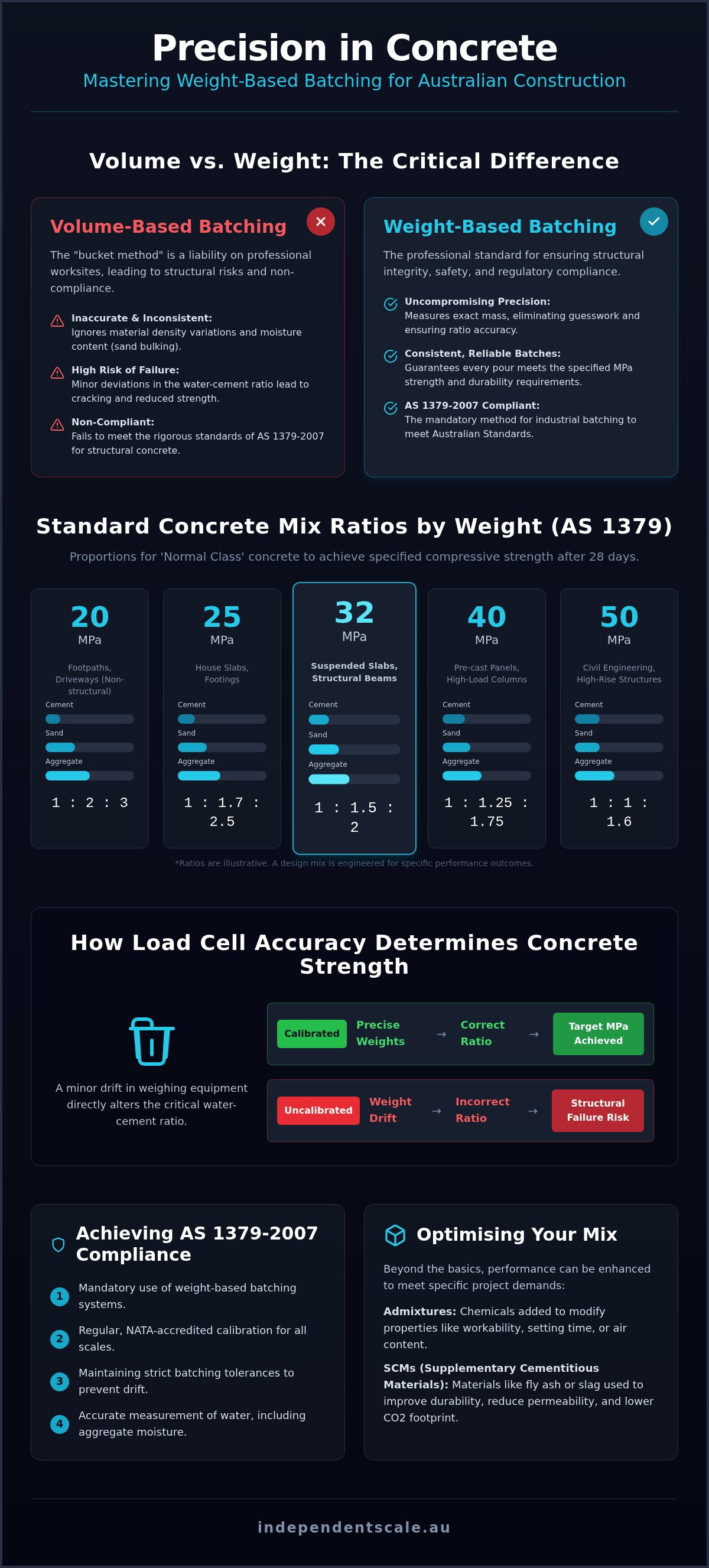
Australian construction projects categorise concrete by its compressive strength, measured in Megapascals (MPa) after a 28-day curing period. Under AS 1379-2007, "Normal Class" concrete is typically specified in standard grades of 20, 25, 32, 40, and 50 MPa. Selecting the correct ratio is not merely about volume; it's about engineering a material that withstands specific environmental and structural loads. Professional contractors must distinguish between a nominal mix, which follows fixed proportions, and a design mix, which is tailored to achieve precise performance outcomes. Adhering to concrete mix design standards ensures that factors like high-early-strength or low permeability are met without compromising the budget or structural safety.
Consistency across batches is the primary challenge in industrial concrete production. This is where how load cell accuracy affects concrete strength becomes a critical operational concern. If a batching plant's weighing system is uncalibrated, the intended 32 MPa structural mix could easily fall to 25 MPa due to an over-measurement of water or an under-measurement of cement. These deviations are often invisible until site testing reveals a failure. To maintain these tight tolerances, regular load cell calibration is a mandatory requirement for any facility serious about compliance and quality control.
General Purpose (1:2:3) Mix
The 1:2:3 ratio is the standard for non-structural domestic applications. It consists of one part cement, two parts sand, and three parts coarse aggregate. This mix is ideal for footpaths, garden walls, and small shed slabs where extreme load-bearing capacity isn't required. It provides excellent workability and a smooth finish. However, it lacks the density needed for heavy-duty structural use. While it's a reliable "all-rounder," it shouldn't be substituted for engineered structural designs in commercial environments.
High-Strength Structural (1:1.5:3) Mix
For those managing broader home renovation projects, BuildMeasureLab provides useful calculation tools that help ensure accuracy when estimating materials for various interior finishing tasks.
For reinforced columns, heavy-duty driveways, and foundations, a 1:1.5:3 ratio is the industrial benchmark. By reducing the proportion of sand, the mix achieves a higher density and greater ultimate compressive strength. This design is less porous, which protects internal steel reinforcement from corrosion. Precision is the defining factor in high-strength pours. Every kilogram of material must be accounted for to ensure the crystalline structure forms correctly during hydration. Inaccurate weighing in these mixes doesn't just waste material; it creates structural vulnerabilities that can lead to catastrophic cracking or slab failure under load.
Volume vs. Weight: Why Professional Projects Abandon the Bucket
Volume-based batching, often called the "bucket method," is a primary cause of structural inconsistency in Australian construction. Professional projects abandon this approach because volume doesn't account for material density variations. A bucket of loose cement contains significantly less mass than a bucket of compacted cement, yet they occupy the same space. For NATA-compliant structural work, mass-based measurement is the only reliable method. Commercial batching plants exclusively use weight-based systems because they provide the precision necessary to meet AS 1379 standards without the guesswork of volumetric gauges.
The bulking of sand is a critical factor that many general guides overlook. When sand contains moisture, surface tension pushes the grains apart, increasing the total volume by up to 30% without adding any actual mass. If you measure by volume, you'll end up with a sand-deficient mix that lacks structural integrity and workability. This is a key reason how load cell accuracy affects concrete strength; by weighing the mass rather than measuring the space it occupies, you eliminate the variables introduced by material density and moisture. Precise weighing ensures that the "filler" in your composite matches the engineering specifications exactly.
The Impact of Moisture Content
Wet sand weighs more than dry sand but occupies significantly more volume due to the bulking effect mentioned above. This paradox makes volumetric dosing impossible for high-specification projects. Engineers must adjust the water-cement ratio based on the existing moisture levels within the aggregates. In addition to weighing solids, dosing water requires high-precision liquid flowmeters to ensure the final mix doesn't exceed the specified water limits. If your water measurement is inaccurate, the entire chemical hydration process is compromised.
Precision Weighing Equipment
Industrial batching requires dedicated industrial weighing scales to maintain batch-to-batch consistency. Platform scales and hopper scales are superior to volume gauges because they provide quantifiable data that can be audited for compliance. Precision measurement directly correlates to material cost-savings by reducing the over-ordering of cement to "compensate" for poor measurement. Ultimately, how load cell accuracy affects concrete strength is seen in the final MPa report; a calibrated system ensures the design mix is exactly what is delivered to the formwork, protecting both the project budget and structural safety.
Compliance with AS 1379: Proportions in Industrial Batching
AS 1379-2007 is the definitive benchmark for concrete specification and supply in Australia. It dictates that batching plants must maintain strict dynamic measuring accuracy throughout the production cycle to ensure material consistency. Specifically, industry standards require a measurement tolerance of ±1% for cement, water, and admixtures, and ±2% for sand and stone aggregates. These aren't suggestions; they're mandatory requirements for ensuring structural safety and project longevity. This is precisely how load cell accuracy affects concrete strength. If your weighing equipment drifts outside these specified tolerances, the resulting MPa rating will fluctuate inconsistently, potentially leading to slab failure, structural cracking, or costly remedial work on-site.
The transition from manual batching to automated systems has made high-precision sensors the foundation of the modern plant. When sensors are uncalibrated, the "brain" of the operation is effectively working with false data. This results in batches that may look correct on a display but fail to meet the chemical requirements for the specified grade. Maintaining these tight tolerances is the only way to guarantee that a 40 MPa design mix actually delivers 40 MPa of compressive strength upon curing. Reliability in these measurements isn't just about quality control; it's about legal and regulatory protection for the supplier.
Load Cells: The Brain of the Batching Plant
Automated batching systems rely on load cells as the primary sensors for material quantification. In industrial settings, tank and silo weighing assemblies monitor the continuous flow of cement and aggregates from storage to the mixer. These sensors convert physical weight into electronic signals that high-precision indicators and displays interpret for real-time ratio monitoring. Common fault points, such as moisture ingress in junction boxes, mechanical binding in the mounts, or environmental vibration, can cause significant measurement drift. When these components fail to provide precise data, the entire chemical ratio of the mix is compromised before the truck even leaves the yard.
NATA Calibration and Audit Trails
Periodic NATA calibration is a legal necessity for any concrete supplier claiming AS 1379 compliance. A NATA-accredited calibration report provides verifiable evidence to building inspectors, project managers, and structural engineers that your weighing systems are accurate to ISO/IEC 17025 standards. This level of certification ensures that truckload 100 is identical to truckload 1, maintaining the structural integrity of the entire project across thousands of cubic metres. Understanding how load cell accuracy affects concrete strength allows operators to identify drift before it results in a batch failure. Without a transparent audit trail backed by professional calibration, you risk regulatory non-compliance, insurance complications, and project shutdowns. To ensure your facility meets these rigorous Australian benchmarks, you should schedule professional concrete batching plant calibration services to maintain peak operational accuracy and minimize client downtime.
Optimising Your Mix: Advanced Considerations
Advanced concrete design moves beyond the basic trio of cement, sand, and aggregate by integrating chemical admixtures and Supplementary Cementitious Materials (SCMs). Plasticisers are essential for increasing workability without adding water, which preserves the design MPa. Retarders are deployed in high-temperature Australian environments to delay the initial set, while accelerators are used in colder climates or for rapid-formwork removal. Because these additives are used in small, high-potency volumes, their measurement must be exact. This underscores how load cell accuracy affects concrete strength; even a minor over-dose of a retarder can lead to delayed strength gain and project downtime.
Industrial projects increasingly rely on SCMs like fly ash and blast-furnace slag to enhance durability and reduce the carbon footprint of the pour. Integrating these materials changes the required proportions of water and cement paste. Fly ash, for instance, improves the spherical particle packing of the mix, which often allows for a reduction in water demand. However, these substitutions require recalibrated mix designs to ensure the chemical reaction remains balanced. Failure to account for the specific gravity differences between Portland cement and SCMs will result in a non-compliant batch that fails to meet AS 1379 standards.
Environmental Factors
Proportions must be adjusted based on real-time site conditions. In hot weather, rapid evaporation increases the risk of plastic shrinkage cracking, necessitating a slight adjustment in water-reducer dosage or the use of evaporation retarders. High wind speeds also accelerate moisture loss from the surface, compromising the integrity of the finished slab. To maintain batching precision during these environmental shifts, the use of high-quality conditioners and transmitters ensures signal stability between the load cells and the control room, preventing electronic interference from heat or vibration.
Troubleshooting a Bad Mix
Identifying mix failures early is critical for structural safety. Segregation occurs when the coarse aggregate settles at the bottom, usually due to excessive vibration or a mix that's too wet. Bleeding is another common issue where excessive water rises to the surface, creating a weak, porous top layer that scales easily. To correct a mix that is too stiff without compromising strength, use a high-range water reducer (superplasticiser) rather than adding raw water to the drum. This maintains the water-cement ratio while achieving the required slump.
Before the first truck leaves the plant, verify the mix design against this final checklist:
- Confirm the aggregate moisture content has been offset in the weight calculations.
- Verify the admixture dispensers are calibrated to the correct millilitre dosage.
- Ensure the target MPa matches the specific SCM replacement levels.
- Check that the load cell indicators are zeroed and free from mechanical binding.
Precision in these advanced stages determines how load cell accuracy affects concrete strength over the lifespan of the structure. A methodical approach to optimization ensures the final product is not only compliant but superior in durability.
Securing Structural Integrity through Precision Measurement
Maintaining the balance between cement, water, and aggregates is a technical requirement that leaves no room for volumetric guesswork. Professional-grade concrete relies on the transition to mass-based batching to account for variables like sand bulking and moisture content. As established, understanding how load cell accuracy affects concrete strength is the difference between a compliant structural slab and a failed MPa test. Don't leave your project's reputation to uncalibrated sensors.
Reliability on the worksite starts with equipment that is methodical and precise. Independent Scale Service provides NATA-accredited calibration to ISO/IEC 17025 standards, ensuring your facility remains fully compliant with AS 1379. We offer expert load cell repair and supply to solve critical measurement problems for industrial clients. Protecting your structural integrity requires a commitment to technical proficiency. Request a Concrete Plant Calibration Quote to secure your next pour. Your commitment to precision today ensures the long-term durability of the structure tomorrow.
Frequently Asked Questions
What is the standard concrete mix ratio for a house slab in Australia?
How much water should I add to a 1:2:3 concrete mix?
For a 1:2:3 mix, the water-cement ratio should stay between 0.45 and 0.55 by weight. This translates to approximately 22 to 28 litres of water per 50kg bag of cement. You must adjust this volume based on the moisture already present in your sand and stone. Adding too much water to improve workability significantly reduces the final compressive strength and increases the risk of surface scaling and shrinkage cracks during the curing process.
Can I use any type of sand for concrete proportions?
You can't use any sand for structural concrete. Professional projects require washed river sand or specific concrete sand that's free from clay, silt, and organic matter. Fine sands, such as brickies' sand, contain too much clay, which increases water demand and weakens the cement bond. Using the wrong sand grade leads to a high void ratio, which compromises the density and ultimate MPa rating of the final concrete structure.
Why is my concrete cracking even though I used the right ratio?
Cracking often occurs due to an incorrect water-cement ratio or rapid drying. Even with the right nominal ratio, uncalibrated weighing equipment can lead to batching errors. This is a primary example of how load cell accuracy affects concrete strength; a scale that drifts can cause an excess of water or a deficiency in cement. These deviations create internal stresses and micro-cracking during the hydration process, even if the volume count seemed correct.
What happens if I add too much cement to the mix?
Adding excessive cement is counterproductive and increases project costs. High cement content generates more heat during the hydration process, which leads to thermal cracking and significant drying shrinkage as the concrete cures. It doesn't necessarily result in a stronger structure if the water-cement ratio isn't balanced. A precise design mix ensures the minimum amount of cement paste is used to coat the aggregates effectively without causing these structural liabilities.
How does AS 1379 affect the way concrete is mixed on industrial sites?
AS 1379-2007 regulates the specification, production, and delivery of concrete across Australia. It mandates that batching plants maintain a measuring accuracy of ±1% for cement and water, and ±2% for aggregates. This standard requires suppliers to provide batching records and maintain NATA-accredited calibration for all weighing equipment. On industrial sites, compliance ensures that the concrete delivered matches the engineered design mix exactly, protecting the structural integrity of the project.
Do I need to weigh my ingredients or can I measure by volume?
Professional projects must always measure ingredients by weight. Volumetric measurement is unreliable because materials like sand can bulk by up to 30% when damp, leading to a sand-deficient mix. Using industrial weighing scales is the only way to ensure batch-to-batch consistency. This precision illustrates how load cell accuracy affects concrete strength by removing the variables of material density and compaction that make the "bucket method" a major structural liability.
How often should a concrete batching plant be calibrated for accuracy?
Concrete batching plants should be calibrated at least every six to twelve months to maintain AS 1379 compliance. More frequent calibration is necessary if the plant undergoes major repairs, experiences significant vibration, or if site testing reveals inconsistent MPa results. Regular NATA-accredited testing to ISO/IEC 17025 prevents measurement drift and ensures that the load cells and indicators remain accurate within the mandatory ±1-2% tolerances required for structural concrete production.
