


Concrete Plant Calibration Service: A Guide to AS 1379 Compliance & Accuracy
Inconsistent concrete batches, the risk of a failed AS 1379 audit, and costly project delays are not just operational headaches-they are significant threats to your business. An inaccurate weighing system can compromise structural integrity, damage your professional reputation, and result in substantial financial penalties. For concrete plant operators across Australia, ensuring absolute precision is non-negotiable. An expert concrete plant calibration service is therefore an essential component of your quality assurance framework, safeguarding your output, compliance, and profitability.
This definitive guide provides the critical information required to master your plant's accuracy and maintain full compliance. We will detail the entire concrete batching plant calibration process, from initial inspection to final NATA-endorsed certification. You will gain a clear understanding of the specific requirements mandated by Australian Standard AS 1379 and learn how to select a competent, NATA-accredited provider. The result is the ability to guarantee consistent, high-quality concrete for every project, minimising downtime and preventing costly errors.
Key Takeaways
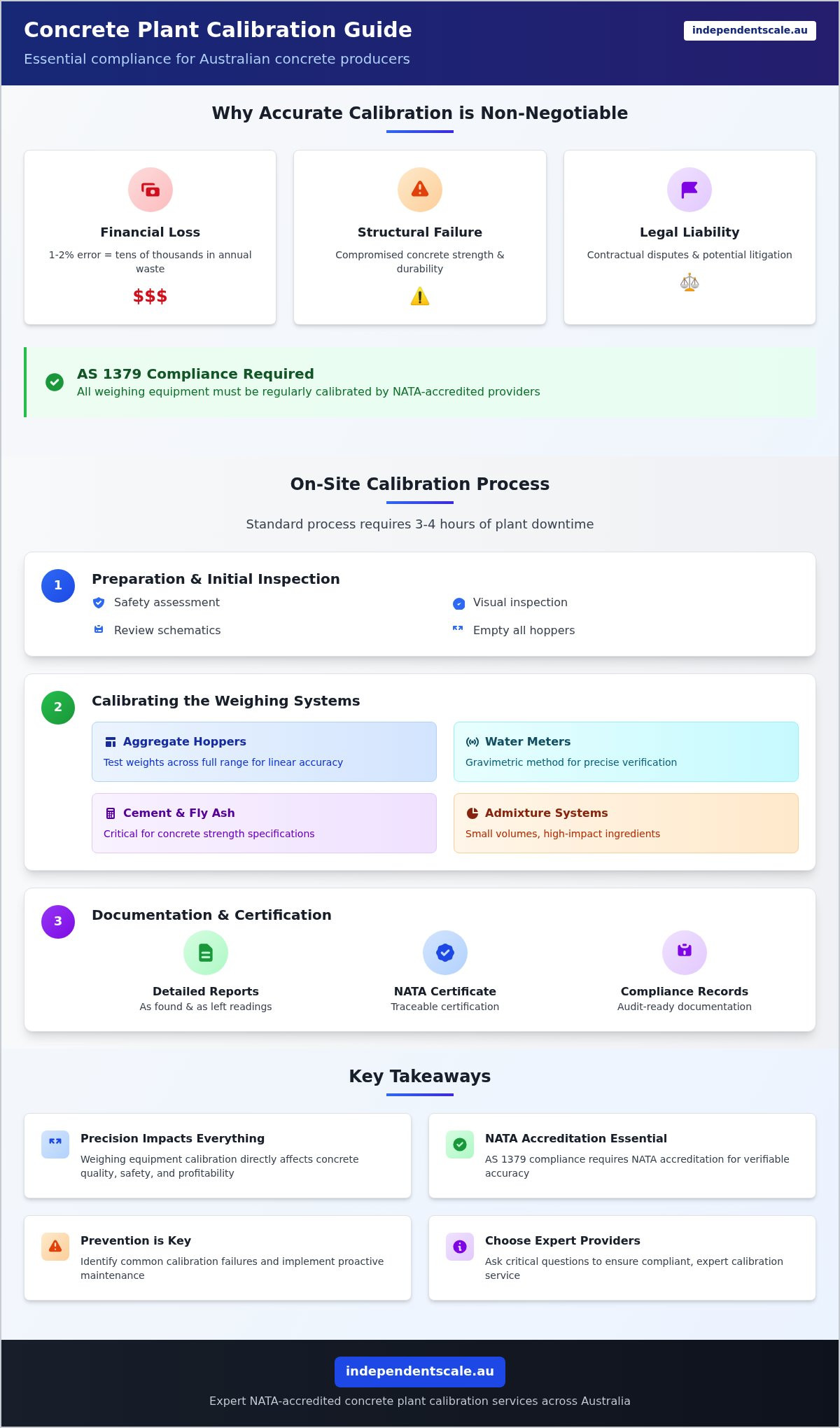
- Understand how precise weighing equipment calibration directly impacts concrete quality, project safety, and operational profitability.
- Demystify Australian Standard AS 1379 and learn why NATA accreditation is the definitive benchmark for verifiable accuracy and compliance.
- Identify the most common causes of calibration failure in concrete plants and discover proactive maintenance steps to prevent costly downtime.
- Learn the critical questions to ask when selecting a concrete plant calibration service to ensure you partner with a compliant, expert provider.
Why Accurate Concrete Plant Calibration is Non-Negotiable
In the Australian concrete industry, precision is not a target; it is a prerequisite. Accurate batching goes far beyond simple measurement-it is the foundation of product quality, structural safety, and operational profitability. Every component, from cement and aggregates to water and admixtures, must be weighed with precision. Failure to do so directly risks the structural integrity of the final build and undermines your business. This is why adherence to AS 1379 is not just best practice; it is a mandatory industry standard.
The Cost of Inaccuracy: More Than Just Wasted Cement
Even a minor, consistent error of 1-2% in your cement or admixture weighers can result in tens of thousands of dollars in material wastage annually. These seemingly small deviations compound over large projects, directly eroding your profit margins. The most critical factor is the water-to-cement ratio, which dictates the ultimate strength and durability. An imbalance compromises the fundamental properties of concrete, leading to significant risks:
- Financial Loss: Over-dosing expensive materials like cement and chemical admixtures.
- Structural Failure: Supplying concrete that fails to meet specified strength requirements.
- Legal Liability: Facing contractual disputes and potential litigation over sub-standard product.
Meeting Your Legal and Contractual Obligations
Engaging a professional concrete plant calibration service is a critical compliance activity. Under AS 1379 - Specification and supply of concrete, all weighing equipment must be regularly calibrated by an accredited body. Major construction contractors and government projects mandate this compliance, requiring auditable proof of calibration before accepting supply. These NATA-accredited records are your primary defence during an audit or legal challenge, demonstrating due diligence and adherence to non-negotiable industry standards.
Ensuring Consistent Product Quality and Performance
An accurately calibrated plant is the only way to guarantee consistent, predictable concrete performance. When every batch is produced to the exact mix design, you can be confident in its slump, strength, and workability. This reliability is the cornerstone of a strong business reputation, as it minimises on-site disputes with clients, builds trust, and secures repeat business. Furthermore, a calibrated system provides a reliable baseline for troubleshooting, ensuring that batching errors are immediately eliminated as a potential cause of any production issues.
The On-Site Calibration Process: A Step-by-Step Breakdown
Understanding what happens during an on-site visit demystifies the process and helps you prepare for minimal disruption. A standard calibration typically requires 3-4 hours of plant downtime, during which our technician performs a systematic, multi-point verification of your entire batching system to ensure operational accuracy and compliance.
Phase 1: Preparation and Initial Inspection
Upon arrival, our NATA-accredited technician conducts a site-specific safety assessment and reviews your plant's operational schematics. A thorough visual inspection follows, checking the integrity of load cells, mounting hardware, and junction box wiring for any signs of wear or potential failure. We require all aggregate, cement, and admixture hoppers to be completely empty to establish an accurate zero baseline before testing begins.
Phase 2: Calibrating the Weighing Systems
This is the critical phase of our concrete plant calibration service. Using government-certified and traceable test masses, we systematically verify the accuracy of each weighing component. The process is methodical and covers every input for your concrete batching.
- Aggregate Hoppers: We apply test weights in precise increments across the full weighing range to confirm linear and repeatable accuracy.
- Cement & Fly Ash Hoppers: The same methodology is used for cementitious weigh hoppers, where accuracy is paramount for achieving specified concrete strength and quality.
- Water Meters: We use the gravimetric method, discharging a measured volume of water into a tared vessel and weighing it to verify the meter's output is precise.
- Admixture Systems: Both scales and flowmeters for admixtures are tested to ensure these small-volume, high-impact ingredients are dosed correctly every time.
Phase 3: Documentation and Certification
Upon completion, you receive comprehensive documentation for your quality and compliance records. We issue a detailed calibration report for every tested component, outlining the "as found" and "as left" readings. Calibration stickers are affixed to the equipment, clearly displaying the service date and next due date. Most importantly, you are provided with a NATA-endorsed certificate, formal proof that your plant meets the stringent accuracy requirements of Australian Standard AS 1379. Schedule your on-site calibration with our expert team.
Understanding AS 1379 and NATA Accreditation Requirements
For any concrete production facility in Australia, compliance with Australian Standards is not optional-it is essential for quality assurance, safety, and commercial viability. The two most critical benchmarks governing weighing equipment accuracy are AS 1379 and NATA accreditation to ISO/IEC 17025. Understanding these standards is fundamental to selecting a competent concrete plant calibration service.
AS 1379 is the Australian Standard that provides the technical specifications for the supply of concrete. It forms the basis of contracts and quality control systems across the industry. NATA (National Association of Testing Authorities) is Australia's national body for the accreditation of laboratories, providing independent assurance of technical competence through a rigorous, third-party assessment process.
Key Requirements of AS 1379 for Weighing Equipment
AS 1379:2007, Clause 1.5.5, outlines the non-negotiable requirements for weighing and metering equipment. The standard mandates specific accuracy tolerances that your system must meet to ensure consistent, high-quality concrete production. These tolerances are:
- Cementitious Materials: ±1% of the net mass being weighed.
- Aggregates: ±2% of the net mass being weighed.
- Added Water: ±1% of the net mass or volume being measured.
- Chemical Admixtures: ±3% of the net mass or volume being measured.
Crucially, the standard requires that the accuracy of all weighing equipment be verified at least every six months by a competent authority. Comprehensive records of these verifications must be maintained for auditing and quality control purposes.
What NATA Accreditation to ISO/IEC 17025 Guarantees
While some providers may claim to be 'compliant' with AS 1379, only NATA accreditation provides independently verified proof of competence. NATA accreditation to ISO/IEC 17025 is the gold standard for calibration laboratories. Choosing an accredited provider guarantees:
- Traceability: The provider uses certified test masses that are traceable to national and international standards of measurement.
- Technical Competence: Technicians are assessed and proven to be technically competent to perform the calibration procedures correctly.
- Quality Management: The provider operates under a documented quality management system, ensuring consistent and reliable service delivery.
- Impartiality and Integrity: Results are generated without bias, and the calibration certificate is a legally defensible document.
In short, 'compliant' is a self-declaration, whereas 'accredited' is a third-party verification of excellence. For critical infrastructure like a concrete plant, engaging a NATA-accredited concrete plant calibration service is the only way to ensure your measurements are accurate, defensible, and fully aligned with Australian Standards.
Common Issues Found During Calibration and How to Prevent Them
Proactive maintenance is the most effective strategy for minimising plant downtime and ensuring your equipment passes its scheduled calibration. Many of the most common causes of calibration failure are preventable with routine visual inspections. Ignoring minor issues like material buildup or a damaged cable can escalate into inaccurate batching, wasted product, and significant financial losses. A comprehensive concrete plant calibration service will identify these faults, but addressing them early is key to operational efficiency.
Load Cell Problems: The Heart of the System
Load cells are the core of your weighing system, and their failure directly impacts every batch. Key indicators of a problem include inconsistent or non-repeatable readings and a "drifting" zero point. Damage is often caused by shock loading from dropped materials, electrical surges from lightning strikes, or water ingress due to failed seals or high-pressure cleaning. It is essential to also inspect summing boxes for moisture and ensure all load cell cables have their protective sheathing intact to maintain signal integrity.
Mechanical and Structural Issues
The accuracy of a load cell is irrelevant if mechanical issues interfere with the weighing process. The most frequent problem is material buildup-hardened cement, dust, and aggregate-on hoppers and lever systems. This debris restricts free movement and adds unaccounted-for weight, leading to inaccurate measurements. Similarly, worn or binding components such as pivots and check rods can prevent the scale from returning to a true zero. In some cases, structural issues with foundations can cause shifts that compromise the entire system's geometry.
A Proactive Maintenance Checklist for Plant Managers
Empowering your operators with a simple inspection routine can prevent the majority of common mechanical faults. This checklist does not require specialised tools and focuses on visual confirmation.
- Weekly: Check for and clear any debris or material buildup around load cells, pivots, and hopper assemblies. Confirm that all components can move freely without restriction.
- Monthly: Visually inspect all visible cables for fraying, cracking, or other physical damage. Ensure all connections at summing boxes and indicators are secure and free from corrosion.
- Quarterly: Verify that cement and aggregate hopper gates close completely and seal properly. A leaking gate is a primary cause of inaccurate batching and material variance.
While this routine is an excellent first line of defence, it does not replace the technical analysis of a professional concrete plant calibration service. If your team identifies any of these issues, or your plant is due for its next scheduled calibration, contact the experts at Independent Scale Service to ensure your operations remain compliant and profitable.
How to Choose a Concrete Plant Calibration Service Provider
Selecting a partner for your plant’s calibration is a critical business decision that extends beyond a simple price comparison. The true cost of an inaccurate batch, a rejected load, or a failed audit is far greater than any initial saving on service fees. A professional concrete plant calibration service ensures your operations remain compliant, protects your reputation, and optimises material usage. To properly vet potential providers, you must ask targeted questions that verify their competence and reliability.
Essential Question 1: Are You NATA Accredited?
This is the most critical question. Insist on seeing the provider's NATA scope of accreditation to ISO/IEC 17025. You must verify that this scope explicitly includes the on-site calibration of concrete batching plants. A generic accreditation is not sufficient. Reports issued by a provider without the correct scope can be rejected during an audit, putting your essential AS 1379 compliance at immediate risk.
Essential Question 2: What Equipment Do You Use?
The right tools are non-negotiable for an accurate calibration. Inquire about the quantity of certified test masses they bring to a job; an insufficient amount of weight prevents a thorough and compliant test. Confirm they possess the specialised equipment to accurately calibrate every plant component, including water meters (via the gravimetric method) and admixture dispensers. All test masses must have current certification and be traceable to Australian national standards.
Essential Question 3: What Is Your Experience and Support?
Proven expertise is built over years of dedicated service in the industry. Ask for references from concrete plants similar to your own and inquire about their technicians' specific training and hands-on experience. Crucially, determine their level of ongoing support. A plant breakdown doesn't wait for business hours; a provider offering 24/7 emergency repair services is an invaluable asset for minimising costly downtime. See why industry leaders trust Independent Scale Service.
Secure Your Compliance and Plant Accuracy with an Expert Partner
Ultimately, accurate concrete plant calibration is not a procedural formality but a critical business function. It is the foundation for ensuring every batch meets specification, maintaining strict AS 1379 compliance, and safeguarding your operational reputation. Understanding the technical on-site process and the importance of NATA accreditation allows you to proactively prevent common errors that lead to wasted materials, project delays, and significant financial loss.
The final, decisive factor in achieving this accuracy is your choice of provider. When you engage a professional concrete plant calibration service, you are investing in certainty. With over 30 years of industry experience, Independent Scale Service is the trusted partner for leaders like Holcim, Boral, and Hanson. Our NATA accreditation to ISO/IEC 17025 provides documented proof of our technical competence and commitment to delivering precise, compliant results.
Protect your assets and secure your compliance. Request a quote for your AS 1379 compliant calibration service and partner with the experts in weighing accuracy.
Frequently Asked Questions
How often does a concrete batching plant need to be calibrated?
In Australia, compliance with AS 1379 mandates that concrete batching plants must be professionally calibrated at least once every 12 months. For high-volume production facilities or plants operating in demanding environmental conditions, a more frequent 6-month calibration schedule is strongly recommended. This proactive approach ensures consistent batch accuracy, minimises material wastage, and maintains full compliance with industry standards, preventing costly production errors and potential disputes over concrete quality.
What is the typical cost of a concrete plant calibration service in Australia?
The cost for a professional concrete plant calibration service in Australia typically ranges from A$1,500 to A$3,000 per visit. The final price is determined by the complexity of the plant, including the number of scales for aggregates, cement, water, and admixtures, as well as the site's location. This cost covers the use of NATA-certified test masses and accredited technicians. Any required repairs or replacement parts discovered during the service would be quoted separately for your approval.
Can my own maintenance team perform the calibration?
While your internal team is vital for routine maintenance, formal calibration must be performed by a NATA-accredited technician to satisfy AS 1379 requirements. This is because certification requires the use of traceable, certified test masses and specific, documented procedures that general maintenance staff are not equipped for. Using an accredited third-party service provides the official documentation needed to prove compliance and ensures your weighing equipment is verifiably accurate, protecting your business from liability.
What is the difference between gravimetric calibration and the 'pull down' method?
Gravimetric calibration is the only method compliant with Australian Standards. It involves placing NATA-certified test masses directly onto the weighing system to verify its performance at various points in its range. The 'pull down' method uses hydraulic force to simulate weight and is not a recognised or accurate calibration technique. It lacks the traceability and precision of using certified masses and will not result in a NATA-endorsed certificate, making it unsuitable for AS 1379 compliance.
How long does an on-site calibration typically take?
A comprehensive on-site calibration for a standard concrete batching plant generally takes between 3 and 5 hours. This timeframe allows our technicians to methodically test all weighing systems, make necessary adjustments, and complete the required documentation. The exact duration can vary depending on the plant's size, the accessibility of the equipment, and whether any immediate repairs are needed. We work efficiently to minimise your plant’s operational downtime while ensuring a thorough and compliant service.
What happens if my equipment fails the calibration test?
If any part of your weighing system fails to meet the required accuracy tolerances, our technician will immediately identify the cause of the failure. Common issues include damaged load cells, faulty wiring, or structural interference. We will provide a direct assessment of the problem and a clear quote for the necessary repairs. Our service vehicles carry a stock of common replacement parts, allowing us to often resolve the issue during the same visit to restore your plant to a compliant and operational state promptly.
