


Concrete Plant Calibration Frequency: AS 1379 Compliance Guide 2026
Relying solely on the minimum six-month interval for your concrete plant calibration frequency might satisfy a basic audit, but it won't protect your project from the high costs of out-of-spec batches. You already know that even a minor deviation in load cell accuracy leads to significant material waste or, worse, total project rejection. Maintaining precision isn't just about ticking a regulatory box; it's about operational reliability and protecting your professional reputation in a high-stakes industry.
This guide provides a definitive breakdown of AS 1379 compliance requirements to ensure your weighing systems meet NATA standards. You'll learn the mandatory intervals for liquid-dispensing and weighing equipment, the specific events that trigger immediate recalibration, and the vital difference between routine in-house verification and formal technical calibration. We'll outline a clear, audit-ready schedule designed to minimize downtime and keep your production within strict tolerance limits.
Key Takeaways
- Understand how AS 1379-2007 governs concrete supply through mandatory precision standards for all batching equipment.
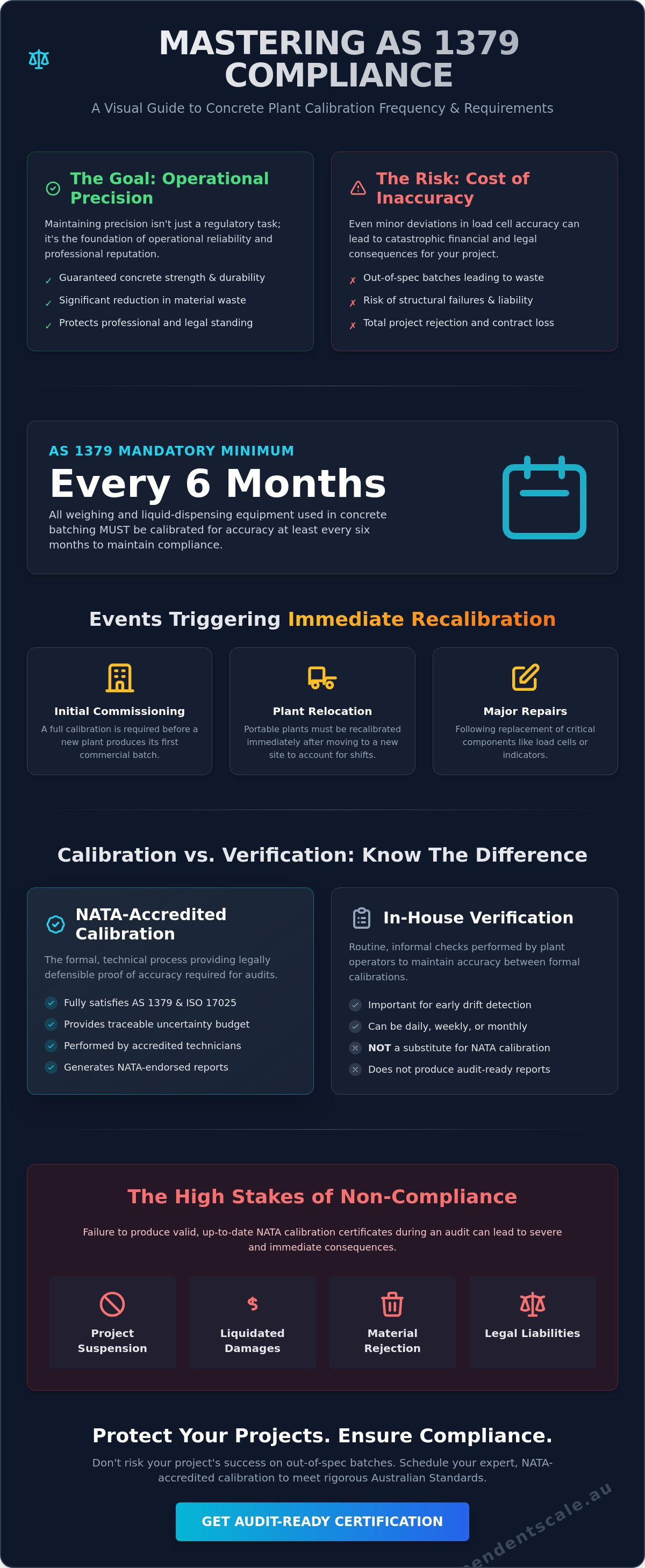
- Identify the mandatory concrete plant calibration frequency, which requires weighing systems to be certified every six months to maintain compliance.
- Learn how high production volumes and environmental stressors like dust or vibration can trigger the need for more frequent testing.
- Establish a clear distinction between daily in-house verification procedures and formal NATA-accredited calibration services.
- Prepare for audits by implementing a structured calibration schedule that aligns with ISO 17025 and NATA technical requirements.
The Regulatory Framework for Concrete Plant Calibration in Australia
Calibration is the technical process of verifying that measurement equipment provides results within specified tolerances by comparing them against a known traceable standard. In a concrete plant, this precision applies to every load cell, hopper, and liquid dispensing system used to create a mix. AS 1379 is the primary standard for concrete production in Australia. It dictates how concrete must be specified, stayed, and supplied, placing heavy emphasis on the accuracy of batching plants. While new equipment often arrives with factory settings, these initial configurations are insufficient for ongoing site compliance. Mechanical wear, vibration, and environmental factors cause measurement drift over time. Maintaining a consistent concrete plant calibration frequency ensures that these drifts are identified and corrected before they impact product quality.
The National Association of Testing Authorities (NATA) serves as the authority for laboratory accreditation in Australia. For concrete producers, NATA accreditation to ISO/IEC 17025 is the benchmark for technical competence. It provides the assurance that the calibration results are accurate, repeatable, and legally defensible. Without this level of oversight, a batching plant operates at significant risk, as unverified measurements lead to inconsistent concrete strength and durability.
The Legal Implications of Non-Compliance
Supplying non-conforming concrete to major infrastructure projects carries severe legal and financial risks. If a structural failure occurs, your calibration records serve as a primary legal defense, proving that the constituent materials were batched within the tolerances defined by AS 1379. Major government bodies, such as Transport for NSW or VicRoads, mandate strict adherence to these standards in their contracts. Failure to produce valid, up-to-date certificates during an audit can result in immediate project suspension, liquidated damages, or the total rejection of supplied material. Consistent concrete plant calibration frequency is the only way to mitigate these liabilities effectively.
NATA vs. Non-Accredited Calibration
There's a critical technical difference between a standard equipment check and a NATA-accredited service. A standard check might verify that a scale moves, but it doesn't provide the traceability or uncertainty budget required by ISO/IEC 17025. NATA-endorsed reports are the only documents that fully satisfy independent auditors and government inspectors. Independent Scale Service provides specialized concrete batching plant calibration that meets these rigorous standards. Choosing non-accredited providers often leaves a plant vulnerable during audits, as their reports lack the recognized authority needed to prove total compliance with Australian Standards.
Standard Concrete Plant Calibration Frequency under AS 1379
The operational integrity of a batching facility depends on the consistent accuracy of its measurement systems. The primary regulatory document, AS 1379-2007, specifies the technical requirements for the production and supply of concrete. Clause 4.1.3 of this standard dictates that all measurement equipment must maintain a high level of precision to ensure the final mix meets engineering specifications. Adhering to the correct concrete plant calibration frequency is the only recognized method for demonstrating this precision during a NATA audit or government inspection.
AS 1379 mandates that all weighing and liquid-dispensing equipment used in the batching process must be calibrated for accuracy at least every six months. This six-month rule serves as the absolute minimum interval for plants operating under standard conditions. However, compliance isn't just about the calendar. Initial commissioning requires a full calibration before a new plant produces its first batch. Similarly, if a portable plant is moved to a new site, the weighing systems must be recalibrated immediately to account for structural shifts and mechanical changes during transport. For facilities requiring professional certification, our weighing scale calibration services ensure your equipment meets these rigorous Australian Standards.
Mandatory Intervals for Different Scale Types
Different components within a plant experience varying levels of mechanical stress and require specific attention. Aggregate and cement weigh hoppers are subject to high-frequency loading and abrasive dust, necessitating strict adherence to the six-month cycle. Water meters and liquid admixture dispensers are equally critical; even a small deviation in chemical dosing can compromise the entire batch. Moisture probes require a different approach, often needing more frequent verification against oven-dry tests to account for changes in material properties. It's essential to treat each measurement point as a distinct compliance requirement rather than a single plant-wide task.
Documentation and Compliance Records
Audit readiness depends entirely on the quality of your documentation. An AS 1379 compliant calibration certificate must clearly state the traceability to national standards, the uncertainty of measurement, and the specific results for each test point. Australian batching plants should maintain these records for at least seven years to satisfy legal and contractual obligations. While many operators are moving toward digital logbooks for better transparency, physical copies should remain accessible on-site for immediate inspector review. Accurate record-keeping transforms a routine service into a powerful legal defense and a proof point of your commitment to quality.
Factors That Demand More Frequent Calibration Intervals
While AS 1379 establishes a six-month baseline, several operational variables necessitate a more aggressive concrete plant calibration frequency. High-volume production facilities often process thousands of tonnes of material monthly. This continuous cycling places repetitive mechanical stress on the weighing assemblies, leading to fatigue in the mounting hardware and eventual sensor drift. Plants producing specialty high-strength mixes or supplying Tier 1 infrastructure projects must maintain tighter tolerances than standard residential operations. In these scenarios, the risk of a single batch falling out of specification outweighs the cost of monthly or quarterly verification.
Environmental conditions also play a decisive role in measurement stability. Dust ingress in cement hoppers can create mechanical binding, while extreme temperature fluctuations cause thermal expansion in steel support structures. Constant vibration from nearby heavy machinery or aggregate conveyors further accelerates the degradation of precision components. When these factors align, waiting six months for a technician often results in prolonged periods of inaccurate batching.
The Hidden Cost of Scale Drift
Scale drift is a silent drain on profitability. A 1% inaccuracy in a cement weigh hopper might appear negligible on a single ticket, but the cumulative impact is significant. If a plant batches 100,000 cubic metres annually, a 1% over-batching error represents a massive volume of uncompensated material. In high-density industrial zones across Sydney and Melbourne, ground-borne vibration from surrounding rail and heavy transport can shift scale zero-points weekly. Older plants typically require quarterly checks to remain within AS 1379 tolerances because their structural dampening systems have degraded over decades of use.
Post-Maintenance Re-Calibration
Any mechanical intervention on a weighing system requires immediate technical verification. Replacing a single load cell or even a mounting bolt voids the existing calibration certificate. Many operators attempt to "re-zero" the indicator to hide the discrepancy, but this doesn't account for linearity or span errors across the full weighing range. Full dead-weight testing is the only compliant solution. Professional concrete batching plant calibration is also necessary following environmental events like lightning strikes. A power surge can damage the internal bridges of a load cell, causing erratic readings that standard in-house checks won't detect.
In-House Verification: Maintaining Accuracy Between Calibrations
Formal calibration is a legal requirement, but internal verification is an operational necessity. While the mandatory concrete plant calibration frequency is set at six-month intervals, accuracy doesn't stay static between these technical service dates. Verification involves a routine "check-weight" procedure where a known mass is applied to the system to confirm the digital output matches the physical load. This process identifies measurement drift early, preventing the production of out-of-spec concrete that results in project rejection or structural liability. Verification does not replace the NATA-certified calibration required by AS 1379; it serves as a risk management tool to ensure the plant remains within tolerance limits until the next scheduled professional service.
Staff must be trained to recognize the technical difference between a zero-point shift and a span error. A zero-point shift often indicates material stuck in the hopper, whereas a span error suggests a failing load cell or a problem with the signal conditioner. Consistent internal logging of these checks provides a secondary layer of data that supports your primary NATA-accredited certificates during an audit. If your internal records show a pattern of instability, it's a clear indicator that the plant requires professional intervention before the standard six-month window expires.
The Weekly Verification Checklist
A structured inspection prevents minor mechanical issues from becoming compliance failures. Operators should perform a visual audit of all tank and silo weighing assemblies to ensure no structural binding exists. Hardened concrete or aggregate dust on a weigh hopper acts as a parasitic load, which directly affects batching precision.
- Check for "bridging" or build-up between the hopper and the support frame.
- Verify that flexible connections and gaiters are not hardened or obstructed by debris.
- Perform a zero-balance check before the first batch of every shift.
- Conduct repeatability tests by applying the same load multiple times to ensure the indicator returns to the same value.
Using Calibration Indicators for Early Diagnosis
Modern indicators and displays provide real-time diagnostic data that can preempt a system failure. Technicians should monitor these screens for erratic digit jumping or values that drift when the scale is empty. These symptoms often point to moisture ingress in junction boxes or a deteriorating cable shield. Understanding specific error codes on batching controllers is critical for minimizing downtime. If an internal check reveals a discrepancy larger than the tolerances allowed by AS 1379, production must cease immediately. For plants requiring immediate technical support or component replacement, you should book a professional concrete batching plant calibration to restore certified accuracy.
Expert NATA-Accredited Calibration for Australian Batching Plants
Independent Scale Service provides technical expertise for batching facilities across Sydney, Melbourne, and regional Australia. We align our operations strictly with ISO/IEC 17025 and AS 1379 standards to ensure your facility remains audit-ready. Generic scale technicians often lack the specific accreditation required for Tier-1 infrastructure projects, leaving your plant vulnerable during regulatory inspections. A NATA-endorsed report isn't just a document; it's a verification of technical competence that satisfies independent auditors and government inspectors. By maintaining a strict concrete plant calibration frequency, you ensure your facility meets these high-stakes requirements without the risk of project-wide rejections or structural liability.
Our service approach focuses on minimizing client downtime. We arrive on-site with all necessary certified masses and diagnostic equipment to perform comprehensive testing in a single visit. This efficiency is critical for modern plants that can't afford extended production pauses. Whether you're operating a high-volume metropolitan facility or a remote regional site, our technical team provides the assurance and dependability needed for serious industrial operations. We don't just identify errors; we provide the mechanical and electrical repairs necessary to restore compliance immediately.
Our Concrete Plant Calibration Process
Our technical team conducts full dead-weight testing using certified masses to verify linearity and span accuracy across the entire weighing range. We don't just check the scales; we test the underlying electronics, including conditioners and transmitters, to ensure signal integrity from the load cell to the batching controller. Admixture and water meter verification are performed using the gravimetric weighing method. This process is far more precise than standard volumetric checks, as it accounts for density variations and ensures every chemical dose meets the exact mix design requirements.
Why Choose Independent Scale Service?
We understand that downtime is a critical business problem for our clients. Our proactive scheduling system tracks your compliance dates so you never fall behind on your concrete plant calibration frequency. This methodical approach removes the administrative burden of compliance from your operations team.
- Decades of experience with Australian concrete production standards and NATA requirements.
- Combined expertise in both electrical fault diagnosis and mechanical weighing systems.
- Comprehensive service reach across Sydney, Melbourne, and regional Australia.
- Traceable, NATA-endorsed reporting that provides total peace of mind for your clients.
Secure Your Operational Compliance and Mix Precision
Maintaining a strict concrete plant calibration frequency is a technical necessity for any batching facility supplying the Australian construction market. AS 1379-2007 requires a minimum six-month certification cycle for all weighing and dispensing equipment; however, high-volume production often demands more frequent oversight. By combining these formal NATA-accredited services with routine in-house verification, you eliminate the risk of structural failures and audit non-compliance. Precision in batching protects your profitability by reducing material wastage and ensuring every mix meets engineering tolerances. It's the most effective method for maintaining your status as a reliable supplier for Tier-1 infrastructure projects.
Independent Scale Service provides the technical expertise required for high-stakes industrial environments. We're NATA Accredited to ISO/IEC 17025 and serve as AS 1379 compliance experts for facilities across Sydney, Melbourne, and regional Australia. Our methodical approach ensures your weighing systems remain accurate and traceable to national standards. Don't leave your project eligibility or mix quality to chance. Request a NATA-Accredited Concrete Plant Calibration to secure your facility's operational future. Ensuring your plant remains within specification today builds the foundation for long-term project success and professional reliability.
Frequently Asked Questions
Is a 12-month calibration interval sufficient for a concrete plant in Australia?
No, a 12-month interval is insufficient and constitutes a breach of Australian Standards. AS 1379-2007 requires that all weighing and dispensing equipment be calibrated at least every six months. Standardizing your concrete plant calibration frequency to this semi-annual schedule ensures you meet the minimum legal threshold for concrete supply and prevents the rejection of batches during project audits.
Does AS 1379 require NATA accreditation for all batching plant calibrations?
AS 1379 defines the accuracy requirements, but NATA accreditation to ISO/IEC 17025 is the benchmark for verifying those requirements are met. Most Tier-1 infrastructure contracts and government bodies like Transport for NSW won't accept non-accredited reports. Using a NATA-accredited service provides the traceability and uncertainty data necessary to satisfy independent auditors and legal inspectors.
What happens if my plant fails an audit due to expired calibration?
Failing an audit due to expired certification typically results in an immediate stop-work order or the rejection of all concrete supplied during the non-compliant period. You may face significant liquidated damages and the loss of preferred supplier status. Structural engineers may also require expensive non-destructive testing on cast elements to verify the integrity of uncertified batches.
Can I calibrate my own concrete batching plant hoppers?
Plant operators can perform internal verifications using check-weights, but they cannot issue the formal calibration certificates required for AS 1379 compliance. Legal calibration requires traceable, certified masses and technical expertise to calculate measurement uncertainty. Professional services ensure the entire signal chain, from the load cell to the digital indicator, is accurately mapped and certified.
How long does a professional concrete plant calibration typically take?
A comprehensive calibration for a standard batching plant typically takes between four and eight hours. This timeframe allows for full dead-weight testing of aggregate, cement, and water scales, along with the verification of admixture flowmeters. Streamlined testing procedures and on-site repair capabilities help minimize production downtime during this mandatory service window.
What is the allowed tolerance for cement weighing under AS 1379?
AS 1379-2007 specifies a batching accuracy tolerance of +/- 1% for cement and other cementitious materials. Aggregates generally have a tolerance of +/- 2%, while water and admixtures must be within +/- 1% and +/- 3% respectively. Maintaining your concrete plant calibration frequency is vital because even a minor error in cement weighing can trigger a non-conformance report and material waste.
Do I need to recalibrate if I move my mobile concrete plant to a new site?
Yes, you must recalibrate any mobile or portable batching plant immediately after it is relocated to a new site. The mechanical stresses of transport and changes in ground leveling significantly impact load cell orientation and weighing accuracy. Commissioning a full technical calibration before the first batch ensures the plant is structurally stable and compliant with site-specific safety requirements.
Are admixture meters required to be calibrated as frequently as aggregate scales?
Yes, liquid admixture dispensing systems must follow the same six-month calibration cycle as aggregate and cement scales under AS 1379. Because admixtures are highly concentrated, small errors in dosing have a disproportionate effect on concrete workability and set times. We use the gravimetric weighing method to verify these meters, providing a higher degree of precision than standard volumetric checks.
