


Compression Load Cell Applications: The Expert Guide for Australian Industry
A single millimetre of measurement drift in a high-capacity silo can result in thousands of dollars in wasted material and immediate non-compliance with AS 1379 standards. You understand that in the Australian concrete and mining sectors, equipment reliability is the difference between a profitable shift and an expensive shutdown. Precision is mandatory. Selecting the right hardware for specific compression load cell applications is the only way to maintain NATA-accredited accuracy when operating in harsh, corrosive environments.
We know you value technical competence and need solutions that work without fail. This guide provides the expert insight required to identify the correct load cell types for your specific silos and plants while ensuring your equipment meets ISO/IEC 17025 requirements. We will examine how to optimise equipment lifespan and prevent the measurement errors that lead to regulatory penalties. You'll learn the exact protocols for ensuring long-term stability and eliminating the unscheduled downtime that compromises your bottom line.
Key Takeaways
- Understand the technical mechanics of strain gauge transducers and how Wheatstone bridge resistance ensures precision in high-capacity environments.
- Discover diverse compression load cell applications essential for real-time inventory monitoring in silos, tanks, and heavy vehicle weighbridge systems.
- Ensure strict AS 1379 compliance in concrete production by implementing high-speed weighing for precise aggregate and cement ratios.
- Learn to accurately calculate required capacity by factoring in Live Load, Dead Load, and safety margins to ensure equipment longevity.
- Identify the critical importance of NATA-accredited ISO/IEC 17025 calibration for maintaining legal accuracy and operational reliability in Australia.
Understanding Compression Load Cells in Industrial Environments
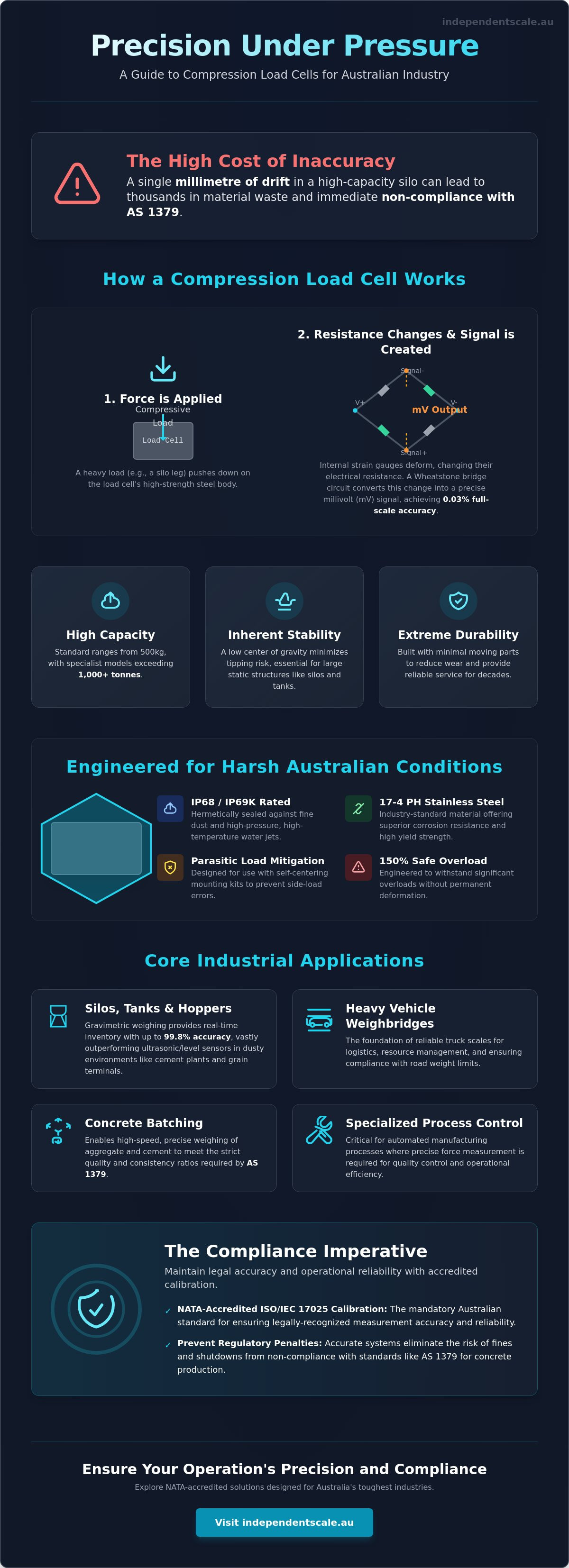
Compression load cells are heavy-duty transducers engineered to measure pushing forces along a single, vertical axis. These units represent the industry standard for high-capacity weighing systems, with some models capable of measuring loads exceeding 1,000 tonnes. Their low-profile, compact design provides the inherent stability required for large-scale compression load cell applications in sectors like mining, civil engineering, and bulk material handling.
The operational reliability of these cells relies on precise electrical principles. To understand What is a Load Cell?, one must examine the internal strain gauges. When a compressive force is applied to the cell's high-strength body, it undergoes minute elastic deformation. This physical change alters the electrical resistance of the strain gauges, which are arranged in a Wheatstone bridge circuit. The circuit converts this resistance change into a millivolt signal that weight indicators can interpret with high accuracy, often within 0.03% of the full scale.
- High Capacity: Standard ranges often start at 500kg and extend to 1,000+ tonnes for specialist applications.
- Stability: The low centre of gravity minimizes the risk of structural tipping during weighing.
- Durability: Built with minimal moving parts to reduce mechanical wear over decades of use.
Compression vs. Tension: Choosing the Right Force Direction
Compression cells are the preferred choice for static stability in silos, tanks, and heavy hoppers. Unlike tension cells (S-type), which are designed for suspended loads, compression mounts keep the weight anchored firmly to the ground. This setup is essential for safety in outdoor environments where wind forces might affect a suspended structure. However, installers must mitigate "side load" and "off-centre" loading risks. These parasitic forces occur when the load isn't perfectly vertical, potentially causing measurement errors or structural fatigue. Using self-centring mounting kits is a standard requirement to maintain alignment.
Design Features for Harsh Australian Conditions
Australian industrial environments demand equipment that can withstand extreme heat, dust, and moisture. For reliable compression load cell applications in regional NSW or Queensland, IP68 and IP69K ratings are essential. These ratings guarantee the cell is hermetically sealed against high-pressure water jets and prolonged submersion. Most high-end industrial cells utilize 17-4 PH stainless steel. This material is the industry standard because it offers superior corrosion resistance and high yield strength, ensuring the cell doesn't permanently deform under 150% overload conditions. To find hardware built for these specifications, explore our range of industrial load cells designed for the toughest local conditions.
High-Capacity Silo, Tank, and Hopper Weighing Applications
High-capacity storage structures require robust monitoring systems to maintain operational efficiency and safety. One of the most effective compression load cell applications involves the conversion of static silos and tanks into active, gravimetric weighing systems. Unlike volume-based measurements, which can be influenced by material density or aeration, compression cells measure the actual mass of the contents. This direct measurement is vital for inventory management of bulk liquids, minerals, and grains across Australian industrial sites.
Integrating weigh modules into existing infrastructure allows for precise control without rebuilding the entire support frame. These modules act as the interface between the vessel's support legs and the foundation. They are designed to withstand the immense vertical forces of a fully loaded silo while maintaining the sensitivity required for accurate data. For facilities managing high-value commodities, this level of precision prevents costly overfills and stock discrepancies.
Monitoring Bulk Material Inventory
Compression cells provide a level of reliability that ultrasonic or level sensors can't match. In environments with high dust levels, such as cement plants or grain terminals, non-contact sensors often fail due to signal interference or surface irregularities. Gravimetric systems bypass these issues by measuring the force exerted by the material weight. Many Australian grain silos have achieved accuracy levels of 99.8% by transitioning to full gravimetric monitoring. This accuracy is essential for commercial trade and internal process control. These systems rely on high-quality tank and silo weighing assemblies to ensure that the load is distributed evenly across all points of contact.
The technical demands of industrial weighing and process control require that each cell is calibrated to account for the dead load of the empty structure. This ensures the resulting data reflects only the live weight of the product. If you're managing complex batching processes, consider our hopper calibration services to maintain system integrity.
Environmental Factors: Wind Loading and Seismic Activity
Outdoor silos in regional Australia face extreme environmental challenges. Wind loading is a primary concern, particularly in regions prone to high-velocity gusts. Engineers must calculate wind force according to AS 1170.2 standards to ensure the weighing system doesn't compromise structural stability. Tall, narrow silos act like sails; wind pressure creates lateral forces that can tip the vessel or damage the load cells.
- Stay Rods: These components are installed to restrict horizontal movement and prevent lateral shifting during storms without affecting the vertical weight accuracy.
- Thermal Expansion: Large steel tanks expand and contract as temperatures fluctuate, sometimes by 30°C in a single day. Weighing assemblies must allow for this movement to prevent side-loading errors.
- Lift-off protection: This is a critical safety feature for tall structures that uses mechanical stops to prevent the tank from being lifted off its mounts by extreme wind or seismic events.
Implementing these safety measures ensures that compression load cell applications remain accurate and safe in the harshest Australian climates. Proper installation and regular maintenance are the only ways to guarantee long-term performance under these conditions.
Heavy Vehicle and Infrastructure Weighing Systems
Heavy vehicle weighing is a primary driver for compression load cell applications across the Australian transport sector. Weighbridges for trucks and rail systems rely on multi-cell configurations to handle gross vehicle masses that often exceed 100 tonnes. The industry's currently moving away from traditional analogue systems toward digital compression load cells. This shift improves data integrity and simplifies remote diagnostics in large-scale logistics operations. Maintaining these systems requires NATA-accredited weighbridge calibration services to ensure compliance with trade measurement legislation. Axle weighing systems are also critical for transport operators. These systems prevent overloading and ensure adherence to National Heavy Vehicle Regulator (NHVR) requirements, protecting both infrastructure and corporate liability.
Weighbridge Construction and Load Cell Integration
Modern weighbridges utilize canister-style or rocker column load cells. These designs are self-aligning, which means they automatically return to a vertical position after the lateral forces of a vehicle braking or accelerating are applied. For legal-for-trade applications in Australia, these cells must meet high-precision OIML R60 C3 or C4 ratings. Because weighbridges are often located in exposed industrial areas, they face high risks from environmental factors. High-quality installations include integrated protection against lightning strikes and power surges to prevent catastrophic component failure during storm events.
Multi-Cell Summing Systems for Accuracy
Achieving accuracy across a 20-metre platform requires precise signal management. Technicians use junction boxes and surge arrestors to balance the output from every individual cell in the network. This process is vital for eliminating "corner errors," where the same load produces different readings depending on its position on the deck. A summing circuit aggregates the millivolt signals from each load cell into a single, unified weight reading for the digital indicator. This hardware ensures that a B-double truck is weighed with the same precision regardless of how it's positioned on the sensors. Proper balancing reduces maintenance costs and extends the operational life of the weighing infrastructure.
- Compliance: Meets National Measurement Institute (NMI) requirements for trade.
- Durability: Stainless steel construction with IP68/IP69K ratings for washdown resistance.
- Safety: Prevents axle overloads that lead to heavy fines and road wear.
Specialized Process Control: Concrete Batching and Manufacturing
Concrete production requires absolute precision to maintain the safety and durability of Australian infrastructure. In this environment, compression load cell applications are the standard for managing the heavy, abrasive materials used in daily operations. These sensors are integrated into batching plant hoppers to provide high-speed weighing that ensures consistent product quality across every cubic metre poured. Without these robust sensors, the variability in moisture and aggregate weight would make consistent batching impossible. Reliability in these high-volume environments is non-negotiable for commercial profitability.
AS 1379 Compliance in Concrete Production
Structural concrete integrity depends entirely on accurate weighing. AS 1379 sets the mandatory requirements for the specification and manufacture of concrete in Australia. Every batching plant must use regular gravimetric calibration to ensure that cement, water, and aggregate ratios remain within strict tolerances. Precise measurement is the foundation of every high-rise and bridge built across the country. Independent Scale Service currently supports 98% of Sydney’s concrete plants with comprehensive compliance testing. Our technicians provide the concrete batching plant calibration and repair services necessary to meet NATA standards and maintain ISO/IEC 17025 accreditation. We focus on minimising downtime by performing these critical checks efficiently. This methodical approach guarantees that your plant’s output meets the engineering requirements of major Tier 1 infrastructure projects.
Dynamic Force Measurement in Manufacturing
Beyond simple weighing, compression cells are essential for quality control in automotive and aerospace assembly. Manufacturers use these sensors for press-fit force monitoring to confirm that components are seated correctly without damaging the material. This prevents assembly failure and ensures long-term part reliability. These systems integrate directly with digital indicators and displays, giving operators real-time data to identify defects instantly. In the mining sector, compression load cell applications are used to monitor the force exerted during crushing and milling operations. This data prevents equipment overloads and helps predict maintenance needs before a failure occurs. Whether it's testing material strength or monitoring assembly lines, accurate force measurement is a critical component of modern industrial efficiency. Reliable data leads to better throughput and less waste across the entire production cycle.
Selection Criteria and NATA-Accredited Calibration
Selecting the correct hardware for compression load cell applications starts with a precise calculation of the total system capacity. This calculation must account for the "Dead Load," which is the weight of the empty hopper, silo, or platform, and the "Live Load," representing the maximum weight of the material to be measured. Industrial standards dictate a safety factor headroom of 20% to 50% above the combined weight. This margin prevents sensor damage from accidental overloading or dynamic shock loads common in heavy industrial environments like mining or bulk material handling.
Matching Load Cell Capacity to Application
In addition to raw capacity, technical specifications like temperature coefficients must be evaluated. In outdoor Australian installations, temperature fluctuations can induce a drift of 0.002% or more per degree Celsius if the sensor is not properly compensated. This drift directly impacts the long-term accuracy of the weighing system. To maintain signal clarity for PLC or SCADA integration, you must select compatible conditioners and transmitters. These devices convert the low-voltage millivolt signal from the load cells into a robust 4-20mA or digital output, reducing the risk of electromagnetic interference in high-activity zones like concrete batching plants.
The Critical Role of Regular NATA Calibration
A standard calibration check is insufficient for safety-critical or legal-for-trade applications. NATA-accredited ISO/IEC 17025 calibration is the benchmark for technical competence and reliability. This accreditation ensures the equipment meets the rigorous requirements of AS 1379 for concrete production, a standard we support across 98% of Sydney concrete plants. Onsite calibration for silos and batching plants involves testing the entire weighing string under real-world conditions to identify errors like hysteresis or non-linearity. Hysteresis is the variance in readings between increasing and decreasing loads, while non-linearity is the deviation from a straight-line output across the scale's range.
Regular maintenance schedules should also monitor for "creep," where the output signal changes over time while under a constant load. A NATA calibration certificate provides documented evidence that the measurement results are traceable to the Australian National Standards of measurement maintained by the National Measurement Institute (NMI). This traceability is a legal requirement for many industrial contracts and quality assurance programs. To ensure your equipment meets these strict standards, book a NATA-accredited load cell calibration with our expert team to maintain site compliance and operational accuracy.
Securing Precision in Your Industrial Weighing Operations
Effective compression load cell applications demand more than just robust hardware. They require a methodical approach to integration within silos, hoppers, and heavy vehicle systems to ensure long-term data integrity. High-capacity environments in Australia, particularly concrete batching and infrastructure, rely on these systems to maintain structural safety and operational efficiency. Choosing the correct load cell involves evaluating technical specifications against harsh site conditions and ensuring every component integrates seamlessly into your process control architecture.
Operational reliability depends on strict compliance and professional maintenance. Independent Scale Service brings over 30 years of industrial weighing expertise to every project, ensuring your systems remain accurate and reliable. We provide AS 1379 compliant services and are NATA accredited to ISO/IEC 17025, giving you the confidence that your measurements meet the highest national standards. Precision isn't optional when downtime or non-compliance impacts your bottom line.
Contact Independent Scale Service for expert NATA-accredited calibration and supply to ensure your facility maintains peak performance and full regulatory compliance. We're ready to support your next project with technical excellence.
Frequently Asked Questions
What is the primary advantage of a compression load cell over a tension cell?
The primary advantage of a compression load cell is its compact, low-profile design that handles high-capacity loads with superior stability. These units are engineered for heavy-duty compression load cell applications like weighbridges and large silos where vertical space is limited. Unlike tension cells, they don't require complex suspension hardware, which simplifies the structural design of heavy industrial weighing systems.
How many compression load cells are needed for a typical silo weighing system?
A typical silo weighing system requires either three or four compression load cells. Three cells are preferred for circular vessels because they create a naturally stable tripod that ensures even weight distribution across all sensors. Rectangular bins or silos with high capacities often use four cells to maintain structural balance. Every installation must include specialized mounting kits to manage thermal expansion and prevent side-loading errors.
How often should industrial compression load cells be calibrated in Australia?
Industrial load cells in Australia require calibration at least every 12 months to maintain accuracy. For concrete batching plants governed by AS 1379, this interval is typically shortened to every 6 months to guarantee regulatory compliance. High-volume facilities often implement quarterly testing schedules to identify measurement drift before it impacts production quality or profitability.
Can compression load cells be used in wash-down or corrosive environments?
Compression load cells perform reliably in wash-down environments if they're rated to IP68 or IP69K standards. These units are manufactured from 17-4 PH stainless steel to withstand chemical exposure and high-pressure cleaning. We specify hermetically sealed cells for Australian food processing and chemical plants to ensure moisture cannot penetrate the internal strain gauges.
What is the difference between an analogue and a digital compression load cell?
Analogue load cells transmit a millivolt signal that's susceptible to electrical interference and signal loss over long distances. Digital load cells convert the weight data into a digital signal within the cell itself, providing much higher noise immunity. Digital systems allow technicians to monitor each cell individually, which speeds up fault finding in multi-cell systems like weighbridges.
What happens if a compression load cell is overloaded beyond its rated capacity?
Overloading a load cell beyond its safe limit causes permanent deformation of the internal spring element. This results in a "zero-shift," where the scale won't return to zero after the load is removed. If the weight exceeds the ultimate overload rating, which is usually 150% to 300% of the rated capacity, the cell may suffer a catastrophic mechanical failure or fracture.
Why is NATA accreditation important for load cell calibration?
NATA accreditation confirms that a laboratory operates to the ISO/IEC 17025 international standard for testing and calibration. This accreditation ensures that all weighing data is traceable to national standards, which is a mandatory requirement for AS 1379 compliance and trade-legal applications. It provides the technical rigour and legal standing required for industrial audits and quality assurance protocols.
How do environmental factors like wind affect compression load cell readings?
Wind creates parasitic forces that the load cell interprets as actual weight, leading to significant measurement errors. High wind speeds against a tall silo can create "lift" on one side and downward pressure on the other, fluctuating readings by hundreds of kilograms. We use digital signal filtering and mechanical stay rods to stabilise readings for silos located in exposed Australian coastal or rural environments.
