


Comprehensive Caravan Weighing Guide 2026: Safety, Compliance, and Technical Accuracy
An overloaded caravan is more than a legal infringement; it is a critical safety failure. Navigating the technical maze of Gross Vehicle Mass (GVM), Aggregate Trailer Mass (ATM), and Gross Combination Mass (GCM) is a non-negotiable requirement for every operator. Miscalculation or reliance on unverified weighbridges leads directly to the risk of substantial fines, voided insurance claims, and compromised vehicle stability on Australian roads. The process of accurate caravan weighing is foundational to your safety and legal compliance, yet it remains a point of significant confusion and risk for many.
This comprehensive guide eliminates that ambiguity. Here, you will find a definitive, step-by-step procedure to master the technicalities of weight limits and distribution. We will demystify the essential acronyms and provide the expert knowledge required to ensure your setup is fully compliant. Crucially, you will understand why the precision of the weighing equipment is paramount and how industrial-grade, NATA-accredited calibration is the only method that guarantees the technical accuracy required to protect your family, your assets, and your insurance coverage.
Key Takeaways
- Master the definitions of Gross Vehicle Mass (GVM), Aggregate Trailer Mass (ATM), and Gross Combination Mass (GCM) to ensure your setup is legally compliant.
- Discover how equipment calibration, temperature, and terrain can significantly impact weight readings, compromising both road safety and insurance validity.
- Understand the key differences between public weighbridges and mobile services to select the most technically accurate method for your professional caravan weighing.
- Follow a proven, step-by-step process to weigh your tow vehicle and caravan correctly, starting with establishing a precise baseline weight.
Understanding Caravan Weight Limits: GVM, ATM, and GCM Explained
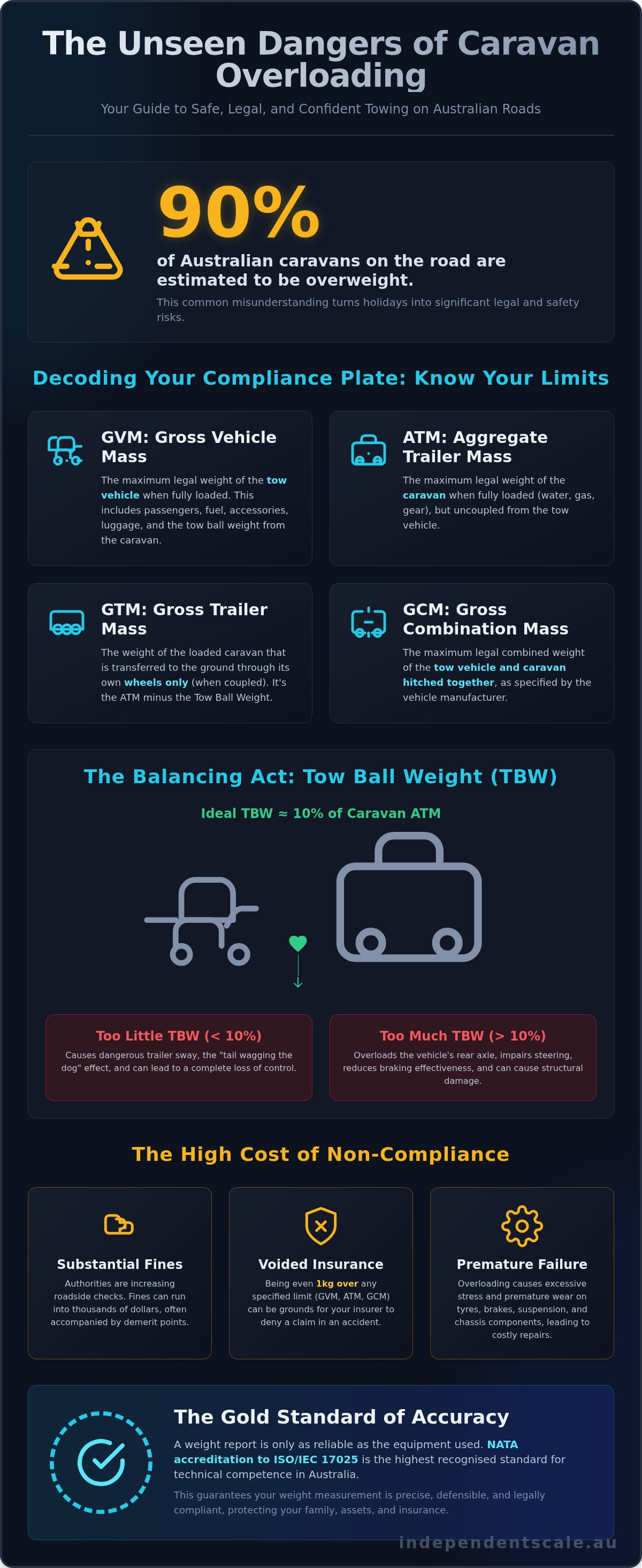
Industry data indicates a critical compliance issue: up to 90% of Australian caravans on the road are overweight. This statistic underscores a widespread misunderstanding of weight ratings, turning family holidays into significant legal and safety risks. A professional caravan weighing service is not merely a recommendation; it is a fundamental requirement for road safety. Mastering the specific terminology is the first step in Understanding Caravan Weight Limits and ensuring your entire rig is compliant and safe.
The key to compliance lies in understanding four critical acronyms stamped on your vehicle and caravan compliance plates:
- Gross Vehicle Mass (GVM): The maximum legal weight of the tow vehicle when fully loaded. This includes all passengers, fuel, accessories, luggage, and the downward force exerted by the caravan's tow ball.
- Aggregate Trailer Mass (ATM): The total weight of the caravan when fully loaded with water, gas, and all equipment, but uncoupled from the tow vehicle. This is the maximum legal weight of your trailer.
- Gross Trailer Mass (GTM): The portion of the caravan's weight that is transferred to the ground through its own wheels when coupled to the vehicle. It is calculated as the ATM minus the Tow Ball Weight.
- Gross Combination Mass (GCM): The maximum allowable combined weight of the tow vehicle and caravan hitched together, as specified by the vehicle manufacturer. You must not exceed the GVM, ATM, or GCM.
The Critical Role of Tow Ball Weight
The Tow Ball Weight (TBW) is the downward force your coupled caravan exerts on the tow vehicle. The accepted industry standard is a TBW of approximately 10% of the caravan's ATM. An incorrect TBW creates dangerous driving dynamics. Too little weight can cause the "tail wagging the dog" effect, or trailer sway, leading to a complete loss of control. Conversely, excessive weight overloads the tow vehicle's rear axle load cells, impairing steering, reducing braking effectiveness, and potentially causing structural damage.
Legal and Insurance Implications of Overloading
Operating an overweight vehicle combination carries severe consequences. Being found just 1kg over a specified limit (GVM, ATM, or GCM) can be grounds for an insurer to void your comprehensive policy in the event of an accident. Furthermore, state transport authorities are increasing roadside compliance checks with portable scales. Fines for non-compliance can be substantial, often running into thousands of dollars, accompanied by demerit points. The hidden costs are also significant, as overloading causes premature failure of tyres, brakes, and suspension components, leading to expensive and avoidable repairs.
The Science of Accuracy: Why Calibration Matters in Caravan Weighing
An accurate weight measurement is not a matter of chance; it is the direct result of precise engineering, robust hardware, and meticulous calibration. At the core of every digital scale are load cells-highly sensitive transducers that convert force into a measurable electrical signal. However, when used in a mobile environment, portable weighing pads are exposed to variables that can compromise accuracy, such as uneven terrain and fluctuating temperatures. This is why the calibration protocol and quality of the equipment used for your caravan weighing service are critically important.
A weight report is only as reliable as the process used to obtain it. Understanding the difference between a simple "verified" scale and one maintained under a NATA-accredited system is essential for ensuring your safety on the road. Industrial standards, once reserved for heavy industry, are now the benchmark for precision in recreational vehicle weighing.
NATA Accreditation and ISO/IEC 17025 Standards
In Australia, NATA (National Association of Testing Authorities) accreditation to ISO/IEC 17025 is the highest recognised standard for the technical competence of calibration and testing laboratories. This is not merely a "verified" check; it is a rigorous, ongoing process that guarantees the measurements are traceable to national standards. For a caravan owner, this means a weight report from a NATA-accredited provider is an objective, defensible, and highly accurate statement of fact. This level of diligence requires regular, documented load cell calibration, applying industrial-grade precision to consumer safety.
Hardware Durability in Weighing Equipment
Consistent accuracy in the field is impossible without durable, high-quality hardware. Professional weighing services rely on industrial-grade load cells that are environmentally sealed and temperature-compensated. These components are engineered to deliver repeatable results despite the challenges of outdoor use. In contrast, cheaper sensors degrade quickly when exposed to moisture and temperature cycles, leading to measurement drift and dangerously inaccurate readings. This data is then processed by sophisticated indicators and displays, which must also be of high quality to ensure the final weight is interpreted and reported without error.
Comparing Caravan Weighing Methods: Weighbridges vs. Mobile Services
Achieving accurate weight measurements is fundamental to road safety and legal compliance. Caravan owners in Australia have three primary options for determining their rig's weight: public weighbridges, professional mobile services, and DIY portable scales. Each method presents distinct advantages and critical limitations that directly impact the accuracy of the results and the safety of your setup.
The Weighbridge Experience: A Step-by-Step Reality
Public weighbridges, often located at tips or industrial sites for a fee around A$40-A$50, provide a basic total mass measurement. The process requires driving the entire rig onto a single large platform. To calculate individual axle loads or the critical Tow Ball Mass (TBM), multiple complex measurements are needed. This frequently involves the difficult and potentially unsafe task of unhitching the caravan on the platform, where any slight slope can lead to significant inaccuracies. The resulting industrial printout is not designed for caravan compliance and can be difficult to interpret correctly.
The Mobile Advantage: Comprehensive Weight Distribution
Mobile caravan weighing services offer a superior level of detail and convenience. A technician uses individual, portable scales under each wheel at your home or storage location. This provides a comprehensive report detailing:
- Individual wheel weights, revealing dangerous side-to-side imbalances.
- Axle group loads.
- Gross Trailer Mass (GTM) and Aggregate Trailer Mass (ATM).
- Gross Vehicle Mass (GVM) of the tow vehicle.
- Precise Tow Ball Mass (TBM).
This granular data allows for on-the-spot expert advice on repositioning your load for optimal balance. For legal certainty, it is essential that technicians use NATA-calibrated equipment, which guarantees the measurements are accurate and defensible.
While consumer-grade DIY portable scales are available, their calibration and reliability are often insufficient for achieving true legal peace of mind. Beyond weight, the integrity of the physical connection is paramount. The immense forces involved in towing require industrial-grade hardware, and using certified special purpose and shackle pins ensures the coupling and safety chains are secure and fit for purpose.
How to Weigh Your Caravan: A Professional 4-Step Process
Accurate caravan weighing is not a single measurement but a systematic process designed to verify compliance across multiple critical weight limits. To achieve a precise and actionable result, follow this methodical procedure at a certified public weighbridge.
First, prepare your vehicle and caravan by loading them to their typical "fully-loaded" travel state. This includes full water tanks, gas bottles, food, luggage, and all passengers. An inaccurate result is inevitable if you weigh an empty setup.
This also includes any specialized equipment needed for passengers with mobility challenges. For families planning accessible travel, NDIS providers such as Accessible Care can offer support services that make touring holidays more manageable.
- Weigh the Tow Vehicle Alone: Drive the fully loaded tow vehicle onto the weighbridge. This measurement provides your Gross Vehicle Mass (GVM), which must not exceed the manufacturer's specified GVM limit.
- Weigh the Caravan Unhitched: Position the caravan's wheels on the weighbridge pads, unhitched from the tow vehicle. This gives you the Aggregate Trailer Mass (ATM). Separately measure the Tow Ball Mass (TBM) using a dedicated ball weight scale.
- Weigh the Combined Unit: Drive the entire coupled rig onto the weighbridge. This measurement determines your Gross Combination Mass (GCM), which must be under the GCM limit specified for your tow vehicle.
- Analyse Individual Axle Loads: A professional weighing service will provide a detailed report showing the weight on each individual axle group. This is essential for identifying dangerous imbalances, such as side-to-side discrepancies or overloaded caravan axles.
Reading Your Weighing Report Like a Pro
Your report will compare actual weights against legal limits (GVM, ATM, GCM, Axle Loads). Any figure exceeding its limit will be in a "red zone," indicating an immediate safety and compliance failure. The load cells in weighbridges are highly sensitive; in complex industrial systems, we use components like junction boxes and surge arrestors to ensure data integrity. This precision is key to identifying overloads. To correct an imbalance, strategically move heavy items to be centred over the caravan's axles.
Common Weighing Mistakes to Avoid
Inaccurate measurements undermine the entire purpose of a professional caravan weighing service. Avoid these common errors to ensure your data is reliable:
- Forgetting Consumables: A full 95-litre water tank adds 95kg. Full gas bottles add significant weight. Always weigh in a true "ready-to-travel" state.
- Ignoring Accessories: Aftermarket bull bars, roof racks, winches, and solar panels contribute to your GVM and must be accounted for.
- Using Uneven Ground: A weighbridge must be perfectly level. Weighing on a slope provides false readings as weight is not distributed evenly across the load cells.
For guaranteed accuracy and a comprehensive safety report, always use a NATA-accredited weighing service. For expert advice on weighing equipment and calibration, visit us at independentscale.au.
Beyond Caravans: Applying Industrial Accuracy to Every Load
The principles underpinning safe towing and high-stakes industrial operations are identical: accuracy, compliance, and the mitigation of risk. At Independent Scale Service, the same NATA-accredited precision we apply to mobile caravan weighing services is foundational to our work across Australia's most demanding sectors. This crossover is clearest in our work with concrete batching plant calibration. Ensuring a concrete mix meets the stringent AS 1379 standard requires meticulous weight measurement of aggregates and cement-a process where slight deviations can compromise structural integrity. This is functionally no different from ensuring your vehicle’s GVM, GCM, and axle loads are correctly balanced for road safety.
Our commitment to precision extends to developing and implementing custom tank and silo weighing solutions for manufacturing and agriculture, where inaccurate measurements result in significant material waste and financial loss. This industrial-grade expertise is what allows us to guarantee that your vehicle or commercial fleet is measured against the highest possible standard of accuracy.
Expert Calibration for Peace of Mind
With over 30 years of specialised experience, Independent Scale Service is the trusted authority in industrial weighing. Our NATA accreditation to ISO/IEC 17025 is your assurance of technical competence and reliable results. This proven expertise is why we service 98% of concrete plants across Sydney-they depend on our precision to maintain compliance and operational integrity. When you require absolute certainty in your measurements, request a professional calibration service from our expert team.
The Future of Weighing Technology in 2026
The weighing industry is evolving rapidly. We are seeing a significant shift towards smart load cells and integrated systems that provide real-time weight monitoring and diagnostic data. This transition to digital conditioners and transmitters enables predictive maintenance and offers greater control over complex processes. These advancements promise enhanced accuracy and efficiency, from large-scale industrial plants to sophisticated onboard vehicle weighing systems that will further enhance road safety. Similarly, as vehicles themselves evolve, new diagnostic needs are emerging; for electric and hybrid vehicles, independent battery health testing, as offered by specialists like EVdiagnostika.si, is becoming just as critical for safety and value retention.
Whether you manage a commercial fleet or are preparing for a trip across the country, the core principle is unchanged: accurate weight data is non-negotiable. The precision required for industrial compliance is the same standard you should demand for your caravan weighing needs. Prioritise accuracy for your next Australian adventure by trusting the experts at independentscale.au.
The Final Weigh-In: Ensuring Accuracy and Road Safety
Navigating the complexities of GVM, ATM, and GCM is the foundational step towards safe and legal towing. However, this knowledge is only effective when paired with technically precise measurements from properly calibrated equipment. An inaccurate scale undermines the entire process, creating significant safety risks and compliance issues. Ultimately, accurate caravan weighing is a non-negotiable aspect of responsible ownership, demanding a standard of industrial precision.
This is the standard Independent Scale Service has upheld for over 30 years. Our NATA Accreditation to ISO/IEC 17025 and compliance with AS 1379 are your assurance that the equipment you rely on delivers certifiable accuracy. We bring decades of industrial weighing expertise to every calibration, ensuring your measurements are not just a guideline, but a guarantee. Ensure your weighing equipment is NATA-compliant-Contact Independent Scale Service today.
Take the guesswork out of your setup and travel with the confidence that comes from certified accuracy and complete compliance on Australian roads.
Frequently Asked Questions
Is a public weighbridge accurate enough for my caravan?
While a public weighbridge can provide an accurate Gross Combination Mass (GCM), it lacks the precision required for individual axle loads and tow ball mass. These facilities are calibrated for heavy commercial vehicles and may not offer the granularity needed for a comprehensive caravan weighing assessment. A specialised service using individual, calibrated wheel scales is superior for verifying load distribution, which is critical for vehicle stability and legal compliance.
Can I be fined if my caravan is only 50kg overweight?
Yes. Australian road laws have no tolerance for exceeding stipulated weight limits. Being overweight by any amount-whether on your Gross Vehicle Mass (GVM), Aggregate Trailer Mass (ATM), or axle loads-can result in substantial fines and demerit points. Penalties vary by state but can be hundreds of dollars for even minor infringements. You may also be grounded until the weight issue is rectified, disrupting your travel plans.
How often should I have my caravan weighed?
A baseline weighing is essential when you first assemble your complete touring setup. It is highly recommended to re-weigh your caravan and tow vehicle annually or whenever you make significant changes to the load. This includes adding or removing permanent fixtures such as solar panels, toolboxes, or extra water tanks. Regular weighing ensures you remain compliant and safe on every trip.
What is the most accurate way to measure tow ball weight?
The most accurate and reliable method is to use a dedicated, purpose-built tow ball weight scale. These devices are specifically engineered and calibrated to provide precise measurements. For definitive accuracy, a professional mobile weighing service can measure the tow ball mass as part of a complete analysis, ensuring it falls within the manufacturer's recommended range (typically 7-15% of the caravan's total mass).
Does my insurance cover me if I am over my GCM?
It is highly unlikely. Exceeding your vehicle's legal Gross Combination Mass (GCM) constitutes a breach of both road laws and the terms of most insurance policies. In the event of an accident, an insurer has grounds to deny your claim, leaving you personally liable for all repair costs, damages, and any third-party claims. Operating an overweight vehicle effectively voids your insurance coverage.
What happens during a roadside police caravan weight check?
During a roadside inspection, authorities will use portable, certified scales to measure individual axle weights for both the tow vehicle and caravan, as well as the total combination mass. If any weight exceeds the legal limits specified on the vehicle or caravan compliance plates (GVM, GCM, ATM, axle loads), you will face fines and demerit points. You may also be prohibited from continuing your journey until the load is corrected.
Can I use a bathroom scale for my tow ball weight?
Using a bathroom scale is not a recommended or reliable method. These scales are not designed or calibrated for the concentrated loads of a tow hitch and can easily be damaged or produce inaccurate readings. This method provides a false sense of security and is inadequate for ensuring safety and compliance. A dedicated tow ball scale is the correct and necessary tool for an accurate measurement.
How do I find a NATA-accredited weighing service near me?
To locate a certified provider, consult the online directory on the National Association of Testing Authorities (NATA) Australia website. You can search for accredited organisations by location and field of testing, such as "weighing instruments." Choosing a NATA-accredited service ensures the equipment is calibrated and procedures meet the stringent ISO/IEC 17025 standard, guaranteeing the highest level of accuracy for your weight report.
