


Common Weighbridge Problems: A Technical Guide to Diagnosis and Compliance (2026)
A single inaccurate reading on your weighbridge isn't just a technical glitch; it's a direct threat to your bottom line and a potential $4,113,837 corporate penalty under the 2025/26 Heavy Vehicle National Law. You know that in high-stakes industrial environments, operational uptime depends entirely on precision measurement. When common weighbridge problems like load cell drift, physical debris interference, or junction box moisture arise, they don't just stop production. They expose your business to regulatory non-compliance risks and high repair costs from technical misdiagnosis.
This technical guide provides the authoritative expertise needed to identify frequent failures, troubleshoot inconsistencies, and maintain NATA-accredited accuracy. Our objective is to help you determine whether a specific component requires immediate repair or a full replacement to restore your measurement chain quickly. We'll examine systematic diagnostic steps, the mandatory 12-month calibration cycles required for trade measurement, and the technical requirements for meeting AS 1379 standards. By following this methodical approach, you can ensure your weighing infrastructure remains a reliable, compliant asset for your operation.
Key Takeaways
- Evaluate the compound financial impact of minor weighing errors and your legal liabilities under the Chain of Responsibility (CoR) framework.
- Diagnose the root causes of common weighbridge problems, focusing on load cell signal drift and environmental interference.
- Learn to mitigate the "binding" effect caused by debris build-up and thermal expansion to maintain consistent deck accuracy.
- Establish a professional maintenance framework featuring daily visual inspections and technical cleaning protocols to maximize operational uptime.
- Gain insights into NATA-accredited calibration requirements to ensure your equipment meets ISO/IEC 17025 and trade measurement standards.
The Financial and Regulatory Impact of Weighbridge Inaccuracy
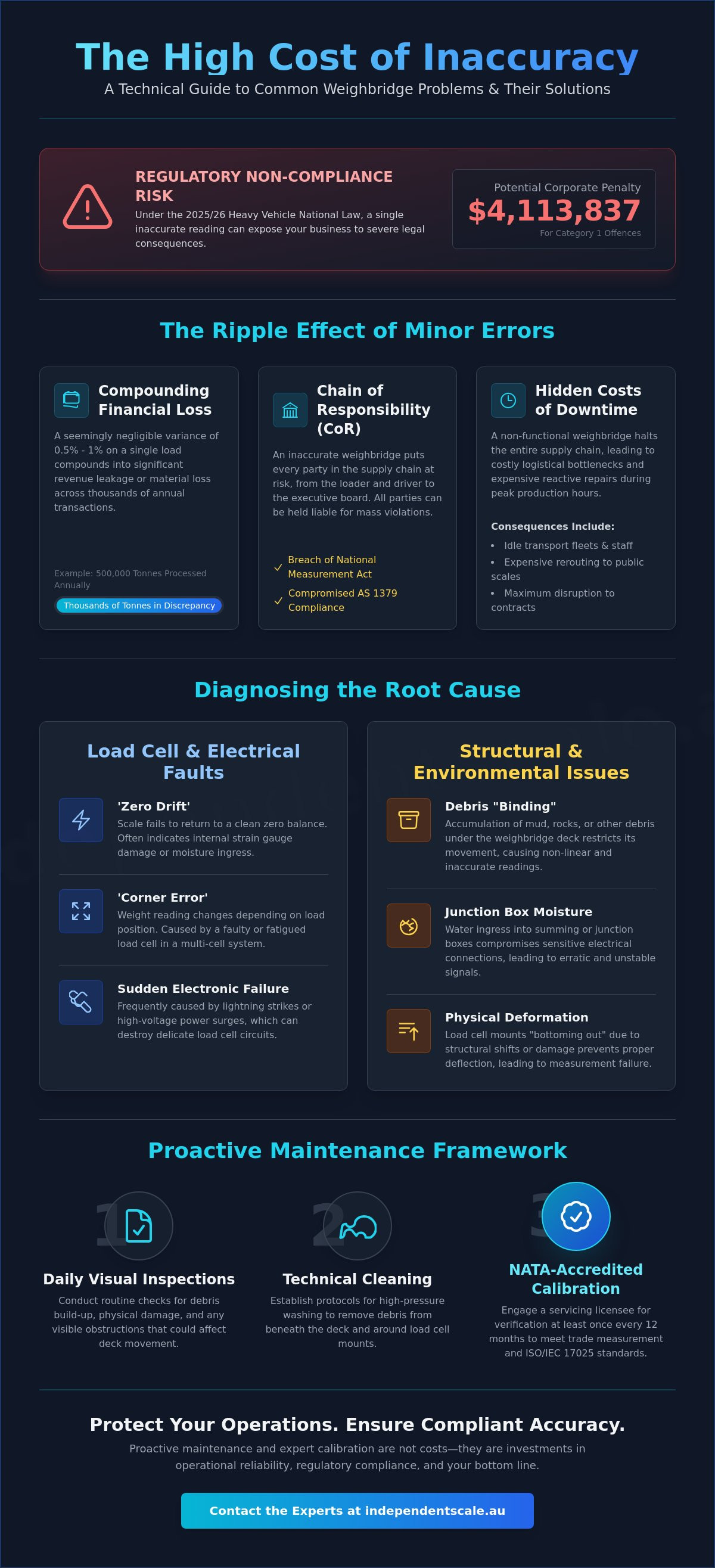
Inaccurate measurement systems represent a significant fiscal leak for industrial operations. While a variance of 0.5% or 1% might seem negligible on a single load, these errors compound across thousands of transactions annually. For a facility processing 500,000 tonnes per year, a minor calibration error results in thousands of tonnes of lost product or unbilled revenue. This revenue leakage is one of the most persistent results of common weighbridge problems, often remaining undetected until a formal audit or NATA-accredited calibration reveals the discrepancy.
Beyond direct financial loss, the regulatory landscape in Australia imposes severe consequences for mass violations. Under the Heavy Vehicle National Law (HVNL) for the 2025/26 period, corporations face maximum penalties of $4,113,837 for Category 1 offences. These penalties are indexed annually based on CPI, ensuring the cost of non-compliance remains high. A truck scale (weighbridge) that consistently under-reads puts every party in the Chain of Responsibility (CoR) at risk, from the loader to the executive board.
For specific sectors like concrete production, accuracy is a technical necessity for product quality. Maintaining AS 1379 compliance requires precise measurement of raw materials. Inaccurate weighing compromises the structural integrity of the batch, leading to contractual disputes and potential safety failures in infrastructure projects. Reliability isn't just a preference; it's a requirement for maintaining client trust and fulfilling bulk material supply contracts.
Trade Measurement and Compliance Risks
Australian law requires any weighbridge used for trade to be verified by a servicing licensee at least once every 12 months. Operating with an expired verification or a non-compliant scale is a breach of the National Measurement Act 1960. Inaccurate data doesn't just affect the invoice; it corrupts your inventory management systems and mass balance audits. When your physical stock doesn't match your digital records, identifying the source of the shrinkage becomes impossible without first addressing underlying common weighbridge problems.
The Hidden Costs of Operational Downtime
The price of a repair is only a fraction of the total cost of a weighbridge failure. When a primary site scale goes offline, the hourly cost includes idle transport fleets, staff downtime, and significant logistical bottlenecks. A non-functional weighbridge can halt an entire supply chain, forcing expensive rerouting to public weighbridges where application fees of $785 and annual maintenance fees of $550 add to the operational overhead. Reactive repairs are consistently more expensive than proactive maintenance because they occur during peak production hours, causing maximum disruption to your contractual obligations.
Diagnosing Load Cell Failures and Electrical Signal Faults
Identifying the source of measurement errors requires a systematic analysis of the electrical signal chain. Most common weighbridge problems originate at the load cell level, where physical force is converted into a millivolt signal. When this signal becomes unstable, the indicator may display 'zero drift', a condition where the scale fails to return to a clean zero balance after a vehicle exits the deck. This inconsistency often points to internal strain gauge damage or a 'bridge imbalance' within multi-cell configurations.
In multi-cell systems, each cell must contribute equally to the total weight. If one cell provides a lower output due to internal fatigue or moisture ingress, the weighbridge will show different weights depending on where the load is positioned on the deck. This is known as a corner error. Technicians diagnose this by measuring the millivolt output of each individual cell under a known load. Sudden electronic failures are frequently traced back to lightning strikes or high-voltage power surges. These events can catastrophically overwhelm the delicate bridge circuit, necessitating a complete Load Cell Supply replacement to restore operational integrity.
Mechanical vs. Electrical Load Cell Issues
Physical deformation is a primary mechanical cause of failure. If the load cell mount is 'bottoming out' due to debris or structural shift, the cell cannot deflect properly, leading to non-linear readings. Technicians test for insulation resistance using a megger to check if moisture has compromised the internal wiring. If the resistance is below 5,000 megohms, the cell is likely failing and requires replacement. You can review common signs you need load cell repair to distinguish between a fixable calibration issue and a terminal hardware fault. If your system shows persistent signal instability, a professional assessment is necessary to prevent further revenue leakage.
Junction Box and Wiring Vulnerabilities
The junction box is the most vulnerable component in the signal chain. It's the primary site for moisture ingress, which causes signal leakage and 'jumpy' digital readings. Water often enters through degraded cable glands or poorly sealed lids during high-pressure cleaning or heavy rain. Once inside, corrosion on terminal blocks or loose wiring connections creates intermittent resistance, throwing off the entire calibration. Maintaining signal integrity requires robust junction boxes and surge arrestors that can withstand harsh Australian environments. For advanced data processing, integrating high-quality conditioners and transmitters ensures the millivolt signal remains clean and accurate as it travels to the digital indicator.
Structural and Environmental Impacts on Weighing Accuracy
While electrical faults often dominate the diagnostic process, physical interference remains a leading cause of common weighbridge problems. The 'binding' effect occurs when debris, such as compacted mud, gravel, or spilled product, accumulates in the gap between the weighbridge deck and the pit wall. This build-up creates a secondary load path, meaning a portion of the vehicle's weight is supported by the debris rather than the load cells. Even a small amount of packed sediment can cause significant measurement errors, often manifesting as non-repeatable readings that fail to meet NATA standards during a weighing scale calibration procedure.
Thermal expansion and contraction are critical variables in the Australian climate. Steel weighbridge decks, which can range from $50,000 to $150,000 for above-ground models according to 2025 industry data, expand significantly when exposed to direct summer sun. If the gap clearances are set too tight during a winter installation, the expanding deck will eventually jam against the approach ramps. This physical contact prevents the deck from moving freely, leading to erratic or frozen weight displays. Proper clearance management is a technical necessity to ensure the structural integrity of the measurement system throughout the year.
Standing water in a weighbridge pit is a recipe for catastrophic hardware failure. While high-quality load cells carry IP68 or IP69K ratings, prolonged submersion in stagnant water can eventually lead to seal failure and cable degradation. Effective drainage is paramount; a blocked pump or silted drain doesn't just damage the electronics, it can also lead to deck buoyancy issues in extreme flooding scenarios. Regular inspection of the pit environment is a core component of maintaining operational uptime and preventing the need for premature component replacement.
Environmental Factors in Regional Australia
Regional sites face unique challenges from dust and sediment ingress. In high-traffic quarry or concrete batching environments, fine particulates act as an abrasive on moving parts and can quickly fill the clearance gaps under the deck. Additionally, wind loading on high-capacity scales can introduce 'noise' into the signal, particularly on exposed sites. This environmental interference requires sophisticated digital filtering within the indicator to maintain a stable reading without compromising response time or accuracy.
Structural Integrity and Misalignment
The foundation is the most critical structural element of any weighing system. Shifting soil or poorly compacted sub-bases lead to uneven foundations, causing the weighbridge to tilt or flex. This misalignment results in non-linear weighing, where the error increases as the load moves across the deck. Operators must also monitor the condition of end stops and bumper bolts, which are available via our options and accessories range. These components prevent excessive deck movement during vehicle braking; if they're worn or incorrectly adjusted, the resulting impact forces can permanently damage the load cell mounts.
A Professional Troubleshooting and Maintenance Framework
Effective asset management requires moving beyond reactive repairs to a structured maintenance framework. While common weighbridge problems like debris accumulation or moisture ingress are predictable, they only become catastrophic when ignored. Operators should perform daily visual inspections of the clearance gaps and T-section rubbers to ensure no physical binding is occurring. Weekly high-pressure cleaning of the pit and load cell assemblies prevents the hardened sediment build-up that compromises accuracy. These simple protocols significantly reduce the risk of unplanned downtime and revenue loss.
The 'Quarter-Point' test is a critical diagnostic procedure for identifying specific load cell discrepancies. By placing a known weight, such as a test truck or forklift, over each supporting load cell, operators can verify if a specific corner is under-reading. If the readings vary beyond the maximum permissible error (MPE) defined by the National Measurement Institute, technical intervention is required. Maintaining accurate logs of these tests provides a diagnostic history that helps technicians identify patterns of failure, such as recurring moisture issues or structural fatigue in the deck.
The Essential Maintenance Checklist
- Inspect T-section rubbers for tears or displacement that allow debris into the pit.
- Clear all obstructions from the clearance gaps between the deck and the approach ramps.
- Check earth bonding cables for corrosion to ensure protection against static and surge damage.
- Verify the indicator and display functionality, noting any specific error codes or signal instability.
- Monitor pit drainage systems to prevent standing water from reaching the load cell assemblies.
When to Call a NATA-Accredited Technician
There's a clear distinction between routine cleaning and complex electronic recalibration. While operators can manage debris, only a servicing licensee can perform a formal weighbridge calibration for trade purposes. Under Australian law, weighbridges used for trade must be calibrated at least once every 12 months. Attempting DIY repairs on load cell circuits or junction boxes often voids trade-measurement certifications and can lead to regulatory non-compliance. If your system fails the Quarter-Point test or shows persistent signal drift, you must engage an expert for NATA-accredited testing to ISO/IEC 17025 standards. To maintain your site's legal and operational integrity, schedule a professional load cell calibration as soon as inconsistencies are detected.
Expert Weighbridge Servicing and NATA-Accredited Calibration
Resolving common weighbridge problems requires more than basic mechanical adjustments; it demands technical precision backed by recognized authority. Independent Scale Service delivers a comprehensive diagnostic approach for Australian industrial clients, ensuring every component of the measurement chain functions within specified tolerances. Our technical team focuses on restoring accuracy to systems compromised by environmental wear, electrical surges, or structural shift. By utilizing high-precision test weights and calibrated digital simulators, we identify the root cause of inconsistencies that standard maintenance checks often overlook.
NATA accreditation to ISO/IEC 17025 serves as the definitive benchmark for measurement authority in Australia. This standard ensures that calibration results are traceable, repeatable, and legally defensible in commercial or regulatory disputes. For the construction and infrastructure sectors, we provide specialized concrete batching plant calibration to meet the rigorous demands of AS 1379. This service ensures your production facility maintains the precise material ratios required for structural integrity and fulfills your contractual obligations to major infrastructure projects.
Why Accreditation Matters for Your Business
There's a fundamental difference between a basic 'test' and a NATA-certified calibration. A standard test might verify that a scale is functioning, but only a NATA-accredited service provides the documented proof of accuracy required for trade measurement compliance. When your weighbridge is used for commercial transactions, it must be a 'trusted asset' that withstands legal scrutiny. Meeting the strict requirements of AS 1379 and the National Measurement Act 1960 protects your business from the liability of incorrect billing or regulatory fines. We provide the technical expertise necessary to keep your equipment compliant and your operations running without interruption.
Comprehensive Supply and Support
Maintaining high-capacity weighing systems requires access to a reliable inventory of specialized components. We offer a robust load cells supply to replace failing sensors quickly, minimizing the impact of hardware breakdowns on your site's productivity. Beyond standard truck scales, our expertise extends to custom solutions for tanks, silos, and hopper calibration. These systems often face unique challenges regarding material flow and structural mounting that require a tailored technical approach. To ensure your weighing infrastructure is optimized for 2026 standards, contact Independent Scale Service for a technical site audit. Our methodical assessment identifies potential vulnerabilities before they manifest as costly operational failures.
Securing Operational Accuracy and Regulatory Compliance
Maintaining a weighbridge in 2026 requires a proactive technical strategy that addresses both mechanical interference and electronic signal degradation. We've detailed how common weighbridge problems like structural binding and load cell drift lead to catastrophic financial penalties and significant revenue leakage. By implementing a structured maintenance framework and adhering to mandatory 12-month calibration cycles, you protect your business from the risks of non-compliance and unplanned downtime. Precision is the foundation of your supply chain integrity.
Independent Scale Service provides the technical expertise necessary to restore and maintain your weighing infrastructure. Our expert technicians in Sydney and Melbourne ensure your equipment remains NATA Accredited to ISO/IEC 17025 and fully AS 1379 compliant. Don't wait for a regulatory audit or a major hardware failure to address measurement inconsistencies. Request a NATA-Accredited Weighbridge Audit or Repair today to secure your site's operational uptime. Your commitment to accurate measurement ensures long-term profitability and industry authority.
Frequently Asked Questions
Why is my weighbridge showing a different weight when the truck is in a different position?
This discrepancy is known as a corner error or eccentricity issue. It occurs when the load cells aren't contributing equally to the total weight signal, often due to a faulty cell, uneven foundation leveling, or mechanical binding at one corner. Technicians diagnose this by performing a quarter-point test to identify which specific sensor is under-performing or physically obstructed.
How often should an industrial weighbridge be calibrated in Australia?
Weighbridges used for trade purposes must be calibrated by a servicing licensee at least once every 12 months. This is a mandatory legal requirement under the National Measurement Act to maintain a valid public weighbridge licence. Beyond the $550 annual licence fee, regular calibration is the primary method for preventing common weighbridge problems that lead to revenue leakage and regulatory fines.
What causes a weighbridge reading to 'drift' or fail to return to zero?
Zero drift is typically a symptom of moisture ingress in the junction box or internal strain gauge fatigue within a load cell. Environmental factors also play a role; compacted debris under the deck can physically prevent the scale from returning to its resting state. If the indicator doesn't settle at zero after a vehicle exits, it's a clear signal that the electrical or mechanical integrity of the system is compromised.
Can lightning damage a weighbridge even if it doesn't hit the deck directly?
Yes, indirect lightning strikes cause significant damage through ground potential rise or induced surges in the signal cables. These high-voltage events overwhelm the delicate bridge circuits in your load cells and can fry the digital indicator's processor. Installing high-quality surge arrestors and maintaining proper earth bonding cables is the only effective technical defense against these atmospheric electrical events.
What is the difference between a pit and a pitless weighbridge regarding maintenance?
Pit weighbridges require intensive monitoring of drainage systems and pumps to prevent load cell submersion. While they save space, they're prone to debris accumulation that's difficult to see. Above-ground or pitless models are easier to inspect and clean; however, they're more susceptible to thermal expansion issues and require more frequent checks of the clearance gaps between the deck and approach ramps.
How do I know if my load cell is faulty or if it's just a cable issue?
Technicians distinguish between these faults by measuring the bridge resistance and insulation integrity with a multimeter and megohmmeter. If the input and output resistance values are within the manufacturer's specification but the signal remains unstable, the issue is likely moisture in a connector or a nicked cable. A faulty load cell usually shows a significant bridge imbalance or a complete loss of insulation resistance.
Is NATA accreditation mandatory for all industrial weighing equipment?
NATA accreditation isn't a universal legal requirement for all scales, but it's the gold standard for ensuring ISO/IEC 17025 compliance. For industries like concrete production governed by AS 1379, NATA-certified calibration is often a contractual necessity. It provides a level of measurement traceability and authority that standard test reports can't match, making your equipment a trusted asset during audits.
How does debris buildup under the weighbridge deck affect accuracy?
Debris causes a "binding" effect that creates a secondary load path. When mud or stones become compacted between the deck and the pit floor, they support a portion of the vehicle's weight. This prevents the full load from reaching the sensors, resulting in significant under-reading. Regular cleaning is the most effective way to prevent these common weighbridge problems from corrupting your transaction data.
