


Common Weighbridge Faults: A Guide to Industrial Diagnosis and Repair
A weighbridge is not merely a piece of industrial hardware; it's a critical regulatory gatekeeper where a minor technical deviation can result in significant financial loss and non-compliance penalties. You likely recognize that when weight data fluctuates, your entire logistics chain stalls. Identifying common weighbridge faults before they escalate is essential to maintaining the integrity of your operations. Inconsistent readings aren't just technical glitches. They're operational bottlenecks that lead to financial leakage and immediate legal exposure under the Heavy Vehicle National Law (HVNL) amendments effective August 1, 2026.
This guide provides the technical expertise required to diagnose, troubleshoot, and resolve these frequent issues to restore your system to NATA-accredited accuracy. We'll examine the mechanical and electrical failures that compromise precision, ranging from load cell drift to environmental interference. By understanding these diagnostic markers, you can ensure your facility remains compliant with the latest National Measurement Institute (NMI) guidelines and ISO/IEC 17025 standards. We'll provide a structured breakdown of repair protocols designed to minimize downtime and prevent future system failures.
Key Takeaways
- Identify mechanical and electrical deviations early to prevent financial leakage and ensure compliance with 2026 HVNL mass limit amendments.
- Diagnose common weighbridge faults such as load cell drift, moisture ingress, and mechanical binding to maintain maximum operational uptime.
- Implement a rigorous "Daily Check" protocol, including visual pit inspections and debris removal, to mitigate structural interference and accuracy loss.
- Understand the technical necessity of NATA-accredited calibration to ISO/IEC 17025 standards for maintaining trade-legal status and NMI compliance.
- Protect high-precision industrial load cells from shock loading and electrical interference to avoid catastrophic system failures and costly hardware replacement.
Identifying Common Weighbridge Faults and Their Operational Impact
A weighbridge fault is defined as any deviation from the system's calibrated accuracy or a physical mechanical failure that prevents precise measurement. While a total system breakdown is immediate and obvious, the most damaging common weighbridge faults are often subtle, incremental inaccuracies that persist undetected for months. Understanding Truck scale (weighbridge) basics reveals that these systems rely on a complex interaction of structural steel, precision load cells, and digital processing. When any single element fails to perform within its NATA-accredited tolerance, the entire data stream becomes a liability rather than an asset.
Total breakdowns stop operations entirely, but intermittent faults cause ongoing financial leakage. An intermittent fault might only appear under specific environmental conditions, such as high humidity or peak temperature, or when a vehicle is positioned on a particular section of the platform. The weight indicator plays a central role in diagnosing these issues. It's the primary interface that translates raw load cell signals into actionable data. When the indicator displays erratic readings or fails to stabilize, it's signaling a breakdown in the signal chain that requires immediate technical investigation to prevent systemic errors in bulk commodity transactions.
The Cost of Inaccuracy in Industrial Weighing
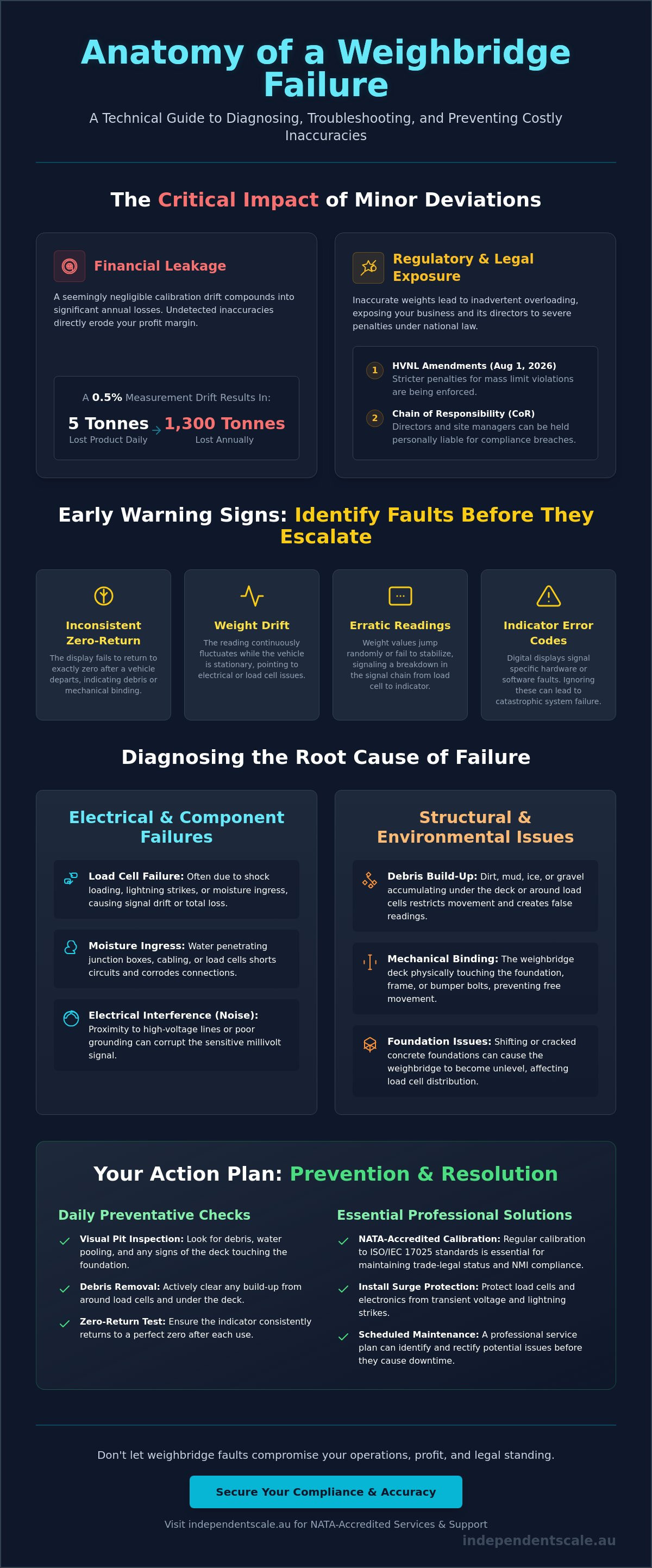
In high-volume industrial environments, minor calibration drift represents a significant threat to the bottom line. Consider a facility processing 1,000 tonnes of material daily. A seemingly negligible drift of 0.5% results in 5 tonnes of unaccounted "shrinkage" every day. Over a standard 260-day operating year, this totals 1,300 tonnes of lost product or unbilled revenue. In a concrete batching plant, these inaccuracies compromise the structural integrity of the final mix, leading to rejected loads and potential project failures. Beyond financial loss, the Heavy Vehicle National Law (HVNL) amendments effective August 1, 2026, impose stricter penalties for mass violations. Relying on a faulty weighbridge increases the risk of inadvertent overloading, which exposes directors and site managers to substantial fines and legal action under Chain of Responsibility (CoR) protocols.
Recognizing Early Warning Signs
Identifying common weighbridge faults before they result in a total shutdown requires a methodical approach to system monitoring. Operators should watch for an inconsistent zero-return. If the weight indicator doesn't return to exactly zero after a vehicle clears the platform, mechanical binding or load cell debris is likely present. Another critical indicator is "weight drift," where the reading continues to fluctuate while the vehicle is stationary. Modern digital indicators and displays are designed to signal these irregularities through specific error codes. Ignoring these diagnostic signals often leads to catastrophic hardware failure. Consistent monitoring of these outputs, combined with adherence to updated NMI legislative instruments effective April 1, 2026, is the only way to ensure your facility remains both compliant and profitable.
Load Cell Failures and Electrical Signal Interference
While the structural platform provides the interface for weighing, the industrial load cells beneath it are the most technically vulnerable components. These precision transducers convert mechanical force into millivolt signals, making them highly susceptible to environmental and electrical stressors. Among the most common weighbridge faults, load cell failure often stems from shock loading, where a vehicle brakes aggressively on the platform, or from transient voltage surges such as lightning strikes. Without robust junction boxes and surge arrestors, these surges can bypass internal protections and permanently damage the strain gauge bridge.
Electrical signal stability is also compromised by "noise" or interference. This typically occurs when weighbridge cabling is routed too close to high-voltage lines or when the system lacks a dedicated, low-resistance ground. Maintaining signal integrity is not just a performance requirement but a compliance necessity. Adhering to standards similar to the UK code of practice for vehicle weighing ensures that the electrical environment of the bridge supports legal-for-trade accuracy. If you suspect signal degradation, assessing your grounding hardware and surge protection is a critical first step.
Moisture and Environmental Seal Failure
Industrial load cells are typically rated IP68 or IP69K, indicating high levels of protection against dust and water immersion. However, these seals degrade over time due to chemical exposure or high-pressure cleaning. When moisture enters the load cell, it drastically alters the electrical resistance of the strain gauge circuit. This leads to "drifting" readings where the weight value fluctuates without any change in load. Corrosion on mounting hardware can also create side-loading forces, further distorting measurements. Regular inspection of the hermetic seals and cable entries is vital for preventing these common weighbridge faults before they require full component replacement.
Cabling and Connection Issues
In pit-mounted installations, cabling is frequently exposed to environmental hazards and pests. Rodent damage to cable insulation is a recurring issue that causes intermittent short circuits or total signal loss. Even minor abrasions to the cable shielding can increase the signal-to-noise ratio, leading to inconsistent data at the indicator. To maintain signal strength over long distances from the bridge to the control room, the use of conditioners and transmitters is often necessary. These devices amplify and stabilize the signal, ensuring that the raw data remains accurate despite the harsh electrical environment of an industrial site. For sites experiencing persistent signal instability, upgrading to high-performance weighing components can provide the necessary technical redundancy.
Structural and Environmental Issues Affecting Accuracy
Structural integrity is the foundation of weighing precision. While internal components like load cells are highly sensitive, the physical environment of the platform often introduces common weighbridge faults through mechanical interference. Mechanical "binding" occurs when the weighbridge deck makes physical contact with the pit walls or the surrounding frame. This contact creates an alternative load path, effectively "stealing" weight from the sensors and resulting in significant under-registration. These structural tolerances are governed by rigorous standards, such as the NIST Handbook 44 technical requirements, which mandate specific clearances to ensure the entire load is correctly transferred to the weighing elements.
Thermal expansion and foundation subsidence present long-term risks to accuracy. Steel expands and contracts with temperature shifts. A bridge that has clear gaps in the morning might bind by mid-afternoon as the metal expands under direct sunlight. Similarly, foundation subsidence—the settling of the concrete base—leads to uneven load distribution across the sensor array. This misalignment often requires professional intervention to relevel the structure and perform a full load cell calibration to confirm the system's return to NATA-accredited accuracy. Ignoring these structural shifts leads to permanent damage to the weighing frame and mounting hardware.
The Problem of Debris Accumulation
Pit-mounted weighbridges are particularly prone to debris ingress. Over time, mud, stones, and spilled product accumulate in the pit or around the load cell assemblies. When packed mud hardens under a load cell, it creates a mechanical "shunt." This shunt carries a portion of the vehicle's weight, bypassing the sensor and causing erratic, low readings. Installing T-section rubber seals along the gaps between the deck and the pit wall is an essential preventative measure. These seals reduce debris buildup and protect the weighing signal from being bypassed by external material.
Structural Binding and Clearance Issues
Regular inspection of the gap between the deck and the approach ramps is mandatory for high-volume sites. Even a few millimeters of contact can invalidate weight data. Worn bumper bolts or check rods, which limit excessive deck movement during braking, can cause common weighbridge faults by locking the deck in a bound position. Operators should inspect concrete foundations for cracks and steel support beams for signs of fatigue or deflection. If the bridge exhibits erratic readings specifically during heavy braking, it's a clear indicator that the restraint system requires adjustment or replacement of the special purpose pins and mounting hardware.
Troubleshooting and Preventative Maintenance Protocols
Asset reliability depends on a clear division of labor between site operators and accredited service providers. By implementing a structured daily check, you can identify common weighbridge faults before they compromise your Chain of Responsibility compliance. This proactive approach ensures that minor mechanical interferences don't escalate into total system failures. Every observation and test result must be documented in a maintenance log to provide a defensible audit trail for NMI or HVNL compliance audits.
A visual inspection of the platform and pit is the first line of defense. Operators should confirm that the gap between the deck and the approach ramps is clear of stones or packed debris. In pit-mounted systems, check for standing water or silt buildup that could submerge load cell assemblies. Once the visual check is complete, perform a simple "End-to-End" test. Drive a loaded vehicle onto the first half of the bridge and record the weight, then repeat the process on the second half. A variance exceeding the scale's verified tolerance indicates a potential load cell failure or structural binding that requires technical intervention.
5 Steps to Troubleshoot Inaccurate Readings
- Step 1: Perimeter Inspection. Check for binding or debris around the platform perimeter. Even a small wedged stone can cause significant weight "stealing."
- Step 2: Cable Assessment. Inspect all visible cabling for signs of physical damage, rodent bites, or moisture ingress at the entries.
- Step 3: Zero-Point Verification. Clear the platform and verify the zero-point stability. If the indicator fluctuates without a load, the signal chain is compromised.
- Step 4: Junction Box Check. Open the junction box to look for water ingress, corrosion on the board, or loose wiring terminals.
- Step 5: Document and Escalate. Record all findings in the site log. If the error persists after cleaning and basic inspection, contact an accredited technician for diagnostic testing.
Establishing a Preventative Maintenance Schedule
Quarterly inspections are the industry standard for high-volume logistics and mining sites. While daily cleaning prevents debris-related errors, it doesn't replace the technical necessity of professional weighing scale calibration. Technicians use certified test masses to verify the bridge across its full capacity, identifying common weighbridge faults like non-linearity or hysteresis that are invisible to daily checks. For facilities with integrated processing, ensure that tank and silo weighing assemblies are included in the broader site maintenance plan. This holistic approach prevents localized failures from disrupting the entire production chain. To ensure your system meets current regulatory standards, schedule a professional calibration with an accredited specialist.
Professional Repair and NATA-Accredited Calibration Solutions
Professional intervention is necessary when basic on-site troubleshooting fails to rectify common weighbridge faults or when the system is due for its mandatory verification. While operators can manage debris and visual inspections, resolving complex signal drift or structural misalignment requires specialized diagnostic equipment. Independent Scale Service provides technical expertise to restore systems to peak performance, ensuring that every measurement is legally defensible and operationally precise. Our approach prioritizes rapid response to minimize logistics bottlenecks and prevent the financial losses associated with inaccurate weight data.
For industrial facilities, the transition from repair to return-to-service must include a verified load cell calibration. This process confirms that the entire weighing chain, from the physical platform to the digital indicator, operates within the strict tolerances defined by the National Measurement Institute (NMI). In specialized sectors like construction materials, we ensure compliance with AS 1379 through dedicated concrete batching plant calibration. These services are essential for maintaining the quality control standards required for large-scale infrastructure projects.
Understanding NATA Accreditation and ISO 17025
NATA accreditation is the recognized benchmark for technical competence in Australia. Calibrations performed to ISO/IEC 17025 standards provide the necessary traceability to national measurement standards. This documentation is critical during commercial disputes or regulatory audits, where the accuracy of a weighbridge may be questioned. Without a NATA-endorsed report, your weight data lacks the legal standing required for trade-legal applications. Our expertise in force gauge calibration allows us to support broader industrial quality control beyond the weighbridge, ensuring all precision instruments on your site are synchronized and compliant.
Comprehensive Repair and Support Services
Independent Scale Service maintains extensive on-site diagnostic capabilities across Sydney, Melbourne, and regional Australia. We address common weighbridge faults by identifying the root cause, whether it's a compromised hermetic seal or a fatigued structural component. Our technicians carry a comprehensive inventory of high-quality replacement parts, including special purpose pins, load cells, and junction boxes. Every repair is finalized with a full system recalibration. This methodical process guarantees that once we leave the site, your weighbridge is fully restored to its accredited accuracy and ready for immediate, high-volume operation.
Securing Long-Term Weighing Precision and Compliance
Maintaining the integrity of your industrial weighing infrastructure requires a methodical approach to both daily operations and professional maintenance. By identifying common weighbridge faults such as load cell drift or structural binding early, you protect your facility from financial leakage and the risk of non-compliance with HVNL mass limits. Consistent adherence to NATA-accredited standards ensures that your data remains a reliable asset for both internal inventory management and legal-for-trade transactions.
Independent Scale Service provides the technical expertise necessary to keep your systems operational. Our technicians serve Sydney, Melbourne, and regional Australia, delivering NATA-accredited services to ISO/IEC 17025 standards. Whether you require AS 1379 compliant concrete batching plant calibration or rapid diagnostic repairs, we focus on minimizing downtime and restoring accuracy. Don't let undetected inaccuracies compromise your operational efficiency or regulatory standing. Contact Independent Scale Service for NATA-Accredited Weighbridge Repair to secure your site's precision today.
Frequently Asked Questions
How often should a weighbridge be calibrated?
Industrial weighbridges should undergo professional calibration every 6 to 12 months to maintain accuracy and regulatory compliance. High-volume sites or facilities operating in harsh environments often require quarterly inspections to mitigate the effects of mechanical wear and environmental stress. Regular verification is a mandatory requirement under the National Measurement Act 1960 for any scale used for trade purposes, ensuring the system remains within verified tolerances.
Why is my weighbridge reading different at each end?
Discrepancies between the ends of a weighbridge usually indicate mechanical binding or a failing load cell at one corner. If the platform makes contact with the pit wall or approach ramp, it creates an alternative load path that effectively steals weight from the sensors. Alternatively, one or more load cells may have drifted out of calibration or suffered internal strain gauge damage. An end-to-end test with a loaded vehicle is the standard diagnostic method for identifying these imbalances.
Can lightning damage a weighbridge system?
Lightning is a leading cause of catastrophic component failure in industrial weighing systems. A direct or nearby strike sends a transient voltage surge through the steel structure and into the sensitive circuitry of the load cells. Without high-quality surge arrestors and a properly maintained grounding system, these surges permanently damage the internal strain gauges. This results in either immediate system failure or persistent, erratic signal noise that compromises data integrity.
What is the difference between a pit and a surface-mounted weighbridge fault?
Pit-mounted weighbridges are primarily susceptible to moisture ingress, debris accumulation, and rodent damage to cabling within the confined space. In contrast, surface-mounted systems more frequently experience common weighbridge faults related to approach ramp alignment and impact damage from aggressive vehicle braking. While both types share issues like load cell drift, the environmental stressors of a pit installation require more rigorous cleaning and drainage maintenance protocols to prevent sensor submergence.
Does my weighbridge need to be NATA accredited?
NATA accreditation is essential if your weight data is used for trade-legal applications or to satisfy formal compliance audits. A NATA-endorsed report provides documented traceability to national standards under ISO/IEC 17025, which is critical during commercial disputes. This accreditation confirms that the calibration was performed by a technically competent specialist using certified equipment, making your weight readings legally defensible and compliant with NMI requirements.
How do I know if a load cell has failed?
A failed load cell typically manifests as erratic weight readings, a failure to return to zero after a load is removed, or specific error codes on the digital indicator. Technicians identify the faulty component by measuring the millivolt output of each cell at the junction box. If one cell provides a signal significantly outside the expected range under a balanced load, it's compromised. Physical indicators like cracked hermetic seals or severe corrosion also signal imminent failure.
What causes a weighbridge to drift?
Weighbridge drift is frequently caused by moisture ingress into the load cells or junction box, which alters the electrical resistance of the signal chain. Thermal expansion of the steel structure and electrical interference from nearby high-voltage lines are also common weighbridge faults that lead to fluctuating readings. Identifying the specific source of drift requires a methodical assessment of the electrical signal stability and the physical clearances of the platform deck.
Can I repair a weighbridge load cell myself?
You cannot repair a weighbridge load cell because they are hermetically sealed, precision instruments that require factory-level assembly. Attempting to open or modify a cell destroys its IP-rating and invalidates its calibrated accuracy. Any component replacement or structural adjustment must be performed by a qualified technician and followed by a professional calibration using certified test masses. This ensures the system is safely restored to service and meets all legal requirements for accuracy.
