


Common Load Cell Failures: A Diagnostic Guide for Industrial Weighing Systems
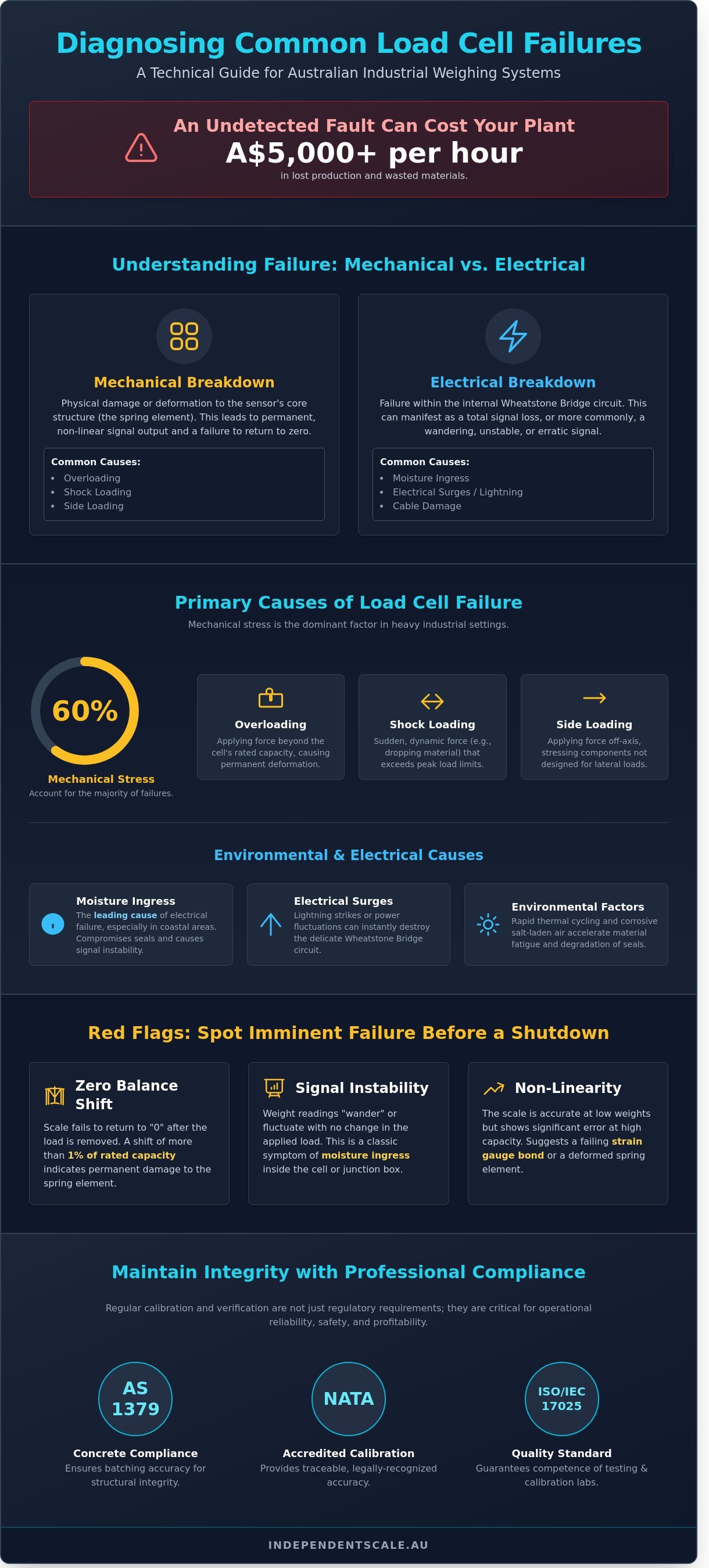
A single undetected fault in an industrial weighing system can cost an Australian concrete plant upwards of A$5,000 per hour in lost production and wasted materials. When accuracy is non-negotiable, understanding the root causes of common load cell failures is the only way to prevent these expensive disruptions. You're likely already aware that even minor drifts in calibration can jeopardize your compliance with AS 1379 standards and lead to significant batching errors that compromise structural integrity. Maintaining NATA-compliant accuracy isn't just a regulatory requirement; it's a critical component of your operational reliability.
This diagnostic guide provides the technical expertise needed to identify, diagnose, and resolve these issues before they result in a total system shutdown. We've drawn on over 30 years of experience servicing 98% of concrete plants across Sydney to outline exactly how to maintain your equipment. You'll learn how to perform on-site testing using NATA-accredited methods, diagnose electrical and mechanical interference, and implement a robust preventative maintenance schedule that aligns with ISO/IEC 17025 requirements to ensure your industrial weighing operations remain precise, compliant, and profitable.
Key Takeaways
- Distinguish between mechanical deformation and electrical signal breakdown within the Wheatstone Bridge to accurately pinpoint the root cause of system inaccuracies.
- Identify common load cell failures such as overloading, shock loading, and side loading that lead to permanent damage and non-linear signal output.
- Understand why moisture ingress is the leading cause of electrical failure in Australian coastal industries and how to mitigate the risks of electrical surges.
- Implement a structured on-site diagnostic framework to safely isolate faults and perform visual inspections before requesting emergency technical support.
- Maintain operational integrity and AS 1379 compliance through regular NATA-accredited calibration and verification to ISO/IEC 17025 standards.
Understanding Load Cell Failure: Mechanical vs. Electrical Breakdown
A load cell failure is defined as the inability of the sensor to produce a reliable, linear signal output that remains proportional to the applied force. This breakdown isn't always a total loss of signal. In many industrial applications across Australia, failure presents as subtle performance degradation that compromises batch accuracy and regulatory compliance. To diagnose these issues, one must first understand the fundamental technology. If you're asking What is a Load Cell?, it's essentially a transducer that utilizes a Wheatstone Bridge circuit. This circuit consists of four strain gauges bonded to a spring element. When weight is applied, the mechanical stress changes the electrical resistance of the gauges, translating physical force into millivolt data.
Distinguishing between catastrophic failure and performance drift is vital for maintaining operational uptime. A catastrophic failure usually results in a "no signal" state or a locked reading on the digital indicator, often caused by a severed cable or a burnt-out bridge. Conversely, degradation involves non-linearity or drift, where the sensor provides data that's slightly inaccurate. These common load cell failures are frequently seen in high-volume sectors. For instance, in the 98% of concrete plants we service across Sydney, environmental factors like high humidity and chemical exposure accelerate the breakdown of internal components long before the sensor physically breaks.
Industrial environments in Melbourne and Sydney present unique challenges for weighing equipment. Rapid thermal cycling in Victorian winters and the salt-laden air of coastal New South Wales accelerate component fatigue. When a cell operates under AS 1379 standards for concrete production, it undergoes thousands of load cycles daily. This constant stress leads to microscopic fractures in the spring element or the degradation of the protective potting compounds, eventually leading to electrical leakage or mechanical hysteresis.
The Anatomy of a Load Cell
The spring element serves as the structural core of the sensor. Manufacturers typically use 17-4 PH stainless steel for its corrosion resistance or high-grade tool steel for higher capacity requirements. While stainless steel is robust, it's still susceptible to fatigue over millions of cycles. The strain gauges are bonded to this element using high-performance adhesives. These adhesives are the most vulnerable point of the system; they can soften or delaminate if internal temperatures exceed 70°C or if moisture penetrates the seal. Inside the housing, a network of compensation resistors fine-tunes the signal for temperature fluctuations, but these delicate wires can snap under extreme vibration or shock loading.
Signs of Imminent System Failure
Recognising the early indicators of a failing sensor prevents costly emergency repairs and product wastage. Monitor your systems for these three specific markers:
- Zero balance shift: If your scale fails to return to "0" after a 5,000kg load is removed, the spring element has likely exceeded its elastic limit. A shift of more than 1% of the rated capacity often indicates permanent structural damage.
- Signal instability: When weights "wander" or fluctuate on the indicator without a change in load, it's usually a sign of moisture ingress. Even a few drops of water inside a junction box can cause the millivolt signal to become erratic.
- Non-linearity: This occurs when the scale is accurate at low weights, such as 500kg, but shows a 20kg error at its 5,000kg capacity. This suggests the strain gauge bond is failing or the spring element is deformed.
Independent Scale Service has over 30 years of experience identifying these faults before they cause a total plant shutdown. Our NATA-accredited technicians use precision multimeters to check bridge resistance and insulation integrity, ensuring your equipment meets ISO/IEC 17025 standards. Addressing these issues early via a scheduled calibration is significantly more cost-effective than an emergency replacement during a critical pour.
Common Mechanical Failures: Overload, Shock, and Side Loading
Mechanical stress accounts for approximately 60% of common load cell failures in heavy industrial environments. These issues aren't just minor wear and tear; they're often the result of exceeding the physical limits of the sensor's metal structure. When a load cell is integrated into a system, it acts as the weakest link by design, intended to deflect under pressure. If that pressure exceeds specific thresholds, the internal components suffer irreparable damage. Understanding these mechanical triggers is the first step in preventing costly downtime and maintaining compliance with standards like AS 1379.
The Danger of Permanent Set
Every load cell has an elastic limit, which is the maximum point the metal can bend and still return to its original shape. Load cells utilise strain gage technology to measure this minute deflection. If you subject a cell to 150% of its rated capacity, you risk a "permanent set." This is a physical deformation where the spring element stays bent. You'll notice this when the scale won't return to zero or if the "zero balance" has shifted significantly. When inspecting tank and silo weighing assemblies, look for warped mounting plates or gaps between the load button and the top plate. A single A$5,000 load cell can be ruined in a fraction of a second by one overloaded hopper.
Shock Loading and Impact
Shock loading is distinct from a slow, static overload. It happens when a load is dropped or stopped suddenly, creating a massive spike in force. A 1,000kg bulk bag dropped from just 10cm can exert a force equivalent to 5,000kg due to gravity and velocity. This sudden impact creates a pressure wave that can crack the internal spring element or debond the strain gages. Industrial scales in high-traffic warehouses often fail because of these "sudden stops" during forklift loading. If your digital indicator shows erratic jumping numbers after a heavy impact, the internal bond of the sensor has likely been compromised.
Misalignment and Side Loading Issues
Misalignment is a silent killer for shear beam and canister cells. In concrete batching plants, vertical force transmission is essential for accurate measurement. If the structure isn't perfectly level, forces move laterally rather than vertically. This is known as side loading. Large silos are particularly vulnerable because thermal expansion can move the entire structure. A silo that's 20 metres tall can shift several millimetres as temperatures fluctuate between a 5°C morning and a 35°C afternoon in Sydney. Using special purpose pins and shackle pins helps ensure that the load remains centred and vertical. Without these self-aligning components, the cell experiences torque and twisting forces it wasn't designed to handle, leading to massive weighing errors.
Corrosion and physical body damage also contribute to common load cell failures. Chemical exposure in food processing or salt air in coastal regions can eat through stainless steel housings. Dents in the canister body often indicate that the internal hermetic seal is broken. Once moisture enters the housing, the cell's electrical resistance drops, and the unit is finished. If you spot rust or compromised seals during your daily checks, it's best to request a technical inspection before the unit fails during a critical production run.
Environmental and Electrical Causes of Load Cell Failure
Environmental factors account for a significant portion of weighing system downtime across Australia. In coastal regions where salt spray and high humidity are constant, moisture ingress is the single most frequent cause of electrical failure. This is not just a surface issue. When moisture penetrates the load cell's internal cavity, it alters the resistance of the Wheatstone bridge. This leads to erratic readings, zero-point drift, or total signal loss. For industries operating near the 25,000 kilometres of Australian coastline, environmental sealing is the first line of defence against premature replacement costs.
Moisture and Humidity Challenges
Selecting the correct Ingress Protection (IP) rating is non-negotiable for site longevity. Many operators mistakenly install IP67-rated cells in heavy wash-down areas. While IP67 protects against temporary immersion, it cannot withstand the high-pressure, high-temperature cleaning required in food production or chemical processing. For these environments, IP68 or IP69K ratings are the required industry standard. A common failure mechanism is "wicking." This occurs when a compromised cable jacket allows capillary action to draw water through the cable and directly into the load cell housing. To mitigate this, it's essential to install high-quality junction boxes and surge arrestors. These components provide a secondary line of defence, preventing moisture from migrating through the conduit system and causing a short circuit across the summing board.
Electrical Surges and Interference
The delicate electrical components within a load cell are highly susceptible to voltage spikes. A frequent mistake on industrial sites involves performing arc welding on a scale's frame without first isolating the load cells. The high-amperage current seeks the path of least resistance, which often leads through the load cell's internal wiring, instantly vaporising the strain gauge. Lightning strikes also present a major threat to outdoor installations like weighbridges and silos, particularly in northern Queensland and coastal New South Wales. Beyond sudden surges, Radio Frequency Interference (RFI) and Electromagnetic Interference (EMI) from nearby high-power motors can corrupt the millivolt signal. Research into common load cell failures highlights that even minor interference can cause weight fluctuations that exceed AS 1379 compliance limits. Implementing specialised conditioners and transmitters is the most effective way to clean these signals and ensure reliable data transmission to the PLC. For more complex site-wide electrical assessments and solutions, engaging an industrial electrical engineering specialist like Armour Corporation is often the best course of action.
Cable integrity is a critical pillar of environmental protection that's often overlooked during routine checks. Mechanical abrasion from vibrating machinery or chemical attacks from caustic cleaning agents can quickly strip cable insulation. In approximately 15% of rural maintenance cases, rodent interference is the primary culprit, as vermin chew through polyurethane jackets. Once the internal shielding is exposed, the load cell becomes vulnerable to both moisture and electrical noise. Chemical wash-down procedures in dairy and meat processing can also degrade silicone seals over a 12 to 18-month period if the material isn't compatible with the cleaning agents used. Regular inspections must focus on these connection points to identify wear before it leads to a catastrophic system failure and unplanned downtime.
To maintain accuracy and ensure your equipment remains NATA-accredited to ISO/IEC 17025 standards, these environmental risks must be managed through robust hardware choices. Protecting the junction boxes and ensuring all cabling is shielded or run through liquid-tight conduit are standard requirements for any high-reliability industrial weighing application. Addressing these common load cell failures through preventative hardware installation significantly reduces the total cost of ownership over the life of the scale.
Diagnostic Framework: How to Test a Load Cell on Site
Systematic testing is the only way to differentiate between a simple calibration drift and terminal hardware damage. Before you begin any technical assessment, safety is the absolute priority. You must isolate the weighing system and secure the load using mechanical jacks or safety stands. In heavy industrial applications, such as the 98% of Sydney concrete plants we service, an unsecured 30-tonne hopper represents a lethal risk if a load cell mount fails during inspection. Once the system is physically stable, conduct a thorough visual check. Look for "binding," where debris or structural contact prevents the load cell from moving freely. Examine the cables for perishing, rodent damage, or chemical ingress, as these are frequent precursors to common load cell failures.
The Zero Balance Check
The zero balance test determines if the load cell has suffered permanent mechanical deformation. You'll need a high-precision multimeter capable of reading millivolts (mV). With the load cell disconnected from the junction box but powered by the indicator, measure the voltage across the signal leads. For a standard 2.0 mV/V load cell with 10V excitation, the output at zero load should be 0 mV. A shift of more than 1% of the full-scale output indicates that the internal spring element has been overstressed. If your readings show a shift of 0.2 mV or higher, the cell's structural integrity is compromised. At this stage, you should stop field testing and request NATA-accredited calibration to determine if the unit is still compliant with AS 1379 standards.
Insulation and Bridge Resistance
Electrical leakage is a primary cause of intermittent weighing errors and "drifting" displays. To test insulation, use a megohmmeter to measure the resistance between the bridge circuit and the load cell housing or shield. A healthy cell must show a resistance of at least 5,000 megohms. Anything lower suggests moisture has breached the seals, a common issue in high-humidity Australian environments. Next, perform a bridge resistance test by measuring the resistance across the input leads and then the output leads. Most industrial cells use a 350-ohm or 700-ohm bridge. If your field reading varies by more than 2 ohms from the value listed on the manufacturer’s original calibration certificate, the internal strain gauges are likely damaged. These electrical discrepancies are common load cell failures that typically require a full component replacement to ensure system reliability.
Identifying these faults early prevents the compounding costs of wasted raw materials or non-compliant product batches. Our team has over 30 years of experience diagnosing complex weighing issues for Tier 1 contractors like Holcim and Boral. We don't just find the fault; we provide the technical certification required to keep your site operational and legal. Accuracy isn't optional in industrial weighing; it's the foundation of your quality control and commercial viability.
If your onsite diagnostics confirm a faulty component, contact Independent Scale Service for emergency 24/7 load cell repairs and NATA-accredited testing.
Professional Solutions: Calibration, Repair, and Compliance
Identifying common load cell failures early is only half the battle. You need technical expertise to restore system integrity. Independent Scale Service (ISS) provides NATA-accredited calibration to ISO/IEC 17025 standards. This ensures every measurement meets the rigorous demands of Australian trade and safety regulations. Professional intervention is the only way to resolve common load cell failures permanently.
NATA Accreditation and Compliance
Standard calibration often fails to meet the legal requirements of regulated Australian industries. ISS manages compliance for 98% of Sydney concrete plants. These facilities rely on AS 1379 compliance to guarantee batch accuracy. We utilize the gravimetric method for liquid flowmeter calibration. This weighing method provides a higher degree of precision than volumetric alternatives. It's the benchmark for accuracy in chemical and concrete production.
Repairing high-capacity weighing systems requires a calculated cost-benefit analysis. For cells with capacities exceeding 20 tonnes, a new unit can cost over A$3,500. In many cases, repairing internal wiring or replacing surge arrestors offers a 60% cost saving compared to a full replacement. However, if the spring element is physically deformed or the strain gauge has debonded, replacement is the only safe option. ISS technicians evaluate the following factors before recommending a course of action:
- Structural Integrity: We check for permanent set or metal fatigue in the cell body.
- Insulation Resistance: We test for moisture ingress that might be fixable via drying and resealing.
- Zero Balance: If the zero shift exceeds 10%, the cell is typically beyond repair.
- Operational Criticality: For high-speed production lines, we often recommend replacement to ensure 100% reliability.
Selecting Robust Replacement Hardware
Selecting the right load cells is critical for harsh Australian environments. Stainless steel, IP69K-rated units prevent moisture ingress in aggressive wash-down areas. Upgrading to digital indicators and displays allows for advanced fault logging. These modern displays provide error codes that help technicians pinpoint issues before they cause a total system shutdown. ISS offers 24/7 emergency repair services to eliminate unplanned downtime for our clients.
When sourcing these components, it's crucial to use genuine parts to maintain system integrity and compliance. Suppliers like InstroDirect provide a wide range of industrial automation equipment from trusted brands, ensuring you can find the right hardware for your specific application.
Preventative maintenance is your best defense against systemic errors. A six-month calibration cycle is the industry standard for high-volume plants. This schedule catches drift and physical wear before they impact your bottom line. ISS has over 30 years of experience maintaining equipment for industry leaders like Holcim, Boral, and Hanson. We don't just fix scales; we ensure your entire weighing infrastructure remains compliant and profitable. Don't wait for a total system collapse. Establish a routine service schedule to maintain your competitive edge in the market.
Protect Your Operational Accuracy and Regulatory Compliance
Identifying common load cell failures early prevents expensive downtime and keeps your facility compliant with AS 1379 standards. Mechanical stresses like shock loading require immediate physical inspection, while electrical drift often signals a need for professional diagnostic testing. Precision's non-negotiable in industrial weighing. A single inaccurate batch can compromise an entire project's structural integrity.
Independent Scale Service brings over 30 years of technical expertise to every site visit. We currently service 98% of concrete plants across Sydney, providing the reliability that major industry players demand. Our team ensures your equipment meets NATA Accredited to ISO/IEC 17025 requirements through methodical testing and gravimetric calibration. Don't let equipment fatigue stall your production schedule or impact your bottom line.
Contact Independent Scale Service for Emergency 24/7 Load Cell Repair to restore your system's accuracy immediately. We're ready to assist with your most critical weighing challenges.
Frequently Asked Questions
Can a load cell be repaired once it has been overloaded?
No, a load cell cannot be repaired once it has exceeded its ultimate overload rating, which is typically 150% of its capacity. Overloading causes permanent plastic deformation of the internal spring element, meaning the metal's molecular structure is compromised. ISS recommends immediate replacement to maintain AS 1379 compliance. Attempting to recalibrate a deformed cell leads to non-linear readings and a 100% failure rate under peak loads.
How often should I calibrate my industrial load cells for AS 1379 compliance?
AS 1379 requires calibration of weighing equipment at intervals not exceeding 12 months. For high-volume concrete plants producing over 20,000 cubic metres annually, 6-month intervals are the industry standard for risk mitigation. ISS provides NATA-accredited calibration to ISO/IEC 17025 standards. Regular testing ensures your batch accuracy remains within the 1% tolerance required for structural concrete production in Australia.
What is the most common reason for a load cell to drift?
Moisture ingress into the cable entry or strain gauge cavity is the most frequent cause of signal drift among common load cell failures. Even a 0.01% change in insulation resistance can cause the zero point to wander. In Australian environments, high humidity or pressure washing accounts for 65% of drift-related service calls. We use hermetically sealed IP68 or IP69K rated cells to prevent this specific failure mode.
Is it possible to test a load cell without removing it from the system?
It's possible to perform a preliminary health check using a high-quality digital multimeter to measure input and output resistance. Check the bridge resistance; a deviation of more than 2 ohms from the original calibration certificate indicates internal damage. For a definitive test, ISS technicians use the gravimetric method with certified test weights. This identifies errors without the downtime associated with full disassembly of the weighing structure.
How does moisture affect load cell readings if the cell is sealed?
Moisture typically bypasses seals via capillary action through the cable jacket or accumulates in the junction box. This creates a parallel resistance path across the Wheatstone bridge, leading to erratic readings or "hunting" on the display. In 40% of cases, the failure occurs at the summing circuit rather than the cell itself. Proper use of desiccant packs and IP67-rated enclosures reduces these incidents by 90% in wet environments.
What is the difference between a load cell and a strain gauge?
A load cell is a complete transducer assembly, while a strain gauge is the internal sensing element that measures the deformation of the cell's metal body. Most industrial cells contain four strain gauges arranged in a Wheatstone bridge circuit. The cell converts mechanical force into a measurable millivolt signal. Understanding this distinction is vital when diagnosing common load cell failures related to internal electrical shorts or gauge bonding issues.
Can lightning strikes be prevented from destroying weighing equipment?
You can protect equipment by installing surge arrestors and ensuring a low-impedance grounding system. ISS installs heavy-duty copper braid bypass cables around each load cell to direct current away from the sensitive strain gauges. Systems equipped with proper lightning protection see an 85% reduction in catastrophic electronic failure during Australian electrical storms. This is an essential investment for outdoor silos to avoid A$5,000 plus replacement costs.
Why is my scale showing a negative weight after the load is removed?
Negative readings usually indicate mechanical binding or a "hung" scale where the assembly doesn't return to its original resting position. Check for debris trapped between the weigh hopper and the frame. If the structure is clear, the load cell might've suffered a permanent zero shift due to a shock load. A shift of just 0.5mV can result in significant negative displays once the tare is cleared and the load is removed.
