


Common Concrete Batching Plant Problems: A Technical Guide to Troubleshooting and Compliance
A single out-of-tolerance batch doesn't just waste raw material; it can halt a multi-million dollar infrastructure project and trigger a full-scale audit of your plant's NATA certification. You understand that unexpected equipment failures aren't just inconvenient. They're severe financial drains that cost thousands of dollars per hour in lost productivity and rejected loads. Identifying and resolving common concrete batching plant problems is the only way to protect your margins and your professional reputation.
This technical guide provides the expertise needed to resolve these failures, ensuring every mix meets high-strength specifications while maintaining strict AS 1379 compliance. You'll learn how to identify critical failure points in load cells and weighing systems. We also preview the impact of the upcoming AS 1379:2026 standards and the precise calibration protocols required to restore plant uptime. By focusing on measurement accuracy and regulatory requirements, you can eliminate the risk of non-compliant concrete and maintain a valid NATA calibration certificate. This methodical approach ensures your facility remains a reliable link in the construction supply chain.
Key Takeaways
- Learn to proactively identify common concrete batching plant problems to prevent the high costs associated with rejected loads and equipment downtime.
- Discover technical methods for diagnosing load cell drift and sensor failures to maintain the high-precision weighing required for structural concrete.
- Implement systematic troubleshooting for material flow issues and electrical faults within control cabinets to restore plant operations quickly.
- Ensure full compliance with AS 1379-2007 and the upcoming 2026 revisions to remain eligible for major infrastructure and government projects.
- Understand the necessity of NATA-accredited calibration for maintaining a valid ISO/IEC 17025 status and meeting rigorous industry standards.
The Impact of Batching Errors on Concrete Quality and Cost
Precision is the baseline requirement for any modern concrete plant. When instrumentation fails, the consequences manifest as immediate financial losses and long-term structural liabilities. These common concrete batching plant problems often stem from a lack of calibration or environmental interference, leading to "out-of-spec" batches that cannot be used in high-strength applications. Operating without verified accuracy isn't just a technical oversight; it's a significant business risk that compromises the integrity of every cubic meter produced.
Financial Consequences of Production Delays
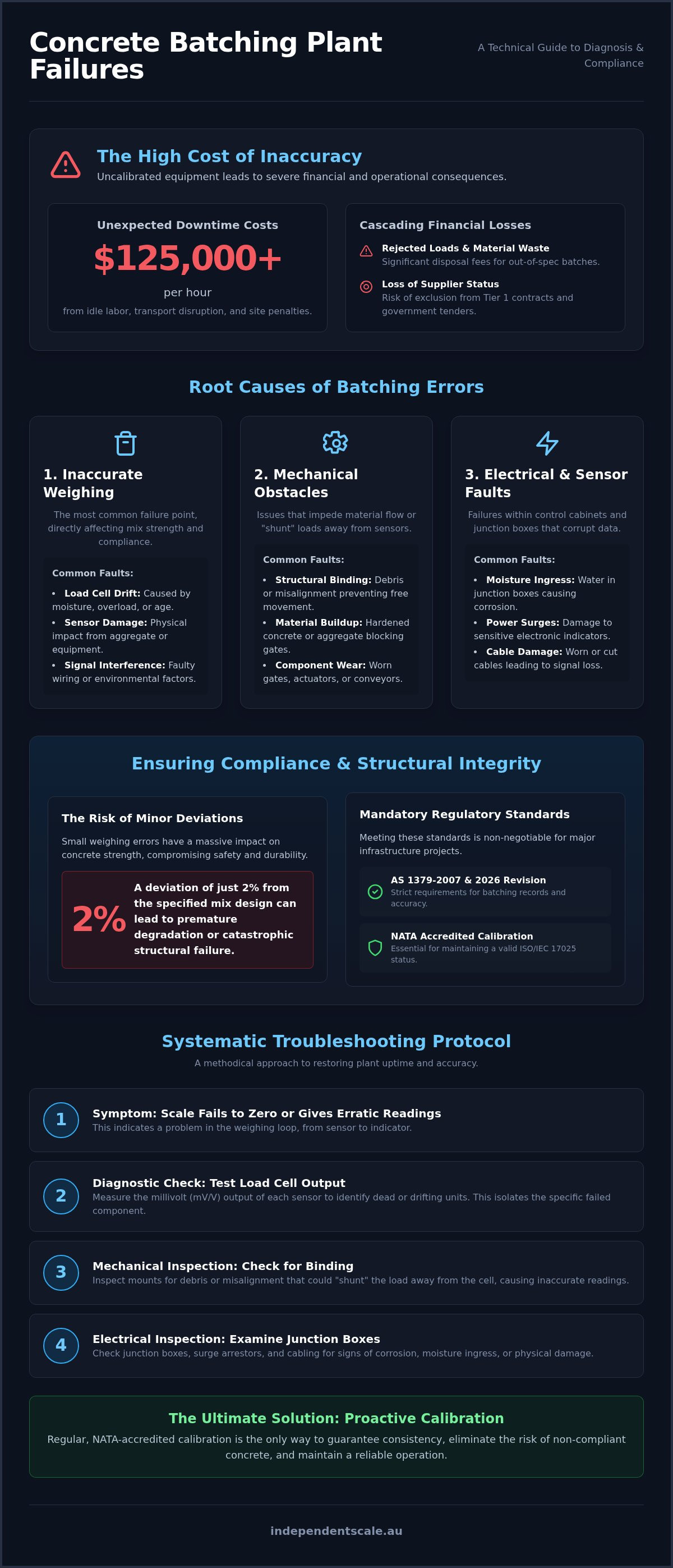
Industrial data indicates that unexpected downtime in the Australian concrete industry can cost operators upwards of $125,000 per hour when accounting for idle labor, transport disruptions, and site penalties. Beyond the immediate loss of production, rejected loads result in significant material waste and mounting disposal fees. Addressing common concrete batching plant problems before they escalate is essential for avoiding these severe site penalties. If a plant cannot provide a valid NATA calibration certificate during an audit, it risks losing its status as an approved supplier for major infrastructure projects. Maintaining a relationship with Tier 1 contractors requires absolute reliability. A history of inconsistent delivery or failed tests can lead to permanent exclusion from lucrative government tenders. A single failed load cell can trigger a cascade of site delays, liquidated damages, and logistical bottlenecks that extend far beyond the plant gate.
Structural Integrity and Mix Consistency
Weighing accuracy is directly correlated with concrete compressive strength. Slight variations in the water-cement ratio, often caused by inaccurate moisture readings or drifting sensors, compromise the durability of the final product. In high-rise construction or heavy infrastructure, even a 2% deviation from the specified mix design can lead to structural failure or premature degradation. Operators sometimes resort to manual overrides to keep production moving during equipment malfunctions. This is a dangerous practice that increases long-term risk and invalidates the batching records required by AS 1379. Using high-quality load cells and ensuring regular calibration is the only way to guarantee that every batch meets the necessary safety margins. Consistency is the hallmark of a professional operation, and it cannot be achieved without reliable, calibrated hardware.
Inaccurate Weighing: Identifying Faults in Load Cells and Indicators
Accurate weighing is the foundation of concrete production. Common concrete batching plant problems frequently involve inaccuracies in the weighing loop, which directly affects material proportions and structural strength. Load cells convert physical force into electrical signals. If these signals drift, the resulting mix will fail strength tests. The MnDOT Concrete Manual states that precise weighing equipment is essential for maintaining the integrity of the mix design. Without this precision, compliance with AS 1379 becomes impossible.
Load cell drift is often caused by moisture ingress, particularly in plants using sensors with inadequate IP ratings. Physical damage from falling aggregate or accidental overload also compromises sensor linearity. For effective raw material management, robust tank and silo weighing assemblies are necessary to ensure consistent inventory tracking and precise batching from the start of the process. These assemblies provide the mechanical stability needed to protect sensitive electronics from the harsh environment of a batching plant.
Diagnosing Load Cell Failures
When a scale fails to return to zero or displays erratic readings, technical diagnosis is required. Start by testing the millivolt (mV/V) output of each sensor to identify dead or drifting units. A common mechanical issue is structural binding, where debris or misaligned mounts "shunt" the load away from the cell. You should also inspect junction boxes and surge arrestors for signs of corrosion or moisture. These components are primary failure points in high-vibration and humid environments where seal integrity is often compromised.
Digital Indicator and Transmitter Issues
Digital indicators interpret the low-voltage signals from the sensors. Error codes often indicate specific failures in the weighing loop, such as signal loss or overload conditions. To maintain signal integrity over long distances, high-performance conditioners and transmitters are used to convert weak signals into stable digital outputs. Unstable power supplies or poor earthing can cause calibration "wandering," leading to inconsistent batch weights. Addressing these common concrete batching plant problems requires a thorough inspection of your indicators and displays to rule out hardware faults. If you're experiencing weighing inconsistencies, consulting a specialist for load cell calibration can prevent costly batch rejections and ensure long-term equipment reliability.
Mechanical Obstacles and Material Flow Challenges
Mechanical efficiency is just as critical as electronic precision. While weighing errors are often traced to sensors, common concrete batching plant problems frequently originate from the physical components that move material between stages. A leaking cement silo gate or a hanging aggregate hopper can introduce "ghost" weights or material shortages that no amount of scale calibration can fix. Maintaining the mechanical interface between storage and measurement is vital for ensuring mix consistency and preventing costly site delays. If the material flow is restricted or inconsistent, the entire automated cycle is compromised, leading to batching cycles that exceed their programmed tolerances.
Silo and Hopper Discharge Issues
Cement silo discharge gates are prone to sealing failures, often caused by hardened material or pneumatic inconsistencies. You must distinguish between a mechanical pneumatic cylinder failure and a solenoid valve fault. While a failed cylinder might move sluggishly due to worn seals or contaminated air lines, a faulty solenoid prevents the signal from initiating movement entirely. Material clumping in cement screw conveyors is another frequent bottleneck, usually triggered by moisture ingress at the discharge point or along the screw housing. To maintain structural safety and weighing accuracy, ensure all weighing vessels are mounted using special purpose shackle pins. These components provide the necessary secure suspension to prevent mechanical binding that would otherwise interfere with load cell readings. Secure mounting is essential for preventing structural vibration from translating into weight fluctuations during the sensitive weighing phase.
Conveyor and Mixer Maintenance
Aggregate delivery relies on perfectly tracked conveyor belts. Misalignment leads to material spillage and timing errors that disrupt the batch cycle and cause uneven wear on rollers. Inside the mixer, worn blades are a primary cause of poor batch homogeneity. As blades lose their profile, they fail to achieve the required shear, resulting in "streaky" concrete that will likely be rejected on-site during slump tests. Moisture probes also represent a critical mechanical-electronic hybrid failure point. If these sensors are coated in hardened slurry or improperly positioned, automated water dosing will become erratic, leading to batches that are either too dry or dangerously over-hydrated. You must implement a strict lubrication schedule for all pivot points and conduct weekly liner inspections to prevent contamination and mechanical seizing. Addressing these common concrete batching plant problems through preventative maintenance is the only way to ensure the plant meets the rigorous demands of AS 1379 concrete production and maintains high-volume output without interruption.
Troubleshooting Guide: Resolving Electrical and Sensor Faults
The control system serves as the central intelligence of the plant, but it's highly susceptible to electrical interference and physical degradation. Common concrete batching plant problems often manifest as intermittent communication errors between field sensors and the central processor. When a system fails, a methodical isolation process is required to determine whether the fault lies in the software, the cabling, or the hardware itself. Rapid diagnosis is essential to minimize the downtime costs discussed earlier. You can't afford to guess when a plant is idle and trucks are waiting.
Electrical Fault Isolation
Start by verifying the physical integrity of all shielded cables running from the batching floor to the control room. These lines are frequently exposed to vibration and mechanical stress, which leads to internal fractures or insulation wear. You must test for continuity and insulation resistance to ensure the signal remains clean and uninterrupted. Surge protection is also a non-negotiable requirement for sensitive load cells, as lightning strikes or industrial power surges can permanently damage the strain gauge bridge. A compromised or high-resistance earth connection often introduces electrical noise that presents as a fluctuating weight reading, effectively mimicking a failing sensor.
Radio Frequency Interference (RFI) represents another significant challenge in modern plants. High-powered motors and variable speed drives (VSDs) generate electromagnetic fields that corrupt digital signals if cables aren't properly shielded or routed. If the system experiences a total computer failure, operators must be trained in manual batching procedures. However, manual operation lacks the automated data logging required for AS 1379 compliance, making it a strictly short-term emergency measure. Professional intervention is required to restore automated precision and regulatory logging.
Preventive Maintenance for Sensors
Data accuracy depends on the cleanliness and physical condition of your sensor array. Moisture probes and infrared sensors require weekly cleaning to remove slurry buildup that distorts readings. You should also conduct a visual inspection of all load cell cables to check for rodent damage or abrasion. Even minor nicks in the outer jacket allow moisture to enter the core, leading to the drift issues identified in earlier sections. Common concrete batching plant problems are often preventable through these simple mechanical checks.
A comprehensive routine inspection checklist should include:
- Verification of terminal block tightness in junction boxes.
- Inspection of cable glands for watertight seals.
- Testing indicators and displays for segment failure or communication lag.
- Recalibration of moisture sensors against oven-dry samples to verify accuracy.
Maintaining these systems prevents the domino effect of component failure. If your system displays persistent error codes or erratic weight shifts, contact Independent Scale Service for professional fault diagnosis and repair to restore your plant's precision.
Ensuring AS 1379 Compliance through Professional Calibration
Compliance with AS 1379-2007 is the primary differentiator between a professional operation and one prone to litigation. This standard dictates the minimum requirements for materials and equipment used in concrete production, and failing to meet its strict tolerances is one of the most significant common concrete batching plant problems. While many operators perform internal checks, these don't carry the legal or technical weight of a formal concrete batching plant calibration. NATA-accredited calibration remains mandatory for any facility supplying government or Tier 1 infrastructure projects. Without a valid certificate, your mix designs won't be accepted for high-specification builds.
Independent Scale Service maintains NATA accreditation to ISO/IEC 17025, providing the technical assurance required for high-stakes projects. This accreditation isn't just a label; it's an international benchmark that proves our technicians possess the proficiency and calibrated equipment to verify your plant's accuracy. We bridge the gap between mechanical performance and regulatory demand, ensuring that your facility is prepared for the upcoming AS 1379:2026 revisions.
The AS 1379 Calibration Process
A compliant calibration involves more than just a zero-point adjustment. It requires a systematic validation of linearity and repeatability across the full range of each scale. AS 1379 specifies different accuracy requirements for cement, aggregate, and water scales, each of which must be tested using certified test weights traceable to national standards. A NATA calibration report must include the uncertainty of measurement and the environmental conditions at the time of testing. This documentation is your primary defense during a quality audit. If a scale shows drift during testing, it often indicates the underlying common concrete batching plant problems discussed in previous sections, such as load cell fatigue or structural binding.
Partnering for Long-Term Plant Reliability
Relying on reactive repairs is a strategy that leads to the $125,000-per-hour downtime losses previously mentioned. Scheduled maintenance ensures that wear in pivot points or sensor drift is identified before it causes a batch rejection. We provide specialized repair and calibration services across Sydney, Melbourne, and regional Australia, focusing on minimizing your operational interruptions. By integrating regular weighing scale calibration into your operational calendar, you maintain the "ready-to-pour" status required by major contractors. You can learn more about our specialized hopper calibration services to see how we maintain precision in aggregate measurement. This proactive approach doesn't just ensure compliance; it protects your equipment investment and guarantees the structural integrity of every load you deliver.
Optimising Plant Performance and Regulatory Compliance
Maintaining a high-volume concrete production facility requires a relentless focus on measurement accuracy and mechanical integrity. You've seen how common concrete batching plant problems, from drifting load cells to pneumatic gate failures, can jeopardise structural safety and result in significant financial site penalties. Addressing these failures through methodical troubleshooting and proactive sensor maintenance is the only way to ensure your facility remains a trusted partner for Tier 1 contractors. Reliability in this industry is built on technical competence and verified precision.
Independent Scale Service provides the expertise needed to keep your operations compliant and efficient. Our NATA-accredited technicians in Sydney and Melbourne specialise in Concrete Batching Plant Calibration to ISO/IEC 17025 standards. Don't wait for an equipment breakdown to disrupt your production schedule or invalidate your compliance status. Secure your facility's reputation by investing in professional, accredited service today. Protecting your margins and ensuring every batch meets the highest standards starts with a commitment to precision.
Book an AS 1379 Compliant Calibration Service Today
Frequently Asked Questions
How often should a concrete batching plant be calibrated under AS 1379?
AS 1379-2007 requires that weighing devices are calibrated at intervals not exceeding 12 months. However, most Tier 1 infrastructure projects and government contracts mandate six-monthly cycles to ensure absolute precision. High-volume plants often increase this frequency to mitigate the risk of common concrete batching plant problems. Regular validation ensures that cement, aggregate, and water scales remain within the specific tolerances required for structural concrete production and NATA certification.
What are the most common signs of load cell failure in a silo?
Signs of failure include weight readings that drift when the silo is static or a scale that fails to return to zero after discharge. You may also observe non-linear weight increases where the displayed value doesn't match the known material input. These issues often stem from moisture ingress or physical damage to the strain gauge. Prompt technical diagnosis is required to prevent incorrect material proportions and catastrophic structural mix failures.
Can I calibrate my own batching plant scales?
While operators can perform internal span checks using known weights, these don't constitute a formal calibration for AS 1379 compliance. Legal and contractual requirements for major projects mandate NATA-accredited calibration performed by qualified technicians. Only a NATA-endorsed certificate provides the traceability and measurement uncertainty data required to satisfy quality audits. This documentation is essential for maintaining your status as a certified supplier on high-stakes construction sites.
Why is my concrete mix inconsistent despite following the recipe?
Inconsistency is typically caused by inaccurate moisture compensation or drifting weighing sensors. If your moisture probes aren't calibrated or are coated in hardened slurry, the automated system will dose incorrect water volumes. Alternatively, common concrete batching plant problems like mechanical binding in the hopper mounts can cause the scale to under-report material weight. This leads to a mix that deviates from the specified water-cement ratio and fails compressive strength tests.
What is the difference between NATA accreditation and a standard calibration?
Standard calibration is a basic adjustment of a scale's accuracy, but NATA accreditation signifies that the service provider meets ISO/IEC 17025 international standards. A NATA-endorsed report includes a formal statement of measurement uncertainty and proof of traceability to national primary standards. This level of accreditation is a mandatory requirement for structural concrete supply on government sites. It provides a higher tier of legal and technical assurance than a non-accredited service.
How do I stop cement from sticking in the silos and chutes?
Cement sticking, or bridging, is usually caused by moisture ingress or poor silo aeration. You should inspect the integrity of silo roof seals and ensure the aeration pads are functioning correctly to fluidise the powder. Installing industrial vibrators on chutes and maintaining a dry air supply for pneumatic systems also prevents material hang-ups. Regular cleaning of the discharge neck is essential to prevent hardened build-up from restricting flow and causing batching delays.
What should I do if my digital weight indicator shows an "OL" or "Err" code?
An "OL" or "Err" code indicates a break in the weighing loop or a signal voltage outside the indicator's range. Immediately inspect the load cell cables for physical damage and check the junction box for moisture or loose terminals. If the code persists after clearing the scale, it likely signifies a dead sensor or a failed transmitter. You must isolate the faulty component before resuming automated batching operations to avoid pouring out-of-spec concrete.
Does weather affect the accuracy of my batching plant weighing system?
Extreme temperature fluctuations cause thermal expansion in mechanical mounts, which can introduce parasitic loads on the sensors. High winds also create lift or downward pressure on exposed hoppers, leading to erratic weight readings during the batching cycle. Additionally, humidity directly impacts the moisture content of stockpiled aggregates. You must account for these environmental factors through robust shielding and frequent moisture probe recalibration to maintain mix design integrity and plant uptime.
