


Choosing Load Cell Suppliers in Australia: A 2026 Buyer's Guide
In high-stakes industrial environments, precision is not a goal-it is a baseline requirement. The integrity of your entire operation can depend on the accuracy of a single load cell, and a substandard component can lead to costly production errors, unexpected downtime, and critical compliance breaches. For managers and engineers, selecting from the various load cell suppliers Australia has to offer is a decision with significant operational and financial consequences. The challenge lies in vetting a supplier's true technical competence, ensuring product quality meets stringent Australian standards, and confirming they provide essential long-term support like NATA-accredited calibration and repair.
This 2026 buyer's guide provides a direct, methodical framework for making that choice with confidence. We will detail the essential criteria for evaluating a supplier to ensure you source accurate, compliant, and reliable load cells tailored to your specific application. By following these steps, you can establish a long-term partnership that minimises operational risk, guarantees regulatory compliance, and secures the long-term performance of your weighing systems.
Key Takeaways
- Understand the critical difference between a simple parts distributor and a technical specialist who can act as a strategic partner for your operations.
- Learn why NATA accreditation is the non-negotiable benchmark for technical competence and calibration accuracy in the Australian industrial sector.
- Develop a comprehensive evaluation framework to compare load cell suppliers Australia-wide, assessing factors beyond price like technical support and compliance.
- Ensure long-term performance and reliability by matching a supplier's expertise and product range to your specific industry's operational demands.
Beyond the Catalogue: What Defines an Expert Load Cell Supplier?
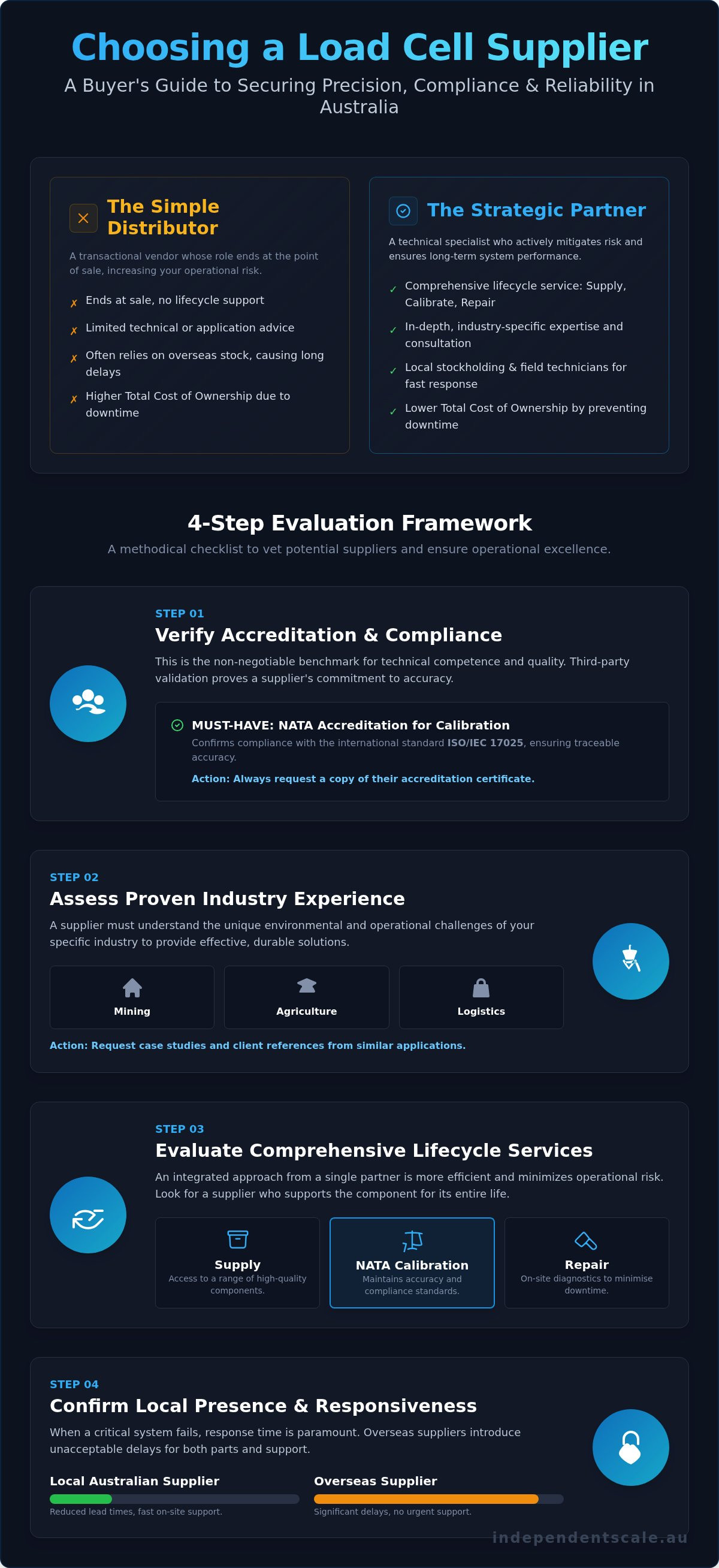
Selecting a load cell supplier is a critical decision that extends far beyond a simple transactional purchase. The initial price of a component is only a minor part of its true total cost of ownership. A genuine technical specialist functions as a strategic partner, actively working to mitigate risk within your industrial processes. This contrasts sharply with a simple distributor, whose role often ends at the point of sale. An expert partner understands that equipment failure leads to unacceptable downtime and financial loss, and they structure their entire service model to prevent it.
In-Depth Technical Expertise and Application Support
An expert supplier possesses deep, industry-specific knowledge. They don't just sell a product; they assess your unique operational environment-from high-vibration manufacturing lines to corrosive agricultural settings-to recommend the correct component. This pre-sales consultation is essential. While understanding the basics of What is a Load Cell? is foundational, an expert provides critical guidance on integrating it with your existing indicators, PLCs, and weighing systems to ensure seamless and accurate performance from day one.
Comprehensive Lifecycle Service: Supply, Calibration, and Repair
Managing separate companies for supply, calibration, and repair is inefficient and introduces unnecessary operational risk. A premier supplier offers a complete lifecycle service under one roof. This integrated approach ensures that the same technicians who understand your initial installation are available for ongoing service. Key capabilities to look for include:
- NATA-Accredited Calibration: Essential for maintaining accuracy, compliance, and quality control standards like ISO/IEC 17025.
- Diagnostic and Repair Services: The ability to quickly diagnose faults and perform repairs on-site or in a workshop is critical to minimising downtime.
Local Presence, Stockholding, and Responsiveness
When a critical weighing system fails, response time is paramount. Sourcing from overseas can introduce significant delays in both parts delivery and technical support. The best load cell suppliers Australia has to offer maintain significant local inventory and a team of field technicians. This local presence guarantees reduced lead times for replacement components and provides access to on-site support for urgent installation, troubleshooting, and emergency repairs, keeping your operations productive and compliant.
Critical Evaluation Criteria for Australian Load Cell Suppliers
Selecting the right partner from the many load cell suppliers in Australia requires a methodical approach that goes beyond surface-level marketing claims. For procurement managers and engineers, a rigorous evaluation process is essential to ensure operational reliability, compliance, and long-term value. Use the following criteria as a practical checklist to vet potential suppliers and secure a solution that meets precise technical and operational demands.
Accreditation and Compliance (NATA & ISO)
The most critical qualification is verifiable accreditation. A supplier's commitment to quality is demonstrated through third-party validation. Insist on evidence of NATA accreditation for their calibration services, which confirms compliance with the international standard ISO/IEC 17025. This is non-negotiable for industries requiring traceable accuracy. Furthermore, confirm their expertise in relevant Australian Standards, such as AS 1379 for concrete production. Always request a copy of their accreditation certificate and verify that its scope covers the specific calibration services you require.
Proven Industry Experience and Case Studies
Theoretical knowledge is insufficient; look for a supplier with a documented track record in your specific industry. Whether your operations are in mining, agriculture, logistics, or concrete manufacturing, the supplier must understand the unique environmental and operational challenges you face. Request case studies or client references from similar applications. A supplier with deep experience in heavy industrial environments can provide more effective, durable solutions and anticipate potential issues before they cause downtime.
Scope of Product Range and Customisation
A premier supplier offers more than just a single product line. They provide access to a comprehensive range of high-quality load cells and weighing components from reputable manufacturers. Evaluate their ability to deliver a complete system, not just an isolated part. Key capabilities to assess include:
- A diverse inventory of load cell types (e.g., shear beam, S-type, compression, tension).
- The engineering capacity to design and fabricate custom load cell mounts or weighing assemblies.
- Supply of all necessary peripheral equipment, including digital indicators, summing boxes, and signal transmitters.
After-Sales Support and Emergency Service
The supplier relationship extends far beyond the initial purchase. Clarify the terms of their warranty, the process for accessing technical support, and the availability of preventative maintenance programs. For critical industrial operations, downtime is unacceptable. Therefore, one of the most important factors when choosing between load cell suppliers Australia is the availability of 24/7 emergency repair and calibration services. This commitment to minimising operational disruption is the hallmark of a true service partner. See how Independent Scale meets these criteria.
NATA Accreditation: The Non-Negotiable Standard for Australian Industry
In industries where precision is paramount-from construction and manufacturing to logistics and resources-the accuracy of your weighing equipment is directly linked to your operational integrity, safety, and profitability. When evaluating load cell suppliers Australia wide, NATA accreditation is not just a certification; it is the definitive benchmark for technical competence and reliability. It provides independent, third-party assurance that a supplier's calibration procedures meet the highest possible standards, ensuring your measurements are accurate, repeatable, and legally defensible.
What is NATA Accreditation to ISO/IEC 17025?
The National Association of Testing Authorities (NATA) is Australia's national body for accrediting laboratories and calibration services. Accreditation to ISO/IEC 17025 is the international standard specifically for the technical competence of testing and calibration laboratories. This guarantees that a supplier's procedures are meticulously documented, validated, and performed by competent staff, ensuring that all measurements are traceable back to Australia's measurement standards as maintained by the National Measurement Institute.
Why Compliance with Australian Standards is Critical
Many Australian industries are governed by strict standards that mandate accurate measurement. For example, AS 1379 specifies the requirements for the production and supply of concrete, where incorrect batch weights can compromise the structural integrity of a final product. Partnering with a NATA-accredited supplier is the most effective way to ensure your load cells and weighing systems are calibrated to meet these legal obligations. Failure to comply can result in significant legal and financial penalties, project delays, and reputational damage.
The Hidden Risks of Using Non-Accredited Suppliers
Choosing a non-accredited supplier introduces unacceptable business risks. While the initial cost may seem lower, the potential long-term consequences are severe. These risks are not theoretical; they are practical, day-to-day operational threats that can undermine your entire quality control system.
- Inaccurate Measurements: This leads directly to product waste, batch failures, and potential safety hazards if structural or chemical compositions are incorrect.
- Contractual & Regulatory Penalties: Non-compliance can lead to failed audits, voided contracts, and fines from regulatory bodies for failing to meet industry standards.
- Lack of Credible Certification: Without a NATA-endorsed certificate, you have no verifiable, legally defensible proof that your equipment is accurate, leaving your business exposed during disputes or quality control audits.
Matching the Supplier to Your Industry's Specific Demands
Industrial weighing applications are not interchangeable. The operational environment of a concrete batching plant presents vastly different challenges from a pharmaceutical manufacturing line. An expert supplier understands these critical distinctions, ensuring the load cells you procure are not just components, but precision-engineered solutions for your specific operational context. This industry-specific knowledge is a key differentiator among load cell suppliers Australia and is essential for maximising operational efficiency and asset longevity.
The right component, specified by a knowledgeable supplier, prevents premature failure, reduces maintenance costs, and ensures consistent, accurate measurement-the cornerstone of quality control and operational profitability.
Construction & Concrete Batching
In the construction and concrete sectors, load cells face constant exposure to moisture, dust, and high-pressure washdowns. A supplier with industry expertise will specify robust, hermetically sealed load cells with high IP ratings (e.g., IP68) to prevent ingress and failure. Furthermore, they understand the critical importance of accuracy for meeting stringent mix design specifications, such as AS 1379. This expertise extends to the correct application and installation in demanding equipment like aggregate hoppers, cement silos, and conveyor belt weighers.
Mining, Quarrying & Resources
The resources sector demands extreme durability. Load cells in mining and quarrying must withstand severe shock loading, constant vibration, and abrasive materials. Your supplier must provide high-capacity, heavy-duty load cells constructed from resilient materials like stainless steel. Proven experience with large-scale applications is non-negotiable, including the specification and calibration of systems for high-capacity weighbridges, ore silos, and robust conveyor weighing systems designed for continuous, high-throughput operations.
Manufacturing & Process Control
Precision is paramount in manufacturing and process control. For applications like chemical dosing, food ingredient batching, or pharmaceutical production, high-resolution and high-accuracy load cells are essential for product consistency and quality control. A specialist supplier adds significant value by assisting with system integration, ensuring seamless communication between the weighing instrumentation and your plant's PLC or SCADA systems. Their knowledge of tank, vessel, and platform scale configurations ensures optimal performance and repeatability.
Selecting a supplier is a strategic decision that directly impacts your bottom line. A partner with demonstrated experience in your industry provides more than just a product; they deliver application-specific advice that prevents costly downtime, ensures process accuracy, and protects your investment. For technical guidance on your specific weighing application, contact our engineering team.
Why Independent Scale is Your Strategic Partner in Weighing
Selecting from the many load cell suppliers in Australia is more than a procurement decision; it is a strategic choice that directly impacts your operational integrity. At Independent Scale Service, we are not simply suppliers. We are a dedicated technical services partner, building our entire business on the foundational principles of accuracy, compliance, and reliability. We provide a complete, end-to-end solution for industrial weighing, designed to reduce your operational risk and enhance performance.
Our NATA-Accredited Expertise in Practice
Our NATA accreditation to ISO/IEC 17025 is your assurance of technical competence. This accreditation covers a comprehensive range of weighing equipment, ensuring every service meets stringent national and international standards. We provide fully traceable calibration certificates essential for your quality assurance systems and regulatory audits. Trust our expert technicians to maintain, repair, and calibrate your equipment to the highest possible standard, safeguarding your compliance and product quality.
Decades of Experience Across Key Australian Industries
With over 30 years of hands-on experience, we have become the trusted service provider for major companies across Australia’s most demanding sectors, including concrete, mining, and manufacturing. This extensive history means we understand the unique challenges and compliance requirements of your industry. Our experience allows us to diagnose issues and implement effective solutions with unmatched speed and precision, solidifying our reputation among the most dependable load cell suppliers Australia has to offer.
A Full-Service Approach: From Supply to 24/7 Support
We offer a truly integrated service model to manage the entire lifecycle of your weighing equipment. Our capabilities include:
- Supply: Sourcing and providing high-quality load cells and weighing components.
- Installation & Commissioning: Ensuring your systems are set up for optimal performance from day one.
- Calibration & Maintenance: Proactive servicing to maintain accuracy and prevent failures.
- Repair: Rapid response to system faults and breakdowns.
Crucially, our 24/7 emergency support service is available to minimise costly downtime and keep your operations running. Partner with a team that is committed to your success. Request a consultation with our weighing experts today.
Partnering with the Right Load Cell Supplier for Operational Certainty
Selecting the right partner is a critical decision that directly impacts your operational accuracy, compliance, and efficiency. As this guide has detailed, the best choice extends far beyond a product catalogue, demanding proven technical expertise and a non-negotiable commitment to NATA accreditation. When evaluating the landscape of load cell suppliers Australia has to offer, prioritising a provider who understands your specific industry requirements is essential for long-term success and operational integrity.
Independent Scale is your strategic partner in precision weighing. With over 30 years of industry experience, NATA accreditation to ISO/IEC 17025, and dedicated 24/7 emergency service for clients in Sydney, Melbourne, and regional Australia, we provide the technical competence and reliability your operations demand.
Ensure your weighing systems are accurate, compliant, and dependable. Contact Our Experts for Your Load Cell Requirements today to discuss a solution engineered for your business.
Frequently Asked Questions
What is the difference between a load cell supplier and a manufacturer?
A manufacturer designs and fabricates load cells, often focusing on a specific range of products. A supplier, such as Independent Scale Service, procures load cells from multiple global manufacturers. This allows us to provide a comprehensive selection and recommend the optimal component for your specific application, unbound by a single brand's catalogue. We provide essential technical support, NATA-accredited calibration, and integration services that manufacturers typically do not offer directly to end-users.
How can I verify a supplier's NATA accreditation status?
To verify a supplier's accreditation, visit the official National Association of Testing Authorities (NATA) website. Use their directory search function to look up the company by name or accreditation number. A valid accreditation, particularly to ISO/IEC 17025 for calibration services, confirms the supplier's technical competence and adherence to stringent national and international standards. This verification is a critical step in ensuring measurement accuracy and compliance for your operations.
What is the typical lead time for industrial load cells in Australia?
Lead times vary based on the load cell's type, capacity, and origin. Standard models, such as common shear beam or S-type load cells, are often held in stock for immediate or next-day dispatch. However, specialised, high-capacity, or custom-configured load cells may have lead times ranging from two to eight weeks. We maintain a significant inventory of frequently required components to minimise client downtime and can provide a precise Estimated Time of Arrival (ETA) upon request.
Do you supply load cells suitable for hazardous or explosive environments?
Yes. We supply a complete range of load cells certified for use in hazardous areas. This includes intrinsically safe (IS) and explosion-proof (Ex) models that meet stringent IECEx certification standards, which are mandatory for explosive atmosphere equipment in Australia. These components are essential for ensuring operational safety and compliance in industries such as mining, gas processing, chemical manufacturing, and munitions. Our technicians can advise on the correct product for your specific hazardous zone classification.
Can you assist with integrating new load cells into our existing control system?
Yes, comprehensive system integration is a core part of our service. As expert load cell suppliers Australia-wide, our capabilities extend beyond simple supply. Our technicians are proficient in wiring, termination, and commissioning new load cells into existing infrastructure, including PLCs, batching controllers, and digital indicators. We ensure the new component communicates correctly with your control system and perform a full system calibration to guarantee accurate, reliable performance from day one.
What information do I need to provide to get an accurate quote for a load cell?
To receive a precise and timely quote, please provide our team with the following key specifications: the required capacity (e.g., 500kg, 20t), the type of load cell (e.g., compression canister, shear beam, S-type), and the material (e.g., stainless steel, tool steel). It is also essential to detail the operating environment (e.g., washdown, high temperature, hazardous zone) and any required accuracy class. For replacements, the make and model number of the existing unit is highly beneficial.
