


Choosing an Industrial Weighing Scale: The 2026 Professional Selection Guide
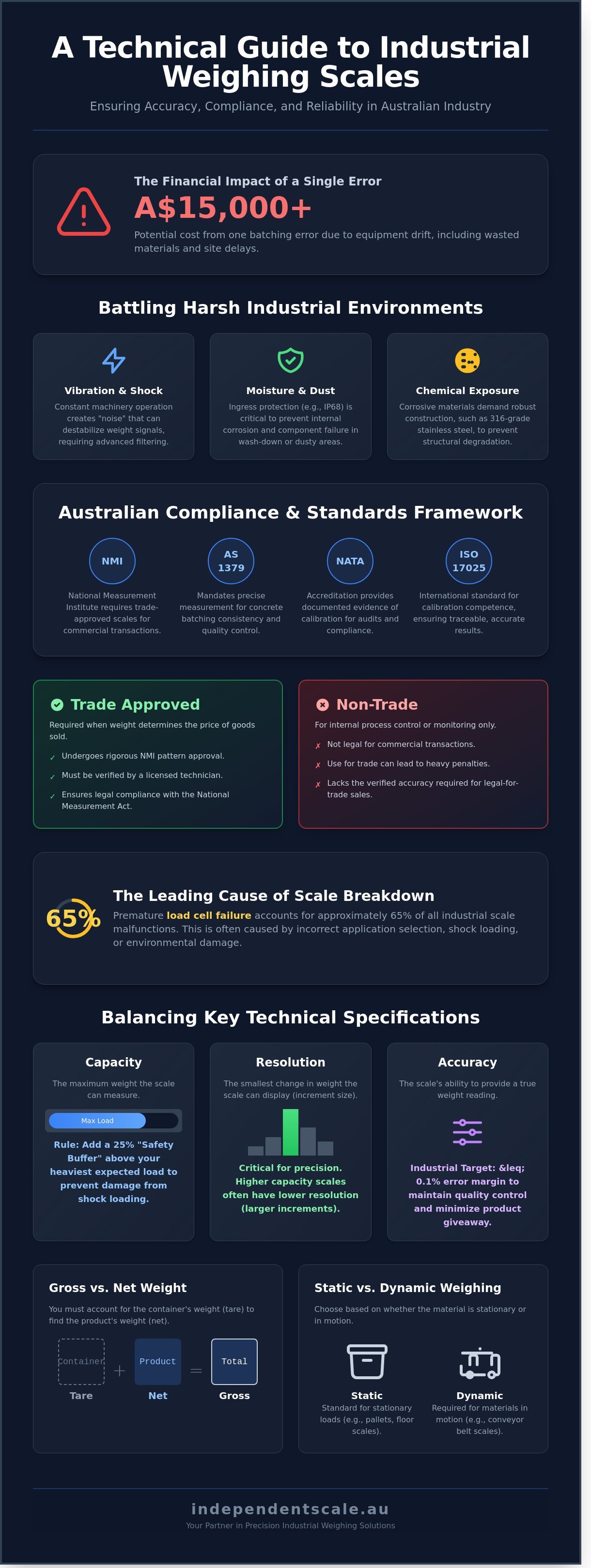
A single batching error caused by equipment drift can cost an Australian concrete plant upwards of A$15,000 in wasted materials and site delays. You understand that maintaining precision in harsh environments is a constant battle against moisture, vibration, and chemical exposure. Choosing an industrial weighing scale isn't just about the initial purchase price. It's about securing a technical system that remains accurate under the relentless pressure of 24/7 operations and heavy industrial use.
You've likely seen how quickly inferior equipment fails during a NATA audit or when subjected to corrosive materials. This guide provides the technical framework for selecting equipment that eliminates these risks while ensuring your facility meets the rigorous demands of AS 1379 and ISO 17025. We'll examine high-accuracy load cell configurations, IP68-rated environmental protection, and the specific calibration protocols required to maintain compliance through 2026. You'll gain the technical expertise needed to reduce downtime and guarantee long-term reliability for your weighing infrastructure.
Key Takeaways
- Understand the critical requirements of AS 1379 and why NATA accreditation is essential for maintaining regulatory compliance in Australian industrial environments.
- Master the technical variables of capacity and resolution to ensure precision and long-term reliability when choosing an industrial weighing scale.
- Distinguish between trade-approved and non-trade equipment to ensure your business meets legal-for-trade requirements and avoids costly compliance failures.
- Identify the engineering considerations necessary for matching scale types, such as hopper or pallet scales, to specific bulk material handling applications.
- Learn how professional installation and preventative maintenance schedules mitigate the risk of premature load cell failure and catastrophic downtime.
Defining Your Industrial Weighing Requirements
Selecting the correct hardware for your facility begins with a clear understanding of Australian regulatory standards. The most critical distinction you'll make is between trade-approved and non-trade scales. If your business uses weight to determine the price of goods sold, the National Measurement Institute (NMI) requires the use of a trade-approved weighing scale. These units undergo rigorous pattern approval and must be verified by a licensed technician to ensure they meet specific accuracy classes. Using non-trade equipment for commercial transactions violates the National Measurement Act 1960 and can lead to heavy penalties and legal disputes.
Application-specific selection is the only way to prevent premature load cell failure, which accounts for approximately 65% of all industrial scale breakdowns. You must define your "Application Environment" with precision. In a concrete batching plant, for example, equipment must withstand constant vibration and dust ingress. In food processing, an IP69K rating is essential to survive high-pressure, high-temperature wash-downs. Chemical exposure also dictates material choice; 316-grade stainless steel is often required for corrosive environments to prevent structural degradation that compromises accuracy. When choosing an industrial weighing scale, neglecting these environmental factors leads to frequent recalibration costs and avoidable downtime.
Your weighing system is the backbone of quality control and regulatory reporting. For operations following AS 1379 standards, precise measurement is mandatory for batch consistency. NATA-accredited calibration to ISO/IEC 17025 provides the documented evidence needed for audit trails. Accurate data doesn't just satisfy inspectors; it protects your margins by eliminating product giveaway and ensuring every batch meets the required specifications.
Gross vs. Net Weight Requirements
Understanding the difference between gross and net weight is vital for calculating your total capacity needs. You must account for the tare weight of containers, pallets, or the hopper itself. We recommend a "Safety Buffer" of at least 25% above your maximum expected gross weight. This buffer protects the internal sensors from shock loading and accidental overfilling. Net weighing is particularly critical for hopper and silo applications where the weight of the vessel, often called the "dead load," can be significant. If you don't factor this in, you'll exceed the load cell's rated capacity, causing permanent deformation.
Static vs. Dynamic Weighing
Static weighing is the standard for stationary loads like pallets or floor scales. However, if your process involves materials in motion, dynamic weighing is required. In industrial plants, vibration from surrounding machinery creates "noise" that can destabilise the weight signal. Advanced digital indicators use filtering algorithms to maintain stability despite these disturbances. Dynamic weighing in the context of belt scales refers to the continuous measurement of material mass flow as it travels across a moving conveyor belt. Choosing an industrial weighing scale for dynamic applications requires high-speed processors capable of performing thousands of weight calculations per second to maintain 0.5% to 1% accuracy levels.
Technical Specifications: Capacity, Resolution, and Accuracy
Choosing an industrial weighing scale requires a precise balance between maximum load capacity and required resolution. A common technical error involves over-specifying capacity. If your facility weighs 500kg pallets, a 2,000kg scale provides a safer structural buffer than a 10,000kg scale. High-capacity load cells often feature larger increments; this reduces precision for smaller loads. Accuracy isn't a single figure but a combination of linearity, hysteresis, and repeatability. Most industrial applications target a 0.1% error margin or better to maintain process control.
Resolution, or increment size, determines the smallest change in weight the scale can display. For legal-for-trade applications in Australia, the National Measurement Institute (NMI) mandates specific resolution limits based on accuracy classes. Standards set by the International Organization of Legal Metrology (OIML) define these performance tiers globally. Class III scales are the standard for most commercial transactions, while Class IIII scales are reserved for heavy-duty applications like axle weighing or scrap metal processing where lower resolution is permissible.
- Capacity: Ensure the rated capacity exceeds your heaviest load by at least 25% to account for shock loading.
- Resolution: Higher resolution isn't always better; it can lead to unstable readings in high-vibration environments.
- Compliance: NATA-accredited calibration ensures your equipment meets AS 1379 and ISO/IEC 17025 standards.
Selecting the Right Load Cell Technology
The structural integrity of your system depends on the load cells selected. Compression cells are standard for silos and large tanks, while tension cells suit suspended hoppers. For platform scales, shear beam cells offer a low profile and high resistance to side loads. Environmental protection is critical. IP67-rated cells handle occasional moisture, but 98% of concrete plants across Sydney require IP69K-rated stainless steel cells to survive high-pressure washdowns. Multi-cell systems rely on summing circuits and junction boxes to equalise signals; a single failing cell can compromise the entire weight reading.
Signal Processing: Indicators and Transmitters
Operators need clear visual feedback, which makes the choice of indicators and displays vital for site safety. High-contrast LED or LCD screens are essential in low-light Australian warehouses. For automated facilities, conditioners and transmitters convert raw millivolt signals into 4-20mA or digital protocols like Modbus and Profibus for PLC integration. While wireless transmission simplifies installation in large-scale plants, wired connections remain the preference for 24/7 critical batching systems to avoid signal interference. Technical experts at Independent Scale Service can assist with selecting compliant equipment for your specific site layout. It's vital to match the transmitter's update rate to your process speed; slow signal processing leads to overfilling in high-speed batching lines.
Compliance and Standards: AS 1379 and NATA Accreditation
Compliance is the most critical factor when choosing an industrial weighing scale for Australian construction and manufacturing. AS 1379 stands as the mandatory standard for the specification and manufacture of concrete. For batching plants, this isn't a suggestion; it's a legal requirement that ensures every cubic metre of concrete meets structural integrity benchmarks. Using non-compliant equipment triggers severe legal implications, including the potential for total site shutdowns and the rejection of poured slabs. If your equipment fails an audit, the cost of remediation and project delays far exceeds the price of a compliant scale system.
NATA accreditation to ISO/IEC 17025 provides the technical framework that protects your business from liability. This international standard confirms a laboratory's competence and the reliability of its testing results. While many providers claim to offer "calibration," only a NATA-accredited service can provide a certificate that holds up in a court of law or during a rigorous Tier 1 builder audit. Compliance also aligns with international frameworks, such as the OIML R 51-1 standards for industrial weighing, which define the metrological requirements for automatic catchweighing instruments used in high-speed industrial environments.
Meeting AS 1379 for Concrete Production
AS 1379 requires strict adherence to concrete batching plant calibration protocols. Cement, aggregate, and water scales must undergo mandatory testing at intervals not exceeding 6 months. For high-volume plants servicing major infrastructure projects, quarterly testing is often necessary to maintain precision. Documentation must be audit-ready, featuring clear logs of all repairs, adjustments, and tolerance checks. Failure to produce these logs during an inspection can result in the immediate decertification of the plant's output.
The Value of NATA-Accredited Calibration
A NATA calibration ensures that your measurements are traceable to national primary standards. This traceability is essential for risk management. In the weighing industry, we distinguish between the gravimetric method and comparative testing. The gravimetric method, using physical certified weights, is the only way to guarantee absolute accuracy. Comparative testing against a master meter is often insufficient for legal compliance in heavy industry. For businesses in Sydney and Melbourne, identifying a service provider with over 30 years of experience and a proven track record with companies like Boral and Holcim is the best way to ensure your equipment stays within tolerance.
Understanding the difference between calibration and verification is vital under the National Measurement Act. Calibration is the process of comparing a scale's reading against a known standard to determine its accuracy. Verification is a legal requirement for "Trade to be Used" scales, where goods are sold by weight. If you're choosing an industrial weighing scale to sell products by the tonne, you must ensure the scale is verified by a licensed technician and marked with a lead seal or green sticker. ISS provides both services, ensuring your plant remains 100% compliant with both industry-specific standards and Australian trade measurement law.
- AS 1379: Mandatory for all concrete production scales.
- ISO/IEC 17025: The global benchmark for calibration laboratory competence.
- 6-Month Intervals: The maximum allowable time between scale checks under AS 1379.
- Traceability: The documented link between your scale and national measurement standards.
Precision isn't just about performance; it's about legal security. A scale that's out of calibration by even 1% can lead to thousands of dollars in lost materials or, worse, structural failures that result in litigation. Relying on expert technicians who service 98% of concrete plants across Sydney ensures that your operations remain profitable and protected.
Matching Scale Types to Industrial Applications
Choosing an industrial weighing scale requires a precise alignment between the hardware's mechanical design and your specific operational environment. Warehouse and logistics facilities rely on platform and pallet scales to manage high-volume throughput. These systems must handle the repetitive stress of point-loading from forklifts and pallet jacks. Heavy-duty mild steel platforms with 5,000kg capacities are standard for these applications. They provide the durability needed for 24-hour freight hubs where equipment downtime directly impacts profitability.
Precision requirements differ significantly in pharmaceutical and laboratory settings. Bench scales provide the necessary resolution for mixing active ingredients or conducting chemical analysis. High-resolution bench scales often feature internal calibration mechanisms to adjust for gravity changes and environmental shifts. These units frequently offer readability down to 0.01g, which is essential for maintaining batch consistency and meeting strict regulatory standards. Data integration is another factor here; modern bench scales must export data directly to Laboratory Information Management Systems (LIMS) to ensure traceability.
Bulk Material Handling and Silo Systems
Retrofitting existing structures for weight measurement requires specialised tank and silo weighing assemblies. These kits convert static silos into active weighing vessels without requiring major structural overhauls. Engineering teams must account for thermal expansion in these installations. Australian outdoor silos experience extreme temperature swings. Steel expands at approximately 12 micrometers per metre for every degree Celsius of temperature change. In regions like Western Sydney or the Pilbara, a 30°C shift in a single day is common. Without expansion-compensating mounts, this movement introduces lateral force on load cells, leading to inaccurate readings. Integrating flowmeters alongside these systems allows for the precise measurement of liquid additives. This is a critical requirement for meeting AS 1379 standards in concrete production, where 98% of Sydney plants rely on accurate additive dosing for structural integrity.
Heavy Lifting and Tension Measurement
Safety-critical weighing in rigging and construction depends on the use of special purpose and shackle pins. These components replace standard pins in lifting gear to provide real-time force measurement. Choosing an industrial weighing scale for overhead lifting requires a focus on ultimate breaking strength and proof-load testing. Load pins are often used in crane sheaves or winches to monitor line pull and prevent overloads that could lead to catastrophic failure.
Compliance mandates regular force gauge calibration in safety-sensitive industries. Structural integrity testing for tension wrenches and load shackles ensures equipment performs under peak stress. Independent Scale Service provides NATA-accredited testing to ISO/IEC 17025 standards. This ensures all force measurement data is legally defensible and technically accurate. Regular testing prevents equipment failure during critical lifts. Technicians use hydraulic test benches to apply controlled loads, verifying that tension wrenches and shackles maintain their rated accuracy within specified tolerances. This rigorous approach to calibration protects personnel and assets on high-risk sites.
Ensure your equipment meets Australian standards and operational demands. Contact Independent Scale Service for expert equipment selection and NATA-accredited calibration.
Lifecycle Management: Installation, Repair, and Emergency Support
Choosing an industrial weighing scale is a capital investment that requires a long-term perspective on maintenance and technical support. Professional installation serves as the foundation for accuracy. If a scale is improperly leveled or secured, even the highest quality load cells will produce erratic data. Our technicians ensure that every installation complies with AS 1379 standards, preventing the 15% margin of error often seen in DIY or non-specialist setups. Accurate installation eliminates mechanical binding and ensures that load distribution remains consistent across all sensors.
Just as professional installation is key, ensuring the technicians performing these tasks are equipped with high-quality, durable workwear is essential for safety and efficiency. For specialized trade apparel, many Australian operations rely on providers like White Wear to outfit their teams.
Preventative maintenance schedules are a financial necessity rather than an optional service. Most industrial scales operate in harsh environments where dust, vibration, and heavy loading are constant. A structured 6-month or 12-month service plan identifies wear before it leads to a catastrophic failure. Data from our 30 years of field experience shows that regular calibration and cleaning reduce the likelihood of emergency breakdowns by 45%. Without this oversight, small issues like debris buildup under a weighbridge can cause significant weighing errors that result in lost revenue or non-compliant product batches.
Downtime in a high-volume facility often costs upwards of A$5,000 per hour in lost productivity and wasted materials. This makes 24/7 emergency repair availability non-negotiable for serious industrial operations. When choosing an industrial weighing scale, the speed of the service response is just as critical as the hardware specifications. We focus on addressing the three most common failure points in Australian industrial settings:
- Surge Damage: Lightning strikes and power fluctuations in industrial parks frequently fry sensitive electronics. We install high-grade surge arrestors to mitigate this risk.
- Moisture Ingress: Humidity and high-pressure washdowns can breach IP-rated enclosures. We use hermetically sealed stainless steel components to prevent internal corrosion.
- Mechanical Binding: Structural shifts or debris can physically jam the weighing mechanism, leading to "dead" scales or non-linear readings.
Diagnostics and Repair Services
Precision begins with identifying the root cause of a failure. We prioritise rigorous load cell testing and fault diagnosis to determine if a component requires replacement or simply recalibration. For facilities running older equipment, we specialise in upgrading legacy systems with modern digital indicators and advanced summing circuits. This process extends the lifecycle of existing hardware while adding modern data logging capabilities. Our team also handles the programming and commissioning of complex weighing logic for automated batching plants, ensuring seamless integration with your existing PLC systems.
Emergency Response and Support
Independent Scale Service maintains a dominant presence in the heavy industry sector, currently servicing 98% of concrete plants across the Sydney metropolitan area. Our Sydney and Melbourne teams are strategically positioned to provide rapid response to plant breakdowns, often arriving on-site within hours of a call. We offer a choice between on-site calibration for large-scale infrastructure and laboratory calibration for smaller, precision instruments. This flexibility allows us to minimise operational disruption. By maintaining NATA accreditation to ISO/IEC 17025, we provide the legal and technical assurance that your weights are accurate and your business remains compliant with Australian trade regulations.
Optimise Your Facility with Professional Weighing Standards
Selecting the right equipment is a critical operational decision for 2026. Choosing an industrial weighing scale requires a strict focus on technical specifications and regulatory adherence to AS 1379 standards. You've learned that accuracy isn't just about the initial purchase; it's about maintaining NATA accreditation to ISO/IEC 17025 throughout the equipment's entire lifecycle. Precision prevents material waste and protects your bottom line from compliance risks.
Effectively managing these operational costs, capital investments, and financial compliance is just as crucial as the technical side of the operation. For businesses in the Cairns region looking for professional guidance on these financial matters, you can discover Cairns Quality Accounting for tailored accounting and taxation services.
Independent Scale Service brings over 30 years of technical expertise directly to your facility. We currently service 98% of concrete plants across Sydney, providing the exact calibration required for high-stakes industrial environments. Our team manages every phase from initial installation to 24/7 emergency repair services across Australia. This commitment ensures your systems remain operational and fully compliant without costly interruptions or unexpected downtime. Don't leave your site's productivity to chance when expert-level calibration and technical support are a phone call away. We're ready to help you maintain the highest standards of measurement accuracy and operational reliability.
Contact Independent Scale Service for Expert Industrial Weighing Solutions
Frequently Asked Questions
What is the difference between a trade-approved and a non-trade industrial scale?
Trade-approved scales are a legal requirement under the National Measurement Act 1960 for any transaction where goods are sold by weight. These units must be verified by a licensed technician and marked with a lead seal or green sticker. Non-trade scales are only suitable for internal process control or check-weighing. Using a non-trade scale for commercial sales can result in corporate fines exceeding A$200,000.
How often should my industrial weighing scale be calibrated to remain compliant?
Industrial scales generally require professional calibration every 6 to 12 months to maintain accuracy and meet Australian regulatory standards. High-volume facilities, such as concrete batch plants, often mandate quarterly inspections to comply with strict site requirements. Regular intervals prevent measurement drift and ensure your equipment continues to meet the ISO/IEC 17025 standards required for NATA-accredited reporting and audit trails.
Does my scale need to meet AS 1379 standards if I am in the concrete industry?
Your weighing equipment must comply with AS 1379 if you produce or supply concrete within the Australian market. This specific standard dictates that all scales used for batching must be calibrated at intervals not exceeding 6 months. Failure to adhere to these benchmarks can lead to the immediate rejection of batch results and the loss of certification for major state infrastructure projects.
What are the main causes of load cell failure in harsh industrial environments?
Moisture ingress and electrical surges from lightning strikes account for 70% of load cell failures on Australian industrial sites. Physical overloading beyond the rated capacity also causes permanent deformation of the internal strain gauge, leading to inaccurate readings. You'll need to install surge arrestors and specify IP68-rated stainless steel load cells to mitigate these risks in wash-down or exposed outdoor environments.
Can I calibrate my own industrial scales, or do I need a NATA-accredited professional?
You can perform basic internal checks using certified test weights, but official compliance requires a NATA-accredited professional. Only a technician operating under ISO/IEC 17025 accreditation can issue the formal certificates required for external audits and legal trade. Choosing an industrial weighing scale with a valid NATA calibration certificate ensures your data is legally defensible and stands up to rigorous regulatory scrutiny.
What is the benefit of a 3-point vs. a 5-point calibration test?
A 5-point calibration test provides a more detailed analysis of a scale's linearity across its entire capacity range. While a 3-point test only checks the zero, midpoint, and maximum capacity, a 5-point test adds two additional increments to identify subtle inaccuracies. This higher level of detail is essential for high-precision batching where even a 0.5% variance can compromise the integrity of the final product mix.
How do environmental factors like wind and temperature affect silo weighing accuracy?
Wind loads create parasitic forces that can add or subtract hundreds of kilograms from a silo's perceived weight during a storm. Temperature fluctuations cause the metal silo structure to expand or contract, which shifts the load distribution across the sensors. You must use high-quality summing circuits and thermal compensation hardware to maintain accuracy within the 2% tolerance often required for industrial bulk storage systems.
What should I do if my weighing indicator shows an "Error" or "OL" message?
An "OL" message indicates an Overload condition where the weight on the platform exceeds the scale's rated capacity. "Error" codes usually signal a communication break between the load cell and the indicator, often caused by a severed cable or moisture in the junction box. If the message remains after you've removed the load, you'll need a technician to perform a gravimetric method calibration to reset the system.
