


Choosing a Crane Scale: A Buyer's Guide for Industrial Applications
Selecting the right high-capacity crane scale is not just a procurement task; it's a critical investment in your operational safety, efficiency, and regulatory compliance. The consequences of an incorrect choice-from catastrophic safety failures under load to non-compliance penalties and costly downtime-are significant. For many industrial managers, navigating the technical specifications of capacity, accuracy, and durability can be a complex challenge, especially when factoring in the stringent requirements for calibration and trade certification within Australia.
This buyer's guide provides a direct, technical framework to simplify the process. We will detail the essential criteria for evaluating and choosing a scale that delivers precision, ensures operator safety, and guarantees compliance with Australian standards. Our goal is to empower you to make a confident, long-term investment in a reliable and accurate crane scale that meets the demanding needs of your facility and minimizes operational risk.
Key Takeaways
- Evaluate a scale’s capacity, accuracy, and durability against the specific demands of your industrial application to ensure operational safety and precision.
- Discover the essential safety and data management features that define a modern industrial crane scale, moving beyond basic measurement to improve worksite productivity.
- Understand why NATA calibration and Legal-for-Trade certification are non-negotiable for mitigating risk and ensuring regulatory compliance in Australia.
- Learn how to select a supplier based on their technical expertise and ongoing support, ensuring a long-term partnership rather than a one-off transaction.
What is a Crane Scale and Why is it Critical in Industry?
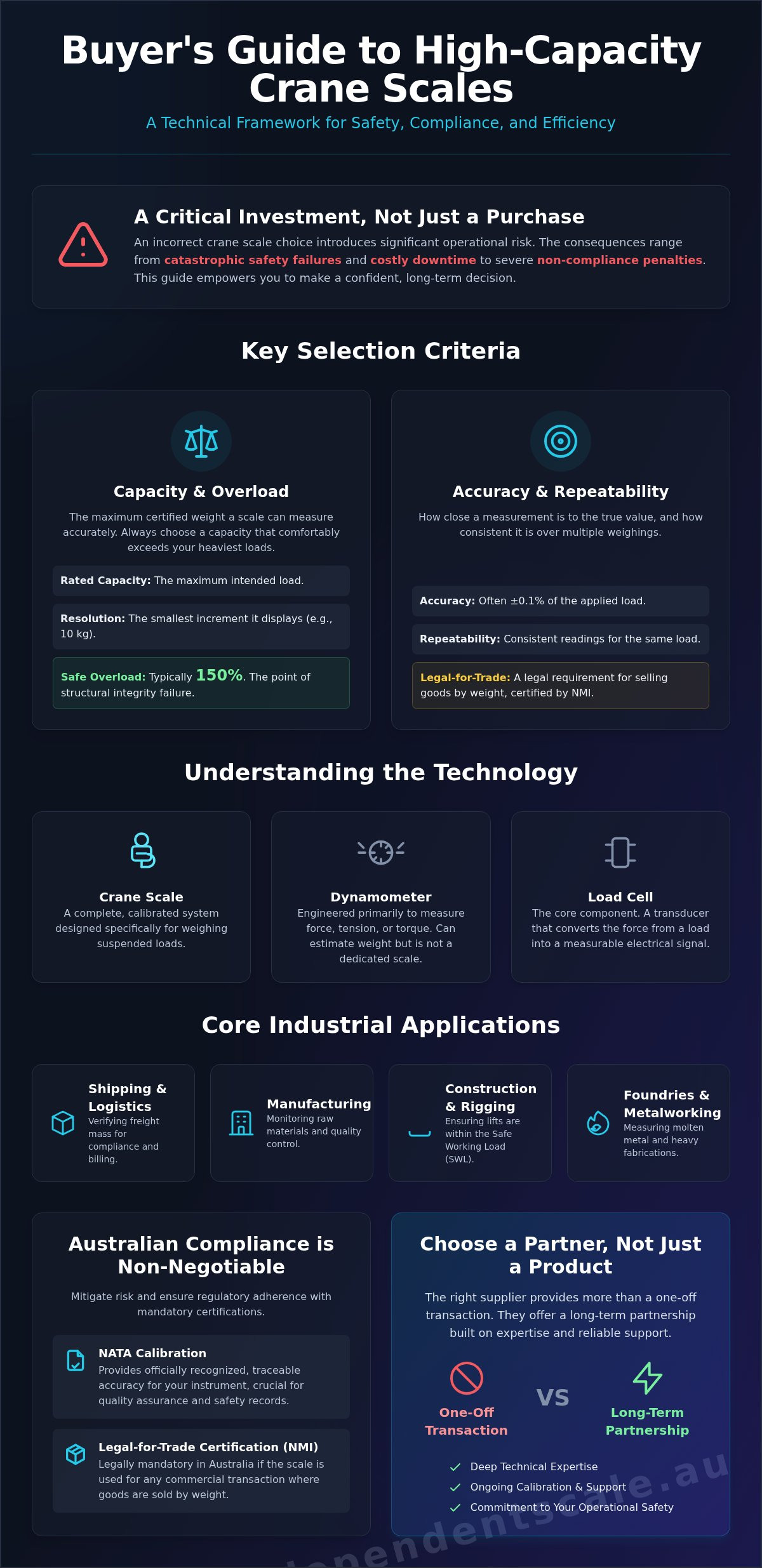
A crane scale is a heavy-duty, purpose-built weighing instrument designed to measure the weight of a load as it is lifted, typically by a crane, hoist, or winch. Unlike platform scales that weigh static objects from below, these devices operate in-line with lifting equipment, providing immediate and accurate weight data for suspended items. For a foundational overview of weighing instruments, understanding What is a Crane Scale in the context of industrial metrology is essential. Its function is critical not just for commerce but for operational safety and regulatory compliance.
Beyond simple mass determination, a high-capacity crane scale is an integral tool for process control and risk management. It provides the precise data needed to prevent dangerous crane overloads, verify shipping weights for freight manifests, manage inventory levels of raw materials, and ensure quality control in production. In Australia, key sectors from shipping and logistics in Port Botany to major construction projects and manufacturing hubs nationwide depend on the accuracy and reliability of these devices for safe and efficient operations.
Core Industrial Applications
- Shipping and Logistics: Accurately verifying the gross mass of freight containers and consignments to comply with transport regulations and ensure correct billing.
- Manufacturing: Monitoring the consumption of raw materials in production batches and verifying the weight of finished goods for quality assurance.
- Construction and Rigging: Ensuring that lifts are within the safe working load (SWL) of cranes and rigging equipment, a fundamental component of worksite safety protocols.
- Foundries and Metalworking: Precisely measuring ladles of molten metal for casting processes or weighing large, heavy fabrications and castings post-production.
Crane Scale vs. Dynamometer vs. Load Cell
It is important to distinguish between related but functionally distinct equipment. A crane scale is a complete, calibrated system designed specifically for weighing applications. A dynamometer, by contrast, is engineered primarily to measure force, tension, or torque. While it can be used to estimate weight, its core function is force measurement. The critical component enabling both is the load cell-a transducer that converts the force exerted by the load into a measurable electrical signal. In essence, a crane scale is a robust housing, display, and hook assembly built around a high-capacity load cell to create a dedicated weighing solution.
Key Selection Criteria: Matching a Crane Scale to Your Application
Selecting the correct high-capacity crane scale is a critical operational and safety investment. The specific demands of your application must dictate the required specifications. Choosing a unit based on price alone introduces significant risks, including inaccurate measurements, premature failure, and potential safety hazards. A forward-thinking approach that anticipates future operational needs ensures a long-term, reliable solution.
The decision process should be guided by four core factors: capacity, accuracy, safety, and durability. Each element must be carefully evaluated to ensure the selected equipment is fit-for-purpose and compliant with industry standards.
Capacity, Resolution, and Safe Overload
The most fundamental specification is the rated capacity-the maximum weight the scale is certified to measure accurately. This is paired with resolution, which is the smallest weight increment the display can show (e.g., a 20,000 kg scale may have a 10 kg resolution). A critical safety metric is the Safe Overload Percentage, typically 150% of rated capacity, which indicates the maximum load the unit can withstand without structural failure. This aligns with global best practices for operational limits, as detailed in frameworks like the OSHA regulations for crane scales, which mandate clear indication of rated loads. As a rule, select a capacity that comfortably exceeds your heaviest typical load to ensure a robust safety margin.
Accuracy, Repeatability, and Tolerances
Accuracy defines how close a measured weight is to the true value, often expressed as a percentage (e.g., ±0.1% of the applied load). Equally important is repeatability-the scale's ability to provide consistent readings for the same load over multiple weighings. The required level of precision is determined by the application. For commercial transactions where product is sold by weight, a trade-approved crane scale certified by Australia's National Measurement Institute (NMI) is legally required. For internal processes like batching or inventory checks, a lower accuracy class may be sufficient. Be aware that environmental factors, particularly temperature fluctuations, can affect a load cell's accuracy.
Durability and Environmental Protection (IP Rating)
A scale's construction must match its operating environment. Key durability indicators include:
- IP Rating (Ingress Protection): This two-digit code rates the enclosure's resistance to dust and moisture. An IP65 rating is suitable for dusty environments and protects against water jets, while an IP67 rating allows for temporary immersion in water, essential for marine or wash-down applications.
- Material Construction: Most industrial scales use high-strength alloy steel. For corrosive environments, food processing, or chemical plants, stainless steel construction is essential to prevent degradation.
- Operating Conditions: Check the specified operating temperature range to ensure reliable performance in extreme heat or cold, such as in foundries or outdoor yards. Shock and impact resistance are also vital in demanding industrial settings.
Essential Features for Modern Industrial Crane Scales
Beyond simple mass measurement, a modern industrial crane scale is a sophisticated tool designed to enhance operational safety, efficiency, and data integrity. The selection of specific features directly impacts worksite productivity and risk management. Advanced functionalities move the device from a basic weighing instrument to a critical component of a streamlined industrial process, providing tangible benefits in demanding environments like manufacturing, logistics, and construction.
Display and Remote Readability
Clear visibility of the load weight is a fundamental safety requirement. The choice between an LED (Light Emitting Diode) and LCD (Liquid Crystal Display) screen depends on the operational environment. LED displays offer superior brightness and are ideal for indoor or low-light conditions, such as in foundries or warehouses. Conversely, LCDs perform better in direct sunlight. A large, bright digital display ensures readings are clearly visible from a distance, allowing personnel to remain outside the immediate lift zone. This aligns with fundamental crane safety standards, which prioritise operator awareness. For crane operators in a cabin, a separate wireless remote display provides a dedicated, real-time readout for maximum safety and control.
Wireless Connectivity and Remote Operation
Remote operation is a non-negotiable feature for safety-conscious industries. A handheld remote control allows operators to perform essential functions-such as Tare, Zero, and Hold-without approaching the suspended load. This functionality is critical for maintaining a safe distance and minimising personnel exposure to potential hazards. Furthermore, advanced wireless options enable the seamless transmission of weight data directly to a PC, PLC, or data logger. This integration automates record-keeping, eliminates manual entry errors, and provides an accurate digital trail for inventory management and compliance reporting.
Power Source and Battery Performance
A reliable power source is essential for preventing costly operational downtime. High-capacity crane scales typically feature long-life rechargeable battery packs, providing extended hours of continuous use suitable for high-throughput facilities. While standard disposable batteries can serve as a convenient backup, rechargeable systems offer a more cost-effective and environmentally sound solution for regular operations. To maximise uptime, look for intelligent power management features such as:
- Auto-off functionality: Powers down the unit after a set period of inactivity.
- Sleep modes: Conserve energy while keeping the scale ready for immediate use.
- Low-battery indicators: Provide clear warnings to prevent unexpected shutdowns during critical lifts.
Calibration, Compliance, and Legal-for-Trade Requirements
For any industrial operation relying on a high-capacity crane scale, accuracy is not a feature-it is a fundamental requirement. Operating with uncalibrated or non-compliant equipment exposes your business to significant risks, including financial penalties, contractual disputes, and safety hazards. Ensuring your weighing systems are precise, certified, and properly maintained is an essential investment in operational integrity.
The Importance of NATA-Accredited Calibration
NATA (National Association of Testing Authorities) is Australia's national accreditation body for laboratories and technical facilities. NATA accreditation to ISO/IEC 17025 signifies that a calibration provider meets the highest technical and quality standards. This ensures that every measurement is traceable to national standards, providing irrefutable proof of your scale's accuracy. A regular NATA calibration schedule is critical for maintaining this precision over time. Learn more about Independent Scale Service's NATA calibration services.
Understanding 'Legal for Trade' (NMI Approved) Scales
If your crane scale is used to determine the price of goods, it must be 'Legal for Trade'. This is a specific certification mandated by Australia's National Measurement Institute (NMI). This requirement applies whenever you are:
- Selling or buying goods by weight.
- Calculating a tax, toll, or fee based on a measurement.
- Complying with laws that require a certified measuring instrument.
NMI approval is a rigorous certification process and is not standard on all scales. It is crucial to use an NMI-approved device for any transactional weighing to avoid severe legal and financial consequences.
Ongoing Maintenance and Recalibration
Calibration is not a one-time event. The accuracy of weighing equipment naturally drifts due to wear, environmental factors, and heavy use. A structured maintenance and recalibration plan is essential to guarantee sustained performance. Periodic professional servicing not only upholds compliance but also extends the operational lifespan of your equipment, protecting your investment and preventing costly downtime. Independent Scale Service provides expert ongoing maintenance to ensure your systems remain compliant and reliable.
Sourcing and Support: Choosing the Right Supplier
Purchasing a high-capacity crane scale is a significant investment in your operational safety and efficiency. This decision should be viewed as the beginning of a long-term partnership, not a one-off transaction. The quality of the supplier's ongoing support is as critical as the technical specifications of the equipment itself. A reputable, full-service provider ensures your asset delivers accurate, reliable performance for its entire service life, minimising costly operational disruptions.
Expert Advice vs. Online Purchase
While online marketplaces offer convenience, they lack the technical consultation required for specialised industrial equipment. An incorrect purchase based on incomplete information can lead to significant financial loss, non-compliance, and safety risks. A specialist supplier assesses your specific application, from load characteristics to environmental factors and data integration needs. This expert guidance ensures the selected crane scale is perfectly matched to your operational requirements, preventing costly purchasing mistakes from the outset.
Assessing After-Sales Support and Repair Services
Before committing to a supplier, it is essential to verify their capacity for after-sales support. Every hour of equipment downtime directly impacts your revenue and project timelines. A supplier without robust service capabilities becomes a liability when issues arise. When evaluating potential partners, ask critical questions:
- Do you provide in-house repair and calibration services?
- What is your typical turnaround time for critical repairs?
- Are you NATA-accredited for calibration and certification?
- Do you maintain a local inventory of essential spare parts like batteries, load cells, and chargers?
The availability of prompt, expert support and parts is non-negotiable for maintaining operational continuity. A full-service provider like Independent Scale simplifies ownership by integrating supply, maintenance, and compliance into a single, reliable point of contact. Contact our experts for a consultation on your weighing needs.
Secure Your Operational Accuracy with the Right Crane Scale
Selecting the correct industrial weighing solution is a critical decision that directly impacts operational safety, efficiency, and your bottom line. This guide has underscored the key pillars of a sound choice: meticulously matching capacity and durability to your specific application, prioritising essential safety and data management features, and adhering to strict calibration and legal-for-trade compliance standards. The right crane scale is not merely a piece of equipment; it is an integral component for maintaining quality control and operational integrity.
Navigating these technical requirements demands proven expertise. With over 30 years of industry experience, Independent Scale Service provides authoritative guidance. As a NATA Accredited facility to ISO/IEC 17025, we supply, calibrate, and maintain equipment to the highest Australian standards. Our comprehensive repair and maintenance services ensure your investment delivers sustained accuracy and reliability. Contact our experts to find the right industrial crane scale for your application and ensure your operations are precise and compliant from the outset.
Frequently Asked Questions About High-Capacity Crane Scales
How often should a crane scale be calibrated?
Calibration frequency depends on usage intensity, the operating environment, and manufacturer specifications. As an industry standard in Australia, annual calibration by a NATA-accredited technician is essential for maintaining accuracy and compliance. For heavy-use or mission-critical applications, more frequent verification, such as quarterly or semi-annually, is recommended to ensure consistent performance and operational safety. Neglecting regular calibration can lead to inaccurate measurements and potential non-compliance with industry regulations.
What is the primary difference between a crane scale and a load link?
The primary difference is the integrated display. A crane scale incorporates a built-in digital screen for immediate weight readout at the point of lift. In contrast, a load link, or dynamometer, is a tension load cell that typically transmits data wirelessly to a separate handheld remote or display unit. Load links are often more compact and better suited for applications where viewing the load from a distance or in-line tension monitoring is required.
Are digital crane scales more accurate than older mechanical models?
Yes, modern digital crane scales provide significantly higher accuracy, resolution, and reliability compared to older mechanical (dial) models. Digital scales utilise precise electronic load cells and microprocessors, eliminating the parallax error common with analogue dials and providing consistent, repeatable results. They also offer advanced functions like tare, peak hold, and data logging, which are critical for modern industrial processes and are unavailable on mechanical units.
What safety checks should be performed before each use of a crane scale?
A pre-use inspection is a critical safety requirement. Visually inspect the hook, safety latch, and shackles for any signs of wear, deformation, or cracks. Ensure the load cell housing is free from damage and that all fasteners are secure. Power on the unit to confirm the display is functioning correctly and the battery level is sufficient for the job. Most importantly, verify the scale's rated capacity exceeds the maximum weight of the intended lift to prevent overloading.
Can a crane scale that is used for weighing also be used for lifting applications?
Yes, a crane scale is engineered to be an integral part of a lifting assembly. It is an in-line device designed to both weigh and safely suspend a load simultaneously. It is imperative that the scale, along with all associated rigging components like shackles and slings, possesses a working load limit (WLL) suitable for the lift. The entire system must be rated for the heaviest anticipated load and maintained in accordance with Australian standards.
What does the 'tare' function do on a crane scale?
The 'tare' function zeroes the scale's display after a load has been applied. This is used to subtract the weight of lifting equipment such as slings, chains, spreader bars, or containers. By taring the weight of this rigging, the scale subsequently displays only the net weight of the object being weighed. This function is essential for accurate invoicing, material batching, and ensuring compliance with specified load weights in commercial and industrial settings.
