


Cement vs. Concrete: The Critical Difference for Industrial Applications
In industrial applications, imprecise terminology can lead to significant operational and financial risk. A fundamental misunderstanding of the cement vs concrete relationship is a common source of error that can compromise entire projects. While often used interchangeably in conversation, in a technical context, this confusion can directly result in non-compliant mixes, failed quality assessments, and ultimately, structural integrity issues that carry substantial liability.
This article provides the essential clarification required for industrial production. We will define the distinct roles of cement as a binding agent and concrete as the final composite material. Crucially, we will explain why the precise, gravimetric measurement of every component is not merely a matter of quality control, but a non-negotiable requirement for meeting Australian Standards like AS 1379, ensuring batch consistency, and safeguarding your operation from the high cost of project failure.
Key Takeaways
- Grasp the fundamental difference: Cement is the active binding powder, while concrete is the durable, composite building material it creates.
- The distinction between cement vs concrete is critical in mix design and specification to avoid costly errors and ensure structural performance.
- Ingredient proportion is not a guideline-it's a critical control point that directly determines the concrete's final strength, durability, and compliance.
- Achieving precise and repeatable batching for industrial applications relies on professionally calibrated weighing systems to meet standards like AS 1379.
What is Cement? A Closer Look at the Key Binding Agent
To accurately understand the distinction in the cement vs concrete discussion, it is essential to first define the core components. Cement is not the final, hard material used for foundations, driveways, or structures; it is a crucial ingredient used to create that material. In the simplest terms, cement is the binding agent-the fine, grey powder that acts as the glue, holding everything else together to form concrete.
The most common type used in construction projects across Australia and worldwide is Portland cement. It is classified as a hydraulic cement, meaning it chemically reacts with water in a process called hydration. This reaction causes it to set and harden, binding the other components into a durable, rock-like mass. Without cement, you simply have a loose pile of sand and gravel.
The Chemical Composition and Role of Cement
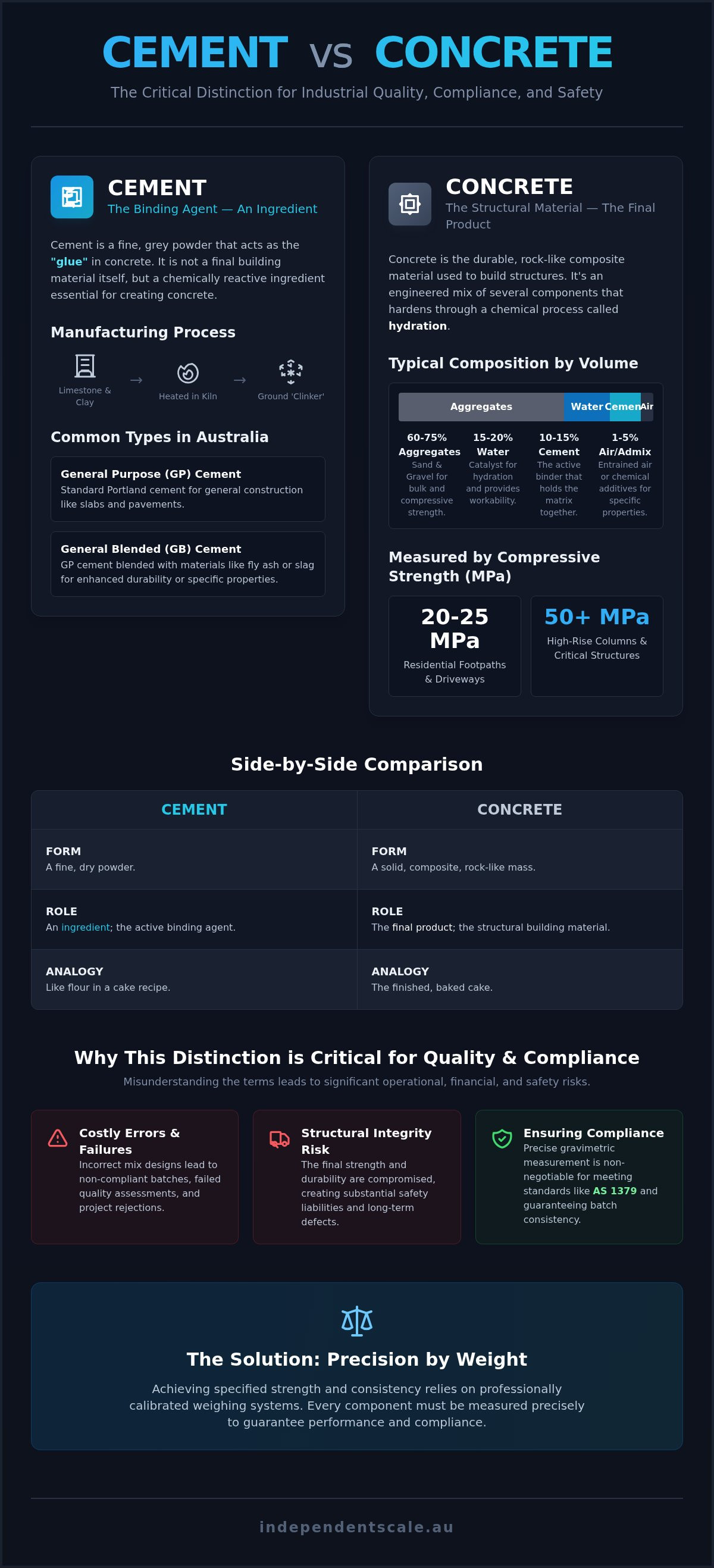
Cement is a carefully manufactured powder produced by heating a mixture of limestone, clay, shale, and other minerals to extremely high temperatures in a kiln. This process creates a substance called 'clinker', which is then ground into the fine powder we recognise as cement. For a technical overview of what cement is, its properties and production are well-documented. As the chemically reactive component in a concrete mix, its primary function is to form a paste when mixed with water. This paste coats the aggregates (sand and gravel) and fills the voids between them, initiating the hardening process that binds all the materials together into a single, solid structure.
The efficient handling and packaging of this fine powder is a critical step in the cement supply chain. Industrial producers often rely on specialized machinery for this process, and those looking to optimize their operations can explore Valve Bag Fillers designed for such materials.
Common Types of Cement in Australia
In Australia, the type of cement used is specified according to the project's performance requirements and compliance with Australian Standards (such as AS 3972). The selection is critical, as it directly impacts the concrete's final properties, including its strength, durability, and workability. The two most common classifications are:
- General Purpose (GP) Cement: This is the standard Portland cement used for a vast range of general construction applications, including residential slabs, pavements, and precast products.
- General Blended (GB) Cement: This type consists of GP cement blended with supplementary cementitious materials (SCMs) like fly ash or slag. These blends are engineered to provide specific benefits, such as improved long-term durability, resistance to chemical attack, or a lower heat of hydration for mass concrete pours.
What is Concrete? The Final Composite Structural Material
While cement is a critical ingredient, concrete is the final, durable composite material used in construction. Understanding the distinction in the cement vs concrete debate is simple: concrete is the robust, stone-like substance that forms foundations, slabs, columns, and roads. It is a precisely engineered mixture that, once set, provides the structural integrity for modern infrastructure.
The hardening process, known as hydration, is an irreversible chemical reaction between cement and water. This reaction forms crystals that interlock and bind the aggregates together, creating an immensely strong and resilient material. Concrete is, therefore, the finished structural product, not a raw powder.
The Four Core Ingredients and Their Functions
The performance and quality of concrete are directly determined by the precise ratio and quality of its core components. An accurate mix is essential for achieving the specified structural properties.
- Cement: The active binding agent. When mixed with water, it forms a paste that coats the aggregates and hardens to bind the entire matrix together.
- Aggregates: A combination of fine aggregate (sand) and coarse aggregate (gravel or crushed stone). They provide the bulk of the concrete's volume, contributing to its compressive strength and dimensional stability.
- Water: The catalyst for the hardening process. It initiates the hydration reaction with the cement and provides the necessary workability (slump) to allow the fresh concrete to be placed and finished correctly.
- Admixtures (Optional): Specialised chemical additives that can be introduced to the mix to modify its properties, such as accelerating or retarding the setting time, improving durability, or increasing workability.
Understanding Concrete Strength and Specifications (MPa)
Concrete's structural capability is quantified by its compressive strength, measured in megapascals (MPa). This rating is the direct result of a carefully formulated mix design, where the water-to-cement ratio is the most critical factor. Engineering plans for any significant project will specify a minimum MPa rating required for different applications. For example, a residential footpath may require 20-25 MPa, whereas a high-rise structural column could demand 50 MPa or more to meet the stringent safety and durability requirements of Australian standards.
Cement vs. Concrete: A Side-by-Side Comparison for Professionals
In industrial and construction settings, precision in terminology is essential for accurate project specification, material ordering, and quality control. While often used interchangeably in casual conversation, cement and concrete are fundamentally different materials. Understanding the distinction is critical for any professional involved in structural work. The core relationship is straightforward: cement is an ingredient in concrete, much like flour is an ingredient in a cake. You cannot build a foundation with cement alone, just as you cannot bake a cake with only flour.
This section provides a direct, technical breakdown of the key differences to clarify the roles and properties of each material.
Composition and State
The primary distinction in the cement vs concrete debate lies in their physical composition and state. Cement is a manufactured, dry powder. It is produced by heating limestone, clay, and other materials in a kiln and does not exist in a natural state. In contrast, concrete is a composite material. It begins as a workable, wet mixture and cures through a chemical reaction (hydration) into a solid, durable mass. By volume, concrete is typically composed of only 10-15% cement, which acts as the binding agent for the aggregates.
Function and Application
The function of each material is entirely distinct. Cement's sole purpose is to act as a binder. When mixed with water, it forms a paste that coats aggregates and binds them together as it hardens. It is never used as a standalone structural product. Concrete, as the final composite material, is used for a vast range of structural applications, including:
- Foundations and footings
- Structural slabs and beams
- Roads, bridges, and dams
- Precast panels and pipes
Cement is also the binding ingredient in mortar, which is a mixture of cement, water, and fine sand, used for bonding masonry units like bricks and blocks.
Quick Reference Comparison Table
For an at-a-glance summary, this table contrasts the essential attributes of cement and concrete.
| Attribute | Cement | Concrete |
|---|---|---|
| Role | An active ingredient; a hydraulic binder. | A final, composite construction material. |
| Composition | A fine powder (calcium silicates, aluminates) made from limestone, clay, and other elements. | A mixture of cement, water, and aggregates (sand, gravel, crushed stone). |
| State | A dry, fine powder before use. | A workable, wet slurry that cures into a hard, solid mass. |
| Primary Use | A binding agent in concrete, mortar, and grout. | Structural applications: foundations, slabs, beams, columns, roads. |
| Strength | Possesses adhesive and cohesive properties when hydrated. | Engineered for high compressive strength; typically has low tensile strength. |
Why This Distinction Is Critical for Quality and Compliance
Understanding the difference in the cement vs concrete debate moves from a simple definition to a critical business imperative in an industrial setting. Cement is a precisely manufactured ingredient; concrete is the final structural product. The quality, strength, and safety of that final product depend entirely on the accurate proportioning of its components. In the production of concrete, there is no margin for error.
The Water-to-Cement Ratio: The Key to Strength
The single most important factor determining the final strength and durability of concrete is the water-to-cement ratio. Too much water creates a porous, weak product prone to cracking and failure. Too little water results in a mix that is too stiff to place and finish properly, leading to voids. Achieving the specified ratio requires exact, verifiable measurements of both cement and water, which is only possible with precisely calibrated weighing systems.
Meeting Australian Standard AS 1379
In Australia, the production and supply of ready-mixed concrete is governed by Australian Standard AS 1379. This standard sets strict requirements for materials, production processes, and quality control. Compliance is not optional; it is a contractual and often legal requirement for major projects. Adhering to AS 1379 demands rigorous process control and equipment-especially weighing systems-that is demonstrably accurate and regularly calibrated by an accredited authority.
The High Cost of Inaccuracy
Failing to control the proportions of cement, aggregates, and water leads to significant financial and safety risks. Out-of-spec concrete is not just a minor issue; it creates severe liabilities that can impact an entire operation:
- Rejected Batches: The immediate cost of wasted materials, labour, and transport, plus the expense of disposing of non-compliant product.
- Project Delays: A rejected batch can halt construction, leading to costly downtime and liquidated damages for missing deadlines.
- Structural Failure: The worst-case scenario. Weak concrete can lead to catastrophic failure, endangering lives and resulting in immense legal and financial repercussions.
- Reputational Damage: Consistently supplying non-compliant product will quickly erode client trust and market position.
Ultimately, investing in accuracy is not a cost-it is an essential investment in operational integrity. Ensuring your batching plant's weighing equipment is professionally calibrated is fundamental to mitigating these risks. For expert calibration services compliant with Australian Standards, visit independentscale.au.
Ensuring Precision: The Role of Calibrated Weighing Systems
Understanding the distinction in the cement vs concrete debate is fundamental, but producing high-strength, reliable concrete depends entirely on the precise measurement of its constituent parts. The specified mix design-the exact ratio of cement, aggregates, water, and admixtures-dictates the final product's performance. In modern concrete batching plants, achieving this precision is not left to chance; it is managed by sophisticated, automated weighing systems.
The entire production process relies on the accuracy of this equipment. From structural beams to pavement, any deviation from the engineered mix design can compromise strength, durability, and safety. This is where professional calibration and high-quality weighing components become non-negotiable operational requirements.
Weighing Materials with Industrial Load Cells
In a typical batching plant, materials are stored in large hoppers and silos. These containers are integrated into weighing assemblies that use high-quality industrial load cells as their core sensor. These robust electronic devices accurately measure the force of the materials by converting pressure into an electrical signal. Separate systems precisely weigh the cement powder, various aggregates (sand and gravel), and water before they are combined in the mixer, ensuring every batch is consistent.
The Necessity of NATA Accredited Calibration
Over time, even the most robust weighing equipment can drift from its original settings due to wear, environmental factors, or mechanical stress, leading to inaccurate measurements. Calibration is the essential process of verifying and adjusting this equipment against a known, traceable standard. In Australia, NATA (National Association of Testing Authorities) accreditation is the industry benchmark for competence and reliability. Regular, NATA-accredited calibration ensures your plant operates in compliance with standards like AS 1379 and produces consistently high-quality concrete. For guaranteed compliance and accuracy, engage a specialist for expert concrete batching plant calibration.
Monitoring the Batching Process
Accurate weighing is only effective if the data is clearly communicated to the plant operator. Modern digital indicators and displays provide clear, real-time readouts of each ingredient's weight as it is batched. This allows operators to monitor the process, confirm that mix design tolerances are being met, and maintain a complete data record for quality assurance. This continuous oversight is critical for identifying potential issues before they impact the final product, turning the complex relationship of cement vs concrete into a predictable, high-performance material.
From Distinction to Precision: Ensuring Compliant Concrete Production
Understanding the critical difference between cement as a binding agent and concrete as the final structural material is fundamental to any industrial application. This distinction is not merely semantic; it directly impacts structural integrity, project specifications, and regulatory adherence. Ultimately, the debate of cement vs concrete gives way to a more critical operational focus: the precise and consistent formulation of the concrete mix itself. This precision, achieved through accurately calibrated weighing systems, is non-negotiable for achieving the required strength and durability.
At Independent Scale Service, we provide the expertise to guarantee that precision. With over 30 years of industry experience, our team ensures your batching plant weighing systems are flawlessly accurate. We offer guaranteed compliance with Australian Standard AS 1379 through our NATA Accredited to ISO/IEC 17025 calibration services. Ensure Your Concrete Meets AS 1379 with Our NATA Accredited Calibration Services.
Partner with us to uphold the highest standards of quality and compliance in every batch.
Frequently Asked Questions
Is mortar the same thing as concrete or cement?
No, they are distinct materials. Cement is the binding agent. Mortar combines cement, fine aggregate (sand), and water; it is used to bond masonry units. Concrete includes cement, fine aggregate, coarse aggregate (gravel), and water. The key difference in the cement vs concrete discussion is the coarse aggregate, which gives concrete superior compressive strength for structural applications. Mortar lacks this structural capacity.
What exactly is Portland cement and why is it called that?
Portland cement is the most common type of hydraulic cement used globally. It is a fine powder produced by heating limestone and clay materials in a kiln and adding gypsum. It is not a brand name but a generic term for cement that sets and hardens through a chemical reaction with water. The name originates from its resemblance to Portland stone, a high-quality building stone quarried on the Isle of Portland in England.
How do different types of aggregate affect the final properties of concrete?
Aggregate constitutes the bulk of concrete volume and is critical to its performance. The type, size, and shape of aggregates directly influence the concrete's workability, strength, and durability. Coarse aggregates like crushed stone provide the primary load-bearing structure and compressive strength. Rounded aggregates enhance flow and workability, while angular, rough-textured aggregates create a stronger mechanical bond within the cement paste, resulting in higher flexural strength.
What happens if you add too much or too little water to a concrete mix?
The water-to-cement ratio is a critical parameter for concrete quality. Adding too much water increases workability but significantly reduces compressive strength and durability, leading to increased porosity and potential for cracking. Conversely, too little water makes the mix stiff and difficult to place and compact properly. This can result in voids, or honeycombing, creating weak points within the structure and compromising its integrity. Accurate water measurement is essential.
How often should the scales in a concrete batching plant be calibrated?
In Australia, compliance with AS 1379 is mandatory. This standard stipulates that scales and metering devices in a concrete batching plant must be calibrated by a NATA-accredited authority at least every six months. More frequent calibration may be required depending on usage and plant conditions. This rigorous schedule ensures batch accuracy, consistent product quality, and compliance with project specifications, preventing costly material wastage and structural defects.
Can you use cement by itself for any application?
Cement is rarely used by itself for structural purposes. When mixed only with water, it forms a paste that is brittle and prone to significant shrinkage and cracking. Its primary function is as a binder within a larger composite like concrete. However, this cement paste, known as grout, is effective for non-structural applications such as filling masonry voids or sealing joints. Understanding the role of cement vs concrete is critical for structural integrity.
