


Cement Mix Ratios Explained: A Guide to Concrete, Mortar & Render
The difference between a structurally sound concrete slab and a crumbly, failed project often comes down to one critical factor: the mix. Incorrect proportions of cement, sand, and aggregate can lead to a lack of strength, premature cracking, and costly rework. Understanding the correct mix ratio cement is not just about following a recipe; it's about ensuring the structural integrity and longevity of your work, whether you're pouring a foundation compliant with Australian Standards or rendering a wall.
This guide provides the technical clarity required to eliminate guesswork. We detail the precise, industry-standard mix ratios for concrete, mortar, and render, enabling you to achieve professional-grade strength and durability. You will learn the correct proportions for specific applications, understand the principles behind them, and gain the confidence to accurately calculate the total volume of materials required for your project. Mastering these fundamental ratios is essential for a compliant and successful outcome.
Key Takeaways
- Understand the four core components of any mix and how their proportions determine the final strength and application of concrete, mortar, or render.
- Access a clear reference chart with standard ratios for various applications, from high-strength structural concrete to general-purpose mortar mixes.
- Learn how to accurately calculate the correct mix ratio cement for your project's volume, ensuring material efficiency and preventing costly waste.
- Discover why precise measurement is non-negotiable for structural integrity and how inconsistent mixes create significant safety risks in any application.
Understanding the Core Components of a Cement Mix
In construction and industrial applications, the term 'cement mix' is often used generically. However, the final product-whether it is concrete, mortar, or grout-is determined by a precise combination of core components. Achieving a structurally sound and durable result is analogous to a chemical formulation; the final product's quality is entirely dependent on using the correct ingredients in precise proportions. The specific mix ratio cement is engineered to meet performance requirements for strength, workability, and longevity.
A standard mix consists of four essential materials:
- Cement: The binding agent.
- Fine Aggregate: Typically sand.
- Coarse Aggregate: Such as gravel or crushed stone.
- Water: The chemical activator.
The Role of Cement: The Binder
Cement, most commonly General Purpose (GP) Portland cement in Australia, functions as the hydraulic binder. It is the 'glue' that holds the other components together. When water is introduced, the Core Components of a Cement Mix undergo a chemical reaction known as hydration. This exothermic process forms a crystalline matrix that interlocks the aggregates, creating a solid, stone-like mass. Different types of cement, such as General Blend (GB) or High Early Strength (HES), are specified for different applications, from general-purpose slabs to high-performance structural elements.
The Function of Aggregates (Sand & Gravel)
Aggregates are the inert granular materials that provide bulk and strength to the mix. They are categorised into two primary types:
- Fine Aggregate: Sand with particles up to 5mm. It fills the voids between coarse aggregates.
- Coarse Aggregate: Gravel or crushed stone larger than 5mm. It forms the primary structural framework of concrete.
Aggregates are not simply filler; they are essential for providing compressive strength, dimensional stability, and resistance to wear. The size, shape, and grading of aggregates directly influence the workability and final strength of the concrete.
The Importance of Water: The Activator
Water is the catalyst that initiates the hydration process in cement. However, its quantity is the most critical factor influencing the final strength and durability of the concrete. While sufficient water is required for the chemical reaction and to ensure the mix is workable, excess water significantly weakens the final product by increasing porosity. The relationship between the weight of water and the weight of cement is known as the water-to-cement (w/c) ratio. A lower w/c ratio is fundamental to achieving higher strength and greater durability in any professional mix ratio cement formulation.
Standard Cement Mix Ratios for Common Applications (With Chart)
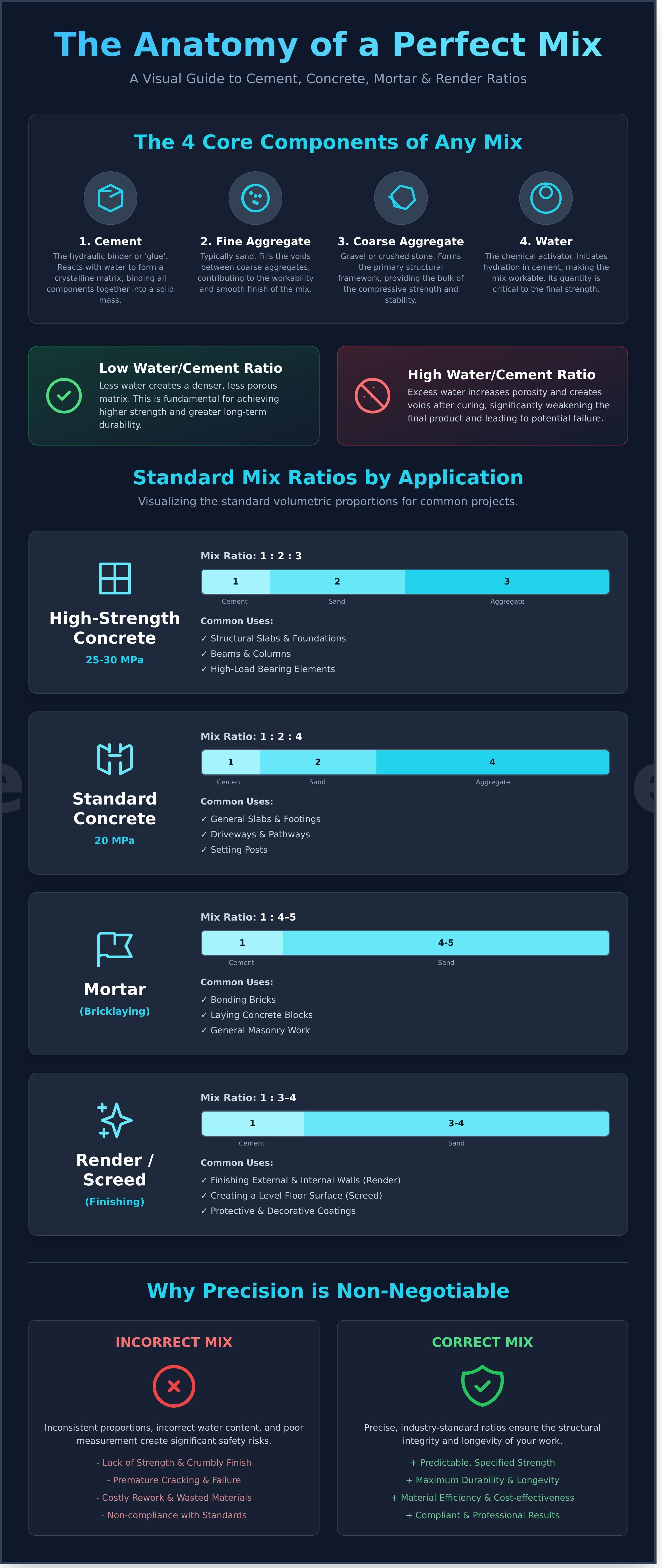
To achieve consistent and reliable results, understanding the correct mix ratio cement is fundamental. In construction and engineering, these ratios are typically expressed by volume-a formula indicating the proportional parts of cement, fine aggregate (sand), and coarse aggregate (gravel). For example, a 1:2:4 ratio specifies one part cement, two parts sand, and four parts coarse aggregate.
While the ratios provided below are established industry standards for general applications, they are starting points. The science behind optimal mix design is complex, which is Why Precision is Non-Negotiable for achieving specified performance and durability. It is imperative to always consult project-specific engineering documents and relevant Australian Standards or local building codes before commencing work.
| Application Type | Mix Ratio (Cement:Sand:Aggregate) | Typical Strength (MPa) | Common Uses |
|---|---|---|---|
| High-Strength Concrete | 1 : 2 : 3 | 25-30 MPa | Structural slabs, foundations, beams, columns. |
| Standard Concrete | 1 : 2 : 4 | 20 MPa | General slabs, footings, driveways, setting posts. |
| Mortar (Bricklaying) | 1 : 4-5 : 0 | N/A | Bonding bricks and concrete blocks. |
| Render / Screed | 1 : 3-4 : 0 | N/A | Finishing walls (render) or floors (screed). |
Concrete Mix Ratios: For Strength and Structure
For load-bearing and structural applications, the inclusion of coarse aggregate is essential for compressive strength. A standard general-purpose concrete mix (approx. 20 MPa) uses a 1:2:4 ratio and is suitable for foundations, slabs, footings, and even setting posts for a backyard tennis or pickleball court. For applications demanding higher strength and durability (25-30 MPa), such as suspended slabs or high-traffic areas, a richer mix of 1:2:3 is specified. The lower aggregate content in this mix ratio cement results in a denser, stronger final product.
Just as getting the concrete mix right is crucial for the court's foundation, choosing the right gear is essential for the game itself. For enthusiasts setting up their own space, specialists like Sturdy Racquets offer a wide range of equipment for these sports.
Mortar Mix Ratios: For Bricklaying and Blockwork
Mortar is a binding paste used in masonry and does not contain coarse aggregate (gravel). A general-purpose mortar for bricklaying typically uses a 1:4 to 1:5 ratio of cement to sand. For improved plasticity and workability, which prevents rapid drying and cracking, hydrated lime is often added to the mix. A common formulation is 1 part cement, 1 part lime, and 6 parts sand.
Render & Screed Mix Ratios: For Finishing Surfaces
Render (for vertical surfaces like walls) and screed (for horizontal surfaces like floors) are used to create a smooth, durable finish. These applications require a finer, more workable consistency than structural concrete. A typical mix ratio is between 1:3 and 1:4 (cement to sand), using a well-graded plasterer's sand to ensure a defect-free surface suitable for final finishes.
How to Calculate and Measure Materials for Your Project
Understanding the correct mix ratio cement is theoretical; applying it accurately is a practical discipline. The final strength and durability of your concrete depend entirely on the precise measurement of its components. There are two primary methods for measuring materials: by volume and by weight. Consistency is the most critical factor, regardless of the method chosen, as variations between batches will create weak points in the final structure.
Measuring by Volume: The DIY Method
For small, non-structural projects like garden edging or a small path, measuring by volume is a common and practical approach. The key is to use a single, consistent measuring container-such as a 10-litre bucket-for every component. If your ratio is 1:2:3, you will use one level bucket of cement, two level buckets of sand, and three level buckets of aggregate. Using the same container ensures the proportions remain constant, even if the exact weight of each "part" varies slightly.
A Step-by-Step Calculation Example
Let's calculate the materials for a small concrete slab measuring 2 metres long, 2 metres wide, and 100mm (0.1m) thick.
-
Step 1: Calculate the total volume.
Volume = Length x Width x Height
Volume = 2m x 2m x 0.1m = 0.4 m³ -
Step 2: Estimate cement required.
A common Australian rule of thumb is approximately 8 x 20kg bags of cement per cubic metre of concrete.
0.4 m³ x 8 bags/m³ = 3.2 bags. You would purchase 4 bags. -
Step 3: Determine aggregate and sand parts.
Using a standard 1:2:3 mix ratio (1 cement : 2 sand : 3 aggregate), and using one 20kg bag as one "part", you need:
- Cement: 4 parts (4 bags)
- Sand: 8 parts (4 x 2)
- Aggregate: 12 parts (4 x 3)
You would then use your chosen bucket to measure out 8 parts of sand and 12 parts of aggregate for your 4 bags of cement.
Measuring by Weight: The Professional Standard
In commercial and industrial applications, measuring by weight is the only acceptable method for ensuring quality and compliance with standards like AS 1379. Weight is an absolute measure, whereas volume is not. The volume of sand, for example, can swell by up to 25% depending on its moisture content, severely altering the water-cement ratio and final strength. Weight measurement eliminates this variable. Professional systems, such as the ACI mix design method, rely exclusively on precise material weights to formulate a concrete mix that meets specific performance criteria. This level of accuracy is why compliant concrete production facilities depend on precisely calibrated, NATA-accredited weighing systems to meet engineering specifications and regulatory standards.
From DIY to Industrial Scale: Why Precision is Non-Negotiable
While an incorrect mix ratio for a garden path might lead to cracks and frustration, the same mistake on an industrial scale has catastrophic consequences. In commercial and civil construction, where structures must support immense loads and withstand environmental stresses for decades, there is zero tolerance for inconsistency. The integrity of high-rise buildings, bridges, and critical infrastructure depends on every single batch of concrete meeting exact engineering specifications. This is where professional production methods diverge completely from DIY approximations, shifting from volumetric guesswork to scientific precision.
How Concrete Batching Plants Ensure Accuracy
Professional concrete suppliers do not use shovels or buckets to measure ingredients. Instead, they rely on a highly accurate process known as 'weigh batching'. In a computer-controlled batching plant, every component-cement, sand, aggregates, and even water-is measured by weight, not volume. This eliminates the inconsistencies caused by material density and moisture content, ensuring the final mix ratio cement is perfect every time. This process is essential for producing concrete that consistently meets the specific strength and durability requirements of an engineering design.
The Critical Role of Calibrated Weighing Equipment
The entire weigh batching system is fundamentally dependent on the accuracy of its weighing equipment, including load cells and scales. If these components are inaccurate, the entire batch is compromised, regardless of the sophistication of the control system. To guarantee precision, this equipment must undergo regular, professional calibration. In Australia, this process is governed by NATA (National Association of Testing Authorities) accreditation, which verifies that calibration procedures meet stringent standards. This is a non-negotiable requirement for compliance with AS 1379, the Australian Standard for the specification and supply of concrete.
Ensuring Compliance and Quality Control
Ultimately, an accurate mix ratio translates directly to predictable and specified concrete strength, measured in megapascals (MPa). Professionals cannot afford to 'eyeball' it when public safety and structural integrity are at stake. They rely on certified systems and processes underpinned by expertly calibrated equipment. This commitment to quality control ensures that the concrete poured on-site performs exactly as the engineers intended. For any operation producing concrete to Australian Standards, precise, calibrated weighing is not just best practice-it is an absolute requirement. Ensure your industrial weighing equipment meets Australian Standards with our NATA accredited calibration services.
Mastering Cement Ratios for Strength and Compliance
Understanding the function of each component-cement, aggregate, and water-is the foundation of any successful project. As we've covered, the ideal mix ratio cement varies significantly between applications like concrete, mortar, and render, directly impacting the final strength and durability. Whether you are tackling a weekend DIY task or managing a large-scale construction site, the core principle remains the same: precision is non-negotiable for a safe and lasting result.
For commercial concrete producers, this precision is a matter of strict regulatory compliance. To guarantee your operations meet Australian Standards, particularly AS 1379, your batching plant scales must be professionally calibrated. With over 30 years of industry experience, Independent Scale Service is NATA Accredited to ISO/IEC 17025 and the trusted expert in ensuring your equipment delivers accurate, compliant measurements every time. For industrial-grade precision, ensure your batching plant scales are NATA certified. Contact us for calibration services.
Frequently Asked Questions About Cement and Concrete Ratios
What is the difference between cement and concrete?
Cement is a key binding ingredient, but it is not the same as concrete. Think of it as the 'glue'. Concrete is the final composite product, created by mixing cement with aggregates (such as sand and gravel) and water. When these components are combined in the correct proportions, the cement and water form a paste that coats the aggregates and binds them together as it hardens, a process known as hydration.
What happens if you add too much water to your cement mix?
Adding excess water significantly compromises the final strength and durability of the concrete. A high water-to-cement ratio creates a weaker paste, leading to a finished product with lower compressive strength. This overly wet mix is also more susceptible to shrinkage, which causes cracking as the concrete cures. It increases porosity, making the concrete less resistant to weathering and chemical ingress, ultimately reducing its service life.
Can you make concrete with just cement and sand?
No, a mixture of only cement and sand creates mortar, not concrete. Mortar is used as a bonding agent for laying bricks, blocks, or stones. For a material to be classified as concrete and possess the required structural strength for applications like slabs or footings, it must include a coarse aggregate, such as gravel or crushed stone. This aggregate provides the bulk, stability, and compressive strength that mortar lacks.
How long do I have to work with concrete before it sets?
Typically, you have approximately one to two hours of working time, or 'pot life', after mixing the concrete. This timeframe can be affected by ambient conditions; high temperatures and low humidity will accelerate the setting process, reducing your working window. It is essential to have all formwork, tools, and finishing equipment ready before you begin mixing to ensure the concrete can be placed and finished before it becomes unworkable.
How many 20kg bags of cement do I need for 1 cubic metre of concrete?
For a standard, general-purpose concrete mix (e.g., 20-25 MPa strength), you will typically need between 15 and 18 bags of 20kg cement to produce one cubic metre (1m³) of concrete. The exact number depends on the specified strength and the precise mix design, including the ratios of sand and aggregate used. Always consult the mix design specifications for your specific project to ensure accuracy and structural integrity.
Is it better to measure cement mix ingredients by volume or weight?
Measuring ingredients by weight is unequivocally superior for achieving a consistent and accurate result. While measuring by volume (e.g., with buckets) is common for small DIY jobs, it is highly imprecise. The volume of aggregates, particularly sand, can vary significantly with moisture content-a phenomenon known as 'bulking'. Measuring by weight eliminates these variables, ensuring your mix ratio cement is precise every time, leading to predictable strength and compliance with standards like AS 1379.
