


Bulk Storage Vessel Load Cells: The 2026 Guide to Industrial Weighing & Compliance
Did you know that under the National Measurement Act 1960, operating with unverified scales can trigger fines exceeding A$220,000? For Australian industrial operators, the financial impact of a single measurement error extends far beyond lost product. It represents a direct threat to your regulatory standing and operational continuity. You likely already know that maintaining a precise bulk storage vessel load cell system is a relentless challenge. Between measurement drift causing significant inventory discrepancies and the persistent pressure of AS 1379 compliance, the margin for error has never been thinner.
This 2026 guide provides the technical expertise you need to master vessel weighing systems. You'll gain a comprehensive understanding of hardware selection criteria and the rigorous Australian compliance standards required for precision. We'll examine the updated National Measurement Guidelines 2026, mandatory calibration intervals, and the specific NATA-accredited protocols necessary to eliminate unplanned downtime. By the end of this article, you'll have a clear roadmap for ensuring your weighing assemblies remain accurate, compliant, and reliable in the most demanding industrial environments.
Key Takeaways
- Identify the critical technical differences between compression and tension assemblies to ensure you select the correct bulk storage vessel load cell for your specific structural configuration.
- Align your industrial weighing systems with Australian regulatory standards, focusing on AS 1379 compliance and NATA-accredited calibration protocols for ISO/IEC 17025.
- Master the calculation of total system capacity by accurately balancing dead and live loads while selecting hardware with IP68 or IP69K ratings for environmental durability.
- Implement proactive diagnostic techniques to detect measurement drift and bridge resistance issues before they escalate into costly unplanned production downtime.
What is a Bulk Storage Vessel Load Cell System?
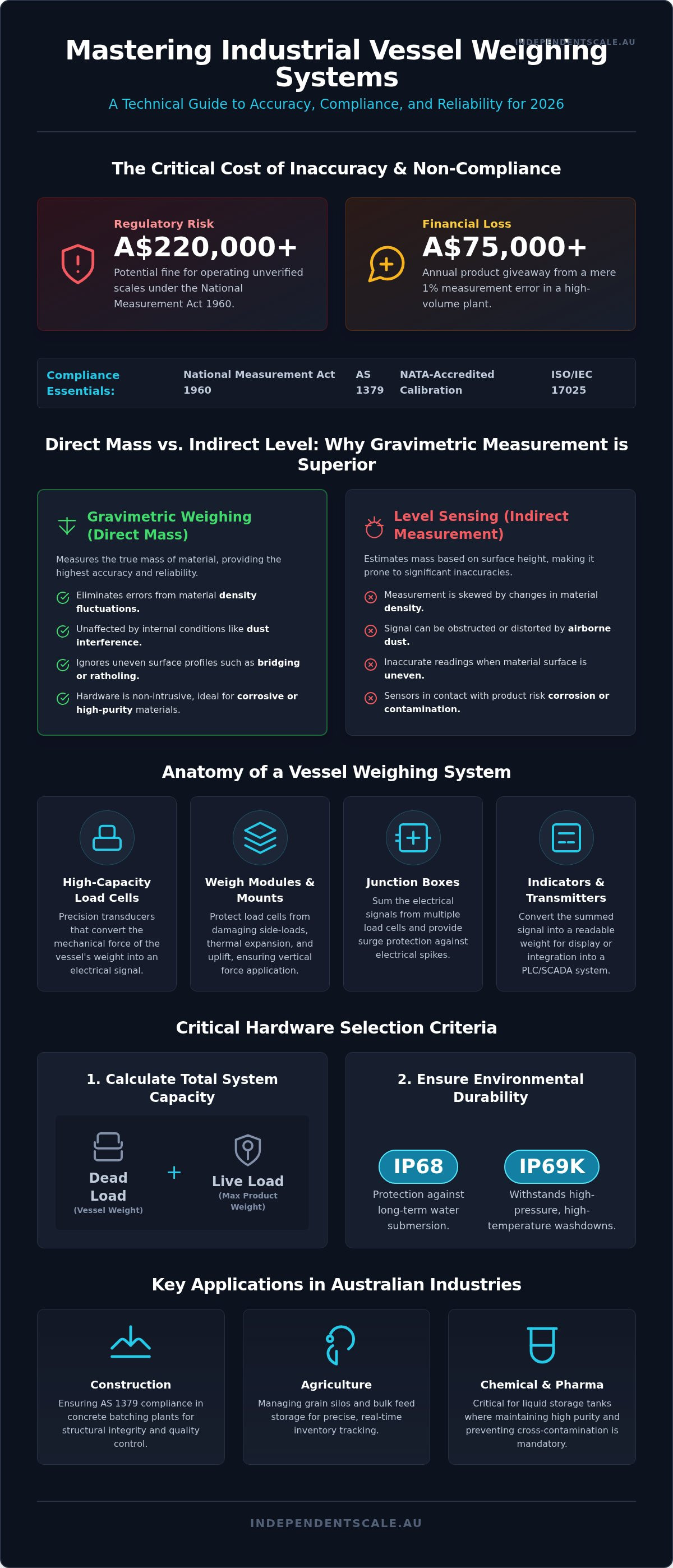
A bulk storage vessel load cell system is an integrated structural measurement solution designed to monitor the mass of materials within a container by measuring the force applied to its supports. Unlike ultrasonic or radar level sensors that measure surface height, gravimetric weighing provides direct mass measurement. This method eliminates errors caused by material density fluctuations, dust interference, or uneven surface profiles such as bridging or ratholing. For high-volume Australian concrete plants, where a 1% margin of error can result in over A$75,000 of product giveaway annually, the precision of a gravimetric system is a financial necessity.
The system utilizes a load cell as a precision transducer. This component converts the mechanical stress of the vessel's weight into a millivolt electrical signal, which is then processed into a readable weight value. Because the measurement hardware remains outside the vessel, it is the optimal choice for hazardous, corrosive, or high-purity materials. Non-intrusive measurement ensures that sensors are never in contact with the product, preventing contamination and extending the operational life of the hardware in aggressive environments.
Core Components of a Vessel Weighing System
A robust bulk storage vessel load cell configuration requires specific hardware to ensure structural stability and signal integrity. Each component must be selected based on the vessel's capacity and environmental conditions. The primary hardware includes:
- High-capacity load cells: These are typically compression, tension, or shear beam models depending on whether the vessel is floor-mounted or suspended.
- Weigh modules and mounting hardware: These assemblies protect the load cells from side loads, thermal expansion, and uplift while ensuring the weight is applied vertically for accurate measurement.
- Junction boxes: These units sum the signals from multiple load cells and often include surge protection to prevent damage from lightning or electrical spikes.
- Digital indicators and transmitters: These devices convert the summed signal into a digital format for display or integration into a PLC or SCADA system.
Applications Across Australian Industries
Precision weighing is critical for inventory control and regulatory adherence across multiple sectors. In the construction industry, concrete batching plants must maintain AS 1379 compliant systems to ensure structural integrity and meet Australian standards. Agricultural operations rely on these systems for managing grain silos and bulk feed storage to track inventory levels in real time. Similarly, the chemical and pharmaceutical industries use vessel weighing for liquid storage tanks where maintaining high purity and preventing cross-contamination is mandatory. These industries require reliable hardware that can withstand harsh washdown or dusty environments while providing NATA-accredited accuracy.
Types of Load Cells for Tank, Silo, and Hopper Weighing
Selecting the correct bulk storage vessel load cell requires a precise analysis of the vessel's physical support structure and environmental exposure. A mismatch between hardware and structural design causes measurement inaccuracy, structural instability, and premature component failure. Industrial weighing systems typically categorize load cells based on the direction of force they are designed to measure: compression, tension, or shear. For large-scale Australian operations, the choice is often dictated by the vessel's capacity and whether it is floor-mounted or suspended from an overhead frame.
Compression Weigh Modules
Large upright silos and heavy-capacity storage tanks rely on compression weigh modules as the primary measurement standard. These assemblies are engineered to manage massive vertical forces while neutralizing horizontal interference. High-quality tank and silo weighing assemblies feature self-aligning top plates that accommodate the natural thermal expansion and contraction of the vessel. This prevents the introduction of side-load errors that would otherwise lead to measurement drift. For outdoor installations across Australia, integrated lift-off protection is a mandatory safety feature. It ensures the vessel remains secured to its foundation during high wind events or seismic activity, protecting both the hardware and the surrounding infrastructure.
Tension and S-Beam Solutions
Process vessels and batching hoppers are frequently suspended from overhead steelwork to save floor space or facilitate gravity-fed discharge. Tension load cells, specifically S-beam models, are the standard choice for these configurations. Achieving accuracy in a suspended system requires specialized mechanical considerations, including the use of rod-end bearings or stay cables to isolate the cell from vessel sway and vibration. Precise vertical force alignment is essential. If the load path is not perfectly plumb, the system will suffer from cosine errors that degrade measurement integrity. For operations involving high-vibration equipment like mixers or vibratory feeders, vibration isolation mounts are necessary to maintain a stable signal for the digital indicator.
Shear Beam and Specialized Pin Solutions
Shear beam and double-ended shear beam load cells provide a low-profile solution for medium-to-high capacity weighing. These are particularly effective for horizontal tanks or vessels where vertical clearance is limited. Double-ended shear beams offer superior resistance to side loads, making them ideal for vessels with internal agitation. For unique structural mounts, such as those integrated into heavy-duty pivot points, special purpose shackle pins and load pins are used. These components replace existing structural pins to provide accurate weighing data without requiring significant modifications to the vessel's footprint. If you are unsure which mounting style fits your infrastructure, reviewing a comprehensive load cell supply range can help identify the optimal transducer for your specific application.
Key Factors in Selecting Vessel Weighing Assemblies
Precision in industrial weighing starts with an accurate calculation of total system capacity. To select the correct bulk storage vessel load cell, you must distinguish between dead load and live load. The dead load includes the weight of the empty vessel, internal agitators, heating jackets, and piping. The live load is the maximum weight of the material to be stored. Engineers typically apply a safety factor of 25% to 50% above the total weight to account for impact loading and uneven weight distribution across support points. Failure to calculate these values correctly leads to cell overloading or poor resolution.
Environmental protection is a non-negotiable selection criterion for Australian sites. Transducers must be rated to IP68 for protection against moisture ingress or IP69K for facilities requiring high-pressure, high-temperature washdown. Material selection also dictates long-term reliability. While alloy steel is a cost-effective solution for dry, indoor aggregate storage, stainless steel is mandatory for corrosive chemical environments or pharmaceutical applications. Additionally, the structural integrity of the vessel supports must be verified; the support legs must accommodate the added height and mounting requirements of the chosen weigh modules without compromising stability.
Accuracy and Resolution Requirements
Your process requirements define the necessary increment size for the weighing system. High-precision batching requires a finer resolution than simple inventory monitoring. Signal stability is critical here; electromagnetic interference (EMI) or long cable runs can degrade the low-voltage signal from the load cell. Integrating high-quality conditioners and transmitters is essential to amplify and stabilize the signal before it reaches the digital indicator. These components ensure that the resolution you require is maintained consistently, preventing erratic readings that disrupt production cycles.
Mitigating Environmental Influences
External factors can significantly distort weighing data if not properly managed through hardware selection. Thermal expansion is a primary concern in Australia, where temperature swings can cause a 10-metre steel silo to expand or contract by several millimetres. Weigh modules must allow for this horizontal growth without applying side loads to the sensor. Wind loading and seismic activity are also critical for tall silos located in coastal or high-wind regions. Robust mounting assemblies provide the necessary uplift protection to keep the vessel secure. Finally, for outdoor installations, integrated lightning and surge protection are required to prevent catastrophic electrical damage during storm events, ensuring the longevity of your investment.
Installation and Calibration Standards for Australian Industry
Maintaining a bulk storage vessel load cell system requires strict adherence to Australian regulatory frameworks. As of April 1, 2026, the National Measurement Institute (NMI) has implemented updated legislative instruments that place a greater emphasis on documented traceability. Fines for using unverified scales can now exceed A$220,000 under the National Measurement Act 1960. For industrial operators, NATA-accredited calibration to ISO/IEC 17025 is the only way to ensure that measurements are traceable back to national primary standards. This accreditation serves as a critical stamp of authority, mitigating liability and ensuring that your inventory data stands up to rigorous auditing.
Achieving AS 1379 Compliance
Concrete production demands high precision to ensure structural integrity and batch consistency. The updated 2026 version of AS 1379 mandates that all weighing equipment in batching plants undergo calibration every six months. High-volume plants that ignore this cycle risk significant financial loss; a 1% margin of error can result in over A$75,000 of product giveaway annually. To remain certified, facilities must use concrete batching plant calibration services that provide NATA-endorsed reporting. These reports are the mandatory benchmark for heavy industry in Australia, confirming that cement and aggregate measurements meet specific accuracy tolerances.
The Calibration Process
The calibration procedure begins with a thorough pre-calibration inspection. Technicians check for mechanical binds, such as stiff piping or structural interference, that could bypass the load cells and cause erratic readings. Once the mechanical health is verified, zero and span adjustments are performed using NATA-traceable standards. While certified test weights are the preferred method, hydraulic force simulation is frequently employed for high-capacity silos where loading physical weights is logistically impossible. Linearity testing is then conducted across the vessel's full operating range to confirm accuracy at every stage of the fill cycle. This methodical approach ensures that the transducer's output remains consistent even under varying load conditions.
Comprehensive documentation is the final requirement for a compliant weighing system. Every calibration must result in a detailed certificate that includes the date of service, the standards used, and the recorded accuracy of the system. Maintaining these records in a digital portal simplifies quality assurance and ensures you're prepared for unplanned audits. If your system hasn't been verified within the last six months, you should book a NATA-accredited load cell calibration to restore precision and maintain your regulatory standing.
Optimizing Performance: Maintenance, Repair, and Troubleshooting
Long-term accuracy for a bulk storage vessel load cell depends on a rigorous maintenance schedule. Unplanned downtime due to system failure is a significant financial risk; Australian manufacturers can lose up to A$427 per minute during critical production halts. Early identification of performance degradation is essential. Common indicators include measurement drift, where the zero balance shifts over time, or non-linearity, where accuracy varies depending on the vessel's fill level. Erratic or fluctuating readings often point to moisture ingress or damaged cabling, requiring immediate diagnostic intervention.
To further protect against operational delays, many Australian facilities also rely on Sacor for the supply and maintenance of industrial separation technology, ensuring that every stage of the production line remains efficient.
Diagnostic testing involves quantifying the electrical health of the transducer. Technicians measure bridge resistance across input and output terminals to check for internal circuit damage. Insulation resistance testing is also mandatory to detect ground leaks or moisture contamination within the cell body. Beyond the sensors, preventative maintenance must include a physical inspection of stay rods, bumpers, and earth straps. Earth straps are vital in Australian industrial environments to protect sensitive electronics from welding currents or lightning strikes, while stay rods must remain clear of debris to prevent mechanical interference.
Troubleshooting Mechanical Binds
Mechanical binds are the most frequent cause of weighing errors in a bulk storage vessel load cell system. Rigid piping, stiff conduit, or heavy-duty hoses can "shunt" weight away from the sensors, leading to under-reporting of inventory. Technicians must ensure all connections use flexible couplings that allow for the vertical movement of the weigh modules. Debris buildup, such as hardened concrete or grain dust, can also lodge in the gaps of the mounting hardware, effectively locking the system. Regular cleaning and inspection of these gaps are necessary to maintain free movement. Additionally, structural deflections in the vessel's support legs or foundation can shift load distribution, causing one cell to bear a disproportionate amount of weight and potentially exceeding its rated capacity.
Professional Load Cell Repair and Supply
Determining whether to repair or replace a compromised component depends on the extent of the damage and the criticality of the application. While some signal conditioners or junction boxes can be repaired, a physically damaged or moisture-compromised load cell usually requires replacement to maintain NATA-accredited accuracy. Sourcing replacements from a load cell supply expert ensures that the new hardware matches the original specifications for sensitivity and environmental rating. For critical plant breakdowns, an emergency response strategy is necessary. Maintaining a stock of essential spares, such as sum cards and spare sensors, minimizes the time required to restore production. If your system shows signs of instability, a professional diagnostic session is the most efficient way to prevent a total system failure.
Securing Your Industrial Weighing Compliance for 2026 and Beyond
Achieving precision in bulk storage measurement requires a systematic approach that balances hardware selection with rigorous regulatory adherence. You've learned that the integrity of your bulk storage vessel load cell system depends on calculating dead vs. live loads accurately and selecting IP-rated stainless steel components for harsh Australian environments. With the National Measurement Guidelines 2026 now in effect, the necessity for NATA-accredited calibration to ISO/IEC 17025 has never been more critical for mitigating legal and financial risks.
Maintaining AS 1379 compliance isn't just a regulatory hurdle; it's a strategy for operational efficiency that prevents product giveaway and minimizes unplanned downtime. Independent Scale Service provides the technical expertise and responsive support required to keep your systems operational across Sydney, Melbourne, and regional Australia. Our team of AS 1379 compliance experts ensures your facilities remain audit-ready and accurate. Contact Independent Scale Service for NATA-Accredited Vessel Calibration today to verify your weighing infrastructure and protect your production continuity. Your commitment to precision today ensures a more reliable and profitable operation tomorrow.
Frequently Asked Questions
How often should a bulk storage vessel load cell be calibrated?
For concrete batching plants, AS 1379 mandates a six-month calibration interval to maintain certification. In other industrial sectors, an annual calibration is generally sufficient unless the system is subjected to high vibration or extreme temperature cycles. Regular verification ensures that your bulk storage vessel load cell maintains its specified accuracy class and prevents long-term measurement drift that can lead to significant inventory discrepancies.
Can I use load cells on a silo that is already installed?
Yes, you can retrofit load cells onto existing silos through a process called jacking. This involves temporarily supporting the vessel while installing specialized weigh modules between the silo legs and the foundation. It's a standard procedure for upgrading older inventory management systems. You must ensure the existing foundation and support structure can accommodate the additional height and specific mounting requirements of the new weighing assemblies.
What is the difference between a load cell and a weigh module?
A load cell is the sensor that converts force into an electrical signal, while a weigh module is the complete mounting assembly. The weigh module includes the load cell plus structural components like top and bottom plates, lift-off protection, and side-load constraints. Using a weigh module is essential for vessel weighing because it ensures the load is applied vertically and protects the sensor from thermal expansion or wind-induced lateral forces.
Why is NATA accreditation important for vessel weighing?
NATA accreditation provides independent verification that a laboratory meets the ISO/IEC 17025 international standard for technical competence. For Australian industrial clients, NATA-endorsed reports are often a mandatory requirement for meeting safety and quality audits. It guarantees that your calibration data is traceable to national primary standards, providing a legally defensible record of accuracy that generic, non-accredited certificates cannot offer for high-stakes industrial applications.
How do environmental factors like wind affect silo weighing accuracy?
Wind creates vertical and horizontal forces that the weighing system can interpret as changes in material mass. In tall silos, wind-induced uplift or side-loading can cause significant measurement errors if the system isn't properly isolated. To mitigate this, engineers use weigh modules with integrated uplift protection and employ digital signal processing in the weight indicator. These filters help average out fluctuations caused by wind gusts, providing a stable inventory reading.
What are the signs that a load cell in my batching plant is failing?
Failing load cells typically exhibit erratic readings, non-linearity, or a persistent failure to return to a true zero balance. You might notice that batch weights become inconsistent or that the digital indicator shows a drifting value even when the vessel is static. If you suspect a failure, performing a bridge resistance and insulation test is the standard diagnostic step to confirm if the internal strain gauges have been compromised.
Is it better to use three or four load cells for a vertical tank?
A three-point mounting system is theoretically superior because it's statically determinate, meaning the weight is always distributed among all three cells regardless of floor levelness. This setup simplifies calibration and ensures stability on uneven surfaces. However, for large rectangular vessels or silos in high-wind regions, a four-point system is often preferred for increased structural stability and safety. The choice depends on the vessel's geometry and specific site risks.
Can load cells be used for legal-for-trade bulk storage?
Yes, bulk weighing systems can be used for legal-for-trade applications provided the hardware is NMI-approved. Both the bulk storage vessel load cell and the digital indicator must have a current National Measurement Institute pattern approval. Once installed, the system must be verified and sealed by a licensed technician to ensure it meets the requirements of the National Measurement Act 1960 for commercial transactions.
