


AS 1379 Calibration: 2026 Concrete Plant Compliance Guide
On May 22, 2026, the publication of AS 1379:2026 officially superseded the long-standing 2007 version, fundamentally altering the compliance obligations for every concrete batching plant in Australia. For plant managers and operators, staying ahead of these changes is the only way to prevent rejected loads and the legal liabilities associated with non-compliant structures. You know that even a minor drift in weighing accuracy can lead to significant project delays and failed audits. Understanding the specific AS 1379 calibration requirements is no longer optional; it's a critical operational necessity for maintaining your standing on high-profile government contracts.
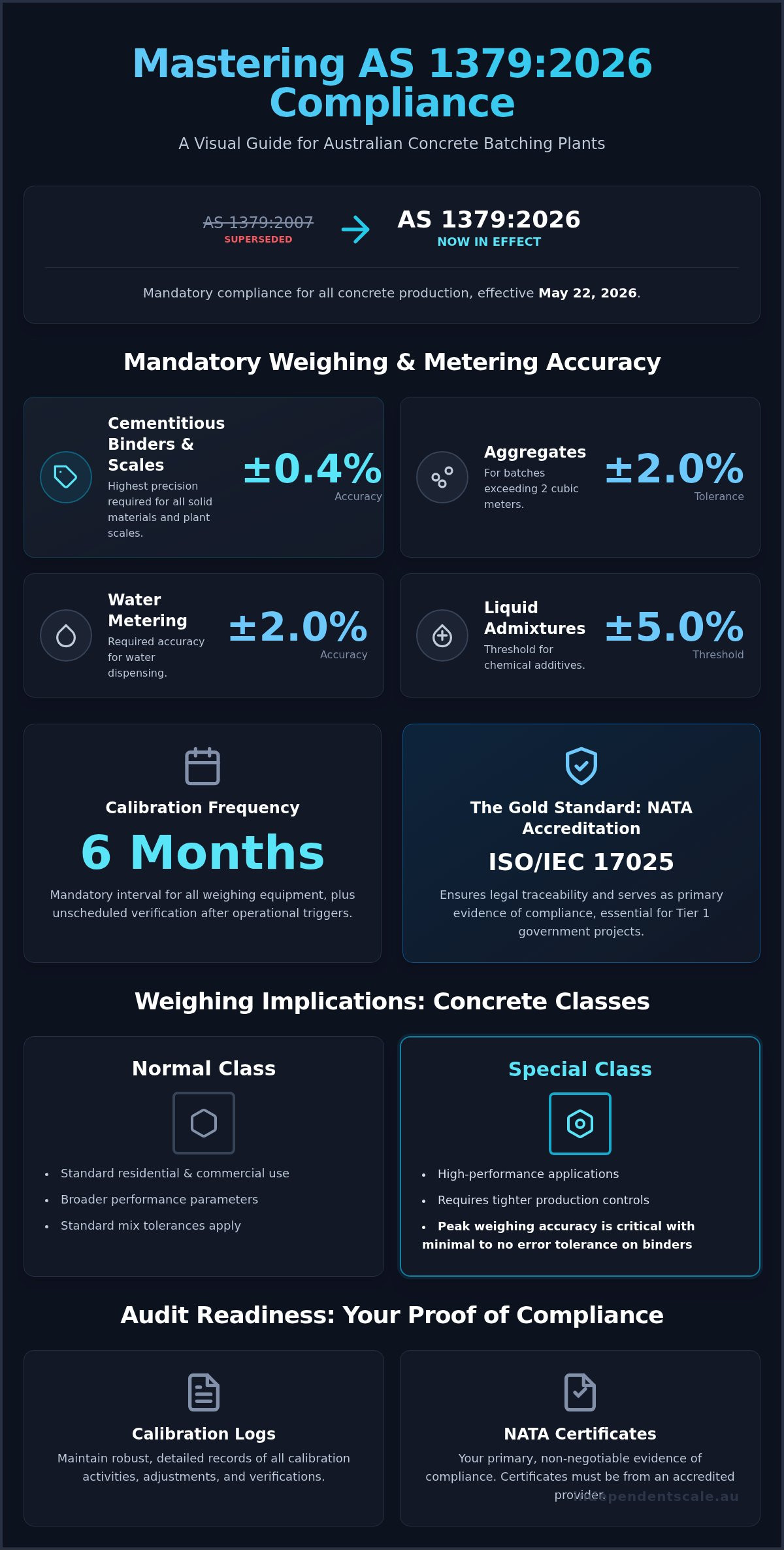
This guide ensures you master the technical tolerances and NATA-accredited standards required for full 2026 compliance. We'll provide a clear breakdown of the mandatory six-month calibration intervals, the ±0.4% accuracy limits for cementitious binders, and the specific ±2.0% and ±5.0% thresholds for water and liquid admixtures. By following this structured approach, you can achieve zero-friction audits and total batching precision. We'll examine the documentation protocols and technical verification steps that distinguish a NATA-accredited service from standard calibration, giving your facility the legal and regulatory protection it requires in a competitive industrial market.
Key Takeaways
- Identify the critical updates within AS 1379:2026 that govern everything from raw material weighing to final product delivery.
- Master the specific AS 1379 calibration requirements, including the mandatory ±0.4% weighing accuracy for cementitious binders and plant scales.
- Maintain the required six-month calibration cycle and identify the operational triggers that necessitate unscheduled technical verification.
- Establish robust documentation protocols, such as Calibration Logs and NATA certificates, to ensure zero-friction compliance audits.
- Leverage NATA-accredited expertise to ensure legal traceability and meet the stringent standards of Tier 1 government infrastructure projects.
Understanding AS 1379: The Regulatory Framework for Concrete Production
AS 1379:2026 is the definitive standard for the specification and supply of concrete in Australia. Published on May 22, 2026, it governs every stage of production from raw material weighing to the final delivery of ready-mix concrete. The standard's scope is comprehensive and demands high levels of technical control. It specifically covers:
- Precise weighing of cementitious binders and aggregates.
- Accurate metering of water and liquid admixtures.
- Uniformity and consistency of the final batch.
- Verification of batching equipment performance.
Compliance is a legal mandate enforced through the National Construction Code. For operators targeting Tier 1 infrastructure or government projects, meeting AS 1379 calibration requirements is the baseline for eligibility. Precision weighing isn't just about efficiency. It's the primary defense against structural failures and the legal liabilities that follow rejected loads. If a batch doesn't meet the specified binder-to-water ratio due to uncalibrated equipment, the structural integrity of the entire project is compromised.
Normal Class vs. Special Class Concrete: Weighing Implications
The Relationship Between AS 1379 and NATA Accreditation
The industry recognizes NATA-accredited calibration to ISO/IEC 17025 as the gold standard for compliance. There's a significant legal distinction between a basic equipment check and an accredited calibration. A standard check might verify that a scale is functioning. Only a NATA-accredited technician provides the traceability required for regulatory audits. These concrete batching plant calibration services produce certificates that serve as primary evidence of compliance. Without NATA documentation, a plant can't prove its measurements are accurate to a national standard. This lack of evidence can stall projects or lead to immediate contract termination on high-stakes infrastructure sites. Meeting AS 1379 calibration requirements through an accredited provider ensures your facility remains audit-ready and legally protected.
Accuracy Requirements for Batching Equipment under AS 1379
AS 1379:2026 establishes rigid accuracy mandates for all weighing and dispensing equipment. The primary requirement is a ±0.4% weighing accuracy for all scales and hoppers used for solid materials. This percentage is calculated based on the maximum scale value. For a 5,000kg hopper, this allows a maximum deviation of just 20kg. If your hardware cannot maintain this level of precision, your plant cannot claim compliance, regardless of batch quality.
Load Cell Performance and Hopper Precision
Industrial load cells must maintain peak performance under extreme environmental stress. In a concrete plant, these sensors are exposed to constant vibration, dust, and temperature fluctuations. These factors often lead to "drift," where the load cell's output signal no longer aligns with the actual weight. Mechanical interference is another common issue; material buildup on hopper mounts or stiff flexible connections can mask true weight readings. Identifying these errors before they exceed AS 1379 limits requires methodical testing and precision equipment. If you notice weight readings fluctuating during static loads, it's time to investigate your sensor health.
Liquid Dispensing: Admixtures and Water Standards
Liquid measurement standards are equally stringent. Water must be metered or weighed to an accuracy of ±2.0%. Liquid admixtures, which are critical for the performance of Special Class concrete, must be metered to within ±5.0% of the indicated value. While many plants rely on volumetric flowmeters, gravimetric (weight-based) calibration is the superior method. Weighing the liquid during the calibration process eliminates errors caused by air bubbles, pressure changes, or temperature-driven viscosity variations. This level of precision is vital for maintaining the chemical consistency required for high-performance infrastructure projects. To maintain these standards, you can utilize specialized load cell calibration services to verify your liquid dispensing systems under real-world conditions.
Calibration Intervals and Verification Protocols
The 2026 standard dictates that all weighing and liquid-dispensing equipment must undergo a full accuracy check at least every six months. This cycle is the absolute maximum duration permitted for compliance. High-volume facilities or those operating in corrosive environments often require quarterly verification to maintain ongoing accuracy. Beyond the calendar schedule, specific operational events trigger an immediate need for unscheduled calibration. These include equipment relocation, significant mechanical repairs, or any instance where batch consistency deviates from the design mix. Ignoring these triggers puts your plant at risk of producing non-compliant concrete that will be rejected on-site.
Verification must utilize certified test masses traceable to national standards. The resulting calibration report is your primary defense during a regulatory audit. It must include the "as found" and "as left" data, the uncertainty of measurement, and a clear statement of compliance against the ±0.4% weighing threshold. Without this detailed documentation, your plant's quality assurance system remains technically incomplete. Meeting AS 1379 calibration requirements involves more than just a passing grade; it requires a documented history of precision and reliability.
The Gravimetric Calibration Method for Flowmeters
Auditors for high-spec infrastructure projects prioritize the gravimetric method over traditional volumetric checks. This approach, specifically used for liquid flowmeter calibration using the weighing method, involves capturing a timed discharge of liquid and weighing it on a high-precision scale. It eliminates the variables that plague traditional flowmeters, such as air entrainment or pressure fluctuations. By converting mass to volume using the specific gravity of the admixture at current temperatures, you achieve a level of accuracy that volumetric systems can't match. This methodology is fundamental to meeting the ±5.0% accuracy threshold for chemical admixtures.
Routine Maintenance vs. Official Calibration
Official calibration doesn't replace daily vigilance. Plant operators should perform weekly "sanity checks" by applying a known weight to hoppers and verifying the readout. If your indicators and displays show sluggish response times or fail to return to zero after a discharge, your hopper calibration may be failing. These intermediate checks identify mechanical wear or electronic drift before they escalate into audit failures. Catching these issues early prevents the production of non-compliant batches between scheduled NATA visits and ensures your facility maintains its reputation for technical excellence.
Audit Readiness: Managing Compliance Records and Documentation
A Calibration Log is the primary evidence of your facility's adherence to AS 1379. It must include a comprehensive register of every measuring device, its calibration status, and its service history. During unannounced inspections, auditors specifically look for the link between your daily batch records and your most recent calibration data. If you can't prove that the specific load of concrete poured yesterday was weighed on equipment verified within its 6-month cycle, you face immediate non-compliance. Your documentation must demonstrate that you are meeting all AS 1379 calibration requirements without exception.
A valid NATA Calibration Certificate contains several critical fields. You must verify the NATA accreditation number, the date of testing, and the Uncertainty of Measurement. This data provides the legal traceability required by Tier 1 contractors. Without these markers, a certificate is simply a piece of paper with no regulatory weight. Store these records in a centralized, accessible location. Digital copies are preferred for quick retrieval, but hard copies should remain on-site to ensure zero-friction during an audit. This accessibility proves that your plant operates with transparency and technical competence.
Preparing Your Plant for a Calibration Audit
Efficiency during a technical visit depends on your site preparation. Technicians require safe, unobstructed access to all weighing components. Follow this pre-audit checklist to ensure a smooth verification process:
- Clear all material buildup from hopper mounts and load cell brackets.
- Inspect tank and silo weighing assemblies for structural bind-up or mechanical shunts.
- Ensure all electrical cables and junction boxes are free from moisture and physical damage.
- Verify that indicators are powering on and displaying stable readings.
Addressing these mechanical issues beforehand prevents the technician from recording a "fail" on your permanent compliance record. A clean plant allows for more accurate testing and reduces the time needed for the calibration process.
Responding to Non-Compliance: Corrective Action Reports
If a scale fails to meet the ±0.4% threshold, you must initiate a Corrective Action Report (CAR). This document outlines the nature of the failure, the immediate repairs performed, and the steps taken to prevent recurrence. AS 1379 requirements demand that any non-compliant equipment be tagged out of service immediately. Professional repair services are essential here. A quick response minimizes plant downtime and ensures that your facility returns to compliant production levels without risking structural integrity in your deliveries. To ensure your documentation and hardware meet the highest standards, you should book a professional AS 1379 compliance audit to resolve these risks before they result in a failed inspection.
Achieving AS 1379 Compliance with Independent Scale Service
Independent Scale Service provides specialized concrete batching plant calibration services designed to meet the rigorous demands of AS 1379:2026. Our technicians operate across Sydney, Melbourne, and regional Australia, bringing NATA-accredited expertise directly to your facility. We understand that compliance isn't just about a sticker; it's about maintaining the technical integrity of your production line. Our team manages the entire calibration lifecycle, from initial accuracy testing to the supply and repair of critical hardware.
We provide an integrated solution that covers:
- Load cell replacement and precision alignment.
- Indicator and display programming for batching accuracy.
- Gravimetric verification of liquid dispensing systems.
- Comprehensive technical reports ready for state or federal audits.
By consolidating your AS 1379 calibration requirements with a single accredited provider, you eliminate the friction of managing multiple contractors. We ensure your plant remains operational and compliant, minimizing the risk of rejected loads or project stand-downs. Our approach is methodical and focused exclusively on solving technical problems for industrial clients.
Why NATA Accreditation Matters for Your Contracts
Independent Scale Service holds NATA accreditation to ISO/IEC 17025, which is the industry's benchmark for technical competence. This accreditation is often a mandatory requirement for Tier 1 and government infrastructure contracts. It provides the legal traceability needed to satisfy ATS-5335 standards for both Normal and Special Class concrete production. Using an unaccredited technician leaves your business exposed to significant liability. In the event of a structural failure or insurance claim, a NATA-certified report serves as your primary defense, proving your equipment met all AS 1379 calibration requirements at the time of production.
Book Your AS 1379 Compliance Audit Today
Maintaining a six-month calibration cycle is simple with our customized maintenance agreements. We track your compliance schedule and contact you before your certification expires, ensuring you never miss a mandatory interval. When our team arrives on-site, we follow a methodical verification process that minimizes your plant's downtime. If we identify a failure, we carry the necessary spares to perform immediate repairs, from load cells to signal conditioners. Don't wait for an audit failure to address your plant's accuracy. You can contact Independent Scale Service directly to schedule your next site visit or to discuss emergency repair needs for critical breakdowns. Our responsive service model is built to keep your facility running at peak precision.
Securing Your Plant’s Compliance for 2026 and Beyond
Maintaining the technical integrity of your batching plant requires a methodical approach to accuracy. The shift to the AS 1379:2026 standard has reinforced the necessity of the ±0.4% weighing tolerance and the mandatory six-month calibration interval. By integrating these AS 1379 calibration requirements into your routine maintenance, you protect your business from audit failures and the high costs of rejected concrete. NATA-accredited documentation is not just a regulatory hurdle; it's a marker of expertise that secures your position on high-value contracts.
Independent Scale Service is NATA accredited to ISO/IEC 17025 and provides specialized support across Sydney, Melbourne, and regional Australia. Our rapid response team ensures your equipment returns to peak precision with minimal disruption to your production schedule. Book Your AS 1379 NATA Calibration Service Now to guarantee your facility remains at the forefront of the industry. We're here to help you build a foundation of accuracy and dependability.
Frequently Asked Questions
How often does AS 1379 require concrete batching plants to be calibrated?
AS 1379:2026 mandates that all weighing and liquid-dispensing equipment undergoes accuracy verification at least every six months. This interval is the maximum permitted limit for compliance. High-volume plants or those operating in harsh environments should consider quarterly checks. Any significant equipment repair or relocation also triggers an immediate requirement for unscheduled calibration to ensure the facility meets ongoing AS 1379 calibration requirements.
What is the required weighing accuracy for cementitious materials under AS 1379?
Weighing equipment for cementitious materials, including Portland cement and fly ash, must maintain an accuracy of ±0.4% of the maximum scale value. This stringent tolerance ensures the structural integrity of the concrete mix. While the final batch tolerance for binders may vary between ±1% and ±2% based on volume, the underlying hardware must consistently perform within the ±0.4% threshold to prevent structural failures.
Does my concrete plant calibration need to be NATA accredited?
NATA accreditation to ISO/IEC 17025 is the industry gold standard and is typically a mandatory requirement for Tier 1 and government infrastructure projects. While the standard specifies technical requirements, NATA-accredited calibration provides the legal traceability and independent verification that auditors demand. Using an accredited provider like Independent Scale Service ensures your documentation serves as primary evidence of compliance during regulatory inspections.
What is the difference between gravimetric and volumetric calibration for water?
Gravimetric calibration involves weighing the actual discharge of water on a precision scale to verify accuracy, whereas volumetric calibration relies on flowmeter readings. Gravimetric methods are technically superior because they eliminate variables like air bubbles, pressure changes, and temperature-driven density fluctuations. Auditors prefer gravimetric verification for high-spec projects because it provides a more reliable assessment of the ±2.0% water accuracy requirement defined by the standard.
Can I perform my own AS 1379 calibration checks?
Plant operators can perform routine internal "sanity checks" using known test masses to monitor for drift, but these don't replace official calibration. AS 1379 calibration requirements mandate formal verification by qualified technicians using certified, traceable equipment. For compliance documentation and legal protection, especially on commercial contracts, you must use an external service provider capable of issuing recognized certificates of calibration and maintenance.
What happens if my batching plant fails an AS 1379 compliance audit?
Failing a compliance audit can lead to immediate project delays, the rejection of concrete loads, and potential demolition of non-compliant structures. Beyond operational downtime, your facility may face legal liability and the loss of eligibility for government contracts. Operators must issue a Corrective Action Report (CAR) and perform immediate repairs and re-calibration before resuming production to satisfy regulatory bodies and project stakeholders.
Does AS 1379 cover the calibration of admixture dispensers?
AS 1379 specifically includes requirements for liquid admixture dispensers, which must be metered to an accuracy of ±5.0% of the indicated value. Given the critical role of chemical admixtures in Special Class concrete, precise dispensing is essential for maintaining performance characteristics. Independent Scale Service provides gravimetric verification for these systems to ensure they meet the 2026 standards for chemical consistency and batch repeatability.
What documentation is required to prove AS 1379 compliance for a government project?
Government projects require a comprehensive evidence package, including a current Calibration Log and NATA-accredited certificates traceable to ISO/IEC 17025. You must also provide batch records that correlate with these calibration dates to prove equipment accuracy during specific pours. These documents must include the "as found" and "as left" data, the uncertainty of measurement, and clear compliance statements against the ±0.4% weighing threshold.
