


AS 1379 Calibration: 2026 Concrete Plant Compliance Guide
With the Australian concreting services market valued at $12.9 billion in 2026, a single rejected load due to out-of-tolerance batching isn't just a site delay; it's a direct threat to your contract eligibility. Maintaining strict adherence to the updated AS 1379:2026 standard is often the difference between securing high-profile infrastructure projects and facing costly audit failures. You likely already know that precision is the backbone of your operations, yet the transition to the May 2026 standard introduces rigorous demands on your weighing and metering systems.
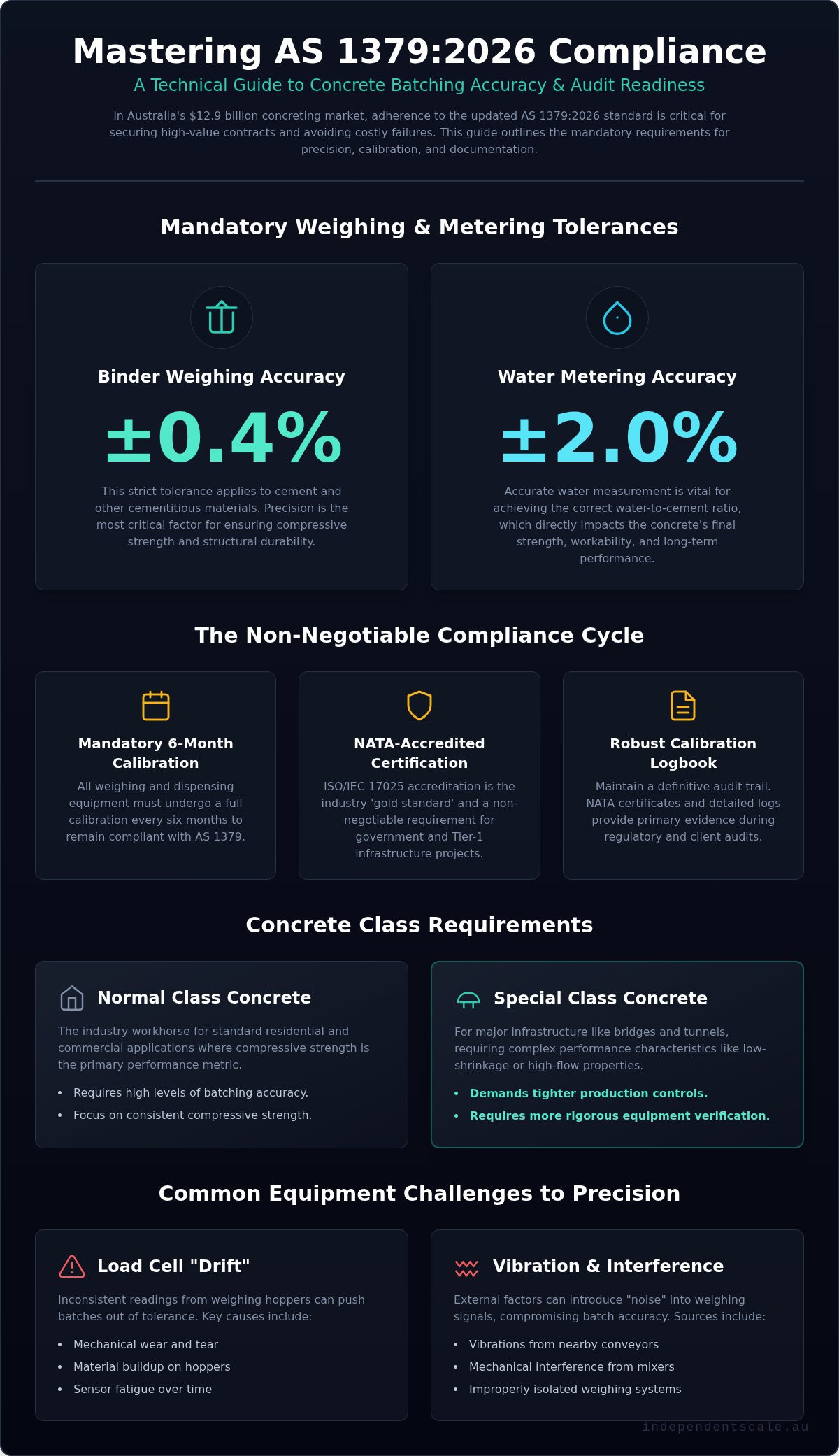
This guide provides the technical roadmap you need to master AS 1379 calibration requirements, ensuring your plant operates within the precise ±0.4% binder accuracy and ±2.0% water metering limits required by law. We'll examine the mandatory six-month calibration intervals and why NATA-accredited certification to ISO/IEC 17025 is now a non-negotiable requirement for government-tier work. By understanding the specific tolerances for chemical admixtures and binders, you can achieve zero-friction compliance audits and maintain the batch accuracy your clients demand.
Key Takeaways
- Identify the specific weighing tolerances for binders and water mandated by the AS 1379:2026 standard to prevent batch inaccuracies and rejected loads.
- Establish a compliant maintenance schedule by adhering to the mandatory six-month calibration cycle for all weighing and dispensing equipment.
- Ensure your documentation meets high-tier infrastructure requirements by utilizing NATA-accredited certification to ISO/IEC 17025.
- Streamline your audit process with a technical overview of the essential AS 1379 calibration requirements for cementitious materials and chemical admixtures.
- Learn how to maintain a robust calibration logbook to provide a definitive audit trail for regulatory bodies and project stakeholders.
Understanding AS 1379: The Regulatory Framework for Concrete Production
AS 1379:2026, published by Standards Australia on May 22, 2026, serves as the definitive regulatory framework for the specification and supply of concrete across the country. This standard governs every technical phase of production, starting with the precision weighing of raw constituent materials and extending to the final delivery of the product to the construction site. For plant operators, compliance is the baseline for operational legitimacy. In 2026, meeting AS 1379 calibration requirements isn't just about quality control; it's a mandatory prerequisite for any business targeting Tier 1 or government infrastructure projects. Precision weighing is the primary defense against structural failures. When batching accuracy drifts, the resulting concrete may lack the required compressive strength or durability, leading to catastrophic structural issues and expensive legal disputes.
Normal Class vs. Special Class Concrete: Weighing Implications
The standard distinguishes between Normal Class and Special Class concrete based on performance requirements. Normal Class concrete is the industry workhorse, utilized for standard residential and commercial applications where compressive strength is the primary metric. Special Class concrete involves more complex performance characteristics, such as low-shrinkage, high-flow, or specific durability properties required for major bridges and tunnels. While both classes require high levels of batching accuracy, Special Class production demands even tighter control over the raw material ratios. Tighter production controls mean that your weighing equipment must be verified more rigorously to ensure that high-performance mixes meet their engineered specifications without variance.
The Relationship Between AS 1379 and NATA Accreditation
The relationship between AS 1379 and NATA accreditation is the foundation of modern industry quality assurance. NATA-accredited calibration to ISO/IEC 17025 represents the industry gold standard for technical competence. There's a significant legal and technical difference between a standard equipment "check" and an accredited calibration. A standard check might confirm that a scale is functional, but it lacks the traceability and rigorous uncertainty calculations provided by an accredited service. NATA certificates serve as the primary evidence during regulatory audits and are often a non-negotiable requirement in government contracts. Utilizing concrete batching plant calibration from an accredited provider ensures that your plant's data is traceable to national standards, providing full legal and regulatory protection for your operations.
Accuracy Requirements for Batching Equipment under AS 1379
Concrete production is a game of precision measurement where even minor deviations result in compromised structural integrity. The core of the Standards Australia AS 1379-2007 and the updated 2026 framework is the ±0.4% weighing accuracy mandate for cement and other binders. This tolerance applies to the maximum scale value, meaning your equipment must maintain extreme consistency regardless of the batch size. Precision in binders is the most critical factor for quality control. A minor deficit in cementitious materials can lead to compressive strength failure, while an excess can cause thermal cracking or unnecessary cost overruns. While aggregate weighing tolerances are designed to balance volume, they still require rigorous control to ensure the structural integrity of Special Class mixes isn't undermined by poor grading.
Load Cell Performance and Hopper Precision
Maintaining these strict tolerances requires high-performance equipment that survives the abrasive environment of a concrete plant. High-quality industrial load cells are engineered to provide stable readings despite harsh conditions, but they aren't immune to "drift." This phenomenon occurs when weighing hoppers provide inconsistent readings due to mechanical wear, material buildup, or sensor fatigue. Vibration and mechanical interference from nearby conveyors or mixers often introduce noise into the weighing signal. If your system isn't properly isolated or verified, these external factors easily push your batching outside the mandatory AS 1379 calibration requirements. Identifying these issues early prevents the rejection of entire loads on-site.
Liquid Dispensing: Admixtures and Water Standards
Water and chemical admixtures require their own specific accuracy protocols to ensure chemical reactions during hydration are predictable. According to the 2026 standards, water must be weighed or metered to an accuracy of at least ±2.0%. Chemical admixtures, which are often used in much smaller, concentrated quantities, require an accuracy of ±5.0% of the indicated value. While many plants rely on volumetric flowmeters, gravimetric calibration is technically superior for high-performance mixes. Weight-based verification eliminates variables like liquid density and temperature that often plague flowmeters. For Special Class concrete, maintaining these ratios is non-negotiable to achieve specific characteristics like high flow or low shrinkage. If you're concerned about your liquid dispensing accuracy, scheduling a professional hopper and silo calibration is the most reliable way to verify your system's performance.
Calibration Intervals and Verification Protocols
AS 1379:2026 mandates a maximum interval of six months between formal accuracy checks for all weighing and liquid-dispensing equipment. This cycle ensures that batching precision remains within the strict tolerances required for compliant production. However, adherence to these AS 1379 calibration requirements is the minimum baseline. Unscheduled calibrations are triggered by major mechanical repairs, plant relocation, or when batch consistency deviates from the engineered mix design. The verification process involves using certified test masses to validate scale performance across its full operating range. To maintain a valid compliance defense, your calibration report must be issued by a facility accredited by the National Association of Testing Authorities (NATA). These reports provide the technical traceability required by auditors to confirm that your plant's measurements are accurate and reliable.
The Gravimetric Calibration Method for Flowmeters
While many plants rely on volumetric flowmeters, liquid flowmeter calibration using the weighing method is the superior protocol for ensuring compliance. This process involves dispensing a set volume of liquid and verifying its accuracy by weight on a calibrated scale. Auditors prefer this gravimetric approach because it accounts for variables like density and temperature, which often distort volumetric readings. Converting volume to mass provides a definitive verification of the actual material delivered to the mix. This level of precision is essential for high-specification projects where chemical ratios are critical to the concrete's performance.
Routine Maintenance vs. Official Calibration
Official six-month calibrations must be supplemented by routine sanity checks conducted by plant operators. Weekly visual inspections of load cell mounts and monthly zero-point verifications help identify drift before it leads to rejected loads. Signs that your hopper calibration is failing include sluggish scale response, inconsistent zeroing, or erratic readings on your indicators and displays. These digital interfaces often provide the first warning of communication errors or sensor fatigue. Addressing these early indicators prevents the downtime associated with emergency repairs and ensures your plant remains audit-ready at all times. Reliable batching starts with maintaining the integrity of the entire weighing chain between scheduled professional visits.
Audit Readiness: Managing Compliance Records and Documentation
Maintaining a comprehensive Calibration Log is the primary defense for any concrete production facility during a regulatory inspection. Auditors prioritize the paper trail because it provides quantifiable proof of historical accuracy and adherence to AS 1379 calibration requirements. A valid NATA Calibration Certificate must contain specific fields: the NATA accreditation number, the date of testing, the specific equipment ID, and the calculated measurement uncertainty. If these fields are missing or incorrect, the certificate may be deemed invalid during an audit. Accessibility is equally critical. Records must be stored where they're immediately available for unannounced inspections. Digitizing these records and linking them to specific batch records allows you to prove the accuracy of every pour, creating an unbreakable chain of traceability from the raw material hopper to the final structure.
Preparing Your Plant for a Calibration Audit
Technicians require safe, unobstructed access to hoppers and load cells to perform their duties effectively. Before an audit or scheduled service, ensure all weighing areas are cleaned of material buildup and debris. A pre-audit checklist should include identifying obvious mechanical issues like loose mounting bolts or damaged cables. It's particularly important to have tank and silo weighing assemblies inspected for structural bind-up. This occurs when physical obstructions or misaligned stay rods prevent the hopper from moving freely, leading to false weight readings that no amount of digital adjustment can fix. Clearing these mechanical bottlenecks before the technician arrives prevents delays and ensures a smoother verification process.
Responding to Non-Compliance: Corrective Action Reports
If a scale fails a calibration check, immediate action is required to satisfy regulatory bodies. You must implement a Corrective Action Report (CAR) that documents the failure, the root cause, and the steps taken to rectify the issue. This often involves isolating the affected equipment until a professional repair is completed. Proving that you have a robust system for identifying and fixing errors is often as important to auditors as the accuracy of the scales themselves. Utilizing professional concrete batching plant calibration services ensures that any failures are handled with the technical rigor required to maintain your plant's standing and minimize operational downtime.
Achieving AS 1379 Compliance with Independent Scale Service
Independent Scale Service provides NATA-accredited concrete batching plant calibration services specifically engineered to address the complexities of the AS 1379:2026 standard. Our technical team operates across Sydney, Melbourne, and regional Australia, ensuring that plants in remote locations maintain the same level of precision as those in metropolitan hubs. We deliver comprehensive reporting that satisfies the stringent audit standards of state and federal transport authorities, as well as private Tier 1 contractors. Beyond simple verification, we offer an integrated approach to plant health. This includes the supply and installation of high-precision load cells and the technical programming of digital indicators and displays. Our goal is to ensure your weighing systems are not just compliant, but optimized for maximum operational efficiency.
Why NATA Accreditation Matters for Your Contracts
Holding NATA accreditation to ISO/IEC 17025 is more than a badge of quality; it's a legal safeguard for your business. When you operate under this level of accreditation, you're meeting the rigorous "Normal Class" and "Special Class" requirements outlined in ATS-5335 and other major infrastructure specifications. This technical alignment is essential for reducing the risk of professional liability and structural insurance claims. If a batch is ever questioned, a NATA-endorsed report from Independent Scale Service provides the definitive evidence of accuracy that non-accredited providers cannot offer. It ensures that your plant meets the precise AS 1379 calibration requirements demanded by high-spec projects.
Book Your AS 1379 Compliance Audit Today
Scheduling a site visit with our team is a straightforward process designed to minimize plant downtime. We offer customized maintenance agreements that automate your compliance schedule, ensuring you never miss a mandatory six-month calibration interval. Our technicians arrive on-site with certified test masses and specialized equipment to perform full-scale verifications of your hoppers, silos, and liquid dispensing systems. For critical plant breakdowns, we maintain high availability to provide immediate service and load cell replacement. Contact Independent Scale Service today to secure your plant's compliance and protect your standing in the Australian construction market.
Securing Your Plant’s Operational Future
Maintaining technical accuracy in concrete production is a continuous commitment to quality and regulatory safety. The 2026 standard demands rigorous adherence to weighing tolerances and documentation protocols that leave no room for error. By mastering the AS 1379 calibration requirements, your plant avoids the costly risks of rejected loads and excluded contracts. Precision isn't just a goal; it's a mandatory operational baseline for modern construction.
Independent Scale Service provides the NATA-accredited expertise required to protect your operations. As specialists in AS 1379 compliance with rapid response capabilities across Sydney and Melbourne, we ensure your facility remains audit-ready and technically proficient. Our ISO/IEC 17025 accreditation serves as your primary evidence of competence for Tier 1 infrastructure projects. It's the most reliable way to ensure your batching data stands up to the closest scrutiny.
Book Your AS 1379 NATA Calibration Service Now and secure your plant's competitive advantage in a demanding market. Reliability remains the foundation of your long-term success.
Frequently Asked Questions
How often does AS 1379 require concrete batching plants to be calibrated?
AS 1379 mandates that all weighing and liquid-dispensing equipment undergoes accuracy checks at least every six months. This interval ensures that mechanical wear or sensor drift doesn't compromise batch integrity. You'll also need unscheduled calibrations if you relocate the plant, perform major repairs, or notice inconsistent batch weights. Adhering to these AS 1379 calibration requirements is a baseline for legal compliance and project eligibility across Australia.
What is the required weighing accuracy for cementitious materials under AS 1379?
Weighing equipment for cement and other binders must maintain an accuracy of ±0.4% of the maximum scale value. This level of precision is critical because binders are the most structurally significant components of the mix. Even minor deviations can lead to compressive strength failure or significant financial losses. Regular verification with certified test masses ensures your load cells stay within this tight tolerance throughout the production cycle.
Does my concrete plant calibration need to be NATA accredited?
While the standard requires accuracy, NATA accreditation to ISO/IEC 17025 is effectively mandatory for government and Tier 1 infrastructure contracts. A NATA-endorsed certificate provides the technical traceability and rigorous uncertainty calculations that standard "checks" lack. Using an accredited technician ensures your calibration data is legally defensible and recognized by regulatory bodies. It's the only way to guarantee your plant meets the highest industry standards for measurement.
What is the difference between gravimetric and volumetric calibration for water?
Gravimetric calibration involves verifying the accuracy of a liquid by weight on a calibrated scale, whereas volumetric calibration relies on flowmeters to measure volume. Gravimetric methods are technically superior because they eliminate variables like liquid density and temperature fluctuations. Auditors for high-spec projects prefer weight-based verification for water and admixtures to ensure the water-to-cement ratio remains perfectly consistent across every batch produced for the site.
Can I perform my own AS 1379 calibration checks?
You can perform internal "sanity checks" to monitor plant performance, but these don't replace official six-month calibrations. Formal verification must be conducted by a technically competent third party, ideally one with NATA accreditation. Internal records of weekly zero-point checks are excellent for your audit trail, but they lack the external traceability required to satisfy AS 1379 calibration requirements during a formal regulatory inspection or government contract audit.
What happens if my batching plant fails an AS 1379 compliance audit?
Failing a compliance audit often results in the immediate rejection of concrete loads and potential exclusion from major contracts. You'll be required to issue a Corrective Action Report (CAR) and isolate the non-compliant equipment until it's professionally repaired and re-calibrated. The financial impact includes downtime, project delays, and potential legal liability if the out-of-tolerance concrete has already been poured into a permanent building or infrastructure project.
Does AS 1379 cover the calibration of admixture dispensers?
Yes, the standard specifically covers chemical admixture dispensers, requiring an accuracy of ±5.0% of the indicated value. Because admixtures are highly concentrated and used in small volumes, even tiny errors can drastically alter the concrete's performance. Maintaining this accuracy is vital for Special Class concrete where specific properties like high flow or low shrinkage are engineered into the mix. Professional calibration ensures these critical chemical ratios remain exact.
What documentation is required to prove AS 1379 compliance for a government project?
Proving compliance for government work requires a current NATA Calibration Certificate for every scale and dispenser in the plant. You must also maintain a comprehensive Calibration Log that tracks historical performance and any corrective actions taken. Auditors will cross-reference these documents with individual batch records to confirm that every cubic meter of concrete delivered was produced on verified equipment within the mandatory six-month window of the test.
