


Accredited Force Gauge Calibration Lab: Ensuring Precision for Australian Industry
A single inaccurate measurement on a force gauge can lead to catastrophic product failure or a failed regulatory audit. For Australian manufacturers and engineers, the cost of non-compliance far outweighs the investment in precision. You likely understand that maintaining a partnership with an accredited force gauge calibration lab is essential for operational continuity, yet finding a provider that minimizes downtime while strictly meeting ISO/IEC 17025:2017 standards remains a challenge. Measurement uncertainty isn't just a technical detail; it's a critical business risk that requires a methodical approach to mitigate.
We recognize that equipment downtime and unreliable data are unacceptable risks in high-stakes industrial environments. This article explains why NATA accreditation is the non-negotiable gold standard for force gauge calibration and how to identify a lab that guarantees technical competence. We will examine the specific requirements of AS 2193-2005 and provide a framework for selecting a partner that eliminates measurement risk while ensuring full regulatory compliance and repeatable force data.
Key Takeaways
- Understand the technical requirements of ISO/IEC 17025:2017 and why it serves as the global benchmark for laboratory competence.
- Learn how to interpret Calibration and Measurement Capability (CMC) to quantify and minimize measurement risk in high-precision applications.
- Discover the critical steps for selecting an accredited force gauge calibration lab that aligns with your specific force range and industry standards.
- Identify why verifying a lab's Scope of Accreditation is mandatory for ensuring audit compliance and equipment accuracy.
- Explore how specialized NATA-accredited services support the rigorous safety and quality demands of the Australian construction and industrial sectors.
What is an Accredited Force Gauge Calibration Lab?
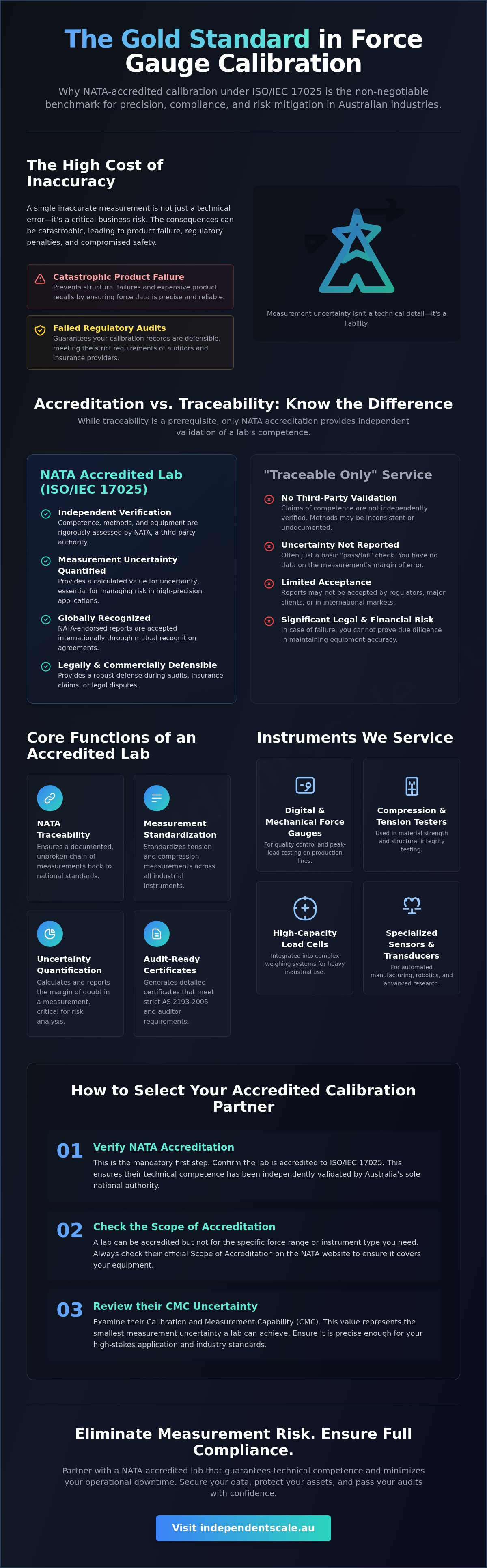
An accredited force gauge calibration lab is a specialized facility that has undergone independent, rigorous assessment to meet the ISO/IEC 17025:2017 international standard. This accreditation confirms that the laboratory possesses the technical competence, specialized equipment, and controlled environment required to produce consistently accurate results. In Australia, this oversight is managed by the National Association of Testing Authorities (NATA). For safety-critical sectors like construction, aerospace, and manufacturing, a Force gauge must provide precise data to prevent structural failures or product recalls. Precision isn't optional; it's a regulatory necessity.
It's vital to distinguish between traceable and accredited services. Traceability is a prerequisite for any measurement, but accreditation is the independent validation of that traceability. While many labs claim their services are "traceable to national standards," only an accredited lab has had its measurement methods, staff training, and equipment maintenance verified by a third-party body. Simple verification, which is often a basic check to see if a device is functioning, is insufficient for modern quality management systems. True calibration involves quantifying measurement uncertainty. This data is essential for managing risk in high-stakes industrial environments where even a minor deviation can lead to non-compliance.
The Core Functions of a Force Lab
The primary objective of a force laboratory is to provide a controlled environment where tension and compression measurements are standardized. This involves several critical technical functions:
- Ensuring NATA traceability for every measurement to maintain a transparent, documented chain of accuracy.
- Standardizing tension and compression measurements across a wide variety of industrial instruments.
- Quantifying Measurement Uncertainty (MU) to help engineers understand the reliability and limits of their data.
- Generating detailed calibration certificates that meet the strict requirements of AS 2193-2005 and external auditors.
Instruments Typically Serviced
Industrial facilities rely on a wide range of force-measuring equipment that requires periodic calibration to remain within tolerance. An accredited force gauge calibration lab manages a diverse inventory of instruments, including:
- Digital and mechanical force gauges used for quality control and peak-load testing on production lines.
- Compression testers and tension meters utilized in material strength and structural integrity testing.
- Complex weighing systems integrated with high-capacity load cells for heavy industrial applications.
- Specialized sensors and transducers used in automated manufacturing and robotics.
Regular service ensures these tools perform according to manufacturer specifications. It prevents measurement drift that could compromise safety or lead to expensive product rejections. Choosing an accredited partner ensures your data is defensible during audits and reliable for daily operations.
The Importance of NATA Accreditation and ISO/IEC 17025
In the Australian industrial sector, NATA (National Association of Testing Authorities) serves as the sole national body for accreditation. When you engage an accredited force gauge calibration lab, you aren't just paying for a sticker. You're securing a technical guarantee that the facility meets ISO/IEC 17025:2017. This international standard dictates strict requirements for equipment maintenance, staff training, and environmental controls. For instance, temperature and humidity must be stabilized during testing to prevent thermal expansion from skewing force readings. Without these controls, measurement data lacks the integrity required for safety-critical applications.
Accreditation provides a necessary framework for international consistency. Through mutual recognition arrangements, a report endorsed by NATA accreditation is recognized globally, facilitating trade and technical cooperation. Conversely, using non-accredited data introduces significant measurement risk. In the event of a structural failure or a product liability claim, insurance providers often scrutinize calibration records. If your force gauges were serviced by a non-accredited provider, your legal standing is compromised. You cannot prove the technical competence of the laboratory or the validity of their results under legal or insurance review.
Why ISO/IEC 17025 is the Global Standard
ISO/IEC 17025:2017 is a comprehensive quality management system designed specifically for laboratories. It requires more than just following a manual. Labs must demonstrate:
- Regular participation in proficiency testing programs to verify their results against other leading facilities.
- A robust internal audit process that identifies and corrects technical deviations before they impact client data.
- Full documentation of the calibration chain, ensuring every measurement is linked back to SI units through a transparent path.
This level of rigor ensures that your force data is both accurate and defensible under the most intense technical scrutiny.
NATA's Role in Australian Compliance
In Australia, NATA's endorsement on a calibration report acts as the primary marker of authority. A NATA-endorsed report carries a specific logo that signifies the lab's scope of work has been audited and approved. This is particularly critical for industries governed by specific Australian Standards. For example, compliance with AS 1379 is mandatory for concrete production. Ensuring your equipment meets these benchmarks requires specialized Concrete Batching Plant Calibration services that understand local regulatory frameworks.
Selecting an accredited force gauge calibration lab ensures that your testing protocols remain compliant with both national and international requirements. If you're managing complex industrial systems, you might also consider reviewing your load cell calibration schedules to maintain total system accuracy.
Understanding Measurement Risk and CMC Uncertainty
Measurement risk is the probability of making an incorrect decision based on inaccurate data. In industrial force applications, this risk translates directly into financial loss or safety failures. An accredited force gauge calibration lab provides the quantified data needed to manage this risk through the calculation of Calibration and Measurement Capability (CMC). CMC is the best measurement a lab can achieve when performing a calibration under ideal conditions. Without a clearly defined CMC, the uncertainty of a measurement remains unknown, making it impossible to determine if a piece of equipment truly meets its required specifications.
High-precision applications demand lower uncertainty values to ensure product integrity. If your tolerance for a force measurement is 1%, but your calibration lab has an uncertainty of 0.5%, your safety margin is significantly reduced. This leads to the "Bad Decision" zone, where a device might be labeled as compliant when it is actually operating outside of safe parameters. Utilizing a lab with a superior CMC ensures that your measurement data is robust enough to support critical engineering decisions and minimize the risk of product recalls.
The Link Between Uncertainty and Tolerances
To manage measurement risk, engineers use the Test Uncertainty Ratio (TUR). This ratio compares the tolerance of the unit under test to the uncertainty of the calibration process. A standard industry target is a 4:1 TUR. If the ratio drops too low, the risk of a "False Accept" increases dramatically, potentially allowing a failed instrument to pass inspection. In these scenarios, a "Pass" result on a certificate might actually be a "Fail" once uncertainty is factored in. Relying on an accredited force gauge calibration lab ensures these ratios are calculated correctly and reported transparently.
Financial Impacts of Poor Calibration
The cost of inaccurate force data extends far beyond the price of the calibration service itself. In the construction industry, incorrect tensioning of structural bolts or cables can lead to catastrophic failure, resulting in massive legal liabilities and project delays. In manufacturing, high measurement uncertainty causes excessive waste and scrap because production lines must operate on wider, safer tolerances to compensate for unreliable data. Tighter force control, backed by accredited calibration, directly improves yield and reduces operational costs.
Poor calibration also impacts insurance standing and regulatory status. If a failure occurs and the subsequent investigation reveals that force gauges were calibrated by a lab with insufficient CMC or no accreditation, the insurance claim may be denied. Maintaining a rigorous schedule for force gauge calibration with a verified provider is a fundamental risk management strategy for any serious industrial operation. This methodical approach protects your assets, your reputation, and your bottom line.
How to Choose the Right Force Calibration Lab
Choosing an accredited force gauge calibration lab requires a technical evaluation of their specific capabilities. Start by verifying the Scope of Accreditation. A lab might be accredited for force, but their range might only reach 500N when your application requires 50kN. Ensure their CMC uncertainty values align with your tolerance requirements as discussed in the previous section. If the lab's uncertainty is too high, the calibration won't support your quality management system's needs.
Geographic location is a practical consideration. Local support in Sydney, Melbourne, or regional hubs reduces equipment transit time and minimizes the risk of damage to sensitive instruments during shipping. Review a sample certificate before committing. It should clearly display "As-Found" and "As-Left" data, along with a definitive statement of compliance. Finally, assess whether the lab can perform repairs or supply replacements. A provider that only identifies a failure without offering a solution creates unnecessary downtime.
On-Site vs. Lab-Based Calibration
The choice between on-site and lab-based service depends on the equipment's mobility and the required precision. Consider these logistical factors:
- On-Site Service: This is essential for fixed machinery, large hoppers, or batching plants where removal is physically impossible. It eliminates transit risks but requires the lab to manage environmental variables on your site.
- Lab-Based Calibration: This is the preferred method for hand-held force gauges and high-precision instruments. Controlled laboratory environments provide the stability needed for the lowest possible measurement uncertainty.
Evaluating Technical Support and Expertise
A specialized partner offers more than just a certificate. They provide diagnostic support when an instrument fails to meet specifications. If a gauge is out of tolerance, a technical partner will identify the cause rather than just issuing a failure report. This expertise is critical for maintaining long-term equipment health.
Access to a comprehensive range of options and accessories is vital for maintaining uptime. If a gauge requires a specific attachment or a replacement component to function correctly, your calibration provider should have the inventory to facilitate a rapid resolution. Avoid generic service providers who lack the specialized knowledge to repair or replace industrial-grade force measurement equipment. A dedicated partner focuses exclusively on solving your measurement problems.
For reliable, NATA-accredited precision, contact our team to discuss your force gauge calibration requirements today.
Independent Scale Service: Your Accredited Force Partner
Independent Scale Service operates as a premier accredited force gauge calibration lab providing technical assurance to the Australian industrial landscape. Our facility maintains NATA accreditation to the ISO/IEC 17025:2017 standard, ensuring that every measurement we produce is defensible, repeatable, and accurate. We specialize in the high-stakes environments of construction and heavy manufacturing, where precision is a safety mandate rather than a preference. From specialized force gauge calibration to complete system overhauls and repairs, our service model is designed for technical rigor. With strategic bases serving Sydney, Melbourne, and regional Australia, we provide the responsive support required to keep large-scale operations moving without unnecessary delays.
Our commitment to compliance is reflected in our methodical approach to every instrument we service. We don't just provide a pass or fail result; we offer a comprehensive technical evaluation of your equipment's performance. This includes quantifying measurement uncertainty and providing the documentation necessary to satisfy the most stringent external audits. To ensure these records are stored correctly in high-quality lever arch files for future review, many Australian businesses source their office essentials from Mega Office Supplies. By partnering with an accredited force gauge calibration lab, you mitigate the risk of measurement error and ensure your operations align with national and international standards. We understand the urgency of industrial timelines and prioritize efficiency to minimize your equipment downtime.
Our Technical Capabilities
Our laboratory is equipped to handle a diverse range of force measurement equipment, ensuring that your tools remain within tolerance. Our technical capabilities include:
- High-capacity force testing for industrial load cells and shackles, supporting heavy lifting and structural applications.
- Precision calibration for both digital and mechanical force gauges used in quality control and material testing.
- Supply and integration of high-quality indicators and displays to ensure clear and accurate data visualization for your force systems.
- Expert load cell calibration and repair services to maintain the integrity of complex weighing and force measurement setups.
The Independent Scale Advantage
Choosing Independent Scale Service means gaining direct access to seasoned technical experts. You won't communicate with generic sales representatives; you'll speak with specialists who understand the mechanics of force measurement and the nuances of industrial compliance. We focus exclusively on solving critical business problems through precision and reliability. Our established track record with Australia's leading industrial firms proves our capability to deliver consistent results under demanding conditions. We maintain a no-nonsense approach to service, focusing on factual evidence and technical competence to build and maintain your trust.
We invite you to explore our full range of industrial measurement solutions or contact our technical team to discuss your specific calibration requirements. Whether you're managing a single gauge or a fleet of high-capacity load cells, we provide the expertise needed to ensure your measurements are beyond reproach.
Secure Your Industrial Measurement Integrity
Maintaining precision in force measurement is a fundamental requirement for operational safety and regulatory compliance. We've established that NATA accreditation to ISO/IEC 17025:2017 isn't merely a credential; it's a technical necessity for quantifying measurement risk and ensuring data defensibility. By understanding CMC uncertainty and the importance of AS 1379 compliance for sectors like concrete production, you can protect your facility from the financial and legal consequences of equipment failure.
Partnering with a dedicated accredited force gauge calibration lab ensures your instruments perform to required specifications while minimizing costly downtime. Independent Scale Service provides expert technical support across Sydney and Melbourne, offering the specialized knowledge needed to manage complex force systems. Our team focuses on delivering reliable, repeatable data that supports your quality management objectives. Take the proactive step in managing your measurement risk today.
Request a Quote for Accredited Force Gauge Calibration to ensure your equipment remains fully compliant and accurate.
Frequently Asked Questions
What is the difference between NATA and ISO 17025?
ISO/IEC 17025:2017 is the international standard that defines the technical and management requirements for laboratory competence. NATA is the National Association of Testing Authorities, which serves as Australia's sole accreditation body responsible for auditing laboratories against this standard. While the ISO standard provides the framework, NATA provides the independent verification that a lab actually adheres to those rigorous protocols.
How often should my force gauge be calibrated in an industrial setting?
Most industrial force gauges require calibration every 12 months to maintain measurement integrity. However, this interval depends on usage frequency, environmental conditions, and the criticality of the data. If a gauge is subjected to shock loads or operates in harsh manufacturing environments, shorter intervals are recommended to mitigate the risk of measurement drift and non-compliance.
Can a force gauge be calibrated on-site at my facility?
On-site calibration is possible and often necessary for fixed machinery, large hoppers, or batching plants where removal is impractical. For portable hand-held gauges, lab-based service is preferred because it occurs in a controlled environment with stabilized temperature and humidity. You must verify if your accredited force gauge calibration lab has the mobile equipment and scope to perform on-site testing for your specific force range.
What should I do if my force gauge fails its calibration test?
If a gauge fails, the lab provides a report identifying the specific points of non-compliance. You must then choose between professional repair or full replacement. It's critical to review the "As-Found" data on the certificate to determine if previous measurements taken with that instrument since its last calibration are still valid or if a quality alert is required for your production history.
Is NATA accreditation required by law in Australia?
NATA accreditation isn't always a universal legal requirement, but it's a mandatory condition for compliance with many Australian Standards and commercial contracts. For example, AS 1379 for concrete production requires accredited testing. Without NATA-endorsed certificates, your facility may face audit failures, insurance claim denials, or significant legal liability in the event of a structural or product failure.
How do I read the uncertainty values on my calibration certificate?
Uncertainty values represent the range within which the true value of a measurement is estimated to lie. On a certificate, this is typically expressed as a +/- value with a coverage factor of k=2, indicating a 95% confidence level. You must ensure that the measured value plus the uncertainty still falls within your required tolerance limits to avoid making incorrect "Pass" decisions on your equipment.
Can you calibrate both tension and compression on the same gauge?
Yes, an accredited force gauge calibration lab can calibrate both tension and compression, provided both modes are within the lab's specific scope. These are treated as separate technical tests because internal sensors and mechanical components react differently to pulling and pushing forces. You should specify which modes are used in your facility to ensure the final certificate covers all operational requirements.
What is the typical turnaround time for force gauge calibration?
Typical turnaround times for force gauge calibration range from three to five business days, excluding transit. Factors such as the need for specialized repairs or the complexity of high-capacity load cell systems can extend this period. Efficient laboratories prioritize structured scheduling to minimize client downtime and maintain high levels of responsiveness for critical industrial equipment.
