


A Complete Guide to Industrial Platform Scales for Heavy-Duty Weighing
In any industrial setting, from a bustling warehouse to a demanding factory floor, an unreliable platform scale is more than an inconvenience-it's a significant business liability. Inaccurate readings can lead to costly shipping errors, flawed inventory management, and non-compliance with industry standards. When an inferior scale fails under heavy-duty use, the resulting downtime directly impacts your productivity and profitability. Choosing the correct equipment requires a clear assessment of your operational needs, from the maximum required platform weight capacity to the specific environmental challenges of your facility.
This comprehensive guide provides the essential technical criteria for selecting the right industrial platform scale for your Australian business. We will systematically cover the critical factors you must evaluate: determining the correct capacity and size, selecting appropriate materials for harsh or wet environments, understanding accuracy standards and their impact on cost control, and planning for the long-term requirements of maintenance and NATA-accredited calibration. By the end, you will be equipped to invest in a durable, precise, and compliant weighing solution that supports your operational objectives.
Key Takeaways
- Understand the critical differences between a heavy-duty industrial scale and a commercial model to ensure you invest in equipment built for your operational environment.
- Correctly matching the maximum platform weight capacity, required accuracy, and material construction to your application is essential for operational efficiency.
- Identify the ideal scale design-from portable floor scales to flush-mounted pit scales-to optimise workflow and safety in your facility.
- Evaluate how advanced features and system integration can transform your scale from a simple weighing device into a critical data-collection point for your business.
- Learn why professional calibration is non-negotiable for maintaining accuracy, ensuring quality control, and meeting Australian compliance standards.
What Defines an Industrial Platform Scale (and What It's Not)
An industrial platform scale is not simply a larger version of a retail or postal scale. It is a robust, engineered system designed to deliver precise and repeatable measurements in demanding operational environments such as factories, warehouses, and processing plants. While the basic principle of any weighing scale is to measure mass, industrial units are distinguished by their high capacity, rugged construction, and integration capabilities. For business-critical operations where an incorrect platform weight can impact invoicing, compliance, or safety, accuracy and reliability are non-negotiable.
These scales are complete systems comprising three core components:
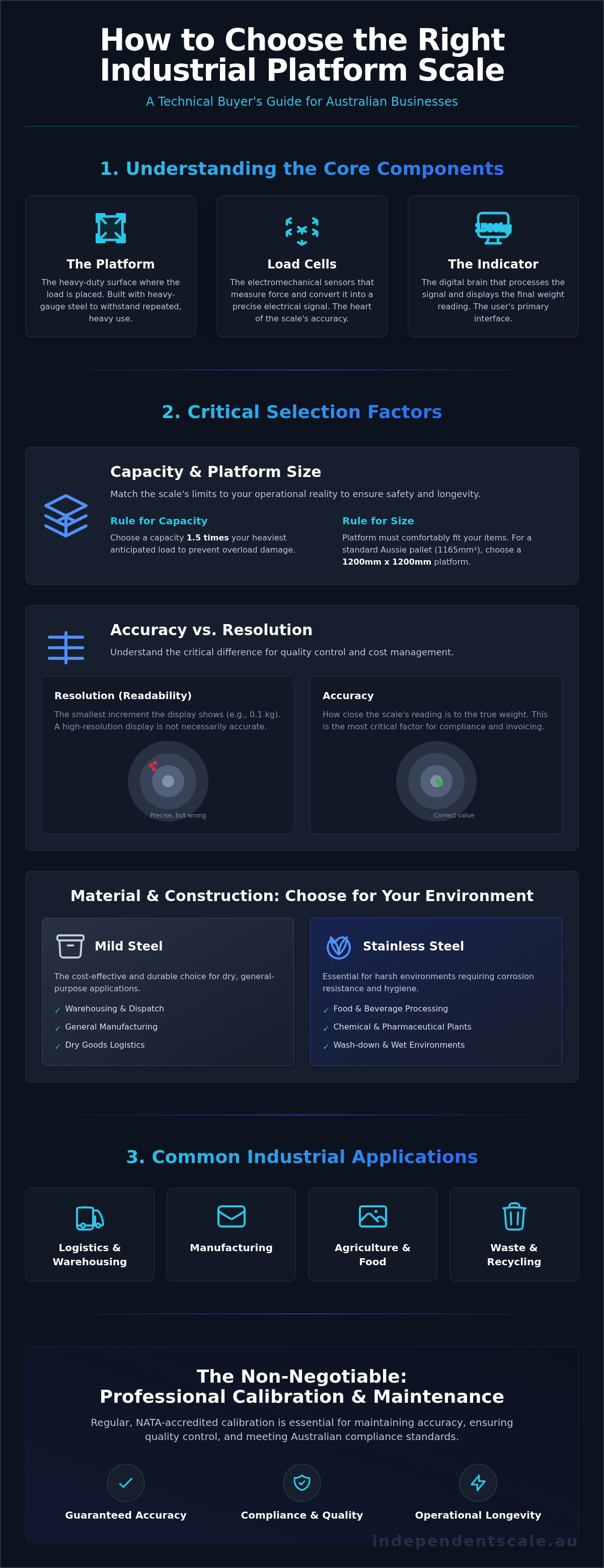
- The Platform: The physical surface where the load is placed, built to withstand heavy, repeated use.
- Load Cells: The electromechanical sensors that measure the force of the load and convert it into an electrical signal.
- The Indicator: The digital display and control unit that processes the signal from the load cells and shows the final weight reading.
Key Differentiators: Build Quality and Durability
The primary distinction of an industrial platform scale lies in its construction, which is engineered for longevity and performance under harsh conditions. Key features include a heavy-gauge steel frame (mild steel for general use or stainless steel for corrosive or hygienic environments), integrated overload and shock-loading protection for the load cells, and thick deck plates, often with a checker plate surface for enhanced grip and durability. Furthermore, IP (Ingress Protection) ratings are critical, indicating the scale's resistance to dust and water, which is essential in wash-down areas or dusty workshops.
Common Industrial Applications
The utility of industrial platform scales spans numerous sectors across Australia, where accurate weight measurement is fundamental to operations. Their design makes them indispensable for a wide range of heavy-duty tasks.
- Logistics and Warehousing: Accurately capturing pallet, skid, and crate weight for freight manifesting, load balancing, and inventory management.
- Manufacturing: Used for batching raw materials, ensuring component weights meet quality control specifications, and verifying finished product quantities.
- Agriculture and Food Processing: Weighing large bins of produce, crates of meat, or livestock to manage yield and streamline processing.
- Waste Management and Recycling: Tracking the inbound and outbound weight of materials for billing, compliance reporting, and operational efficiency.
How to Choose a Platform Scale: Key Technical Specifications
Selecting the correct platform scale requires a methodical review of its technical specifications. The right choice ensures accuracy, operational efficiency, and longevity, balancing your current requirements with future needs. The focus must extend beyond the visible platform to the critical internal components that define performance and reliability.
Capacity, Platform Size, and Resolution
These three factors are the foundation of your selection. As a rule of thumb, choose a capacity that is 1.5 times your heaviest anticipated load to prevent overload damage and ensure a long service life. The platform size should comfortably accommodate what you weigh; for a standard Australian pallet (1165mm x 1165mm), a 1200mm x 1200mm platform is appropriate. It is also crucial to distinguish between resolution (the smallest increment the display shows) and accuracy (how close the reading is to the true weight). Your process dictates the required precision, not just the display's readability.
Material and Construction: Mild Steel vs. Stainless Steel
The operational environment is the primary determinant of material choice. For general-purpose, dry environments like warehouses or dispatch areas, a durable, powder-coated mild steel construction is the most cost-effective solution. However, for applications requiring frequent washdowns, such as in food processing, or for corrosive environments found in chemical plants, stainless steel is essential. The material grade must match the environment to prevent premature failure and ensure compliance with hygiene standards.
Load Cells: The Heart of the Scale
The accuracy of any platform weight measurement depends entirely on its load cells. These transducers convert the force of the load into a precise electrical signal. Most industrial platform scales utilise robust shear beam load cells. Investing in high-quality, environmentally sealed (e.g., IP67 or IP68 rated) load cells is critical for long-term reliability and minimises costly downtime. The manufacturing and calibration of these components are subject to stringent Australian standards, overseen by bodies like the National Measurement Institute (NMI), which sets benchmarks for quality and legal metrology for weighing instruments.
Indicators and Displays
The indicator interprets the load cell signal and presents the final weight. Your choice of indicators and displays hinges on application complexity. A basic indicator with a clear digital display is sufficient for simple weighing tasks. Advanced models provide valuable functions like parts counting, checkweighing for quality control, and data connectivity (e.g., RS-232, Ethernet) for integration with inventory or control systems. Consider visibility, required mounting options (desk, column, or wall), and necessary features before finalising your selection.
Common Types of Industrial Platform Scales
Selecting the correct platform scale is critical for operational efficiency and accuracy. The design, or form factor, directly impacts how the scale integrates into your workflow. Understanding the maximum expected platform weight and the physical constraints of your workspace will determine the most suitable category for your needs.
Heavy-Duty Floor Scales
These scales are engineered for high-capacity weighing directly on a warehouse or factory floor. Constructed from durable materials like mild or stainless steel, they are built to withstand demanding industrial environments. They are frequently installed in a shallow pit to be flush with the floor or paired with ramps to allow seamless access for pallet jacks and forklifts.
- Primary Applications: Weighing pallets, large shipping crates, industrial bins, and heavy machinery components.
- Pros: Extremely high weight capacities, robust and durable for harsh conditions.
- Cons: Requires a permanent, dedicated floor space; less flexible for changing layouts.
Low-Profile and Portable Scales
Low-profile scales offer a practical solution where ramp access is constrained or frequent loading is required. Their very thin platform minimises the effort needed to move goods on and off. Portable models build on this flexibility, incorporating wheels and handles for easy relocation around a facility. This adaptability is essential for dynamic workplaces where weighing locations may change daily.
- Primary Applications: Shipping and receiving areas, temporary stocktake stations, and workshops with varied weighing needs.
- Pros: Enhanced mobility, easy loading without long ramps, and a smaller operational footprint.
- Cons: May have a lower maximum capacity compared to fixed heavy-duty floor models.
Bench and Countertop Platform Scales
For tasks requiring high precision with smaller items, bench and countertop scales are the industry standard. These compact units are designed for placement on workbenches, tables, or conveyor lines. While their capacity is lower, their resolution is significantly higher, making them ideal for detailed measurement and control processes where every gram counts.
- Primary Applications: Parts counting, quality control checks, chemical formulation, and dispatch/shipping verification.
- Pros: High accuracy and resolution for precise tasks, compact size for limited spaces.
- Cons: Strictly limited to weighing smaller, lighter objects and materials.
Essential Features and System Integration
In modern industrial environments, a platform scale's function extends far beyond simple weight measurement. It serves as a critical data acquisition point. Integrating these scales into broader business systems transforms a basic platform weight reading into actionable intelligence, driving efficiency, ensuring data accuracy, and enabling automation. The key lies in selecting equipment with the appropriate features and connectivity for your operational needs.
Connectivity Options for Data Transfer
Effectively transferring weight data is fundamental to system integration. Connectivity options range from legacy standards to modern network solutions:
- RS-232: A reliable serial port standard for direct output to printers for ticketing or to a dedicated computer for basic data logging.
- USB: Provides a simple, plug-and-play connection to a local PC, ideal for straightforward data capture into spreadsheets or software.
- Ethernet & Wi-Fi: These network connections allow the scale to communicate directly over your local area network (LAN), enabling seamless integration with inventory management systems, ERP software, and cloud-based databases.
Choosing the correct interface ensures that weight data is captured accurately and automatically, eliminating manual entry errors and improving traceability.
Signal Conditioners and Transmitters
For reliable integration, especially in complex industrial settings, the raw signal from a scale's load cells must be processed. Specialised components like conditioners and transmitters are essential for this task. They convert the low-level analog signal from the load cells into a stable, amplified, and noise-free output (such as 4-20mA or 0-10V). This is critical for applications involving long cable distances where signal degradation is a risk, or when interfacing directly with industrial control systems like a PLC.
Advanced Weighing Functions
Modern digital indicators offer built-in software functions that streamline specific industrial tasks:
- Parts Counting: This function uses the weight of a small sample to calculate the total quantity of uniform items on the scale, essential for inventory control and packaging of small components.
- Checkweighing: Ideal for quality control, checkweighing allows you to set a target weight range. The indicator then displays whether a package is under, over, or within the accepted tolerance.
- Accumulation: This feature allows the system to sum the platform weight of multiple, separate loads to provide a running total. It is invaluable for batching processes or calculating total order weights for shipping.
Selecting a scale with the right combination of features and connectivity is critical for maximising your return on investment. For expert advice on system integration, contact the specialists at Independent Scale Service.
Ensuring Accuracy and Longevity: Calibration and Maintenance
A platform scale is a significant investment in your operational efficiency and quality control. However, its value is entirely dependent on one factor: accuracy. An inaccurate scale is not just useless; it is a liability, leading to material waste, compliance failures, and financial loss. Protecting your investment and ensuring reliable performance requires a structured approach to professional calibration and routine maintenance.
The Critical Role of Professional Calibration
Professional calibration is the only method to verify that your scale's output is accurate and compliant with industry standards. Initial calibration upon installation is non-negotiable to establish a correct performance baseline. Following this, a schedule of regular weighing scale calibration, typically annually, is essential to counteract drift caused by wear and environmental factors. For guaranteed competence in Australia, service should be performed by a technician with NATA (National Association of Testing Authorities) accreditation to ISO/IEC 17025. This certification ensures procedures are followed meticulously using traceable mass standards, something 'self-calibration' features cannot replicate for industrial or trade use.
Routine Maintenance Checks
While professional service is critical, daily user checks play a vital role in maximising the lifespan and reliability of your equipment. These simple, preventative actions can identify minor issues before they escalate into costly failures. Your team should be trained to perform these basic checks:
- Keep it Clean: Regularly clear debris, dust, and product spillage from on, under, and around the scale deck. Buildup can impede the mechanism and affect the final platform weight reading.
- Visual Inspection: Check all visible cables for signs of fraying, cracking, or damage from pests or machinery. Ensure connections to the indicator are secure.
- Check for Binding: Confirm the platform is level and moves freely. It should not be touching any adjacent structures, walls, or framework, as this will interfere with accurate weighing.
When to Call for Professional Repair
Even with diligent maintenance, industrial environments are tough on equipment. It is crucial to recognise the signs of a malfunction and engage expert technicians immediately to minimise downtime. Contact a professional service provider if you observe drifting or unstable readings, consistently inaccurate weights when tested with a known mass, or persistent error codes on the digital indicator. Expert technicians have the diagnostic tools and genuine parts to correctly service complex components like load cells and summing circuits. For older equipment, they can also provide an objective assessment on whether a repair is economically viable versus a full replacement.
For expert NATA-accredited calibration and emergency repair services, contact the specialists at Independent Scale Service to ensure your operations remain accurate and compliant.
Secure Your Operational Accuracy with the Right Platform Scale
Selecting the correct industrial platform scale is a critical decision impacting operational efficiency, safety, and compliance. The process requires a detailed assessment of technical specifications, from resolution and materials to environmental protection and system integration. Furthermore, achieving consistent accuracy is not a one-time setup; it demands a rigorous program of professional calibration and maintenance to ensure every platform weight measurement is precise and reliable for the life of the equipment.
For over 30 years, Independent Scale Service has provided Australian industries with solutions built for absolute precision. Our expertise is proven by our NATA Accreditation to ISO/IEC 17025, guaranteeing every product and service meets the highest standards. Backed by 24/7 emergency support, we are your dedicated partner in minimising downtime and maximising operational integrity. Invest in a solution you can trust.
Browse our range of industrial weighing equipment or contact us for expert advice.
Frequently Asked Questions About Industrial Platform Scales
How often should an industrial platform scale be calibrated?
The frequency of calibration depends on the scale's application, environment, and specific quality assurance requirements. For general industrial use, annual calibration by a NATA-accredited technician is standard practice. However, for high-use scales or those in harsh environments, calibration may be required quarterly or even monthly to ensure consistent accuracy and compliance with standards like ISO/IEC 17025. Regular verification checks should also be performed by operators between professional calibrations to maintain measurement integrity.
What is the difference between static and dynamic weighing on a platform scale?
Static weighing measures the mass of an object that is completely stationary on the scale platform. This is the most common method for obtaining a precise platform weight for items like pallets, bins, or containers. Dynamic weighing, or in-motion weighing, measures the mass of an object as it moves across the scale, such as on a conveyor belt system. This method is essential for high-throughput processes but typically involves specialised equipment and algorithms to ensure accuracy despite the motion.
Can platform scales be used in certified hazardous environments (Ex rated)?
Yes, but only scales specifically designed and certified for such use are permitted. These are known as intrinsically safe or Ex rated scales. They are constructed with components that prevent the generation of sparks or sufficient heat to ignite flammable gases, dust, or vapours present in the hazardous area. All components, including the indicator, load cells, and junction box, must carry the appropriate Ex rating to ensure full compliance and operational safety in these critical environments.
What does an IP rating (e.g., IP67) mean for a platform scale?
An IP (Ingress Protection) rating defines a scale's level of sealing effectiveness against foreign bodies like dust and moisture. The first digit indicates protection against solids (e.g., 6 means dust-tight), and the second indicates protection against liquids. For example, an IP67 rating signifies the scale is completely protected from dust ingress and can be submerged in water up to 1 metre deep for 30 minutes. This is critical for scales used in washdown areas or harsh industrial settings.
Are ramps required for all floor scales?
Ramps are not required for all floor scales. If the platform scale is installed in a pit, making its surface flush with the surrounding floor, ramps are unnecessary. However, for surface-mounted scales that will be accessed by pallet jacks, trolleys, or forklifts, ramps are essential for safe and efficient loading and unloading. The choice depends entirely on the installation method and the specific operational workflow of the facility, balancing accessibility with available floor space.
How does temperature affect the accuracy of a platform scale?
Temperature fluctuations can significantly impact the accuracy of a platform weight reading. Extreme heat or cold can cause the metal components within the load cells and the scale structure to expand or contract, altering their electrical resistance and leading to measurement drift. High-quality industrial platform scales are designed with temperature-compensated load cells and electronics to minimise these effects. For optimal accuracy, scales should be operated within their specified temperature range and calibrated at their normal operating temperature.
